Episode XII.05 - The First Lesson


How to teach the first lesson of the Western Traditions curriculum.
(Music)
Now that we have established some tools for studying - such as asking questions, the note-
taking system, the basic approach to outlining and such - we are finally ready to dive into the
curriculum. Today’s episode will show you how to set up and administer the first lesson, the
very first lesson, of the Western Traditions Curriculum.
This episode will be the first in a short sequence of episodes about how to make the first two
weeks of a Western Traditions Curriculum work in either a traditional school setting or in a
homeschool.
Now, I intend to publish several different episodes about how to approach the Western
Traditions Podcast as a curriculum. I will also publish methods of implementing the historical
episodes on this podcast as a curriculum for adults to use to educate themselves in the
classics.
This episode, though, is going to focus on using all this material as an instructional program
more or less at the high-school level. There is nothing stopping someone, however, from using
this same curriculum for children as young as fifth grade. It all depends on the ability and the
interests of the students who are using the material.
Furthermore, you could also ignore all the talk in this episode about a separate teacher and
student and you could simply apply this system to yourself. There will be versions of this
curriculum for adult-learners published later. However, if you do not feel that you have the
proper background to approach the classics of our Western Traditions at that level, then you
would likely do well to approach the the curriculum as if you were a high-school student.
Now, the tools that I provide here, such as the systems for note-taking, asking questions, the
outlining, they may all seem very elementary. This is by design. The most excellent mind, the
mentality most capable of powerful analysis, is one that relies on simple, sturdy approaches to
learning. As things progress, you will see how the tools provided here allow a student to utilize
them in increasingly effective ways.
Let’s get on with the lesson.
Now, I am going to speak entirely of the lesson and its implementation here. I will not mention
anything about the environment of the classroom, the “learning area”, whatever you want to
call it. There is a lot to be said about this matter, but this is also largely a private choice and
one that depends on your circumstances. You may be implementing this curriculum in a
traditional classroom, in a library, in your living room, at a table in a cafe or even in a car or a
bus.
The environment is important, but not as important as what I am about to tell you.
The entire curriculum that you use will includes a variety of subjects like mathematics, history,
science, economics, literature, and so on. This sequence of lessons that I have begun here will
rely entirely on a combination of the subjects of religion, history and literature. It is possible, of
course, to then apply the same approach to other subjects, especially those that involve a lot
of reading.
You may be implementing this curriculum with a single student at home, perhaps with your
own child. Or you may be in a classroom or you may be starting to study the Western
Traditions yourself. So conform the following instructions to whatever your circumstances are.You may choose to simply play this following portion of the episode for your student to hear.
Or, you may wish to print the transcript out and then adapt the text to suit your own purposes.
When it comes to the questions, print those out for the student to look at as you speak about
them.
(Music)
You may read the following to the student:
Today we begin the Western Traditions curriculum. The word curriculum means all the subjects
taught in a particular school or program.
Your first lesson in this curriculum will show you how to study. There are many things to learn
from our Western Traditions and I want to give you what you need to learn those things.
The word ‘tradition’ comes from the Latin verb “tradere.” This word means ‘to hand down.’ Our
Western Traditions are things that have been handed down to us by our ancestors, like the
ancient Romans, as well as by people from other cultures and time periods. These things that
they handed down include things like language, religion, mathematics, science and more.
Basically, everything that makes up our modern society.
We learn about these traditions, the things that have been handed down to us, by learning the
history of the Western World. This history goes back to ancient Greece and beyond, to places
like Ancient Egypt and all the history of the lands mentioned in the Bible.
In order to understand what we are reading, and to retain all the important information, we need
to have the right mental tools. Today, we are going to listen to a history podcast and read along
with the transcript.
Now, before we read a book or essay or watch a video on some topic, we should ask ourselves
what we want to learn from it. This will help us to focus as we read or listen and it will help us to
retain the most important information in our minds.
But I don’t want you to have to figure out on your own how ask questions properly. So I am
going to show you one way to ask questions about something that you are going to read.
A good way to get information about any resource that you are investigating is to use
something called the five Ws. Really, it should be called the five Ws and the one H, but from
now on, I will just call it the five Ws. In the future, I might remind you to use the five Ws when
you are researching something and you will know that I am referring to this system.
The five Ws and one H are the following words that we often use when asking questions:
Who?
What?
When?
Where?
Why?
How?I will use these words to figure out some questions to ask about the podcast that we are going
to listen to. I will also ask other questions that occur to me. You do not have to always use the
five Ws, but they are very helpful.
The episode that we will listen to is called the General Prologue. It is an introduction to the
whole history of Western Civilization. It is about 18 minutes long.
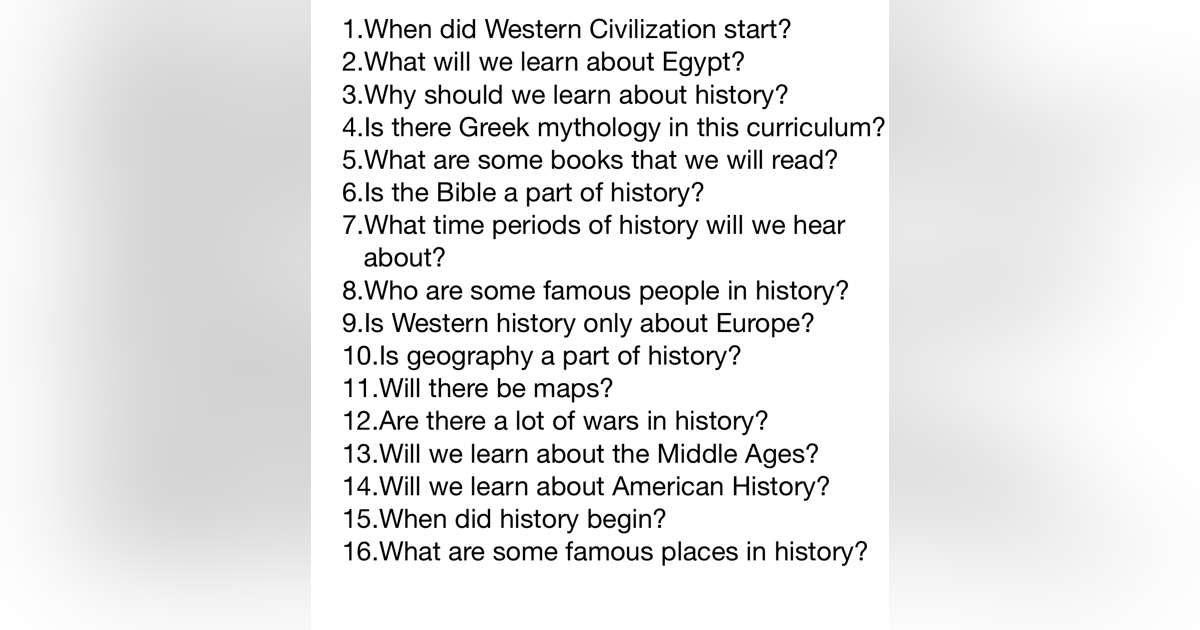
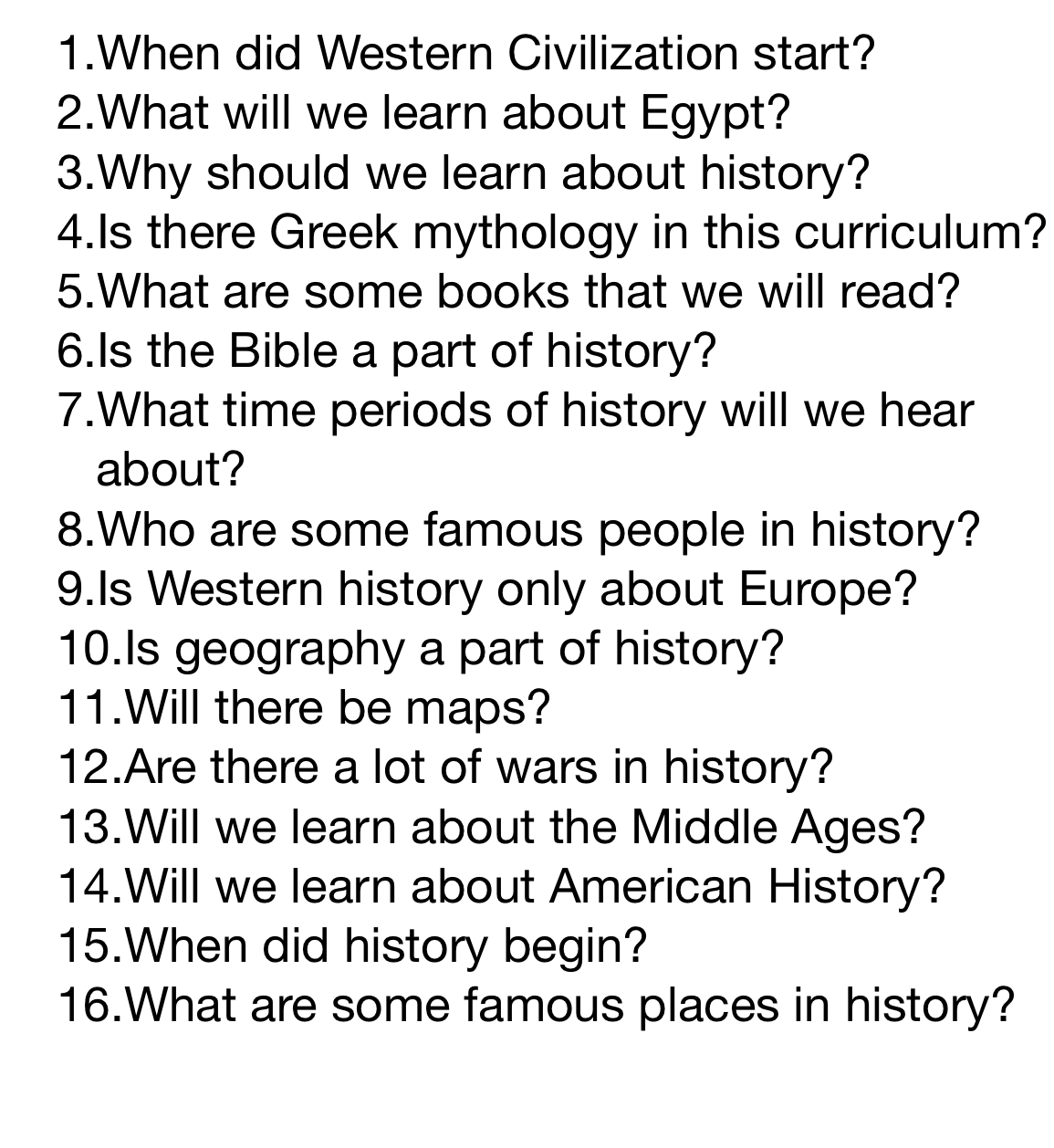
Here are the questions that someone might have before beginning to learn about history.
1. When did Western Civilization start?
2. What will we learn about Egypt?
3. Why should we learn about history?
4. Is there Greek mythology in this curriculum?
5. What are some books that we will read?
6. Is the Bible a part of history?
7. What time periods of history will we hear about?
8. Who are some famous people in history?
9. Is Western history only about Europe?
10. Is geography a part of history?
11. Will there be maps?
12. Are there a lot of wars in history?
13. Will we learn about the Middle Ages?
14. Will we learn about American History?
15. When did history begin?
16. What are some famous places in history?
Now, start the podcast or present the transcript to the students. Ideally, you can simply have
the questions on the students tablet or laptop screen. If the students are listening to the
podcast, allow them to stop the podcast at any time to write answers. They may want to jump
around, rewrite answers or add to answers as they go. This is all fine. There is no hurry. The
episode is about 18 minutes long, so even with stopping and starting, this is still doable within
a timely framework for your school day.
You should feel free to help students with their answers. You can even go so far as to write the
answers out on a white board or on some other means of presentation, like a computer screen.
Remember that this lesson provides a model for the student. You, as the instructor, are
showing them how to do something.
Do not make the mistake of expecting the student at this point to provide the answers
independently. If the student shows readiness and capability to answer on his or her own, that
is fine.
But the lesson is designed for the instructor to be doing most of the work. You provide the
questions and, as the student listens to the podcast, you are also pointing out the answers and
helping the student to turn those answers into complete sentences. Just about the only thing
that the student is really required to do is to write the answer down.In educational philosophy, this type of modeling is known as “the gift.” You are gifting the
student with a solid idea of how to do something. This is not the time to let the student fumble
around trying to come up with an answer. We will move gradually toward student
independence with the next lesson.
This lesson is a lot of work for the instructor. Later, it will be the student who is doing the hard
work, but only after you have provided them with the proper tools.
When you have finished the podcast, notice that you cannot really answer all the questions.
This is fine. It’s important that the student gets used to having unanswered questions. Asking
questions that do not get answered still accomplishes something. Just by asking the question,
we focus our mind on what we want to learn. The more that we do this, the sharper our minds
become at determining what it is that we want to learn.
Unanswered questions can be saved for later. Maybe they will find the answer in a future
podcast. Maybe they will decide to look up the answers independently.
Here are some sample answers using information found in the podcast. Answers should
always be in complete sentences.
You may prefer to have students type their answers into some sort of word document on a
computer but I strongly recommend that you require answers in handwriting. This is not
because I am a luddite. I am not anti-technology. But the brain of a human being responds to
handwriting differently than it does to typing. We learn better by writing than we do by typing.
You can look up the science about this matter yourself.
1. When did Western Civilization start?
It sounds like Western Civilization began with a place called Sumer. The podcast does not say
exactly when Sumer existed but it sounds like it was older than Egypt. You could also say that
Western history begins with the first pages of the Bible.
3. Why should we learn about history?
Learning history helps us to acquire knowledge from the past. We can learn how to avoid the
mistakes of the past.
6. Is the Bible a part of history?
The Bible is a core document of our Western Traditions.
10. Is Western history only about Europe?
No, it sounds like there were many other places involved in Western history. For example,
ancient Egypt is a part of Western history and Egypt is in Africa.
16. What are some famous places in history?
The podcast mentioned places like Greece, Egypt and Rome. It also mentioned cities like
Jerusalem, Athens, Paris, London and Washington.Once you have answered the questions, it is time to move on to lesson two. I will describe that
and other matters in the next episode, which is titled The First Day.