Episode XII.002 - The Study Method I




Asking questions about your reading projects to increase retention of information. The power of handwriting. Avoiding negative input during the early stages of learning.
RECOMMENDED READS - Click Image for Link:
XII.02 - The Study Method I
(Music)
-As their thought processes matured, I taught them how to fit knowledge into logical structures. I spent a lot of time in one on one discussion and interaction. We learned spelling rules, mathematics and basic logic. We followed a strict grammar book and diagrammed sentences of increasing complexity. We kept science notebooks and timelines so that we could organize their growing knowledge of facts into logical and chronological order. I taught them how to organize a paragraph, an essay, and a research paper. We studied Latin grammar, took music lessons and carried out science experiments, including one memorable dissection of a cow’s eyeball. They learned how to follow custom-made schedules, balancing academics, and personal interests like music program in a creative writing.
And they continued to read.
-This was the recollection of Jessie Wise, a homeschool parent and the mother of Professor Susan Wise-Bauer
(Music)
All my life, ever since I could read anyway, I have gravitated to the classics. You know, heavy-weight stuff, like Homer, Plato, Tacitus, Augustine, and so on. For men like me, Shakespeare is light reading.
But I have also noticed down through the years that I haven’t always engaged with this material as thoroughly as I wanted. In other words, I was just breezing through many passages, without taking them to heart, without incorporating them into my own understanding of history and literature and my own general philosophy of life. I was imbibing enough to sound witty and learned in conversation, but I didn’t always feel like I was really learning when I read the great books.
When I started this podcast, though, everything changed. Naturally, I had to read about many things that I thought I already understood, and I had to reread some of the great books to provide content for my podcasts. Reading them this time with a purpose, I found that I retained much more knowledge than I ever had before, even though I am an old dog trying to learn new tricks.
For example, I had read Thucydides’ account of the Peloponnesian War many years ago. While this already gave me a leg up in intellectual terms, compared to the average man today, anyway, it wasn’t like I was ready to write a college essay on the subject matter. I was able to remember offhand the name of Pericles, that he had made a famous speech at a funeral, that the the book about the war was never finished, and that the Spartans had slowly learned to wage war differently than they ever had before.
After I read this book in preparation for my sequence of episodes on the Peloponnesian War, however, thoughts of the Peloponnesian War filled my head with images that I had only acquired in the latest reading: Brasidas fighting on the wall of an embattled city, those tired Athenian soldiers on the Sicilian beach seeing the eclipse and fearing to depart, Alcibiades fleeing his burning home, sword in hand, and falling as arrows pierced his dying body.
What had changed this time? Why did I retain so much more information this time around? Why do those images remain in my mind even now, months later?
And why was I more prepared, suddenly, to discuss some of the eternal questions that the book evoked, regarding human conflict, ambition, despair, demagoguery and both personal and cultural survival?
Partly this was probably due to the purpose involved, that I was going to turn the book into a podcast. But the the methods that I used to study this time around were also crucial. I hadn’t just breezed through the book again and tried to write about it.
Instead, I had approached the text with a handful of tools that I had not ever implemented before.
The purpose of this sequence of episodes on the Study Method is to give listeners, as well as teachers and students that use the podcast, is to describe some of these useful methods for retaining what we learn. Each episode in the sequence will build on the previous episodes, to give you increasingly powerful tools to turn information into education, to help you retain the important information and the beautiful ideas.
In the next brief segment, I will discuss the first thing, not the only thing but just the first thing, that you should do before you open one of the Great Books.
(Music)
The next time you pick up one of the great books, put it down. Don’t read it yet. I mean that. Put it down and get out a sheet of paper, a good pen, maybe a snack and a drink, and start to ask yourself some questions.
This goes for more than just books. If you're planning on watching some compelling documentary, or even just planning on having a conversation with someone knowledgeable, pause, get some paper out, and give yourself some space and time to think.
What are you going to think about? You’re going to think about questions. Questions that you have about the material or the subject, questions that you hope that it will answer.
This may sound trivial, perhaps, but it has a certain level of effectiveness. Are there more rigorous methods of acquiring meaning from your reading? Sure. But let’s take baby steps. I’m assuming that you, like me, do not have the greatest study skills, that you perhaps apply them haphazardly at best.
And just imagine how it would change your reading of a text like the Bible. If, instead of simply plowing into Genesis chapter one and pushing on toward the apocalypse some one thousand or more pages away, some 800,000 words away, think how it would change your approach if, before you started, you asked yourself some questions:
Like, who is God? Why did he make the world? Why did he make man? What is good and evil? How are we supposed to act? Why do good people suffer and bad people prosper? I’m sure you can think of more questions that you have about the relationship of God and Man, about human behavior, about the meaning of life.
Now, imagine how having such a list would change the way that you read and interact with the Bible. Could you come up with a more sophisticated list than that? I hope so, but the point here is to start to give you direction and purpose in your reading, and to help you retain it, without the need to take tests in a classroom and spend a lot of money.
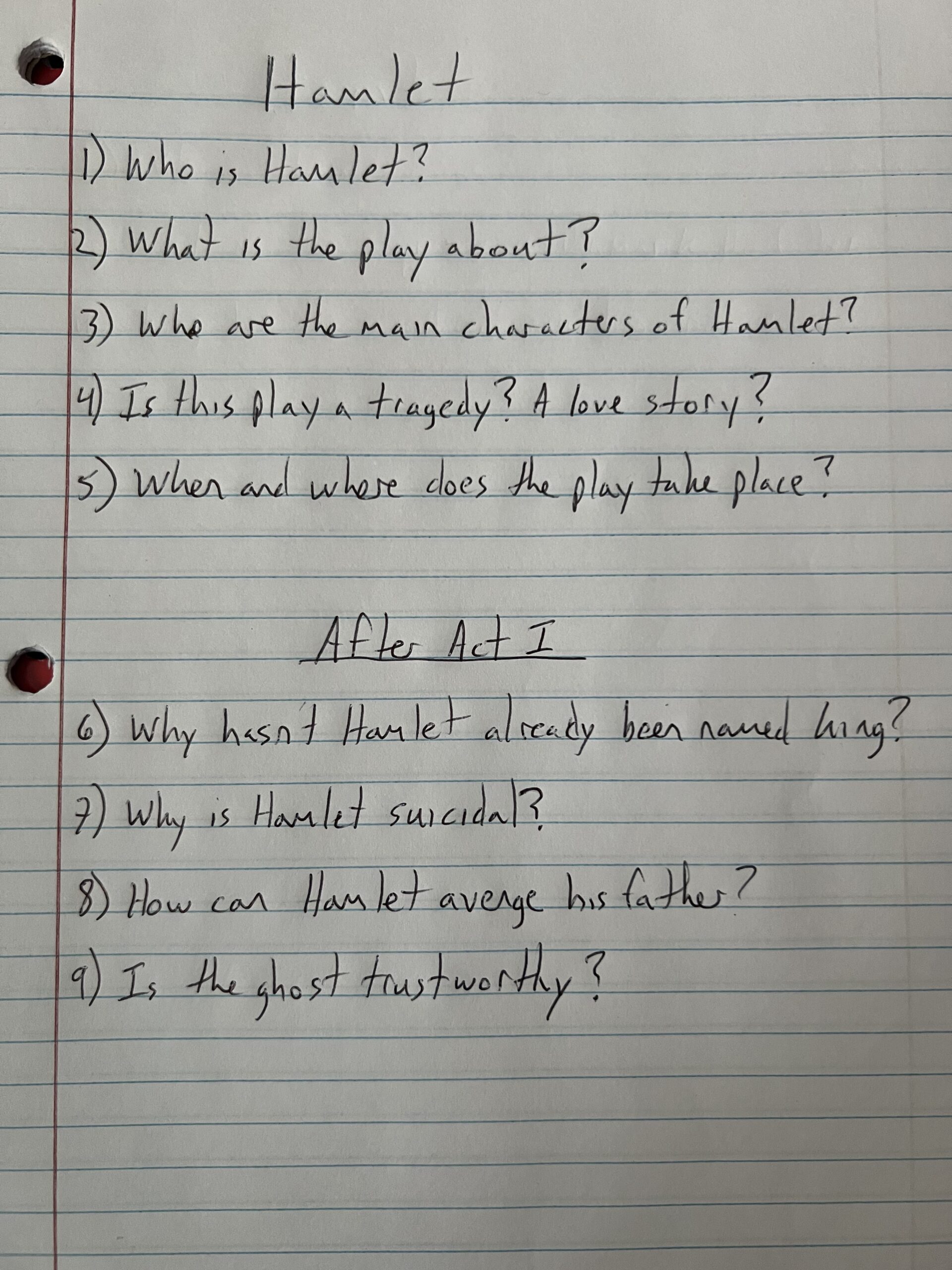
On the website, I’ve placed a photo of a sample list of questions that a reader might produce before reading Hamlet, a play by William Shakespeare. This is assuming only a minimal foreknowledge on the part of the reader, who may only know that the work is a play. So there are some very basic questions (such as, when does it take place) and some possibly more profound questions, such as Is the play a tragedy or a love story?
These questions have a minimal amount of sophistication. And that’s fine. If you are doing this yourself or teaching your children, it is important not to put pressure right away, on yourself or on your child or on your student, with regard to the polish of the questions, so to speak. Probably, if you or your child had worked their way through any curriculum that eventually brought them to read Hamlet, then they would already be capable of asking some pretty good questions right at the outset. They would already have a rhythm, in other words.
I have also included questions that arise after the first act has been read, and this is a good way to elicit deeper, more profound questions about any text.
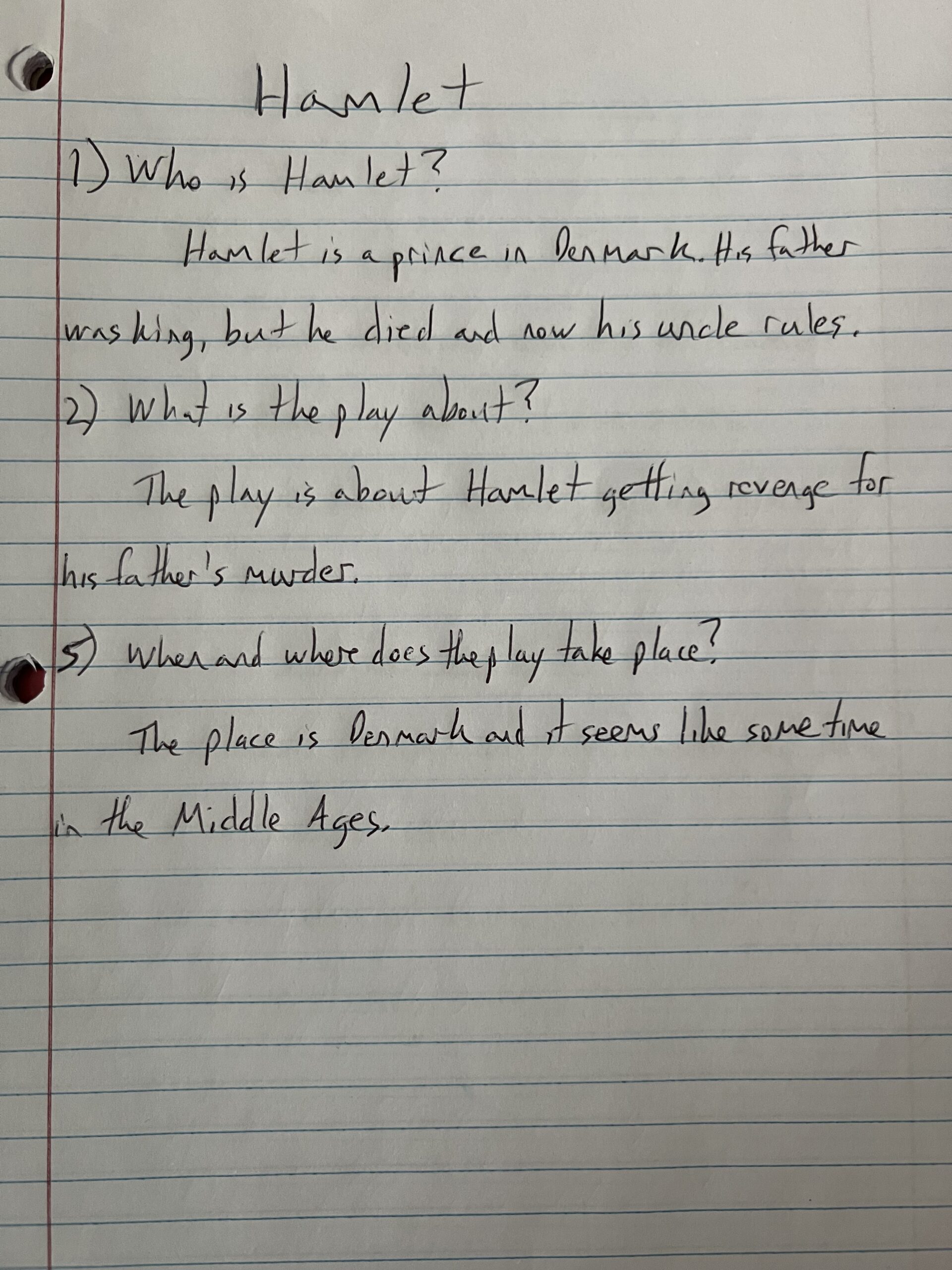
There is a second photo on the website that shows some of the answers that might be written out after reading the play. Now, I have written complete sentences here, but that is just for your sake. You could scribble whatever fragments of thoughts or even just single words, whatever you want here. We’re not writing an essay here. This is a document that will only exist to serve the reader's own thoughts later on.
And there is simply a power in writing things down, no matter how elementary the written words may seem to you. If I were a neuroscientist, perhaps I could explain this process better, but I am certain that every expert in the field of education would agree that there is a power in writing things down, that our brains capture ideas better when we write them down, that we hold on to information, and process the information more thoroughly, when we write them down.
And I mean write them down physically. I know that you may want to drop the 19th century technology of paper and pencil and embrace digital technology and just type these things into your laptop or even just recite the ideas into a recording app on your phone. And I’m not against those things.
But the act of writing, by hand, is, for whatever reason, actually more powerful than these other methods. If you want to walk down this road with me, this road to better learning, then you need to accept that there is something more effective about handwriting when it comes to retaining information in your Brian, and not offloading it into your computer or into the cloud.
Another really important thing: When you start doing this, yourself or with a child or student, when you or they start proposing questions, do not “shoot down” questions, not your own and not the kids’. For instance, someone new to reading this type of literature might ask a question that seems simplistic or even pointless to a more sophisticated reader.
For example, an apprehensive child, who maybe doesn’t like reading as much as he likes other subjects, might write down a question like, Is this play really long?
Don’t knock the question. Neither should you let that question suffice, go ahead and ask for more, but don’t critique their questions and don’t critique your own if you are taking on this curriculum yourself. There is no need at the early stage for any kind of negative input. Believe me, if you put yourself through this rigor or a young child goes through it, after time, they will probably not want to litter the page with a lot of questions of little or no substance. People will naturally, in these situations, seek to economize the time and effort they put into things and their questions will just naturally become more sophisticated.
Now, this is just a way to accumulate some thoughts on the material that you read. It’s just another form of note-taking, really. As I said, not very sophisticated. With the coming lessons, things will get a little more organized, a little more complex, and a little more ambitious each step of the way.
And that’s it for this one. I’ll see you in the next episode about the second study method.
(Music)