Episode XIB.010 - Genesis 14
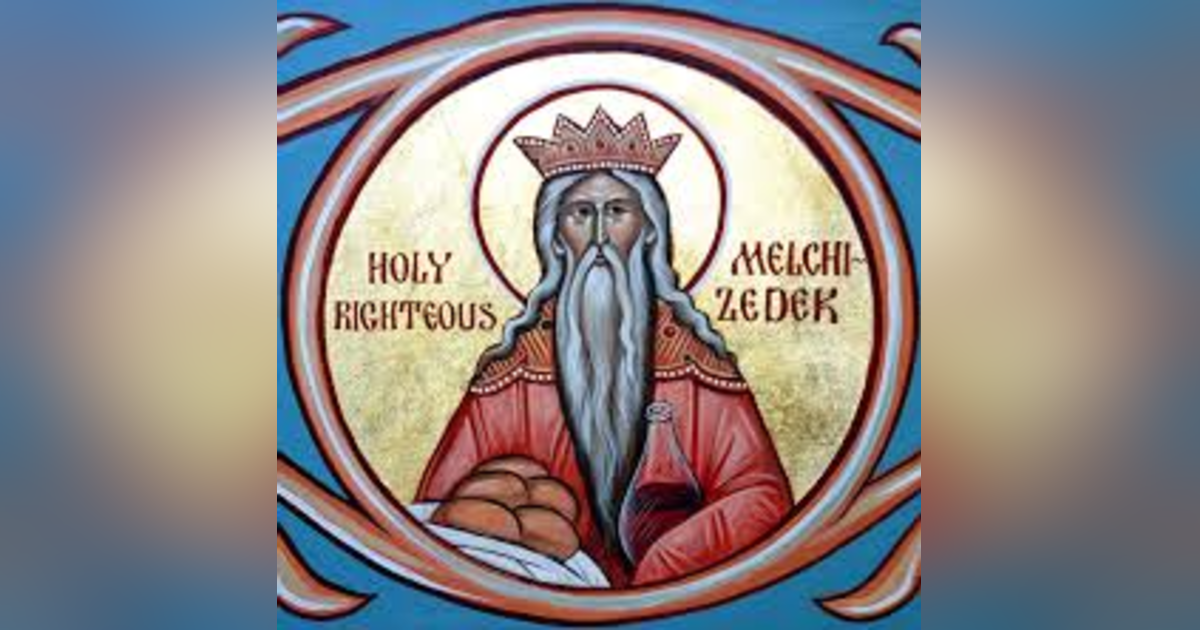


Abram rescues Lot. Melchizedek celebrates a type of the Eucharist. A look at Jewish, pagan and Christian ceremonies. The identity of Melchizedek. The long life of Shem, son of Noah.
RECOMMENDED READS - Click Image for Link:
(Music)
The day before he suffered, he took bread into his holy and venerable hands and with his eyes
lifted up to heaven, unto Thee, O God, His Almighty Father. Giving thanks to Thee, He blessed,
broke and gave It to his disciples, saying, take, all of you, and eat of this, for this is my body.
-Translated into English, these are the words of consecration from the traditional Latin Mass of
the Roman Catholic Church.
(Music)
Christians today probably remember the fourteenth chapter of Genesis primarily due to the
references made in the Epistle to the Hebrews. That epistle, found in the New Testament and
possibly penned by St. Paul the apostle along with other men of the early Church, is a
significant theological document. In describing the Christian revelation, the epistle describes
Melchizedek, an otherwise obscure Old Testament figure, in an unexpected way.
But in this episode, I want to get into the way that Genesis describes Melchizedek and also
consider some Jewish theories about this ancient king and priest.
Furthermore, in this fourteenth chapter of Genesis, Melchizedek performs a ceremony involving
bread and wine which also has profound meaning for the Christian church and is another
excellent example of typology in Genesis.
Now, I opened the episode with that reading from the mass, in which the elements are
consecrated and become the body and blood of the Lord Jesus. As you might have guessed,
we will look at this passage about bread and wine through the lens of the mass, but we will
also consider the meaning of this ceremony within the Jewish context and among the many
pagan, Mediterranean religions which also incorporated bread and wine and or similar
elements in their ceremonies.
And, as usual, we will approach this matter with our four-part tool of exegesis.
(Music)
The chapters of Genesis can be divided into four parts or volumes within the entire book.
Chapters one to eleven are the primeval history. Chapters 12 through 26 tell the story of how
Abram became Abraham and they briefly describe the life of his son Isaac. Chapters 27-36 tell
the story of Abraham’s grandsons Esau and Jacob. And Chapters 37 to 50 tell the stories of his
12 great-grandsons, with special focus on Joseph.
This block of chapters devoted to Abraham, chapters 12-26, can be further divided into parts.
We might half-seriously call chapters 12-19 the adventures of Abraham and Lot. The two men
often share space on the page just as they shared territory in real life. But they each also serve
to make point and counterpoint. In chapter 13, Lot goes right and Abram goes left. Later, in
chapter 19, we will see the terrible consequences of that early choice by Lot.
But before any of that, in chapter 14, Abram must come to the rescue of Lot.
The chapter opens describing two coalitions of warring kings. The first king mentioned here is
Amraphel, king of Shinar. This is fascinating because we already know that Shinar is the
ancient Hebrew term for Sumer, already used in chapter 10.Now, some scholars have tried to suggest that this name, Amraphel, might be the ancient
Hebrew way of saying Hammurabi. Other scholars object and say that they may be trying too
hard to make things work here. Since we suspect that Abraham lived around the same time as
Hammurabi, the ancient king of Babylonia, and that Jewish law may have inherited some
impetus, anyway, from this famous law-giver, it is tempting to try to connect the dots and
place Abraham and Hammurabi in the same environs. I won’t bog down into how the name
Amraphel may be a translation or transliteration the name Hammurabi.
There are also plenty of scholars who simply think that the name and the entire account is
fictional.
Jewish tradition, on the other hand, in the Talmud, identifies this king named Amraphel with
Nimrod. Now, Nimrod is mentioned as the king of Shinar in chapter 10 of Genesis, and he is
traditionally identified also as the king who built the tower of Babel (though, it should be noted,
the passage about the tower of Babel in chapter 11 does not mention Nimrod by name).
I find the Jewish tradition to be even more interesting than the scholarly interpretations. Before
I heard of this tradition, I always imagined Abram living long after the Babel incident, in a world
in which the chaos of that event was long ago, and now people had settled into long-
established routines of civilization, and of agricultural life and nomadic life and so on.
Jewish tradition would have us believe that Abram instead lived in a quite tumultuous period, a
time of disruption, when the world as we know it, a multicultural world of distinct languages
and customs, was quite young.
And this idea is supported by the text, really. After all, we have four kings suddenly warring
against five kings, with no background given to the cause of the war. Are we meant to interpret
the cause as the disruption of the previous chapter, in which the tower of Babel was destroyed
and the people scattered across the face of the earth?
And the initial verses of the chapter describe an alliance of kings rampaging through Canaan,
conquering cities. Are these kings trying to reestablish the order that was lost by the disaster at
the Tower of Babel? The names and origins of the kings seem to suggest something like that.
One coalition seems to be from the East, where the tower of Babel would have been built. This
coalition includes the aforementioned king of Shinar and Chedoarlamer, the king of Elam. Elam
is a region to the southeast of Babylonia, quite far from Mediterranean and the land of Canaan.
Myself, I would have never connected the warlike chaos of this moment in scripture with the
chaos of Babel, if it hadn’t been for learning about this Jewish tradition, and about one more
ancient Hebrew interpretation of this chapter, which I will get to in a moment.
Before that though, I would like to reflect that there are many fascinating relics of the ancient
world in the Old Testament, relics of language and references about geography, and there is
another such clue about the ancient world here in this name of the king of Elam.
While many people might assume that the authors would have just invented a name, the name
Chedaorlamer is apparently an authentic Elamite name, even though we have yet to discover
any evidence of a King of Elam with that particular name. But the name, and the grammatical
elements of it, are not Hebrew. Whoever wrote this passage, was familiar with Elam, or with
the language of those people, anyway.
Meanwhile, the other coalition in this war includes more local sovereigns, such as the Kings of
Sodom and Gomorrah.The eastern kings win the battle, and the forces of Sodom and Gomorrah flee through a
treacherous area south of the Dead Sea in which there are pits of bitumen. Bitumen is a tarry,
petroleum-like substance and the passage tells us that some of the fleeing troops actually fell
into these pits.
Now, it is well-known that the Israelites did not have a high opinion of the people of Sodom
and Gomorrah and we will hear in a later episode a little more about that animosity. So,
scholars have some reason to suspect the veracity of this tale and of the whole war, really.
Perhaps, some will reason, this account is just an invention to make the people of Sodom and
Gomorrah look bad, with their kings retreating and their soldiers falling into slime pits and being
dispatched by their conquerors.
Regardless, the key point in the passage is the inclusion of Lot, Abram’s nephew, in the
casualties of war. Lot, as well as his whole household apparently, is captured and taken away
by the victors after this battle. It is unclear if Lot was actually in the battle himself or if he and
his people and goods were captured after the city of Sodom was taken.
The next passage, verse 13, is quite striking.
Then, one who had escaped the battle came, and told Abram the Hebrew, who was
living by the oaks of Mamre
The verse refers formally to Abram the Hebrew. This is a strange way to speak about a
character to whom we have already been introduced and about whom we have already read
multiple adventures. He’s just been Abram up to this point for us.
Suddenly, we are being reintroduced, it seems. Some scholars suggest that this bit of text
may actually be some kind of an insertion into the Hebrew text; that this is a story about
Abram which was told by non-Hebrews and that the authors of the Bible simply grabbed it, so
to speak, from another source and interpolated it here.
Anyway, Abram the Hebrew, living near those sacred oak trees at Mamre, sets out with over
three hundred men of his own household, chases down the army that had run off with Lot as a
captive, and somehow defeats them with a ruse just briefly described as involving the division
of his forces and a night attack. Then he returns with his rescued nephew and his nephew’s
household women and servants and goods.
Truly, if ever a passage left you wanting more, here it is. The story of this combat ruse and the
night attack sounds riveting, but, as usual, the Bible is not interested in the same things that
other profane texts want to elaborate on. We want to hear about Abram’s combat tactics, why
and how he dangerously divided his forces and used them to defeat superior forces.
What matters in the Bible, though, besides someone’s faithfulness, is religious ceremony. The
entire book of Leviticus, after all, as well as much of Exodus, Numbers and Deuteronomy, will
all be about performing ceremonies.
And here, in verse 17, instead of telling us more about Abram’s military acumen, the text moves
on quickly to tell us about the religious ceremony that followed Abram’s victory.In an unusual pairing, Abram meets up with the King of Sodom after this battlefield victory, and
to them both comes a man named Melchizedek, who is the King of Salem. Melchizedek brings
with him bread and wine.
He is the king of Salem. Now, it is possible to assume then that he is the King of Jerusalem,
which at that time would have been a pagan city, since this is centuries before David would
conquer the city and turn it into his Hebrew capital. But, the word Salem is derived from the
Hebrew word Shalom, or peace. So, the title can also be rendered as King of Peace.
The name, Melchizedek, in the Hebrew Masoretic text, is rendered actually as two words,
Malkhi Zedek, though most other translations combine these elements into one word:
Melchizedek.
Now, the first word or part of the word is derived from the Hebrew word Melek, which means
king. So this name either means King Zedek, because Zedek could be a proper name, or it
might be a reference to a local Canaanite god named Zedek, and so the name might mean My
King is Zedek, which would not have been an unusual way to name someone after a god in
that time period.
Or, as the epistle to the Hebrews in the New Testament will argue, this term, Zedek, should be
translated as a word meaning “righteousness.” Therefore, this figure is the king of
righteousness.
However you say his name, he is identified additionally here as a “priest of God Most High.”
God Most High is the English translation of the Hebrew original text: El Elyon. This is similar,
our ears, anyway, to the already-established name given to God in the first chapters of
Genesis, Elohim. Both contain the “El” sound at the beginning.
Now, many scholars believe that this is really just a reference to the well-known Canaanite god
named El. In other words, El most high. And this fits with the idea that this text is brought in
from another, non-Hebrew, but probably still Semitic, Canaanite source. And that Melchizedek
is meant to be a pagan priest, not a follower of the same god as Abram.
However, Jewish priests will later identify themselves as “Priests of God Most High” as well.
During the Hasmonean dynasty, in the 2nd century BC, the Jewish rulers called themselves
“High priests of El Elyon.” Though this may only indicate that they were taking advantage of the
language of the Bible to support their claim to power during the period of Jewish
independence between Greek domination and Roman conquest.
Whoever he is, Melchizedek brings bread and wine and with these sacred elements performs a
religious rite of blessing, saying-
Blessed be Abram by God Most High,
maker of heaven and earth;
and blessed be God Most High,
who has delivered your enemies into your hand!
Again, that bit about “maker of heaven and earth” might seem like a reference to Genesis 1
and help establish the connection between El Elyon and Abram’s god, but then I suspect that
most religions considered their god to be the “maker of heaven and earth,” so perhaps this
isn’t much of a connection.As for the bread and wine, I will elaborate on their significance in the next segment.
And then, after the ceremony, according to most interpretations, Abram gives Melchizedek a
tenth of the spoils which he brought back from his combat victory. There is some textual
uncertainty here, since the verse literally just says “he gave him a tenth of everything.” And we
lack a proper antecedent for the pronouns here and so we can’t know exactly who gave what
to whom. But most agree that it makes sense that the warrior, Abram, gave a tithe to the priest,
Melchizedek.
And this would, again, certainly seem to indicate that Abram and Melchizedek are worshippers
of the same god.
Then, the king of Sodom, also present at the ceremony, turns and negotiates the division of the
remaining spoils by saying: give me the persons, keep the goods. The King wants slaves or
captives for ransom, most likely, and he offers to let Abram have all the other material goods.
Abram, however, takes the high road. He has already sworn not to take anything from the
spoils. He is content to let the king have virtually everything. He does not want to be tied too
closely to the King of Sodom, apparently.
As to the oath that Abram swore, the English text states that Abram swore to “the Lord God
Most High.” Now, this might appear to be simply the same God as that invoked by
Melchizedek, God Most High, and it may be.
But remember that Lord here is just the translation of the tetragrammaton, YHWH. So Abram
invokes, YHWH God Most High, or YHWH El Elyon. Is this the same god, or is Abram elevating
his own God, YHWH, to the same level as the Canaanite God? There is no clear answer and
you are free to parse the language here on your own.
This entire chapter, really, is the kind of text that you could write entire books about. There is so
much history, textual interpretation, and theology to derive from it that you could literally never
stop reading and writing about it.
We, however, do not have the luxury of spending eternity on a single passage. It is time to
move on to the allegorical interpretation of this chapter.
(Music)
Allegorically and typologically, there are basically just two major points that we will address in
this episode: The identity of Melchizedek and the significance of the bread and wine offered in
the blessing.
The epistle to the Hebrews makes a great deal of the sudden appearance of Melchizedek, and
of the nature of Melchizedek’s priesthood. There is a sort of super-hierarchical idea implied in
that Christian epistle, the idea that the priesthood of Melchizedek is not just prior to the
Aaronic priesthood of Israel, but also superior to it.
I’m actually going to leave that argument for another time, for when we come to the epistle of
Hebrews in this scriptural journey. That is a primarily Christian theme and, while I do
underscore constantly the intricate and interconnected nature of scripture, of the Old and New
Testaments, I want to make space here for some of the Jewish traditions about Melchizedek,
including those from the Talmud and those found in the Dead Sea scrolls and so on.Now, Melchizedek is mentioned in one other spot in the Old Testament and, if you’re a bible
reader, you are probably one step ahead of me already. Yes, Psalm 109 in the old count or
psalm 110 if you use the Protestant numeration of the psalms. This particular psalm is
sometimes known as the Royal Coronation psalm, and it is also grouped in a category of
psalms known as the Messianic psalms, along with the 2nd psalm and some others.
The psalm mentioned here is addressed to the Davidic kings in Jerusalem, not to the priests
or to the laity, but directly to the king. In the 4th verse of this psalm, it states:
The Lord has sworn, and will not change his mind. You are a priest forever, according to the
order of Melchizedek.
The idea is that the kings are also priests, of a sort. Now, as I said before, we will eventually
get to how Christianity applies this psalm as well to Jesus, but it is important to remember, in
the ancient world, that kings were often considered to be also the high priests of the state.
This was true among the Greeks. Recall, if you will, the image from the Odyssey when
Telemachus comes to the realm of Nestor and witnesses that king of Pylos leading the sacrifice
of bulls before his people.
This double role as priest and king, or priest and executive of the state anyhow, exists
among the ancient Romans as well. Even under the Roman Republic and the Empire, if the
leading executives, king, consul or emperor, did not act as priests, they chose men to do so in
their place. The power of the priesthood was in the king’s hands, so to speak. Only in certain
areas and time periods in history were there completely separate brotherhoods of priests with
no link to a sitting king.
And these priesthoods were sometimes in open conflict with the priesthood of their rulers. In
Egypt, the pharaoh was certainly the chief priest in a sense, but if he offended the institutional
priesthood, he put himself at risk. And they also had to fear his martial and executive power.
And Melchizedek is clearly identified here in Genesis as both king of Salem and high priest of
God Most High, thus reinforcing this real combination of priestly and kingly roles.
So, even though Israel, and later Judah, had official priesthoods, there was always tension,
and sometimes even competition, with the legal ruler of the state, who himself felt that he was
also an instrument of God. We will see this plainly when we come to the books of the kings.
And there is no doubt, for example, that Emperor Constantine, however he may have been
managed by the institutional church at the Council of Nicea in AD 325, as a Roman, he
definitely felt some right to intervene in religious matters due to his office as Emperor, and
therefore as a sort of high priest, even if, in the end, he was deterred from doing anything more
than preside over the meetings of the council.
So, that digression aside, the Jewish rulers in Jerusalem considered themselves to possess a
sort of parallel, or maybe even superior, priesthood when compared to the Temple
priesthood. Again, this notion will later contribute to the double nature of Christ as both king
and high priest in Christianity.
But, let’s get back to Melchizedek himself. Who was he? Was he a pagan? This seems like the
most likely interpretation, since Abram would appear to be the only follower of YHWH in the
world at this time, and the nation of Israel has yet to be born.There is no direct and clear guidance on this matter. Even Jewish tradition is divided.
Josephus, a famous Jewish historian of the 1st century AD, stated that Melchizedek was a
Canaanite chief or priest.
Now, another later tradition, found in an apocryphal document known as the Second Book of
Enoch, identified Melchizedek as the son of the virgin wife of Nir, a brother of Noah before the
Flood. In the story, Melchizedek is taken up by angels and saved from the flood.
Now, like me, you might hear this story and think, wow, they really had their timeline screwed
up. I mean, Abraham lived a LONG time after the Flood, so whoever wrote that account did not
understand the biblical timeline.
And that’s where you and I would be wrong and this realization, that the era of the Flood was
not out of reach for the people of Abram’s time, it hits you like a brick in the face and it paves
the way for what I think is the most shocking possibility regarding the identity of Melchizedek.
Now, first, let’s get something out of the way. If you are reading the Bible as a myth, as an
allegory, as a purely spiritual guidebook of sorts, then this next portion of the podcast might
seem to be less valuable for you. But hear it out first, and I will try to help you understand why
it merits your attention and, maybe, even, your awe.
Now, here’s the theory, found in a number of Jewish traditions, and in rabbinical literature.
Hold on to your seats. Get ready. Here it is: Melchizedek was Shem. Shem, the son of Noah,
who witnessed and survived the Great Flood by riding it out in the ark made of gopherwood.
Now, right away, as with the story about Melchizedek being a different relative of Noah, you
might start to pull out your permanent marker to cross out the idea. After all, the Flood was
long ago and everybody from that era was dead, so Shem couldn’t be around.
Here’s the thing, though. Maybe Shem was or was not Melchizedek, but he was alive. Yes,
Shem, the son of Noah and the survivor of the Flood, was contemporary with Abraham. In
fact, get ready for this.
Shem outlived Abraham.
Now, again, if the Bible is a spiritual allegory for you, this is perhaps less meaningful for you.
But if you sincerely believe the Biblical timeline, and you take the genealogies seriously, well,
you have no choice but to believe that Shem, the son of Noah, was still alive at this time.
If you look back at Genesis 11, verses 10 through 26, you will see again the genealogy of
Abraham, starting with Shem. The verses here tell us that Shem first fathered a child when he
was 100 years old, two years after the flood. And that Shem lived to be 600 years old.
The thing is, though, that every one of Shem’s descendant’s lived shorter lives, often much
shorter. And they all first had kids comparatively young, usually in their 30s. Again, this is all
explained in those verses from chapter 11. If you set out with a piece of paper and a pencil, or I
guess you could just ask some AI software to do it for you, but if you tabulate birth years and
death years for all the descendants of Shem, you will find that, during Abraham’s life, most of
Abraham’s ancestors died or had died long ago. But not Shem. Even though ten generations
had passed between the two men.
Due to the young age of fathering for most of Shem’s descendants, except, notably, Abraham,
Shem is only about 390 years old when Abraham is born. And he is going to live another 210years. Yet Abraham, spoiler alert here, Abraham is only going to live to be 175. So Shem, if we
are strictly following the biblical timeline, he is still definitely hanging around. I think it works out
that Shem would have outlived Abraham by 35 years or so.
There is a way to number the years here that is specific to the Bible. In the Christian tradition,
we call this dating system the Year of the World. Anno Mundi, in Latin. So, we start out with
Genesis, chapter 1 as the first year of the world, during which Adam and Eve are born. And
then, you track the years from there based on the genealogies and timelines given in the
scriptural text. If you are a real nerd like me, you can even have fun working this all out yourself
with pen and paper, tracking when people are born and when they die and when they have
kids.
And, if you do this, you will see that Shem was born in Anno Mundi 1558. That is, one
thousand five hundred fifty-eight years after the creation of the world. Now, there are some
minor differences in translations, particularly depending on whether your translation uses the
Masoretic Text or considers the Septuagint as fundamental, so you might get a slightly, but
not significantly, different date for Shem’s birth, if you do it right.
And Abraham, using this same system, was therefore born in Anno Mundi 1948.
Now, that does not mean that Shem is Melchizedek, but it does more than just leave open the
possibility.
You recall what I said about rulers being automatically priests in some way. Well, the same
goes for fathers, and for patriarchs, for those men who ruled over their households and estates
as the senior male. Even in Rome, a culture at first sight quite distinct from the Jewish culture,
in the home, every Roman father was the high priest of the family. And in other cultures,
especially in ancient Canaan, the most senior male in a family was automatically granted a sort
of priestly status.
He would either take the lead at sacrifices and prayers, or he would delegate the responsibility.
So, for some rabbinic interpreters of the text here, for these men who know scripture back
and forth, it is obvious that Melchizedek, the king of righteousness, was actually Shem. And
therefore he was not a pagan priest and Abram was not engaging in pagan worship but rather,
when the bread and wine came out, he was participating in a thanksgiving that was entirely
within his faith tradition, and led by the only man qualified to celebrate that sacrament, his
many times great-grandfather, Shem, the venerable son of Noah.
Now, about that bread and wine.
Without saying, there is an obvious type of the Eucharist here, the great thanksgiving and
sacrifice of the mass.
For those of you who do not know much about Christianity, the celebration of the eucharist is
central to the practice of the faith for most Christians and always has been. It is, among other
things, the memorial of the last supper but also is a participation in the sacrifice of Christ on
the cross, as well as an act of faith and obedience in consuming the body and blood of the
Lord and therefore fulfilling the desire that Christ expressed that all would find eternal life
through this divine meal, that all would unite with him most intimately through this very
consumption of His Self.And all the way back here, thousands of years before Christ, ancient Jewish leaders, even
before the existence of a formal priesthood, celebrated a type of the holy eucharist, in a
blessing ceremony, as well as in the Passover meal.
In the book of Leviticus we find descriptions of a variety of sacrifices and ceremonies over
which the Temple priests were to preside. Among these are included the feasts of the
Passover, the Feast of Pentecost, the Day of Atonement and so on. Getting specifically into
chapter 7 of Leviticus, we find a description of a sacrifice that involves the offering of bread, or
a cereal offering. That is, the offering of gifts made from grain. This specific sacrifice is known
today as the Todah offering (spell it). We can get deeper into these sacrifices and their meaning
when we come to Leviticus. But for the moment, I just want to establish that such offerings
involving bread were part of Jewish tradition from the beginning.
These offerings of bread, and often wine as well, were also found all around the Near East and
in the Mediterranean in Antiquity. The Greeks, celebrating the death and resurrection of
Dionysus or of another god, would make similar offerings. We know very little about the
Eleusinian mysteries practiced among the Athenians, but do know that the ritual observed
there involved the elevation and silent adoration of an ear of grain before gathered believers. If
you have bene to Catholic mass or mass with certain high church traditions like the Anglicans
or Lutherans, you are probably seeing a connection here, a resemblance.
The wine seems to be implied here, as I do not see any sign of it in the biblical text at that
specific chapter, but certainly the cultures surrounding the Jews were using wine in their
ceremonies. Dionysus, for example, was the god of wine so both grain and wine would have
played a role in the ceremonies of his cult.
So, as much as I want to make the typology of this moment in scripture clear, and to establish
the symbolic connection between the early chapters of Genesis and the incarnation of Christ in
the New Testament, I do also want to draw attention to the Jewish connection to the other
cultures with which they were contemporary and with whom they obviously shared foundations
that are, nevertheless, not easy for us to determine exactly today.
(Music)
Sometimes it is hard to run on all four wheels of exegesis. Indeed, sometimes I link together
multiple chapters just so that I can do a better job of including all four lenses, so to speak, of
our analytical eyeglasses. Sometimes, it is harder to find typology. Sometimes, finding any kind
of moral message is tough and, for sure, the eschatological view point is often tricky to find,
but that may be a result of my own theological obtuseness.
Here though, while I think that the moral message is understated, I think that it is still here. One
can’t help but feel a tone of disdain as the author describes the kings going to war at the
beginning of the chapter. Violence may be universal and a fundamental part of the human
makeup, but war, organized war, is a product of urban life. A product of civilization, since
civilization really means, in terms of etymology, it means urban life. City-life, is a good, working,
translation of that word, civilization.
And war happens because of cities. Roving bands of hunter-gatherers may have raided one
another, may have carried off women from other tribes and so on, but the large-scale
destruction of human life and property is a feature, not a bug, of urban civilization. Urban life
leads, inexorably, to the nuclear bombing of Hiroshima.And I think that this text makes a good go at condemning this sort of behavior, this sort of a
society which turns men into mindless killers and inevitably produces wholesale destruction. Of
course, this does then reveal a sort of fissure in the textual tradition of the Bible. Because,
without question, there will be future books and future chapters in the Bible encouraging the
exact same kind of mass violence. But I think this is part and parcel of the biblical story, in the
sense that the text is sometimes at war with itself.
There are portions of scripture which seem undeniably pacifistic, and others which exhort one
to violence in the name of the Lord. There are some books and passages that condemn luxury
and sensuality, while other portions of the narrative do not hesitate to describe David’s
amorous conquests, or Solomon’s vast wealth, or worshipfully describe women and men’s
bodies, as in the Song of Songs.
The psalms are a great example of this dichotomy. Some psalms are beautifully eloquent
meditations on the glory of God, of creation, or they are exhortations to mercy and
compassion, exalting peace and brotherhood. And other psalms are angry, even bloodthirsty
diatribes.
Sometimes a psalm is both at the same time. Psalm 138, in the old count, its psalm 139 for
many of you listening, this palm begins in perhaps one of the most moving and introspective
passages in the Bible.
O Lord, thou hast searched me and known me!
Thou knowest when I sit down and when I rise up;
thou discernest my thoughts from afar.
The first stanzas are essentially a long, touching meditation on the intimacy of the psalmist and
his Lord. But the final stanza of verses begins thus:
O that thou wouldst slay the wicked, O God
And it goes on later with the following:
I hate them with perfect hatred
This is not, however, the time to discuss the psalms in depth. Still, all those later examples
aside, I think the perspective of the author in Genesis is clearly that of a rural, pastoralist, who
disdains the endemic corruption of the cities and contemplates instead the purity of a religion
based not only around rugged individualism, but also on the bonds of family, and the
sacredness of nature.
(Music)
Eschatologically, that is, with regard to the ultimate destiny of man, the meaning of the passage
is clear. In one single chapter, we transition from war, from the ugliness of a broken world, with
its violence and its broken families and ruined cities, to a thanksgiving ceremony and a
prototype of the eucharist. So the entire arc of the Bible is summarized here, really. We go from
that ugly, fallen world, to the great mass which the Apocalypse at the end of the Bible outlines
in its ceremonies, its trumpets and incense, and its recitation of the sacred words Lamb of
God, to the final and completely satisfying sacrifice of the one
who is and who was and who is to come, the Almighty one.In the next episode, we will return to Abram as he steps back from his world for a moment, and
explores his relationship with his God.
Until then, I thank you for listening to the Western Traditions podcast.
(Music)