Episode XIB.007 - Genesis 6:1-9:29
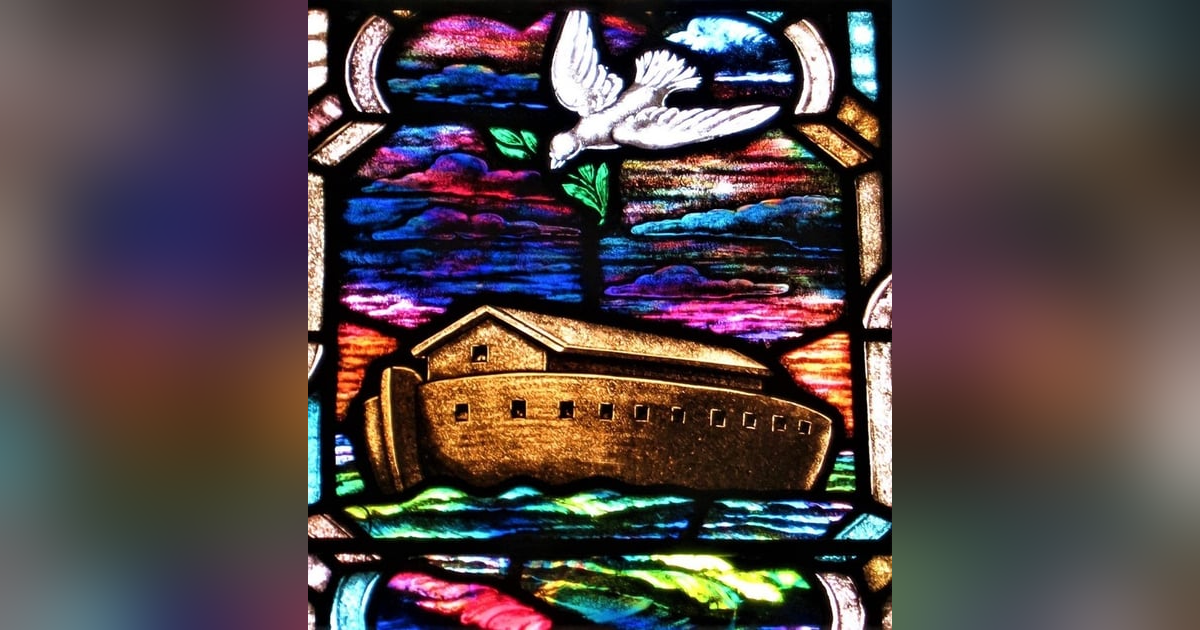
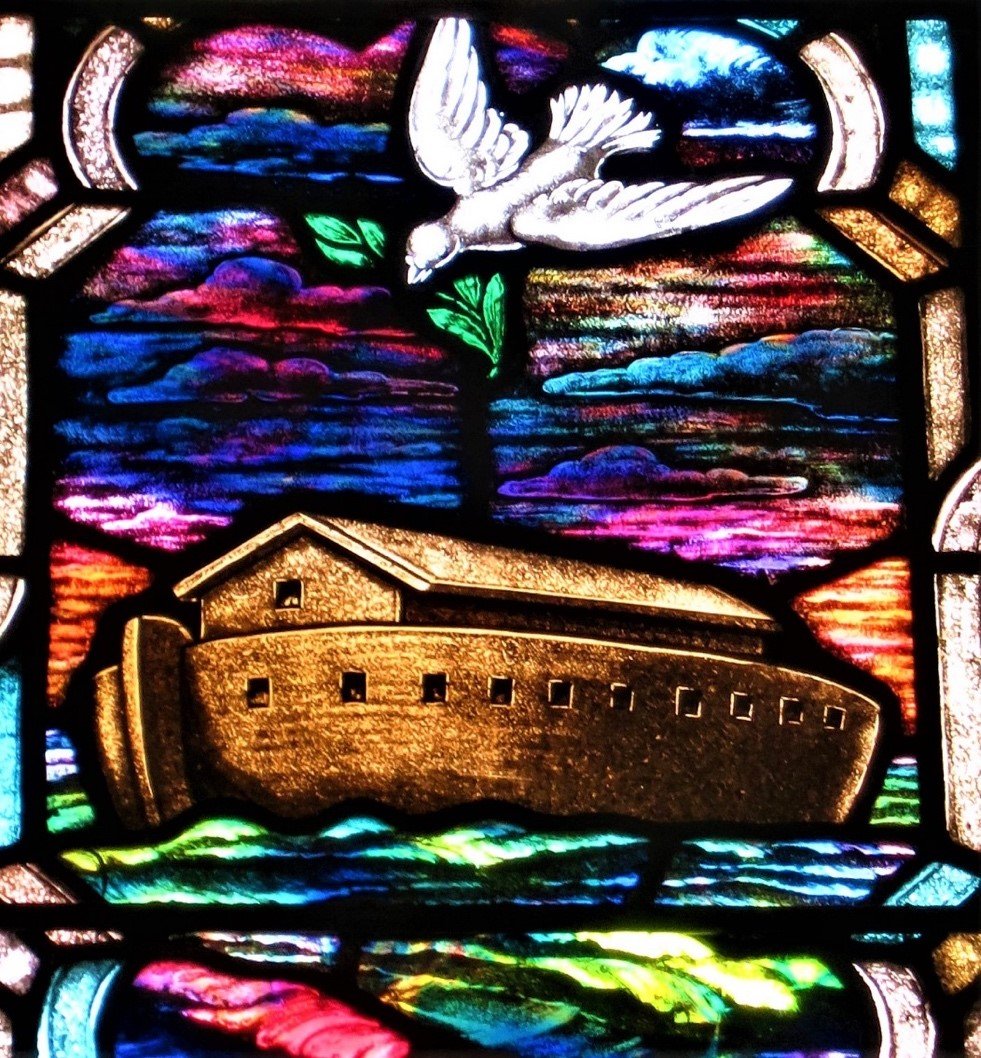


God chastises the world with the Flood. Only Noah and his family are spared. A breakdown of symbols and morality in the flood narrative.
RECOMMENDED READS - Click Image for Link:
(Music)
“Seven days from now, I will bring rain down on the earth for 40 days and 40 nights, and so I will wipe out from the surface of the earth every living creature that I have made.”
Genesis, chapter 7, verse 4
(Music)
Welcome to the Western Traditions podcast. Today’s episode looks at what is probably the most famous passage from the Old Testament, in modern Western society anyway: The Flood of Noah, from the book of Genesis, chapters six through nine.
Now, I did not read aloud the whole passage at the start of the episode this time because it is quite long, so I recommend that you get out a bible and read through those four chapters before listening any further, unless you are just already well-acquainted with the biblical text.
And while you’re pausing the podcast, consider heading over to my website, western-traditions.org, if you’re not already there. I have posted there all the episodes of all my podcast series on history and other matters. You can also purchase western traditions merchandise there or support the podcast directly though the PayPal or patreon options. Patreon supporters have access to my patreon page, where I share updates about the podcast as well as interesting historical links and other resources that I occasionally find.
And now, we leave behind the original family drama of the Bible, the story of Adam and Eve and their troubled children, and move on to a world full of their descendants, an even more troubled world,
the primeval society of the entire human race.
(Music)
But, first, something completely different.
The story of Noah, as contained in Genesis chapters six through nine, has an interesting preface. The first four verses of Genesis, chapter six, have been a flashpoint for discussion and controversy, perhaps since the very beginning. Here they are, quickly, according to the Douay -Rheims version of the Bible.
And after that men began to be multiplied upon the earth, and daughters were born to them, 2 The sons of God seeing the daughters of men, that they were fair, took to themselves wives of all which they chose. 3 And God said: My spirit shall not remain in man for ever, because he is flesh, and his days shall be a hundred and twenty years. 4 Now giants were upon the earth in those days. For after the sons of God went in to the daughters of men, and they brought forth children, these are the mighty men of old, men of renown.
Now, it is my custom or routine in this podcast series to take entire portions of the biblical text and to examine them, sequentially, in four-part fashion, literal, allegorical, moral and eschatological. Here, though, I will just make a quick but hopefully comprehensive pass through this short passage, before going on with the rest of the flood narrative, since these verses are hard to examine in that same fashion, and because I regard these verses as possibly separate from the story of the flood, but not really significant enough to get their own entire episode.
So, the startling portion is in the second verse. The sons of God marrying the daughters of men and procreating with them. What could this possibly mean?
Right from the beginning, there have been attempts to explain this portion of the text. Does sons of God refer to angels? Is this a sort of semi-pagan portion of the Bible, something left over from a pagan, pre-Hebrew past, in which divine beings mate with humans, as we hear so much about in Mesopotamian, Egyptian, Greek or Roman mythology? Like Zeus coming down to breed with beautiful women and to create one demi-god after the other?
The following verses seem to suggest this when it says that giants lived in the land and that the sons of God had children who became men of renown in their time. Just as you might imagine demi-gods: as somehow superhuman, stronger, faster, smarter than the rest of us.
But there are many ways to read the Hebrew text here, and just as many ways to understand the syntax. Is verse 4 saying that the giants are the offspring of these matings between humans and sons of God? Or that the giants were countered by the “men of renown” who were the offspring of the angels?
Even Hebrew scholars seem a little perplexed by this brief account at the beginning of chapter six of Genesis. The whole idea of sons of god, angels or “divine beings” as Hebrew scholar Everett Fox translates the term, the whole idea of these beings coming down and mating with humans seems to depart from the primary idea that the Bible seems to tell us about God and the universe: that the Lord rules over an ordered universe and is in complete charge of what happens.
In the first chapter of Genesis, we were presented with with an orderly roll-out of the entire universe, and with a God who is clearly and completely in charge. Here, in these verses in chapter six, things seem to be getting a little out of hand. Angels or demi-gods or whatever you take “sons of God” to mean, coming down and cavorting with beautiful women and having children through them.
Then again, perhaps that is what the author intends. To show that, somehow, cracks were forming in the order established by god. This does not really hold with the traditional interpretation the passage, though.
Since the very beginning, there have been orthodox attempts to explain these verses more coherently and in line with the rest of the Bible. In the footnotes of the Catholic Douay-Rheims Bible translation we find the ancient Christian explanation: that the phrase “sons of God” refers to the offspring of Seth, the “good” son of Adam and Eve. Remember that Adam and Eve had more children after Cain killed Abel and he was sent into exile. Here is the footnote from the Douay-Rheims bible, in part:
The descendants of Seth and Enos are here called sons of God from their religion and piety: whereas the ungodly race of Cain, who by their carnal affections lay grovelling upon the earth, are called the children of men.
This is a long-standing tradition, supported by many fathers of the church. That the “daughters of men” referenced here in the passage are the daughters of the ungodly people, the descendants of Cain, and that, when the descendants of Seth, the “sons of God”, intermarried with these women, they ruined the bloodline of the human race. In proudly Catholic fashion, the footnote for this verse in the Douay-Rheims translation goes on to use this verse as a way to warn readers against marrying the wrong kind of person. I.E., non-catholics.
This explanation does actually, in some way, address something that I’ve skipped over so far: that troubling third verse. God suddenly says, in a bit of a non-sequitur, that, because men are flesh, their days shall only be 120 years. Even the Douay-Rheims and other translations are a bit confused about meaning here. Does it mean that men, who previously seemed to live to the age of 900 according to chapter 5, does it mean that the maximum lifespan has been reduced to 120? Or, is it a warning that only 120 years remain until the flood which is described later in the chapter? In other words, men have only 120 years until I bring the flood.
That later might bear out from just reading the text. You could logically draw that conclusion from the wording. But it’s kind of a weird thing to pronounce. I am angry at mankind, they’ve only got 120 years until I really lose my patience with them.
And as for the age limit explanation, that doesn’t really fit with the continuing narrative. Noah and his sons will all live longer than 120 years, by far, and so will much later patriarchs like Abraham, who will live to the age of 175.
The Book of Enoch is an ancient, if apocryphal, tale that elaborates on these verses. That book boldly states that the so-called sons of god mentioned in these verses, were, in fact, rebellious angels, known as the watchers, and modern interpretations of that book, the book of Enoch, state that this is all a gnostic tale about the war between ignorance and knowledge, between light and dark. But gnosticism is a topic for much later in this podcast series, and I do want to get on with the flood.
To be fair, though, while orthodox Christian sources do generally deny the fallen angel interpretation, this book of Enoch is quoted authoritatively in the Bible itself, in the book of Jude in the New Testament. So you cannot so easily bat away that unusual take on the first four verses of genesis chapter six.
Now, if you hear someone talking about Nephilim in the Bible, that is a reference to the Hebrew term used here in verse 4, and other places, where the English translators often say “giants,” especially in older translations. The New American Bible, a modern Catholic translation, simply uses the raw Hebrew term Nephilim here in the text, and then explains it at length in a footnote.
The substance of that footnote is essentially a modernist, archaeological interpretation. It suggests that the Hebrews who edited and published this text meant to describe the tall men who were encountered by the Israelites when they first tried to enter the Promised land, as related in the Exodus from Egypt. Therefore, this passage in Genesis provided for the origin of those tall men who stopped the Israelites from making an earlier entrance into the Promised land and forced them to endure 40 years wandering in the desert before crossing the Jordan river.
And this explanation also goes on to suggest that perhaps this was really also an explanation for all of the ancient, megalithic structures in their land that later Israelites could not explain after they conquered Canaan.
All things considered, this is a difficult portion of scripture, too difficult for me to do justice. I said earlier that these verses did not merit an episode. I should clarify: They don’t merit an episode within the context of my goals for the podcast, which is to provide a certain level of education in scripture. That certain level is a little ambiguous, to be sure, but even having allotted several hundred episodes to describing the Bible, I just don’t have the time to run down the rabbit hole that these verses constitute.
But people do write books about just those four verses. And the history channel had sure churned out a lot of schlock about this passage, as well.
But its just too tangled a mess to try to unravel within an hour-long podcast episode. Just read the verses again now, and see how they don’t even seem to follow one another. Verse three doesn’t even seem to follow on the theme of the prior two verses. And suddenly in verse four there are giants, etc.
For the sake of moving on, let it suffice to say that these first four verses of Genesis, chapter 6, are controversial, and poorly understood compared to many other passages in the Bible, but that the orthodox interpretation of them is that they essentially set the stage for the coming world-wide flood. When go on ahead to verse five, we learn that things are getting worse on planet earth…
(Music)
“Now the LORD saw that great was humankind’s evildoing on earth, and every form of their heart’s planning was only evil all the day.”
Thus Genesis chapter six, verse five, according to the Everett Fox translation. This contrasts starkly with the world as it was portrayed at the beginning of Genesis. But it also continues the theme that man had brought evil into the world with him, from out of the garden. To me, there also seems to be a kind of subtext here, a sort of racial lament for having left the simple, hunter-gatherer lifestyle of the past, regret for having adopted the brutal labor of agriculture, and the oppression and corruption of the society that is inevitably born out of agriculture and urbanization.
But the transition to agriculture brought not only dehumanizing labor, but also wickedness of all kinds. The text here is not specific, but we can assume, based on the rest of the bible, that the depravity referred to here involves violence, sexual immorality, oppression of the poor, and so on. All things associated primarily with urban life.
In verses six and seven, we learn that it has become so bad that God repents of having made man. Another shocker. Things had seemed so certain before, forgiveness so clear. Man had set things right after that first error in the garden. Hadn’t the children of Seth called on the name of the Lord, as told us at the end of chapter 4?
Maybe the ancients are right in interpreting those enigmatic first four verses in chapter six as describing the intermarriage of the sons of god and the daughters of men to mean that the two lines intermingled, ruining the promise of Seth’s bloodline.
Regardless, God now plans to wipe out humanity, to erase this botched project.
But Noah, as the Douay-Rheims translation tells us, Noah found grace before God. He “walked with God.”
And so God reveals his plan to Noah, and tells him to build an ark to save himself and his family. Here is verse 13 from chapter 6:
“I have decided to put an end to all mortals on earth: the earth is full of lawlessness because of them. So I will destroy them and all life on earth.”
This bears some similarity to the tale of the flood as given in the Epic of Gilgamesh, a Sumerian tale about a famous king of the ancient city of Uruk in Mesopotamia. The plural gods in that tale had become upset with humans, though primarily it seems because they were just noisy and bothersome. Here, in the Hebrew tale of the flood, God is specifically mad with people’s “lawlessness.” Their immoral, disordered behavior.
Now, before we get on with the building of the ark, we should consider the significance of this sharing with Noah, how God shares his thoughts and plans with Noah. This, for the Hebrews, is the mark of a prophet. Today many confuse the idea of prophecy with the act of seeing and telling the future. There is an aspect of this in all prophecy, in all cultures and religions, but the real significance of a prophet in almost any belief system is his or her privilege to know God’s mind and his desires. The prophet can tell us what God wants. What will happen, according to almost any prophet, is also contingent. Are you going to get right with God? If so, then X, Y or Z may not happen to you after all. We will revisit this concept again and again in scripture.
But here, there is no contingency. The flood is coming. Noah needs to build the ark.
So Noah, like all later prophets, is privileged to know God’s feelings, his ideas, his plans: He knows what God wants. In this way, really, all prophets are like the earlier humans depicted in the Bible, like Adam and Seth and even Cain, because they have conversations with God, God makes his wishes known to them. One senses that the other people on planet Earth, within the context of this story, the other people have all lost that ability to hear God, to converse with him, to know his mind. So God is going to take the one that still hears him and restart humanity.
In this sense, prophets are not supposed to be special. We are all supposed to be prophets, to know, like those aboriginal humans, to know God’s mind, to be one with Him in that sense. Later, in the book of Numbers, Moses will rejoice that others among the Israelites demonstrate the gifts of prophecy, and lament that more men are not gifted with God’s spirit. Jesus will tell his apostles to stay out of the way of people who are reportedly using his name to exorcise demons even though they are not part of his group. He, like Moses, wishes all people to return to our earliest state, to be prophets, to know God intimately.
For now, though, as I said, there is no way out. God reveals his plans to Noah, but the rest of humanity is too far gone to be saved. It’s just gonna be Noah and his kin. God tells Noah to build an ark, he describes its dimensions, and gives the chosen man detailed instructions regarding interior design and the kind of cargo he wants on board. Two of every kind of animal, one male and one female.
Most important in this sixth chapter may be the last verse: “This Noah did, he carried out all the commands that God gave him.”
Noah was, and remains, a paragon for virtue. He is, as the text tells us, righteous in the sight of God and he does all that God commands.
Now, in the very next passage, right at the beginning of the very next chapter, chapter 7, God gives slightly different instructions regarding the animals to be taken on board the ark. He wants seven pairs of each clean animal, and only one pair of each kind of unclean animal.
Some see this as a later revision made by orthodox Jewish editors, possibly working with the text in the 5th or 6th century BC, after the return from Babylonian exile. After all, the clean animals were the kind that Jews could eat and that they could sacrifice to God. There would have to be more of them right after the flood so that Noah and his family could eat and make sacrifices to God. As for the unclean animals, they could repopulate more slowly.
This is also probably the first example of something that we will see throughout the Pentateuch, that is, the first five books of the Bible. With regard to this particular phenomenon, there will, every so often, appear to be a second example of a story already provided in the text, sometime with slight differences. Just as here, we are again told the arrangements God ordered for the ark, with the second story being a little different.
This will happen again with Abraham and Isaac and after that as well. We get one story in one chapter, and then, the story will either be retold, or a very similar circumstance happens to someone else in the story later on. The theological significance of this doubling will be discussed more in depth when we come to those patriarchs, but some scholars say that this is simply the result of two traditions being mingled in the text.
I mentioned in previous episodes the Documentary hypothesis, which states that there were four traditions or texts which were edited and combined into one document, which are the first five books of the bible that we have today. These traditions are known as J, E, P and D. This theory about the biblical text, that it is a compilation of distinct texts edited and pieced together sometime in the 5th or sixth century BC, this theory has come under fire recently and not only from Orthodox Jewish and Christian quarters. You can take it for what it is worth to you.
Now, chapter 7 of Genesis, or this portion of the chapter, then, according to this theory, seems likely to be from the priestly tradition, or from the P tradition. In other words, it may be the Temple account of the Flood, whereas chapter 6, or much of it, may be from another tradition. The Temple account is, then, naturally focused on the aspects of the story related to Temple worship, to sacrifices and so on.
Anyway, we also learn in chapter 7 that Noah was 600 years old when the flood finally came upon the earth. He and his family climbed into the ark along with “pairs of all creatures in which there was the breath of life.” Verse 16 tells us that the Lord, YHWH, the tetragrammaton, closed the door of the ark himself.
Just as God had promised, seven days later, the flood begins. Genesis describes it’s beginning thus in chapter 7, verse 11:
“All the fountains of the great abyss burst forth, and the floodgates of the sky were opened.”
For forty days and forty nights, the text tells us, heavy rain poured down on the earth. This the first, but not the last time, that we will hear of this length of time, the forty days and nights. The flood waters rise so high that even the highest mountaintops are submerged. The final verse of chapter 7 tells it all:
“The Lord wiped out every living thing on earth: man and cattle, the creeping things and the birds of the air, all were wiped out from the earth. Only Noah and those with him in the ark were left.”
Chapter eight gives us more “doubling,” the giving of two versions of an account. At first, the text tells us that the waters abided 150 days on the earth, completely wiping out all life. Then the waters began to recede, and the ark came to rest among the mountains of Ararat, a location in Eastern Anatolia, a region common to present day Turkey, Armenia and Iran.
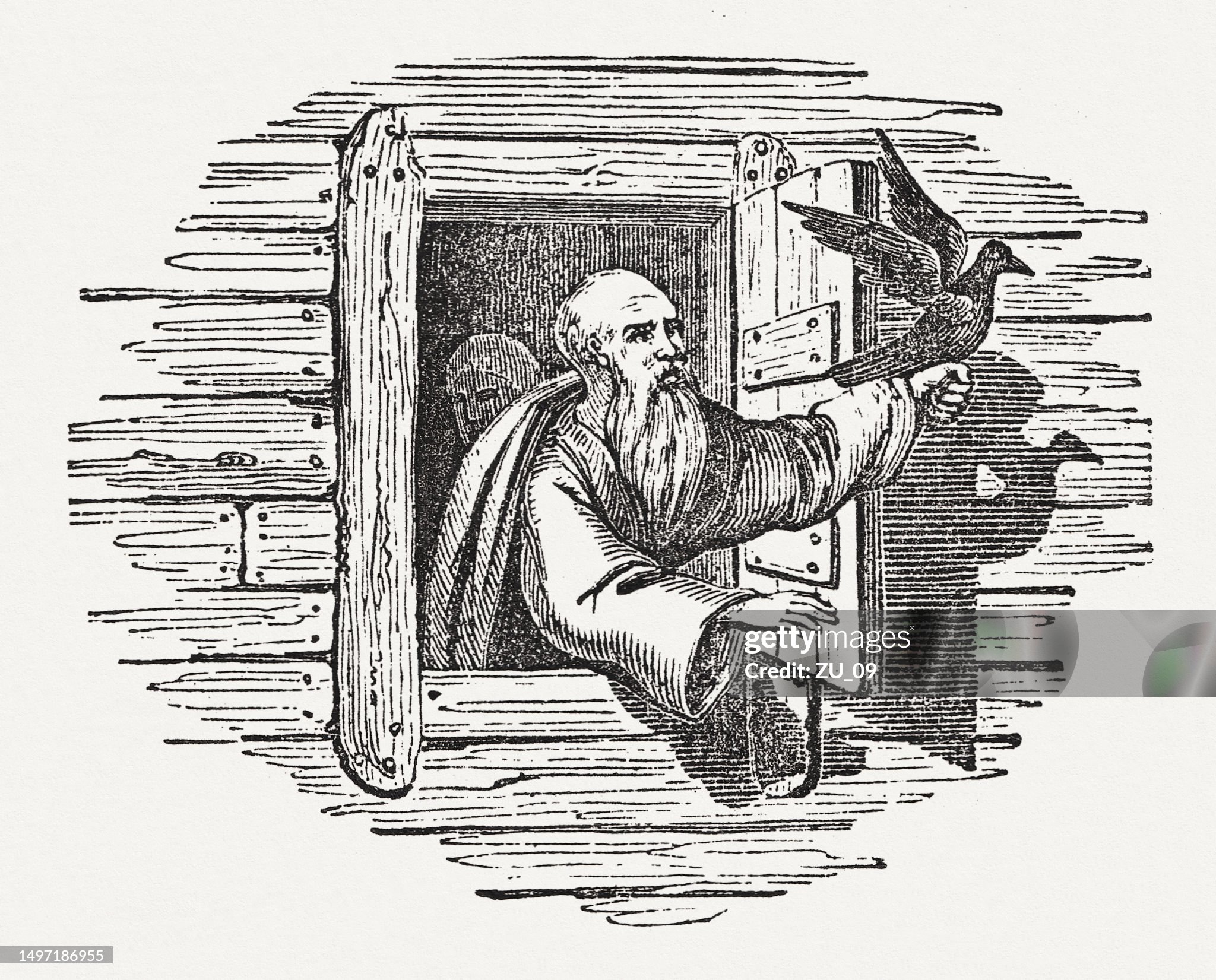
But then, we hear the more charming and more memorable story of Noah releasing the raven and the dove in an apparently different chronology of events. This story could, of course, also simply be an elaboration on events that happened during the previously-mentioned 150 days.
Regardless, in the six hundred and first year of Noah’s life, on the first day of the first month, the waters began to dry up. By the 27th day of the second month, the land was dry. God tells Noah to release all the animals from the ark, so that they may repopulate the earth. And then Noah builds an altar and makes animal sacrifices to God. God smells the “sweet odor” of the holocausts on the altar and swears:
“Never again will I doom the earth”
And we hear this bit of poetry at the very end of chapter 8:
As long as the earth lasts
Seedtime and harvest
Cold and heat
Summer and winter
And day and night
Shall not cease
This divine reaction is a little more reassuring than that recounted in the Epic of Gilgamesh, where the gods are depicted hovering “like flies”, as the text of that myth states, over the sacrifices of the flood survivor Utnapishtim.
Chapter nine of Genesis begins with God blessing Noah and his sons. The blessing is reminiscent of the blessing given to the first humans in chapter one
God says, according to the Fox translation,
“Bear fruit and be many and fill the earth!”
And in the original Hebrew this is identical to chapter one’s blessing of the male and female humans.
As I pointed out in the last episode, reproduction is, fundamentally, a spiritual action, it’s practically a religious rite in the Hebrew milieu. It is a sacred partaking in the exitus and reditus of God himself, this act of creation. There is no higher blessing that God can give. He invites humanity to fill the world. Furthermore, he lays out a new game plan, so to speak, for humanity, with its own rules.
“Fear of you…shall be upon all the wildlife of the earth…into your hand they are given.
All things crawling about that live, , for you they shall be, for eating, as with the green plants, I now give you all.
However, flesh with its life, its blood, you are not to eat.”
In addition to this dietary guidance, there are some other rules and God here also makes a covenant with Noah and, through him, all humanity.
In the moral examination later in this episode, I will go over all this.
Finally, after blessing them and giving them rules to live by and other instructions, God makes a solemn promise to all humans, as a rainbow appears:
“My bow I set in the clouds, so that it may serve as a sign of the covenant between me and the earth:
When I becloud the earth with clouds
And in the clouds the bow is seen
I will call to mind my covenant…
Never again shall the waters become a deluge,
to bring all flesh to ruin”
Finally, the account of the flood ends with a disturbing little scene. Noah plants a vineyard and, presumably some years later, he drinks the wine it produces. One of Noah’s sons, Ham, the youngest, finds his father passed out and naked in a tent. Here is how the King James’ translation describes Noah’s drunken episode:
“And he drank of the wine, and was drunken; and he was uncovered within his tent.
And Ham, the father of Canaan, saw the nakedness of his father, and told his two brethren.”
So Ham goes and tells his brothers, Shem and Japheth, and those two go and cover up their father with a cloak. They do so by walking into the tent backwards with a blanket between them and then covering the sleeping Noah without seeing his nakedness.
When Noah awakes, and learns what Ham has done, he curses his son. This is something else that we shall look at in the moral examination later in the episode.
Chapter nine ends by telling us that Noah died 350 years after the flood, at the age of 950.
(Music)
As with all exegesis, it can be tricky here to separate neatly the allegorical, moral and eschatological meanings of the text. The moral and the allegorical meanings and symbols are much more strongly intertwined here. And, as always, it is difficult to separate allegorical and eschatological into neat compartments. I will try, as much as possible, to save the moral significances for the subsequent segment and stick to the purely symbolic here in the allegorical section.
But, it goes without saying that this entire passage has a strongly moral message. Right behavior, right belief, true faith, all result in salvation. And wickedness is punished most fiercely.
So, then, with that overwhelmingly obvious significance to the text clearly laid out, let us turn to what is probably the most well-known symbol of the text. I speak of Noah’s Ark.
The Ark is not simply the boat in which Noah’s family is saved. First of all, Noah’s family represents the entire human race, at this point. Since, according to the tale, everyone else died in the flood, Noah is the new Adam, in a sense. The identical blessing given to Noah after the flood is evidence of this. Noah is the father of us all. So, it is really all of us in that boat. We are all preserved from the flood by the Ark. This is true in the strictly genetic sense. All of our bloodlines, our DNA, ride in that ship tossed by the waves of the floodwaters.
I cannot speak very well with regard to Jewish theology, but, for the Christian, the flood, and all its elements, are highly symbolic. One way of interpreting the ark, from a Christian viewpoint, is seeing it as the church. The church is the abstract ark, the institution, the body, the assembly of believers in which one is saved from destruction, preserved for salvation. And the way that one gains entry into the ark is through imitating Noah.
This actually brings us to a point of more modern contention. Just how does Noah please God? Why is he righteous in his eyes? A typical protestant response would be that Noah pleases God through faith. Noah listens to and believes God, and is therefore deemed righteous. A believer from the Catholic and Orthodox traditions would more likely include that Noah also does right in God’s eyes, and that his faith is a part of his good works, his righteous deeds and behavior.
This is an argument that we will revisit in the New Testament and my historical podcast will also revisit in the fifth series, about the early modern period, which includes the Reformation.
However, the text bears out very strongly that Noah does right in god’s eyes. Consider, why is the rest of humanity doomed? Recall the wickedness of the first four verses of chapter 6. People were not doomed because of their lack of faith, but because of their wicked deeds, their depravity. This is reiterated in verse 12, that all mortals led depraved lives. Their actions were wicked and so they were doomed. Thus Noah, and his family are blessed because they do what is right.
Verse 22 from chapter 6. Noah did all that God commanded him.
But, my Catholic card is showing and the proper time to discuss the faith vs works battle is much later.
We have not left the ark behind, though. When we come to the story of Moses, this term will factor in the story more than once. The basket in which Moses, as a baby, floats down the Nile is another ark. In fact, in the original Hebrew, ark is the word used in the text of the Exodus, not basket. Moses’ sister places him in an ark and sets it down in the river. Once again, the salvation of humanity, or at least of the Jews, is carried in an ark.
And then, later on in the book of Exodus, there is the ark of the covenant. So much typology, so little time.
But let’s move on for now and look at an allegory from this chapter that has a much more widespread agreement among Christian sects. The meaning of the flood waters themselves.
Essentially every christian theologian agrees that the flood waters are a prefiguration of baptism, a type if you will. We have talked about typology already and it is really the key to understanding the Bible. A strongly typological viewpoint will identify nearly everything in the Old Testament as basically a preparation for, an introduction to, a prologue to and a sort of shadowy copy of nearly everything in the New Testament. Jesus is the New Adam, he is also David, he is also Moses or Joshua. The ark is the church, the state of the city of Jerusalem is the state of your soul. The journey out of Egypt and into the Promised land is the Christian’s journey out of the depravity of the world and into the salvific purity of God’s reign. And so on.
The floodwaters symbolize baptism. But they do so in that they symbolize death. Water symbolizes death in many human cultures. It also symbolizes life. Types can be versatile. The Crossing of the Red Sea is another, stronger and more frequently referenced type of baptism. The Israelites descend under the sea, in a sense, and then re-emerge on the other side, out of Egypt at last.
But right from the get-go in Christian theology, baptism, particularly through immersion in water, symbolized the death of the individual’s old self, and the emergence from the water stands for rebirth. The waters can also be seen as cleansing the soul, when poured over the human head, as the waters of the flood cleansed the world of its depravity.
We will revisit this topic and this passage again, then, in the Exodus and when we come to the New Testament and the real concept of baptism.
Speaking of things to be revisited, I should not miss mentioning the appearance of the forty days and forty nights of the flood rains.
Numerology and the Bible. These days you may have heard of the Bible code, and its reliance on numbers and patterns to derive meaning and even prophecy from the text of the Bible. This is neither the time nor the place to discuss the topic of the Bible Code, but I refer to it in order to highlight the significance of numbers in the Bible. Whether you believe in the reality of something like the Bible code or not, you can’t get away from the real importance of numbers in the Bible and in most cultures, even modern cultures. Even today, we continue to apply value to certain numbers. It takes two to tango, two’s company but three’s a crowd, the seven days of the week, we might give debts 30 days to be paid, we sell eggs and donuts by the dozen, and so on.
For the ancients, though, certain numbers had specific meanings. Three, four, seven, twelve, the list goes on. God ordered seven pairs of clean animals to be preserved on the ark. I won’t bog down into a study of numerology, but understand that forty was another one of those special numbers, especially for the Hebrews. Forty days and forty nights is a duration of time that is repeated when Moses spends forty days and nights fasting on Mt. Sinai, Elijah travels forty days and nights to Mt. Horeb in the book of kings, Jesus spends forty days and nights in the desert fasting and being tempted, he also spends forty days with his apostles after his resurrection, and it appears in many other passages.
And the significance of the number is still borne out in the church. For instance, the season of Lent, from Ash Wednesday to Easter, is forty days long (though you have to subtract all the Sundays in that calculation).
Now, there is debate about how exact this number was originally meant to be. Some say that 40 days and nights is just shorthand for a long time, for a period of more than a couple weeks but less than several months, perhaps. Others would insist on its exactness. You can feel either way about it, but you should understand, when you see the number pop up in the biblical text, that it is time to slow down for a second and really focus on what is happening, because something sacred is being described.
(Music)
Many of the moral implications of this passage in Genesis are obvious, but some are a little more subtle.
As I mentioned earlier in this episode, there is here the quite apparent message that one will only be saved by obeying God, by being like Noah.
But at the end of the ordeal, when Noah and family emerge from the ark, God makes a new covenant with Noah, and through him, with all humanity.
A covenant is essentially a deal, a contract, an arrangement, but a specifically sacred one. When two tribes form an alliance, it might be termed a covenant, because this is not just a contract about the price of sheep or the value of labor. It is a deal in which life and death are at stake. It is not just a written bargain between two entities, but also a bonding between them. Men who engage in a covenant become, in a sense, family, brothers almost.
When I was a kid, boys still talked about becoming blood brothers by cutting open our hands with our pocket knives and then clasping the hand of our chosen ally and mingling our blood. Some of us actually even did stuff like that but I wouldn’t recommend that kind of thing today. Blood-borne pathogens are real.
Anyway, the covenant here essentially says that God will continue to bless mankind, and to refrain from destroying them with the floodwaters, and they will hold up their end of the deal by following certain rules.
Now the components of the covenant enacted here in Genesis chapter 9 are known as the Noahide laws. In Jewish theology, these regulations apply to all of humanity, since technically everyone, even the non-Jew, is a descendant of Noah. This is not like the precepts and ordinances of the Torah, which Jews apply only to their own nation. The Noahide laws are fundamental rules for all people, in this viewpoint.
In the historical segment of this very episode, I related one of these laws when I mentioned God’s prohibition about eating meat with the life still in it. Now, all my life I have seen this interpreted as a rule against eating raw or undercooked meat. Nevertheless, when I research it now, I see that online resources have interpreted this to mean the eating of flesh torn from a living animal. I don’t really have a dog in the fight, so to speak, since the laws don’t apply to me, but for the sake of accuracy, I would mistrust such sources when researching scripture. You’re best bet is to look at the footnotes of a bible printed, by virtually any christian or jewish sect, sometime last century, in my opinion.
But anyway.
The rest of the so-called Noahide laws are derived either from further things that God tells Noah in this passage, or from even more fundamental things previously explained or implied to Adam or during earlier epodes in the Bible, such as in the aftermath of Cain’s murder of Abel. Here, then, are the seven Noahide laws as recognized today:
- Do not worship idols
- Do not curse God
- Do not murder
- Do not engage in sexual immorality
- Do not steal
- Do not eat flesh with the life still in it
- Establish in your land courts of justice
There’s that number seven again.
Except for the last mentioned law, they are all negative laws, laws commanding restraint, laws of prohibition. They are kind of like seven “commandments" given to everyone, rather than the ten commandments given to the Jews later on.
But, more significant for Western, Christian theology is probably the simple establishment of a covenant here. A modern convert to Catholicism and American theologian by the name of Scott Hahn has written a great deal about something called covenant theology. The primary, underlying idea to this line of thinking is that the Bible essentially describes a series of covenants established between humanity and God.
Indeed, the word covenant is interchangeable with testament, both are translated form the exact same greek word, diatheke, which was used to describe the two parts of the Bible in greek: The Old Covenant and the New Covenant.
For more details, you can check out Hahn’s books, but basically God established a covenant with Adam, and humans fouled up their end of the deal. So he establishes another covenant here with Noah. Later, there will be a covenant with Abraham, with his descendants, with David, King of Israel, and so on, until we finally come to the eternal covenant established by Jesus at the Institution of the Eucharist at the last supper, when he holds up a cup of wine and says,
“Take this, all of you, and drink from it, for this is the chalice of my blood, the blood of the new and eternal covenant, which will be poured out for you and for many for the forgiveness of sins. Do this in memory of me.”
I mentioned in a previous episode that the Bible is full of connections like this, connections which cross the barriers of time and text. The pages of your bible appear to go in linear order, but really, on a more abstract level, they are stitched together like a mobius strip, which has no beginning or end. The same themes and words and ideas are found throughout the text, tying it all together. The sacraments of the New Testament, for example, are found throughout the Old. We have seen baptism already. When we come to Abraham, we will see a type of the eucharist, and so on.
Now, as promising as the new covenant with Noah sounds the Bible doesn’t even give us a few paragraphs of satisfaction before the new relationship with God is quickly marred by the sin of Ham, the son of Noah.
In verse 21 of chapter nine, as described in the historical segment of this episode earlier, Noah gets drunk and his son Ham apparently sees him naked and tells his brothers.
There has always been a little mystery about the meaning of that passage in which Ham simply sees his father passed-out drunk and then seems to receive a really draconian sort of punishment. Even from a strictly moral vantage, Noah appears to go a little overboard here, forgive the awkward pun, with his response. Here is the curse laid down by Noah as the Douay-Rheims translates it:
Cursed be Chanaan, a servant of servants shall he be unto his brethren. And he said: Blessed be the Lord God of Sem, be Chanaan his servant. 27 May God enlarge Japheth, and may he dwell in the tents of Sem, and Chanaan be his servant.
Now, the first thing you might notice is that Ham isn’t even mentioned here, and he was the one who saw Noah naked, but, instead, its Caanan who is cursed. Caanan is a son of Ham, and he, and his descendants, are cursed to be the servants of Shem and Japheth, the other two sons of Noah. All Hebrews will be descended in particular from Shem, or Sem as it is sometimes pronounced. It is from his name that we get the term Semites, for people of Semitic origins.
Anyway, as for the apparent name change in the curse, using Canaan instead of Ham, modern scholars will suggest that this story is a convenient way for the ancient Israelites to excuse their conquest of the land of Canaan after they fled Egypt, as is related in the book of Joshua in the Bible. From this viewpoint, the people in the land of Canaan, which we now call Palestine or Israel, the people there were descendants of Canaan, a cursed man, they were a corrupt and cursed race and it was justifiable to attack their cities and to enslave them.
There is also, though, a traditional Hebrew explanation that Canaan, the son of Ham, was actually also present when Noah’s nakedness was discovered, and he somehow participated in dishonoring Noah.
But that leads us to the darkest speculation associated with the text: that is, the exact nature of the sin that Ham, or Canaan, committed here. Was this heavy curse all due to Ham simply seeing his father drunk? Or maybe because he didn’t immediately do anything to help his father?
Martin Buber, a respected 20th century Jewish philosopher, posited that some sort of sexual immorality perpetrated upon Noah is being implied here, and that this sin taints the entire race of Canaan, then, the people in the land that the Jews will later go on to conquer. This is fitting with the way that the Canaanites will be depicted later on, as a decadent and depraved, soft people living in cities in the book of Joshua when the Israelites emerge, battle-hardened and hungry, from the Syrian desert.
However you choose to interpret these lines, there is no doubt that these four chapters seem designed with moral exegesis in mind. There is a wealth of material here to mine for interpretation.
(Music)
The flood story is also one which lends itself to eschatological exegesis. That is, interpretation of a biblical passage in light of the final destiny of man.
There is a saying in the Orthodox Christian Churches of the East; that the church is a hospital. In the New Testament, Jesus comes to dine with sinners and to heal the sick. That is, he comes to the wounded, to the fallen, not to the well. He comes to save, to cure. And so, in this interpretation of salvation, all those baptized into the church are like patients in a hospital, getting better so that they might live.
I should note that this is simply a popular saying in some Orthodox circles, and is not a comprehensive presentation of Orthodox theology. For that, you need to visit your local Orthodox parish Church.
But anyway, I bring this up because it is very similar to another way of interpreting the church: as an ark. The ark in the biblical text about the Flood, for Christians, represents the earthly church itself. Those who have chosen to climb inside are preserved from the turmoil and destruction of the world. And I don’t speak simply of protection from some kind of apocalyptic, end-of-days scenario like the flood but rather that the church, the ark, preserves Christians from the flood that IS the surrounding world itself, the violence, the depravity, the oppression, the terror of the world are, its betrayals and heartaches, they are all, in a sense, a kind of flood, a great peril. And only the ark, the church, which is created by God, can serve to protect one from danger.
Note that phrase about the ark that I used: created by God. And consider the text of this passage. God literally designs the ark. He doesn’t just say, build the best boat that you can and I will watch out for you guys. No, he tells Noah how big it should be, he tells him what kind of wood to use. As the King James Bible has it: Make thee an ark of gopherwood, which is apparently a reference to some sort of unknown tree wood used by the ancients.
And God tells Noah how to construct the rooms, how many levels to make, where to put a window. God is in charge of all but the actual laying on of hands with the materials to actually put the ark together. In fact, as I noted earlier, the text even states that God is the one who closes the door of the ark before the rains begin to fall.
And this is fitting with the message of the whole Bible. That it is God who ultimately does everything, guides everything. As Proverbs chapter 21, verse 31 has it:
“The horse is equipped for the day of battle,
but victory is the Lord’s.”
Man may prepare all he wants, but in the end, it is God who decides how things will turn out. As the poet Robert Burns said, originally in his Scots’ dialect, the best laid plans of mice and men often go awry.
Today we have a different saying: How do you make God laugh? Tell him your five-year plan.
The meaning that the ancients were trying to get across here is that circumstances, fate, chance, the Fortuna of the Romans, about which the philosopher Boethius will speak, and if you so choose to call this entity God, then know that it is ultimately forces, or a force, beyond your control that will determine the outcome of all your plans.
In the story of the Flood, as in the Christian reality, God is in charge, and we must trust him unto the end.
(Music)
Before we conclude, though, here’s another note on morality.
A lot of people, particularly atheists, take umbrage at the very idea of this passage being some kind of moral guidebook. They jump, justifiably, and immediately, on the most horrific part of these chapters. The entire human race, men, women and children, as well as most of the planet’s terrestrial animals, are wiped out in this story. Who kills them? God does. Why does he kill them? Apparently become humans were immoral.
Obviously, on its face, this is an excellent counterpoint. No theologian today could, with a straight face, defend this mass murder. No matter how wicked the rest of humanity was, the idea that they all deserved death, down to the smallest child, seems to offend each man’s innate sense of justice, and to defy our mutual desire for a moral God.
How can I square this scenario, reconcile this vengeful God destroying the world with the god of Love, the God who wishes us, as Jesus says, to have life and have it in abundance?
Many before me and you have tried, that is for sure.
The gnostic Christians, again, we’ll speak about them at length in the future, the gnostics have an easier solution to this. They do not believe that the angry God of the Old Testament is really God. He is not the father of Jesus anyway. Perhaps the God as represented in some of the prophets is God the father, but the God who massacres humanity and orders the slaughter or enslavement of the Canaanites is NOT the real god, but rather an impostor of sorts, the God of the physical world, which is a sort of prison from which Jesus was sent to rescue us.
So much for the gnostic take.
Of course, there were and are theologians who take a heavy-handed approach. We must simply accept, they tell us, these severe punishments and fear God’s wrath as much as we cherish his forgiveness. St. Augustine was not alone among church fathers to take this approach to the text.
Most theologians, today, it seems to me, try to walk a line somewhere between those two extremes.
Myself, I focus less on forcing my own morality on a situation that is thousands of years old and which occurred under circumstances that I will hopefully never understand, and I think more about what I know from archaeology and history. This flood narrative, as well as those flood narratives in the Epic of Gilgamesh and in Greek and Roman mythology and in other religious traditions, this narrative is inspired by a real event. The end of the last glacial maximum, and the severe flooding that would have been experienced around the world, at different times, starting some ten to twelve thousand years ago.
There doesn’t seem to be much point in discussing whether it was right for all those people to die when the glaciers melted and the world flooded. They did, and the survivors of the flood tried to make sense of it all as best they could.
Perhaps they, like many people today when they consider impending climate change, perhaps they held themselves, humanity at large, at fault for the disaster. Plenty of people are going around today saying that climate change is going to kill us all and that we essentially deserve it for abusing the environment. Perhaps they are the same people who think God was unjust when he sent the flood.
Maybe it’s a cop out on my part. Or maybe I just tend to approach the Bible with a different intent. I want to understand, and not to judge, the document and the people that wrote it and the people that lived it. And the Flood narrative is a story that may be one of our oldest surviving memories as a species, the memory of something globally traumatic, which led to a complete reset of our society.
I think that we can learn from everything that the ancients left us as a record of their lives and their thoughts. But I sincerely hope that we don’t have too much to learn from Noah’s Flood. Like some of you, maybe, I hope it remains just an interesting fable, and not an allegory for disaster in our own future.
In the next episode, we will move on to the multiple human societies, described in chapter ten, which grow from out of Noah’s family, and, in chapter 11, come to the end of the history of the primeval world.
Until then, I thank you for listening to the Western Traditions Podcast.
(Music)