Episode XIB.002 - Genesis 1:1 - 2:3
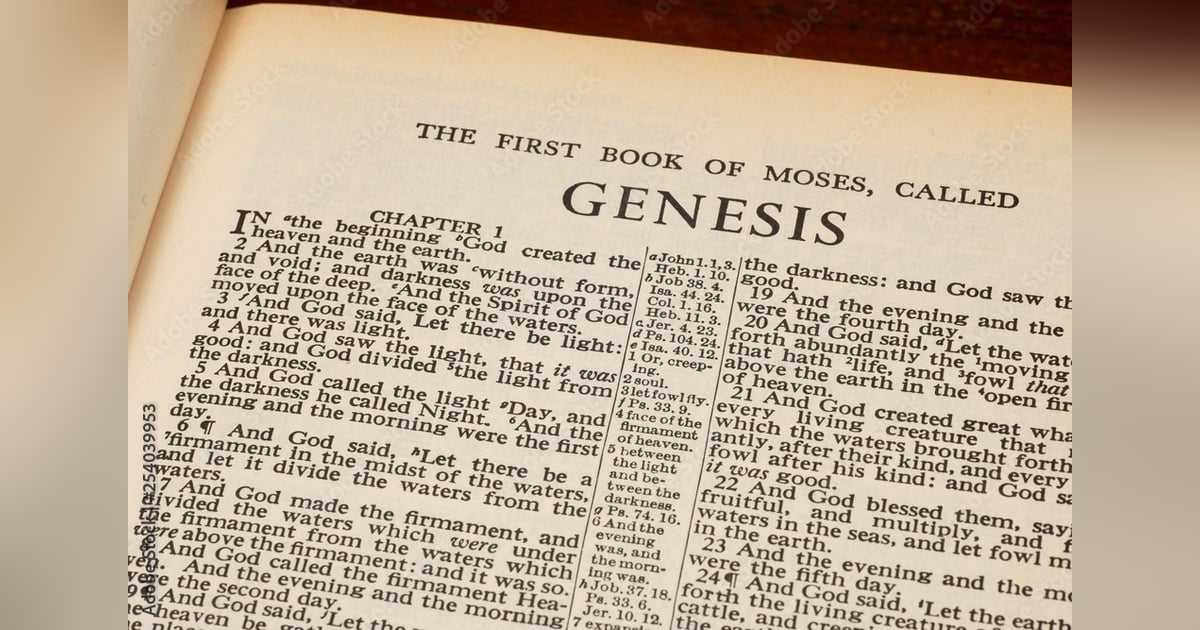
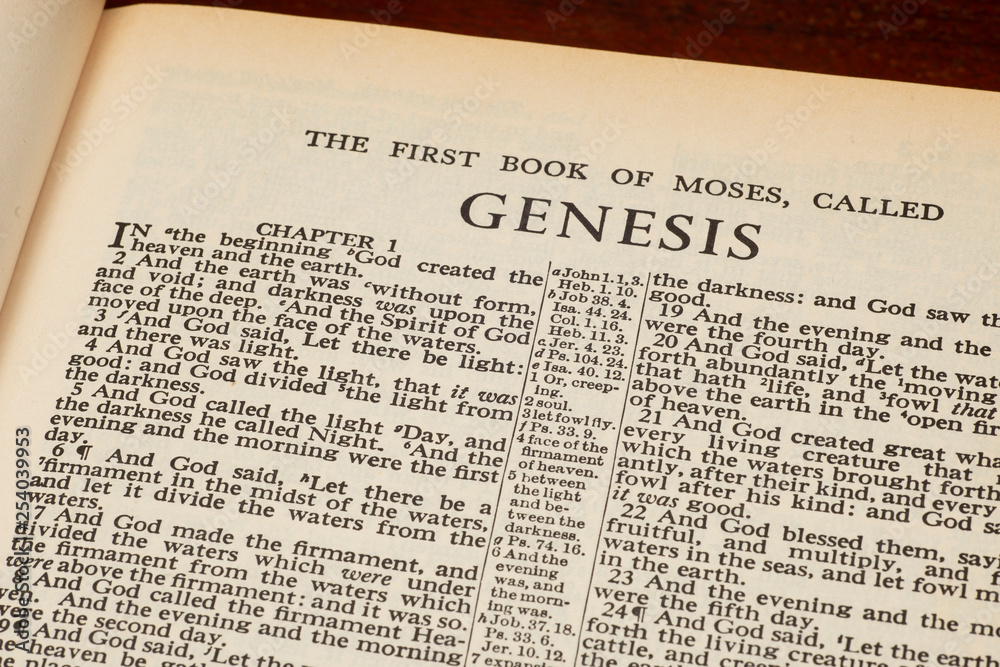


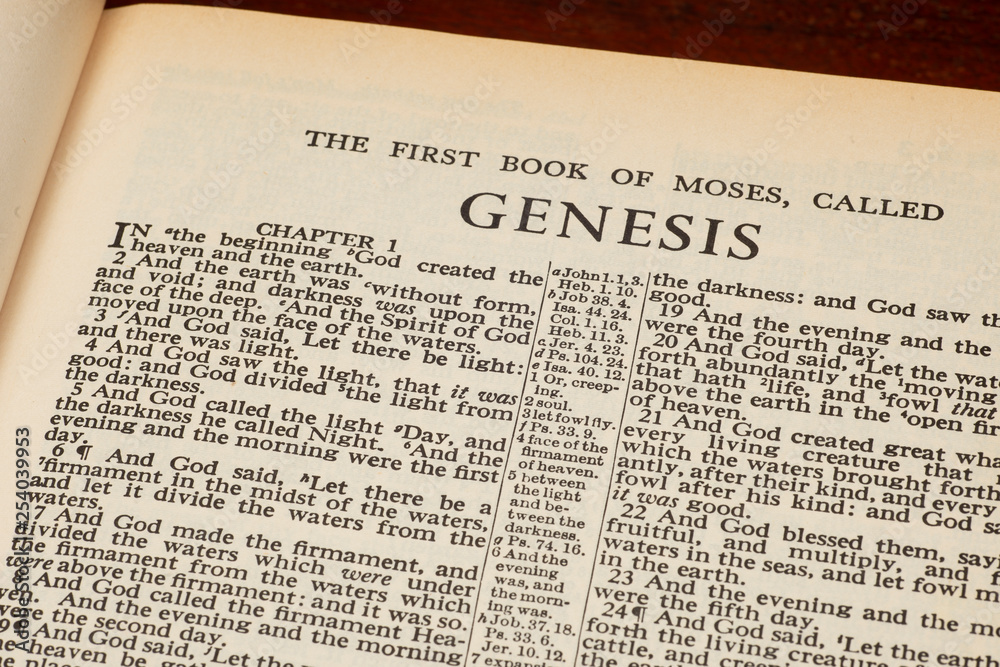
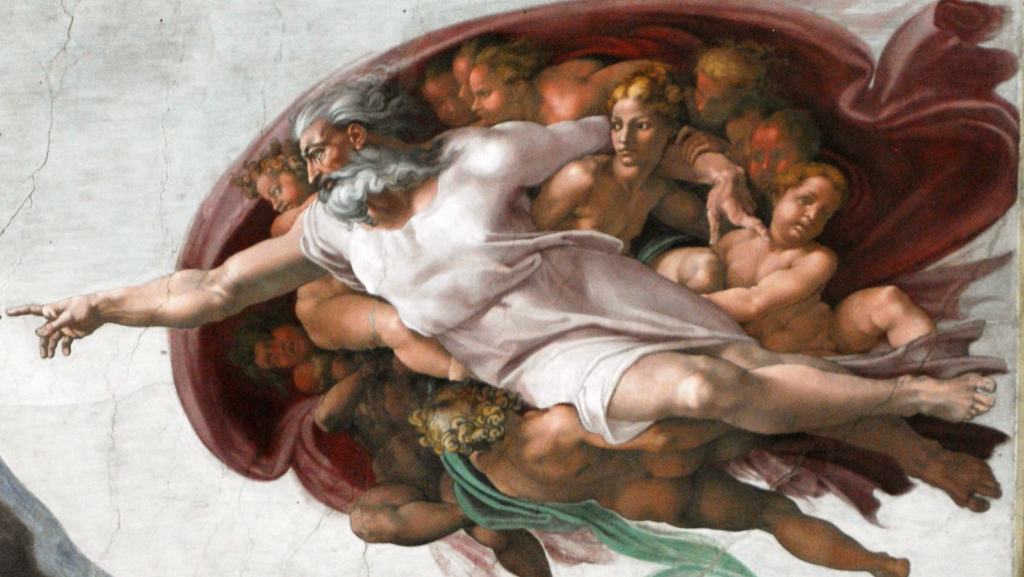
The creation of the world in seven days. Allegory and Anagogy. The textual loop of Scripture.
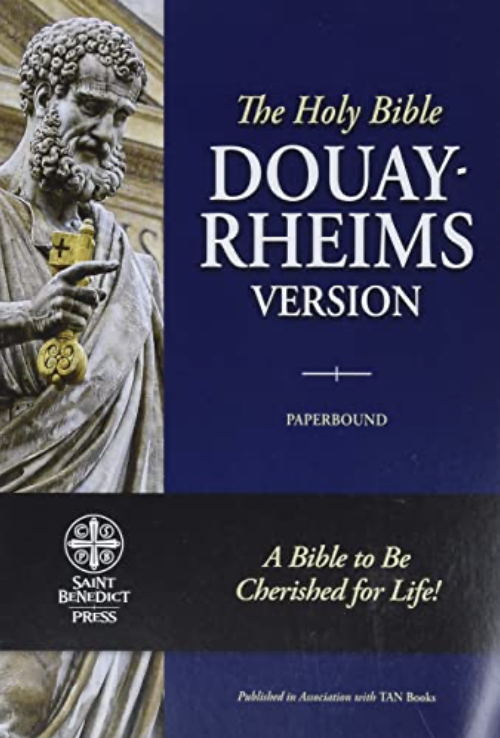
RECOMMENDED READS - Click Image for Link:

Episode XIB.002 - Genesis 1:1 - 2:3
(Music)
-Read Genesis 1:1 - 2:3
- Genesis, chapter 1 and the first three verses of chapter two, according to the Douay-Rheims translation.
(Music)
Welcome to the Western Traditions Podcast study of the book of Genesis. We begin
today with the first chapter of this book and therefore the first chapter of the entire Bible.
Genesis 1 is also the first chapter of a section of Genesis sometimes known as the history of the primeval world. These first eleven chapters describe episodes from the most ancient, prehistoric times, before the life of Abraham, who, along with his direct descendants, will be a central character for the remaining chapters of the book.
The primeval history has no associated, documented period of human history to go along with it. For instance, for Abraham, who appears for the first time at the end of chapter eleven, we can say roughly that he probably lived around the time of the first Babylonian kingdom, sometime around 1800 BC.
But for the other personalities of the first eleven chapters of the book, we cannot make any such association with history. Persons like Adam and Noah live in deep prehistory, and we will get to whether or not they lived at all or rather they were characters in an allegory in the coming episodes.
For now, let’s look at the very first chapter of Genesis, as well as the first few verse sof the second chapter. This opening episode of the Bible contains the celebrated creation story known throughout Western civilization: the seven days of creation. Even today, in a much more secular age, it is not uncommon to hear references outside of spiritual circles, in entertainment and social media, such as “it took God six days to create the world”, or “God rested on the seventh day.”
Now, I mentioned the documentary hypothesis in the prior episode introducing the Old Testament. This hypothesis attributed the entire pentateuch to the interlacing of four different traditions and narratives, labeled as either J, E, P or D, about the earliest days of the Hebrews and the entire world. According to this hypothesis, the story here of the creation in seven days is a priestly account, or a P narrative.
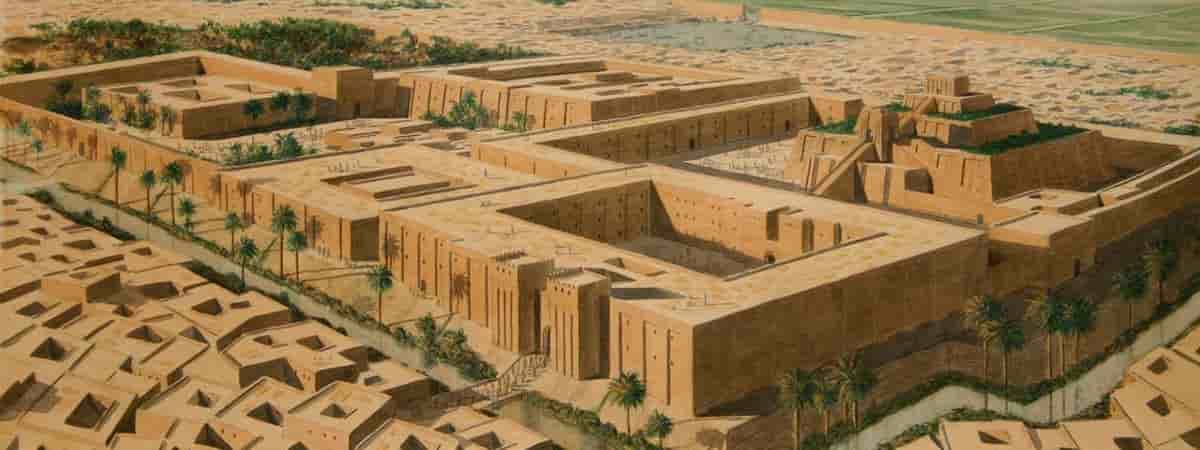
The rationalization for this interpretation goes something like this: The Jews, who began to return from Babylonian exile in the sixth century BC, had been living among pagans for decades. The popular creation stories of the Mesopotamians, with which they had been surrounded for years, were fantastic and unforgettably gory accounts of heavenly battles and betrayals.
For example, there is a tale known as the Enuma Elish, which probably, in some version, dates back to most ancient Sumer, maybe even as early of 3000 BC or before. This story is a bloody tale of divine conflict in which the world was established almost as a byproduct of war between the gods. The tale probably was told in different versions down through the ages but, in the account that survives today, the ancient Babylonian God Marduk created the universe when he defeated the primordial sea goddess Tiamat and ripped her in pieces and used portions of her body to make heaven and earth.
See the fourteenth episode of my first podcast series on the ancient world for more information about the cities of ancient Sumer and that tale.
Scholars of the documentary hypothesis believe that the creation story found in Genesis 1 may have been crafted by the priests of the Jewish temple, either while in exile or after their return, to distinguish their own version of the origin of the universe from the pagan versions that surrounded them. It may have also been done in a competitive way, with the desire to show that they too had a magnificent story about how the world began.
One can only imagine how this story might have been told in the Jerusalem temple, how they might have accompanied it with sound effects, crashing gongs or bells, smoking incense, and so on between each day of the account. It was probably a grand production.
However, while it is allegedly a tale composed by Jewish priests and possibly for Temple services, notice that Genesis 1 does not make a distinction between men. It neither trumpets the superiority of the Jewish people nor even mentions them. It only mentions mankind as a a whole. Though possibly composed with a partisan intent, the Creation story of Genesis 1 is ecumenical and universal. All men were made by God, not just the Hebrews.
Also, when compared to the Babylonian, pagan versions of Creation, the Hebrew account is a much simpler but also much more orderly affair. There is no chaotic battle amongst warring gods here. There is only one God, who speaks and creates a world that unfolds and develops in an orderly fashion.
Of course, there is another, more poetic, perhaps more romantic way of imagining the origins of this story, rather than as a clever way to complete with the pagans. We can also accept what the ancients did, that it was truly written down by Moses, that this story had been handed down to him and his brethren through the dusty centuries since the world was created by the hands of God. Thus Jews and Christians have believed for thousands of years.
Now, as with all theories, the documentary hypothesis has received a lot of criticism in recent decades. Whichever theory dominates biblical interpretation doesn’t really matter, though, and the opinions of scholars come and go.
Scripture remains the same, and it is yours just as much as it is theirs.
Now, there are some other elements of the text that bear mentioning here.
First, note how the days are distinguished and described.
Here is how the Douay-Rheims version describes the first day in verse 5:
“There was evening and morning one day.”
In the King James Version, the same verse says “the evening and the morning were the first day.”
All the days are described this way. Notice that the night comes first when characterizing a day. “The evening and the morning were the first day.”
Quite opposite of how we imagine the days. When you think of Wednesday evening, let’s say, you think of the dark hours after sunset on the calendar day Wednesday. But our calendar days, which start with a morning and end in the middle of the following night, are not like the ancient form of timekeeping.
For the ancients, the following day began in the evening. This is why Jews begin to practice their sabbath rest on Friday evening rather than Saturday morning. This is why the Catholic Church holds vigils and vespers for feast days on the evening before the actual day of the saint’s feast. Because the day which we moderns believe does not begin until midnight, actually began at sunset the evening before, for the ancients.
Scholars have also noted certain divisions or groupings in the text of this first chapter. For instance, notice how God first creates, and then divides. This is a repeated pattern. He made light, then separated or divided the light from the darkness. He makes the firmament and then divides the waters, meaning the waters here below in seas and lakes and rivers from the waters which rain down from the sky.
This happens multiple times. He even makes mankind, and then separates them into male and female.
If you read the text over and again, you might yourself find other patterns with regard to the way that the days themselves are divided or grouped.
Speaking of division, the text of the creation story here does not finish in the first chapter, but rather carries over into the first few verses of the second chapter, which may seem inconvenient to you. However, you should know that the division of the Bible into chapters and verses is actually a medieval intervention. At least, the chapters were conceived in the medieval period. The verses may have been determined some centuries later.
Among the ancients, each book in the Bible, even a very long one, was simply one long stream of text. This is why, in the New Testament and among the early Christians, you will hear Saint Paul or Saint Peter or some one else refer to scripture and say something like, “It says somewhere in such and such book”. And you might have wondered, “why doesn’t he just say, it says this in Genesis chapter 3, verse 7, just like preachers do today.”
The saints don’t say it like that because there were no verses or chapters in their day. They were simply quoting passages that were somewhere in scripture. They had no way of describing exactly where a passage was found.
And the chapters that we have today often seem poorly arranged, sometimes a chapter break occurs right in the middle of single, coherent passage, and sometimes a single chapter will contain different concepts that might appear to us to have been better broken into smaller chapters.
This is because the text, when it was divided up into chapters, appears to have been divided based primarily on the simple length of each passage. In other words, a chapter may have been cut off where it was because it was all that could fit on one page of handwritten text. So the nature of the content often had little to do with the actual chapter breaks.
The details of this process, though, are lost to time. There were priestly councils in the early centuries of Christianity that delineated which books to include in the Bible, but we have few records of how it was decided to actually divide the text up, nor do we really know who made those decisions.
In the 13th century, it is believed that an English Cardinal of the catholic church, by the name of Stephen Langton, came up with the modern chapter scheme as we know it, but we also know that he was working with and rearranging an already-existing organization of the text.
This all happened before the printing press was invented, so it might have played out differently if the press had been invented earlier. But, as it is, the needs and requirements of handwriting ended up having a big impact on the arrangement of the biblical text.
One more thing for this segment of the episode on Genesis chapter one. It is important to familiarize yourself with another fundamental Christian idea that is derived from this passage.
In many other religious and cultural traditions, God or the gods create the world from an already existing matter. Such as the Babylonian god Marduk creating the world from Tiamat’s gruesome remains. Though you may choose to read the text differently, of course, it is a time-honored interpretation among most Christian traditions that the opening verse of the Bible indicates that God created the universe ex nihilo.
This is a Latin term which means out of nothing, or from nothing. This term is important to know when it comes to the discussions in the early church of the first few centuries after the death of christ.
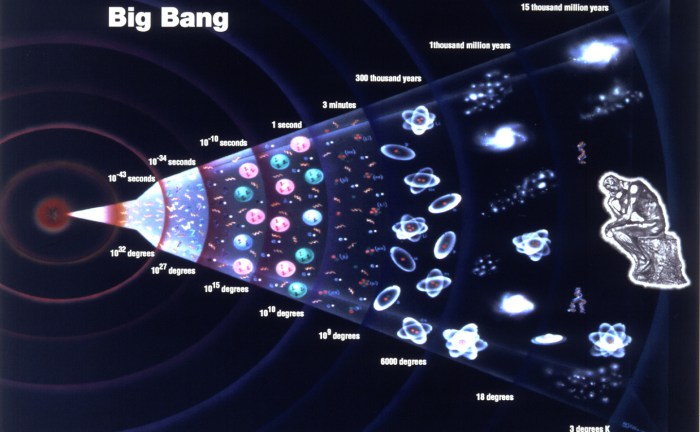
It is also worth noting that this concept, ex nihilo creation, was one of the driving factors which made physicists in the 20th century discredit the Big Bang theory, which was first posited by a Catholic priest named George LeMaitre. That theory seemed to them to be too much like the Creation account in Genesis and it seemed essentially underpinned with the ex nihilo idea, this tiny pinpoint becoming the whole universe in an instant. It didn’t help that the deviser of the theory was a catholic priest.
This Big Bang theory, like many other physical theories, is presently coming kind of unglued due to the revelations made by the James Webb Space telescope, which was launched on Christmas Day, 2021.
This may ultimately seem off topic, but it just goes to show that this most ancient text, the very first line of the Bible, can still find its way into our thinking, even in roundabout fashion, many thousands of years after it was first composed.
(Music)
The first words of the the book of Genesis have often been translated as: in the beginning, God created heaven and earth. Thus do both the original King James’ Bible and the Catholic Douay-Rheims bible have this verse.
However, various translations today give the verse as “In the beginning, WHEN God created the heavens and the earth…”
You have to remember that this text was originally written in ancient Hebrew, and, if you truly speak any other languages than your own, then you know that translation is not a word-for-word business. All translation is paraphrase, and determining exactly how to translate a phrase or sentence is a tricky business. But even Hebrew scholars will translate this verse into English with something a little less direct than the King James Version. Instead, they will translate the first verse as something more like, “in the beginning of god’s creation of heaven and earth, etc”
The distinction is subtle but meaningful, for a number of reasons. Understanding that there is a word, or concept, like “when” in there, or a phrase that suggests an indefinite time period, this opens a window for reinterpretation.
And right now I want to address the impact it has on the interpretation of the creation account as literal or allegorical.
You can easily find on Youtube, Reddit, or other social media, places where people either attack or defend the belief that God literally created the universe in seven days. There is literally a whole universe of topics that fall into this area, I think the phenomenon is known as an iceberg now, a grouping of topics associated with some overarching idea. I am sure that you can also find discussions about young earth, old earth, flat earth, and other topics as well when you go searching down this rabbit hole.
The only thing that I want to discuss here, because it impacts your reading of the text and may impact your faith, whatever that is, the only thing that I want to discuss right now is the literal vs allegorical interpretation of the seven days creation.
Now, it is a somewhat widespread belief today in American society that the ancients, early christians in particular, believed this chapter of the Bible literally, that God took seven calendar days to create everything that exists.
But this is actually not a true characterization of the early christians. The ancient Christians had different understandings of the biblical texts, and when I speak of the nuances here, I am not just relying on renegade christians but rather on celebrated, orthodox Christians, such as St. Augustine, whose theology inspires both Catholics and Protestants.
Some modern Christians try to square this idea of seven days of creation with modern understandings of the age of the universe by reckoning each day in Genesis 1 as simply some eon of indeterminate length, millions or billions of years. A very small minority of Christians, in the global sense, simply denies scientific theories about the age of the universe and they assert that, according to the timeline given in the Bible, by reckoning up the lifespans of the patriarchs or heroes of the Old Testament, that the entire universe is only about 6000 years old.
Most others, though, including popes and preachers, see the seven days as an allegory, or a poetical way of describing vast periods of time and vaster amounts of space.
St. Augustine, in the 4th and 5th centuries AD, believed that the story here was an allegory partly because he believed that it was nonsense that it would take almighty God seven whole days to make the universe. Obviously, Augustine said, God made the universe instantaneously but the story here describes the steps for us in order to teach us something about God.
Indeed, Augustine also said that we are in fact not required to believe anything in Scripture which violates our sense of reason. How Augustine squared that view with things like the resurrection are topics for a different episode.
Origen, a 3rd century Christian, a philosopher and a scholar, was extremely devout and suffered for the faith. His father died a martyr. But Origen believed that much of scripture was simply allegory, meant to convey much more meaning than just the literal text could possibly do. For him and for most Christians, then, a story such as the Exodus is not just the story of the Israelites escaping slavery in Egypt, but it is also an allegory describing each soul’s escape from the slavery of sin. For this reason, Exodus is read in the liturgy of the hours in the church during Lent, to help the reader make the same spiritual journey of repentance before Easter.
Maimonides, a highly respected medieval Jewish rabbi and theologian, declared that it was not required to understand the text of the torah literally and, that whenever the Torah and science seemed to disagree, then we are simply misunderstanding one of them, either we misunderstand the biblical text or science has not yet come to understand certain physical phenomena.
However, I do not want to make it sound like all early Christians or Jews necessarily had a nuanced and allegorical view of the Bible. Saint Basil the Great, widely respected among both Catholic and Orthodox Christians, he insisted on the literal view of this chapter in the Bible.
Early christians and jews may have believed that the seven-day account was literal, but it does not seem to have mattered even to those who insisted on its literalism, because the real importance of the text here is not in its literal count of seven calendar days, but rather is better seen using two other exegetical lenses with which I will view the text in the next segment of this episode: the moral and the anagogical.
(Music)
-God called the dry land Earth, and the gathering together of the waters he called Seas. And God saw that it was good-
Suddenly, on the third day of the Creation account, we have this declaration. Not only that God created the earth and the sea, but that it was good. It was all good.
This positivity is reiterated multiple times in the chapter. For example, the emergence of life in verses 11 and 12 is deemed good, in God’s eyes. At the end of the chapter, at the finish of the sixth day, verse 31 says, And God saw that all the things that he had made, and they were very good.
This is something critical to Catholic theology. That the world is inherently good. God made the world and therefore it must be good. It may be a fallen world, the world and its inhabitants may have defects, but the world is substantially good. It is a product of God’s hands.
Since the very beginning, the church has struggled against various heresies which say otherwise about the world. For example, one of the tenets of gnosticism, discussed in a separate series of episodes, is that the world is a bad place, that it was made by an evil god and that Jesus can deliver us to a spiritual existence that is above and beyond the physical world.
Probably many Christians, without knowing that they are doing so, adhere to this idea. They think that they will someday escape the world after death and be brought up to heaven to live forever with God.
But that is not christian theology.
The traditional theology of the church declares that this is wrong. In fact, one of the purposes of the resurrection narratives in the gospel, in which Jesus appears to his disciples and insists on his physicality, the purpose here is to stress the physicalness of the resurrection. Jesus says to his disciples, put your hands in my side. He sits down and eats fish with them on the beach. He is modeling the glorified body which we shall all have in the afterlife.
And the apocalypse, the last book of the Bible, also reiterates the importance of the physical world. We are not going to become spirits and live in the clouds or in some ethereal state with God forever. No, we are going to live, in physical bodies, in an urban environment, after the New Jerusalem descends from the heavens. Note the importance of that idea. The Apocalypse does not describe saved souls ascending to heaven, but rather heaven comes down to earth and we live in it bodily, inhabiting bodies.
Indeed, even the maleness and femaleness of our bodies is God’s idea. In verse 27, God creates mankind, and immediately divides them into male and female.
So, even though there is great stress on sexual purity and even celibacy in the Christian tradition, our sexual natures, our bodies are also fundamental, they are divinely created, they are good.
Indeed, they are created in God’s image, as the text says. This speaks strongly to the dignity of the human form, both physically and spiritually.
Now, there are many religious traditions in the world, with many varying perspectives on the value of the world and our bodies. For instance, in Buddhism, the world is called a burning house, it is something terrible from which we must escape. And I won’t get in a quarrel with Buddhism over that idea. It’s well-founded idea and certainly many of us must feel this way at times. But this is a podcast about Christianity and Christian perspectives.
In certain other religions and philosophies, the world is considered to be an illusion, and the only real things that exist are human souls and God.
And sometimes, especially in early Christianity, there will be a great struggle against such viewpoints among its earliest adherents. We will get into that struggle against heresies when we come to the New Testament and I address the same issue in episodes about the early church in the roman empire series.
But, however those other religions and sects may see the universe and existence, it is important to understand that Christianity, authentic, traditional Christianity, takes a distinct viewpoint. For Christians, the created world is something good.
Now, this does not contradict Jesus’ statements in the New Testament in which he talks negatively about the world, because he is talking there about society and how it warps us and judges us. Here, I am talking about creation, about nature, about the sunrise and about food and drink, bread and wine, and the changing seasons and animals and plants and the human body.
For the Christian, these are not things to be escaped, these are not illusions. As the book of the Apocalypse states at the very end of the Bible, all the saved are coming back to live on Earth, not in Heaven, but in a city, the New Jerusalem, where rivers flow and trees produce fruit. Now, there is certainly some allegory about that text, and it can be applied spiritually not literally, just like the text of Genesis, and we will come to that interpretation, but as further proof of the Christian belief about this physicality of eternal life, we need only look at the final stanza of the Apostles’ Creed, which is probably one of the oldest non-Biblical texts in Christianity:
I believe in the Holy Spirit,
the holy catholic Church,
the communion of saints,
the forgiveness of sins,
the resurrection of the body,
and life everlasting.
Eternity will not be spent as a spirit floating around an ethereal heaven, but instead everlasting life is just that, life in a resurrected body that does not suffer as this one does but it still a body nonetheless.
The world is a good place, and we will inhabit it forever, though it may be transformed.
This may seem to be getting very far ahead of myself and, in truth, I have wandered into anagogy here, the type of exegesis which sees scripture through the lens of infinity.
The difference between allegorical and anagogical exegesis is subtle. Sometimes, it is difficult to separate the two. Other times, it is quite easy. In the previous episode of this series, I described how the allegorical view sees a passage as symbolic or representative of some other topic or issue.
Anagogy specifically relates a passage to something regarding the final destiny of mankind. This is known in Catholicism as eschatology. The study of the final state of man, the eternal significance of events, and the future or end time reconciliation of all things.
This opening passage of the Bible, from genesis chapter 1, verse 1 to chapter 2, verse 3, it really speaks to the interpretation of the entire biblical text and points us toward the last book, the Apocalypse of St. John, and thus it creates a textual loop of sorts, all of scripture essentially an infinite circle.
What do we learn, what who we understand anagogically, from this passage, from the Creation account at the beginning of the book of Genesis about the final destiny of man?
We learn that God is in charge of things. He has laid out the foundations of the world, he has developed it in an orderly fashion. Reinforced here is the idea that God has a plan, even though the world may seem like the chaotic mess that we see in stormy, pagan creation accounts, it is really all part of a plan that will someday make more sense.
In its creation, the tapestry of history seems incomplete and without purpose, but, as time passes, the threads come together, and we begin to see patterns. Someday, somewhen, the tapestry will be complete, time will be over, and God’s plans, like the seven days of creation, will all be complete, and
we will know everything.
(Music)