Episode X.002 - Paleo-American Origins I: The Beringia Theory


The Beringia Theory. Clovis points and the extinction of the megafauna.

RECOMMENDED READS - Click Image for Link:

Episode X.002 - Paleo-American Origins I: The Beringia Theory
(Music)
Hello and welcome to the Western Traditions podcast. This is the second episode in the series on the history of the Americas. Today we will go over the story of the peopling of the Americas that was most popular in the 20th century: The Beringia Theory.
Now, there are competing and increasingly popular versions of the story of the peopling of the americas which have sprung up in the last few decades. However, no matter which theory you prefer, most utilize the Beringia theory to some extent. In other words, everyone even remotely credible agrees that a substantial portion of the population of pre-Columbian America arrived via the Bering Land Bridge that existed temporarily at the end of the last Glacial Maximum. Even native accounts of their origins would, logically, have to accept that some people immigrated across the Bering Strait, which is navigable by boat even today, after all.
So today’s episode will focus on Beringia, that is, the pure Bering Land Bridge theory. Future episodes will cover alternate ideas about how the Americas were populated by homo sapiens.
Before we begin, let me remind you to head over to the website, western-traditions.org, (repeat) if you’re not already there. You can find helpful pictures and maps, some good books, transcripts of the episodes and you can even buy Western traditions merchandise on the shopping page. You can also contribute directly to the support of the podcast through the PayPal or Patreon options.
(Music)
Let me begin by saying that we are talking about the greatest migration of human beings ever. Ever.
Now, I did an episode on the expansion of the Indo-European speaking peoples in the first podcast series. That was episode 12 of that first series. And I love that story. I love being a part and product of the Indo-European expansion. I’m a proud Indo-European, you could say.
But this, this peopling of the Americas, no matter which theory you adhere to, it is truly the greatest story of human movement and conquest, though it is one which we unfortunately will probably never know much about.
Now, when Europeans first encountered the native populations of America, they were simply assumed to be people from the South and East Asian lands which Christopher Columbus had been attempting to find. In particular, he had wished to find India and initiate direct trade that did not have to pass through the hands and the tolls and controls of the Turks and other Near Eastern powers.
So the inhabitants of America were initially simply presumed to be Indians, and so they were called Indians. Later, when that perception was realized to be false, and it was understood that there were two entire, previously unimagined continents here, the people of America came to be called American Indians or Amerindians, particularly by professionals in the study of history, anthropology and so on.
Of course, we know now that, genetically and culturally, modern Native Americans have little in common with India. In fact, as we learned in that 12th episode of my first podcast series, The people and culture of India actually have more in common with Europeans than they do with the rest of Asia.
Now, as these realizations sank in, scientists had to account for how Native Americans came to these continents. Popular for a long time was the idea that the Natives of these continents were, in fact, descendants of the lost tribes of Israel. I’m not going to spend time on that idea here but it was popular even in the late 19th century.
Around this same time, though, it was also becoming understood in Western science that man had evolved from apes in Africa. So it was not a scientific option to imagine that the ancestors of Native Americans might have evolved first in America. Like all humans, according to this way of thinking, the Native Americans had to originally have come from Africa and gotten to the Americas somehow at a later date.
And the scientists of this period, like the scientists of all periods, were influenced by their own perceptions of the Native Americans. And frankly, no matter how open and friendly they might have been with Native Americans personally, these researchers and scholars possessed a perception that ultimately saw the Native Americans, and their distant ancestors, as inferior, and not capable of the kind of feats of exploration that the Europeans had accomplished.
So, they could not therefore have sailed, in some deep period of the past, from Europe or Africa. And it was already known that the Natives had not possessed horses or any draft animals at the time of European contact. So they must have walked.
Just as evolution was coming into fashion in scientific circles at this time, so was the understanding of ice ages and the climatic upheavals of the prehistoric human past. When it was realized that ice ages caused the sea levels to fall, there appeared a very convenient location for the ancestors of today’s Native American population to have traversed.
The Bering Strait.
Now, there are have been five major ice ages in the long history of the Earth, time periods when the ice caps and glaciers grow considerably and cover much of the planet’s surface. The first ice age was billions of years ago. We are presently in an ice age that began just two and half million years ago.
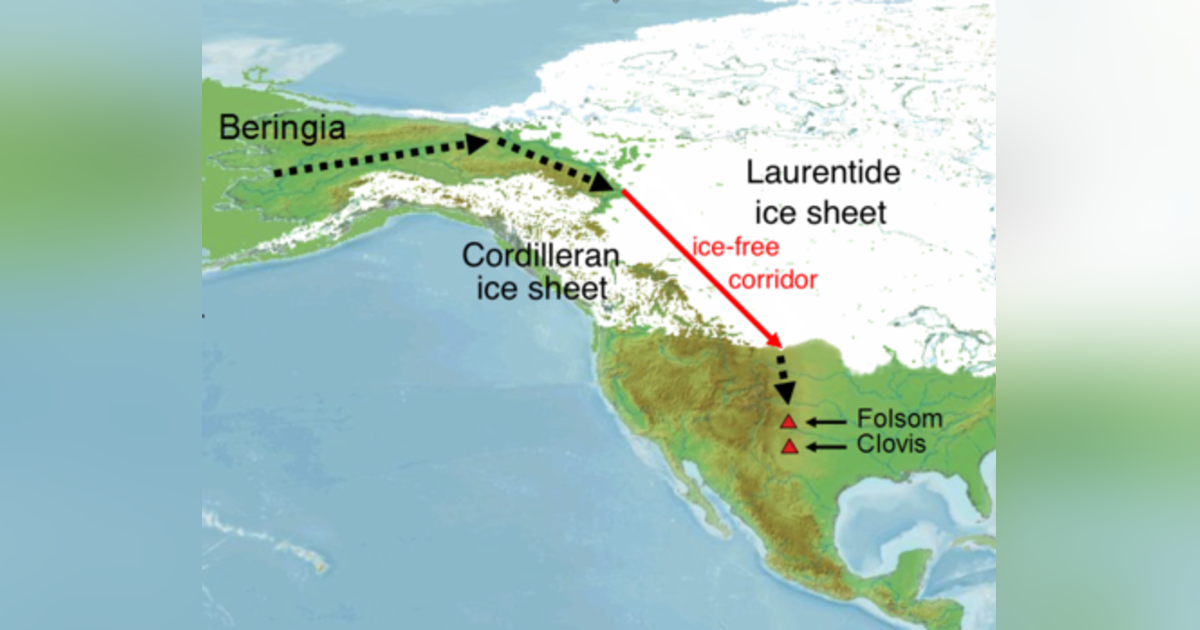
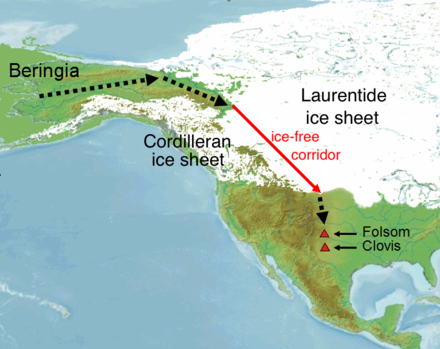
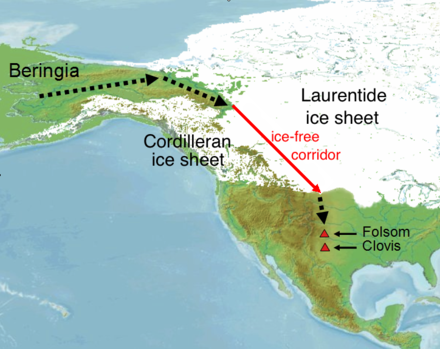
We live now in what is known as an interglacial period, when the glaciers and ice caps retreat for an uncertain time period, and during which almost all of human urban civilization and technological advancement has occurred. This began when the last glacial Maximum came to an end, sometime around 13,000 years ago. Right around then, there was a brief, brief in geological terms, a brief window of perhaps only one or two thousand years during which an ice-free land corridor would have opened between Alaska and Eastern Siberia.
These two land masses, Asia and America, would have been connected by land during all glacial periods, of course, but this land bridge was also usually completely covered in ice and totally uninhabitable. There would have literally been an ice wall many miles tall separating land passage from Asia into the Americas. And during fully interglacial periods, like now, the two land masses are separated by water.
However, studies of the ice and ground have shown that there would have been this short period when there was dry, ice-free land, connecting Asia and America, before rising seas reclaimed that land, and that there had been a corridor through the ice sheets in what is now Canada, leading into the rest of the North American continent.
So, the thinking was that this is when it must have happened. Ancient humans had migrated from Northeast Asia and populated the Americas during this geologically brief time period. And then, once temperatures rose a little more and Beringia, as the land bridge between Siberia and Alaska was called, Beringia was submerged in the sea.
Contact with Asia was lost and the people of the Americas continued on their own course culturally and genetically, cut off from Asia and Europe and Africa.
Now, if you already find yourself poking holes in this theory, just bear with me for the remainder of this episode. Even I, for one, as I immediately thought when I first heard this theory as a child, I thought, why couldn’t people have come over before in boats, following the shoreline? And why would they have stopped coming over, when the land masses were separated only by a few miles of water?
But I could imagine all this as a child because children have not absorbed the racism and other prejudices of the adult world. As forward-thinking as the proponents of the Beringia theory might have considered themselves, they could not see Native Americans and imagine them or their ancestors capable of such things. It was supposed that they could not have invented boats, but we have since learned that humans were using boats as early as 40 or 50 thousand years ago, and maybe before that, to reach Australia.
So really, this was not racism directed just at Native Americans, it was directed at all ancient humans, and we are all often guilty of this. We constantly imagine our ancestors as ignorant, knuckle-dragging primitives, and yet, every new discovery shows us that they were actually more resourceful and more intelligent than we are today, when we rely on technology to complete nearly every simple task.
So, yes, this Beringia theory has its flaws. But, as I said, I will get into alternate theories, including Native American views on the subject, in future episodes.
So, these people of Beringia, these Paleo-Americans, according to the theory, started to come over the land bridge some 13,000 years ago or maybe a little later. They followed big game, presumably woolly mammoths and mastodons and other megafauna of the ice age. And they found themselves in a land completely uninhabited by man.
They would have been the true discoverers of America.
(Music)
Why 13 or so thousands of years ago? Why did it take humans so long to find the Americas? Why not before? Humans, homo sapiens like ourselves, have been on the planet for hundreds of thousands of years. Recently, discoveries proved the presence of homo sapiens, who presumably originated in East Africa, having migrated as far west as the shores of Northwest Africa nearly 300,000 years ago. And we know that they reached Australia, by boat, at least 40,000 and maybe as long ago as 70,000 years ago.
You can find studies showing all sorts of movement of homo sapiens into places we didn’t previously suspect, in time periods much farther back than previously thought.
So why did it take us until just 13,000 years ago, according to the Beringia theory, to populate America?
One early school of thought suggested that it was not the difficulty of passing through Beringia which kept humans from finding their way into the Americas but rather the difficulty of even getting through Siberia first. It is a land and a climate unimaginable to most humans and remains very sparsely populated even today.
Now, before we get carried away buying into the latest headline about ancient humans presences in the Americas, we must remember that we don’t even have signs of humans in Japan until 40,000 years ago. And surely archaic humans in Asia would have reached Japan first, before expanding into Siberia and the Americas. So, in that sense, the traditional story of humans crossing the Bering land mass 13,000 years ago is pretty believable.
As to why we don’t see earlier hominids, such as Homo Erectus, coming this way and populating the American continents with species of great apes, Siberia presents the same barrier. To endure that land, even during this interglacial period, you must have control of fire and wear animal skins for protection and warmth and, of course, have regular access to food and water. Archaic humans may have been able to use fire for hundreds of thousands of years, but we don’t know that they had all the requisite capabilities to survive Siberian winter until much more recently.
So, even with the movement of homo sapiens throughout Africa and Asia and even Australia being much earlier than we thought before, the timeline of movement into the Americas through Beringia roughly thirteen thousand years ago, its still believable.
You have to not look at the map and just see space, when imagining the movements of our ancestors. You have to imagine also the terrain, the climate and other potential barriers.
What was it like, though, crossing this land, what scientists now call Beringia, a land that was then made of a portion of Siberia, some of Alaska and a lot of land now sunken beneath the waves?
We imagine that they followed the big game, large mammals such as mastodons and others. While the process of deglaciation may have begun even as early as 15,000 years ago, it would not have freed up passage into America in one instant. Instead, it was a process and human movement would have presumably progressed geographically with the viability of the new lands. As the land became viable for game and certain flora, humans would have followed.
In fact, modifications of the Beringia theory imagine a population of humans inhabiting Beringia before the ice-free corridor opened up, and being culturally and physically separate from the rest of East Asia, essentially becoming their own subset of the human genetic pool, over the course of a few thousand years, moving farther East into the Americas as the land permitted.
Because it was not like a huge corridor suddenly appeared one day though the ice, like Moses splitting the Red Sea. It would have taken centuries, probably, and anyway, the land connecting Asia and America here would not have been immediately inhabitable after the glaciers retreated. The newly exposed land would have been bare and unwelcoming even to basic plant life for some time, so even herds of game would not have been interested in moving over it because there would have been nothing to eat.
In fact, no matter how warm things got during this time period, Beringia was never a garden of Eden. Places like northern British Columbia, freed from the retreating ice cap, eventually became home to forestland, yes, but the tundra of Beringia was likely never more than a barely endurable, cold land, however much it may have been been home to a variety of shrubs, with succulent berry bushes and gorgeous flowers and herds of game passing under the bright arctic sun. This is known as the tundra biome. And however beautiful it may become at high summer it must yearly endure a frighteningly long, cold and brutal winter.
Nevertheless, the marine environment along the coast at this time may have been more plentiful and a source of food for human populations, even if they were itinerant.
But cold was really not the only source of danger. The rapid climate change of the period would have probably caused significant flooding from a turbulent sea. I am confident that our indomitable ancestors could have overcome these challenges, but their life would not have been idyllic in this environment.
Still, those hardy enough to cope with the challenges of this passage, they would have been drawn towards the end of the road, which, as it turned south into the Americas, would have presented an increasingly attractive environment, with bountiful game, tall trees, a more pleasant climate and milder winters and summers far more pleasant than the tundra of Beringia had ever given them.
(Music)
What would this have been like? This peopling of two entire contents? How long did it take? Why are there so many different native cultures today? So many languages? And what happened to the big game, to the woolly mammoths and the giant sloths?
First of all, it must have been a marvelous experience to be a part of. Two entire contents of land. Likely the Paleo-Americans of Beringia were already nomads, like all our most ancient ancestors, hunter-gatherers, living off the land and moving seasonally with the game.
In other regions of the world, though, where people lived all around you, inter-tribal conflict would have been a constant struggle. Disputes over territory, access to water, would have required difficult-to-manage pacts and alliances. Inevitably, sometimes disagreements would have turned into battles.
How marvelous it would have been for the Paleo-Americans, for many centuries probably. Every time that conflict brewed with another clan, another tribe, over land or water or game or any thing else, violence could be avoided simply by moving on to the next piece of uninhabited land.
This may seem like a strange digression, but violence avoidance is a major part of human interaction, one which we do not necessarily recognize as part of our various cultures.
In the ancient past, when you encountered a stranger, violence toward him made a great deal of sense. As did the fear that he would hurt you. Strangers, in your territory, were a threat, no matter how kind they might seem. They were eating your resources, drinking the fresh water you wanted your family to drink, picking fruits and nuts and digging up roots that you wanted to your children to have.
Everyone in your clan was part of your life-support system. Everyone not in your clan was a threat to that system.
So how did we avoid constant warfare? And make no mistake, no matter how nice you might think that you are, humans are born killers. Europeans, Africans, Asians, Americans. We are all descended from, and carry the genes of, casual killers. Men and women who could kill a stranger with no regret.
In Ken Burns’ documentary about the Vietnam War, Karl Marlantes, a marine veteran of that war, talk about the perception that Marine boot camp turns men into killers. Au contraire, he tells us, boot camp is just a finishing school. We’re born ready to kill.
After all, we are animals. This is not news.
But we also desire, deeply desire, to avoid that violence, if we can find a good reason to. Researchers like Jared Diamond have discussed different strategies people living according to more ancient ways in different parts of the world would use to find ways to turn meetings with strangers into peaceful encounters. One way is to establish an existing relationship with the person so encountered. You query about who they are married to, who they are a son or daughter of, and you find some way to connect them to yourself, to your own family, your own tribe.
We still do this today. The mother of my children is from the mountains of Copan, Honduras, where the people are largely Mayan Indians. And she would describe how people would meet on the roads and trails of the surrounding hills and immediately begin to inquire about relationships, and always establish some kind of connection, no matter how tenuous, before carrying on.
Oh, the conversation might go after a few such questions, you are the son of such and such woman, who married a friend of my 2nd cousin. And thus now we know each other and can carry on with less suspicion and mutual fear.
So even thousands of years later, we still meet one another and try to bring strangers into our family, we try to resolve ancient and even forgotten motives for violence.
Given all this, imagine how wonderful it was for the paleo-Americans. Plentiful game, and no need to allow conflicts to brew into violence. When things got tense within the tribe or with another clan or even another family member, you could just move on. There was always more open land, with no pre-existing, potential enemies already living on it.
In the Bible, in the 13th chapter of the book of Genesis, we actually see this same dynamic in play. Abraham and Lot are blood relatives and nomadic pastoralists, practically hunter-gatherers, living in the Near East close to some 4,000 years ago, but each leads his own large band of servants, slaves and family members. When they realize that their two clans are constantly in dispute, they coincidentally find themselves amid open land in southern Canaan, and they agree to part ways to avoid conflict, each clan taking separate, available land.
Proponents of the Beringia theory estimate that it probably only took one thousand years to populate the Americas, even though the original number of ice-age immigrants may have been small, just in the thousands or tens of thousands. And, with this violence avoidance in mind, it makes sense. People would have just resolved conflict by moving on. And populations, lacking the stresses of famine and violence, would have probably exploded.
For about a thousand years anyway. And then, the land was full, and people had to start learning again how to live to gather, how to form alliances, how to live in a land full of other humans, and how to succeed in competition with them.
(Music)
When humans are pressed like this, when they are challenged to overcome the limitations of environment and access to resources, they have always done so by advancing the technology. It is the key trait that distinguishes us from other animal populations. We are technological creatures, who use our tools to face and defeat obstacles in our lives. It is how we have avoided extinction when others have disappeared in history.
In the Americas, according to what is now known as the Clovis-first theory, the first technology that developed locally as a result these challenges was the Clovis spearpoint.
In 1929, a young man exploring in the New Mexico wilds discovered an ancient deposit of mammoth remains. Among the remains, he discovered some stone spearpoints that were quite distinct. When the site was dated, it was realized that the spearpoints were approximately 13,000 years old.
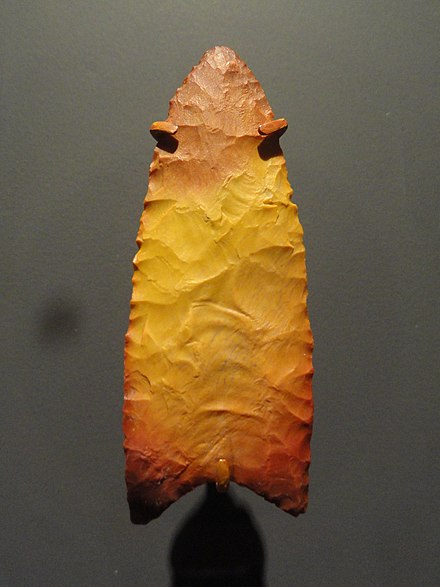
?What made them so distinct, so different than what archaeologists might have seen before? These spear heads, named Clovis points after the small town nearest their discovery, bear a particular appearance and shape. I have posted examples on the page for this episode on the website, western-traditions.org.
Clovis points, typically made from chert, are large, usually close to four inches in length and two inches wide. Each of the two faces of the spear head are flaked to achieve sharpness, and the base of the blade is fluted on both sides. Fluted means that the base is flaked specially so that it can be inserted into a haft, or rather, so that a spear can grip it. Again, look at the picture on the website for a better understanding.
Now, it is not that Clovis was such a spectacular spear point that makes it stand out or makes it of special interest to archaeologists. What makes it so interesting is that we have since discovered the exact same style, or lithic tradition, used to make spears throughout north america, and even in portions of south america, starting before 11,000 BC and lasting for over a thousand years.
In other words, people are not just spread around the Americas and each group coming up with their own ideas for spear points.
You might think to yourself, what’s the big deal, a spear point is a spear point, how different could they be? Well, if you look at spears made around the world, in different eras, you will see how each region and culture has their own particular approach to the work of producing blades and spear heads. The Clovis discoveries show that Paleo-Americans, even as spread out around the Americas as they were, they shared a common technological and stylistic background.
Which is also strongly suggestive of the very scenario that the Beringia theory suggests. That a single culture crossed over from Asia and populated most of North and South America in a matter of centuries. And that this single culture, among other things, shared a particular style of weapon fashioning. Eventually, after a few thousand years, archaeologists see that the techniques involved in making spear heads change, as the single culture of the earliest Paleo-Americans becomes spread out and each tribe begins to distinguish themselves from one another, and possibly as a new wave of immigrants comes into the land. So the technology changes.
By ten thousand years ago then, in North America, the Clovis point had disappeared and was replaced by newer styles of flaking and fluting spear blades. The Folsom point is one example. I have placed a photo of a Folsom point on the website as well, so that you can see the stylistic changes, how the Folsom point, for example, delays narrowing toward the tip until much farther along the blade than the typical Clovis point.
With the passage of more time, the tools and weapons of each region of the Americas begin to take on their own, individual styles and characteristics. But in that first couple thousand years or so, after the opening of the Bering Land Bridge, the Clovis point was the only weapon in style, so to speak, according to this theory. And this interpretation of events also led to the creation of the Clovis-first theory, which essentially declared that the people of the Clovis technology were the first inhabitants of the Americas.
What was the Clovis point for, with its long, deadly blade? This size of weapon would be overkill for hunting deer, rabbits and so on. Surely, the Clovis point was intended as a lethal weapon in the hunting of megafauna.
(Music)
Megafauna. That is the scientific term for big game. When you say big game now, you might think of rhinos or elephants in Africa. But megafauna, in general, means really big game. The kind of big game that is mostly extinct now: woolly mammoths, giant ground sloths, mastodons and so on. The American Bison is probably the only survivor of this period and it is one of the smaller animals in this category.
As far as we can tell, creatures such as the woolly mammoth went extinct in the Americas about 10,000 years or so ago. Isolated populations appear to have survived elsewhere in the world until only a few thousand years ago, and there are some controversial findings right now in 2024 that suggest that there may have been large living populations in parts of Eurasia and America until roughly 6000 years ago, but that is unsubstantiated as of yet.
Regardless, for many years, it was assumed that the mammoths and the other megafauna, including the saber-tooth tiger, the giant ground sloth, the mastodon and others, it was assumed that they went extinct about 10,000 years ago. And this tied in nicely with the Beringia theory and with the Clovis-first theory.
We now had a nice, neat picture.
About 13,000 years ago, humans, belonging to a single culture, moved through the ice-corridor from Beringia into North America, either bringing with them or developing their Clovis spearpoints in response to the new environment that they encountered. Then, as they expanded their population and moved through North America into South America, they wiped out the megafauna, and then began a long, slow transition into agricultural civilization. They had not quite transitioned, therefore, out of the stone age when they were nearly wiped out by their encounter with Europeans.
Over the years, new discoveries have both supported and contradicted this imagining of the peopling of the americas.
Important contributions in this area have come both from the study of DNA and the study of linguistics.
Linguistics has shown that there are in fact, clear connections between languages spoken in northern Siberia and certain modern native American languages, in particular languages spoken by the Na-Dene cultures, such as the Apache and the Navajo.
And the DNA evidence is very convincing as well. The DNA of modern Native Americans bears strong signals of East Asian connections.
All this makes sense and supports the Beringia theory, and the Beringia theory, contrary to popular belief, is not dead yet. In modified, augmented form, it still has great support among professionals in this area of study.
However, there are increasing defects in this theory, especially in its exclusive form, that is to say, the idea that the Bering Land Bridge is the only route of entry into the Americas for the paleo-Americans, that they came in roughly 13,000 years ago, that they all possessed Clovis culture and technology and that only one population wave entered before Beringia sunk beneath the seas of a warming world and left the Paleo-Americans in their own, completely separate genetic and technological pool for some 10 or 11,000 years.
But we have since discovered tools and signs of inhabitation from prior to 13,000 years ago. At Monte Verde, at the southern extreme of South America, we have discovered ruins and signs of megafauna hunting at least a thousand years older than the earliest Clovis point discoveries. And footprints of ancient humans discovered recently in New Mexico have proven to be some 20,000 or more years old.
But DNA studies now also show intriguing mixtures of gene types only found in Island people of the South Pacific. And these traces of DNA are found not on the coast but deep in the Amazon jungle.
But the coastline exposed during the end of the last glacial maximum, which would have possibly been an ideal environment for a marine culture, is now beneath several hundred feet of ocean and possibly hiding signs of settlements much older than Clovis.
But Woolly mammoths and other megafauna also went extinct at exactly the same time in Europe and Asia as they did in the Americas. So how could this have been the result of the arrival of the Paleo-Americans with their Clovis points?
But spear points in Europe, developed by the Solutrean culture some 20,000 years ago, bear striking resemblance to Clovis points.
But, it is hard to believe that just being separated by a few miles of water would have cut off communication and trade between Siberia and Alaska. Already, we know that the Yupik peoples had settled both sides of the Bering trait by 3,000 years ago and remained in contact, so it seems clear that there was probably an ongoing connection, commercial and cultural and biological, between Asia and America.
The list of exceptions goes on and on and, increasingly, proponents of the Beringia theory have to perform a juggling act to maintain the believability of their hypothesis.
Future episodes in this sequence will address these newer ideas about the peopling of the Americas.
Until that next episode then, I thank you for listening to the Western Traditions Podcast.
(Music)