Episode III.18 - The Second Punic War IV: The Deadlock Years


The Second Punic War spreads into Greece, Sicily, Africa and Spain. The Illyrian Wars and the Macedonian Wars break out. Fabius and Marcellus are not alone among the men who come forward to serve Rome in this moment of need. Publius Cornelius Scipio dies fighting deep in Carthaginian territory in Spain. His son, who will someday become known simply as Scipio Africanus, is sent to salvage Roman security in the region.
(Music)
-The Romans were most to be feared when they stood in real danger.”
A quote from Polybius, author of the Rise of the Roman Empire
(Music)
Hello and welcome to the Western Traditions Podcast. My name is Rob Paxton and this is the
eighteenth episode of the Roman Empire, a series about Ancient Roman history.
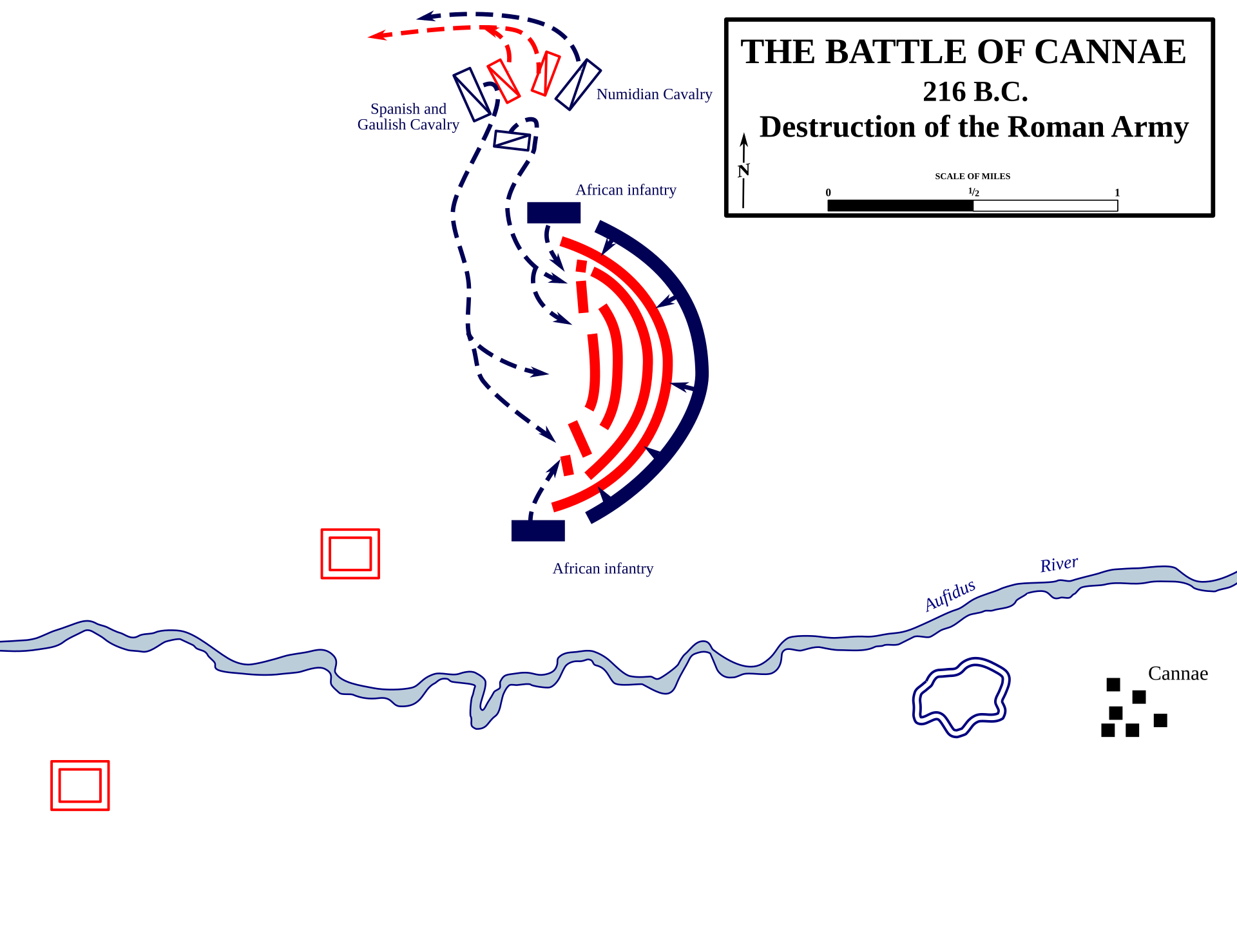
So far, we have come to the year 216 BC and the disastrous defeat of the Roman legions at the
battle of Cannae. Given the amount of danger that Rome was in at that juncture, one might
have easily expected a capitulation of some sort, for Rome to ask for terms of peace, perhaps.
Certainly, the Carthaginian mind would go in that direction. After so many battlefield losses,
and the presence of a powerful enemy army just a short march from Rome, it made sense to
negotiate a peace, to surrender far away territories, like those in Spain, for instance, in
exchange for safety.
This, in fact, is essentially what Carthage had done decades ago at the end of the First Punic
War. In the last year of that conflict, Rome had been everywhere victorious and, though she did
not have an army near Carthage itself, that had not been not a far-off prospect with Carthage’s
navy scattered and her army stranded in Sicily.
So Carthage had swallowed her pride and negotiated a humiliating peace in order to survive.
So, again, it made a kind of sense to think that Rome would do the same.
But that also betrays a lack of understanding, a lack of learning. If there is anything that one
learns from the history of Rome, it is that Romans do not give up easily.
Some historians have looked back on that year, 216 BC, and additionally criticized Hannibal for
failing to take advantage of the moment. Supremely victorious in the field, Rome’s largest army
crushed, and Rome just a short distance away, Hannibal chose not to march on the enemy
capital, chose not to besiege Rome. One of his cavalry commanders, by the name of Maharbal,
lamented this lost opportunity as soon as Hannibal announced his decision to avoid the siege
of Rome.
“You, Hannibal, know how to win a victory,” Maharbal sadly commented, “But you do not
know how to use one.”
A critical point-of-view suggests that Hannibal lost his nerve here and failed to deliver the
knock-out punch required to finally win the war. Will Durant comments that the entire city of
Rome was in a delirious panic for about a month and, had Hannibal marched on it right away,
he might have won that much-desired capitulation from the Roman Senate.
But there are also at least a couple good reasons to think otherwise, and to sympathize
somewhat with Hannibal’s dilemma.
First of all, the Carthaginian warlord did not have siege equipment, not the kind he would have
need to besiege a city like Rome. It was one thing to surround and assail a small, walled-town
in the hinterlands of Italy. It was quite another to besiege Rome, a city that had now becomeone of the world’s metropolises. So any direct move against Rome would have been doomed
in that respect.
Secondly, Hannibal had probably been a little alarmed by the failure of the Italian countryside to
rally to his cause, and to abandon alliances with Rome. All through 217 and 216 BC, he had
been expecting to hear more about uprisings across the land, and to receive envoys from
random parts of Italy, pleading with him for assistance in throwing off the shackles of Rome.
In that moment after the victory at Cannae, he had as yet not received many such offers. For
the first two years of the war, the Latin allies of Rome had been quietly watching Rome fail in
battle. It was not enough for the Romans to fail once or even twice. They had done so in the
First Punic War, and had always managed to pull through, and God help the traitors whom she
discovered when things eventually turned back her way. No, if the allies and subjects of Rome
were to give her up, they had to be sure that Rome was going down this time.
So, for two years, Hannibal surely had been impressed with the idea that nothing could pull
other cities away from the clutches of Rome, and that to take his army within reach of that
great city, which still had its defenders, while Rome’s allies looked on only in curiosity, would
be to risk the complete destruction of his army.
Alas, for Hannibal, he did not live in an age of faster communication. Because it was this
victory at Cannae that began to pry allies away from Rome, but he would not know that right
away. As he wintered, and 216 BC became 215 BC, he began to receive embassies, some
from far away, from Greece even. People were now finally willing to risk Rome’s wrath because
it seemed like a suitable champion for their cause had come.
There, in Apulia, in southeastern Italy, Hannibal possibly rued his conservative turn immediately
after the battle, and he must have pondered Maharbal’s words, that he knew how to win a
victory but not how to use one.
His regret probably entertained more than one cause. He was getting older. Now in his thirties,
he was in the prime of life for this venture. Alexander the Great had conquered the world by
this age, and he, Hannibal, had yet to truly conquer anything.
But he was also getting worn down. He had lost an eye due to some ill-described illness that
had afflicted him that momentous year, when he had no time listen to his physicians and to rest
and heal, and so he had lost all vision in the eye.
Still, perhaps he had missed his moment. But there might be others. Rome had, unfortunately,
already had time to regroup by the winter that brought the new year, 215 BC. But Hannibal was
acquiring new allies. Ambassadors from all over were approaching him with offers of alliance.
His troops were resting. And by capturing cities on the Adriatic coast, he had re-established
direct communication with Carthage by sea.
Even now have he might be finally acquiring the means with which to bring down Rome, his
ancestral enemy, against whom he had once sworn a blood oath to Baal-Hammon, alongside
his now-deceased father.
As it turned out out, though, the next five years were going to be disappointing for everyone
involved in this bloody struggle for domination of the West.
(Music)Rome had certainly not given up. The Second Punic War is not so much a story of a Rome that
conquers, but rather a story of a Rome that struggles and overcomes. Never since Rome’s first
appearance in the annals of history had the city been so endangered, unless the legend about
the Sabines breaching the walls in the 7th century BC was more than just an inspiring story.
First of all, Rome’s losses were immense. After Cannae, the total wartime casualties were now
well beyond a hundred thousand, in killed, wounded and captured. This total would have easily
constituted a fifth or more of the adult men in Rome and in the cities of her allies. No wonder
the populace of the city was delirious with terror after the loss at Cannae. The flower of her
manhood bleeding out across the expanse of Italy.
But amid the terror, and even immersed certainly in the guilt surrounding his poor judgement
and performance at Cannae, the defeated consul Varro did not stop being consul. He rallied
the remnants of his forces, maybe ten or fifteen thousand men of disparate formations and
units, and kept watch on Hannibal’s victorious army. He did not leave his post, until the Senate
had sent Marcellus to replace him.
At this juncture in the histories of Rome, I am struck again by the oligarchy of competence that
the Romans maintained. What I mean is this: in any other culture, when a man like Marcellus
or Fabius came forward and achieved great victories, we generally see him move to the throne
and rule over a city-state until he dies, whether of age, or in an assassination or in combat. And
then the cycle repeats with another powerful man assuming his place.
But Rome kept a corral of such men and simply rotated them in and out of power. Consider
that Fabius had been dictator now twice, but at the time of the battle of Cannae, he was just
another Senator. Now, yes, he was definitely an influential senator and a power to be reckoned
with, but he did not hold, nor did he seem to vie for, supreme power.
Consider Marcellus. We learned in a previous episode about his spolia opima. He was the last
Roman to ever achieve this nearly unique accomplishment, to rule as consul and
simultaneously kill an enemy king in personal combat and to be feted in a triumph
memorializing the occasion. Yet, after this high point, he had returned to the ranks of the
Senate, to await his next opportunity to serve Rome. And now he came forward, to once again
rescue his people.
But make no mistake, and this may be a spoiler for you, Marcellus does not go on to become
dictator or king in Rome. He will serve nobly in this war, on more than one occasion, but he will
never grasp for total power. Neither will any of the other great men who serve Rome during this
war.
Was this all done out of genuine patriotism, these sacrifices for Rome, or was it an ingenious
part of Rome’s political system, which enabled it to reap the befits of service from great and
charismatic men without suffering their tyranny?
Perhaps these men truly did love Rome and her society so much that they refused to turn their
battle achievements into popular support for their own ascension to tyrannical power. But the
Senate’s collective fear of monarchy probably did much to deter anyone’s aspiration for a
permanent dictatorship. Each man knew that his peers would never tolerate his own mastery.
Each noble and senator of Rome cherished his own independence, and knew that his
colleagues individually also cherished their own, and thus all knew that reaching for the crown
would result in his death.Fast forward to the death of Julius Caesar nearly two hundred years later, and perhaps you will
see how lasting, how serious, and how ingrained, this fear of monarchy was.
However you view the situation, it is just remarkable that Rome could just pull out of the
cupboard random men who could rise to a situation, rescue the city, and then quietly accept
being sidelined for years to come, as consul, as censor, as praetor, governor, general, high
priest, and so on.
In fact, at this critical moment, after Cannae, the Senate neither turned to Marcellus nor to
Fabius or any other great man among them. Fabius went on pulling strings in Rome, Marcellus
rescued the army, but it was Marcus Junius Pera who was made dictator. The dictatorship,
you see, required only a competent man, not a genius like Hannibal, or a man practically cut
from legend, like Marcellus, in order for the position to serve Rome’s needs.
Pera scrapped together four fresh legions in the aftermath of Cannae. He recruited underage
boys, he freed 8,000 slaves in exchange for their military service, he even forgave debts and
criminal punishments if a man would step forward and serve the nation. As dictator, he could
ramrod these decisions through the legislative process that would have otherwise balked and
hesitated, held back by special interests and ulterior motives.
But either by necessity or by choice, the doctrine of Fabianism in warfare, in Italy at least,
continued in use. No direct battle with Hannibal would be sought. The young boys, the slaves
and the criminals drafted into the army were meant for defense in extreme necessity. They
were not meant to march in disciplined formation and launch an offensive against Hannibal’s
veteran soldiers.
But there was more to Fabianism than just a hesitant approach to warfare. In fact, Fabianism
was part of a growing conservatism in Rome, perhaps in response to the advent of all the
Novus Homos, the new men, of the recent generations.
In the last ten years of history, since 225 BC, only five new families had been admitted into the
nobility. The doors of opportunity for the upper middle and merchant classes were closing
again. Many historians mark this epoch of Roman history as the beginning of the so-called
Ciceronian republic era of Rome, during which the Republic abides as a conservative society,
strongly aristocratic, with a highly-structured class system and ruled over by a Senate that
reigned supreme.
But this is also a generalization which requires a lot of qualifications. Roman society had been
conservative in nature before. Like most Western societies, it went through social pendulum
swings, from one ideology to another, and, in particular, from conservatism to liberalism. As the
appearance of the Novus homos among the Senators demonstrates, there had been a recent
period of opening to new possibilities and viewpoints among the leadership of Rome.
Now the pendulum was simply swinging back.
But to state that the Ciceronian republic would continue for centuries, down to the time of
Cicero, is also to overgeneralize. Obviously, with the recent combat losses among the senators,
it might be necessary to revisit the idea of new admissions to the nobility in the near future. In
fact, one of the first matters to be reviewed by the government of Rome, after securing the
defense of the city in 216 BC, was to fill the 177 vacancies in the Senate which had
accumulated since the start of the war,
most of those senatorial seats emptied by men now dead on a battlefield somewhere.The following century of Roman history would also see many popular uprisings and social
instability, so we will see just how well the “Ciceronian republic” weathered those storms.
Nevertheless, getting back to the Second Punic War, Fabius Maximus was ascendant. Even
more so as Cannae did not prove to be the last military disaster that year. The Boii, the Gaulic
tribe in the far north of Italy, against whom the Romans had been at war for many years now,
they were inspired by Hannibal’s success and they massacred an entire force of 25,000 more
Roman and allied soldiers. The newly elected consul in charge of that army, Lucius Postumius
Albinus, was killed in the battle. The Boii decapitated his corpse and covered his skull in
molten gold. The king of the Boii would use it as a celebratory drinking cup for years to come.
But the war was not contained to Italy, though it’s greatest dramas had occurred there in the
opening years of the conflict. As the war dragged on Rome had to engage various enemies on
different battlefields.
We will begin a review of these other theaters in the war by looking at matters as they stood in
Greece.
(Music)
Even prior to the officially recognized start of the Second Punic War, Rome had become
involved in Greek politics. In a previous episode, I alluded to how Rome, after the First Punic
War, began engaging directly in political matters among the Greeks living along the opposing
Adriatic coastline from Southern Italy. This was, in may ways, only natural, since Rome only
solidified their control of southeastern Italy through events in that earlier war and now, for the
first time, had reason to contact these Greek city-states across the Adriatic Sea.
But, they initiated this contact in a very ambitious, Roman way. Soon, the Romans achieved
naval supremacy in these waters and became allies with some of the various powers in the
region. The purpose behind these alliances, though, was very much imperial. Rome wasted no
time in attempting to vie for supreme power. These alliances with whichever power, the
Achaean League. The Spartans, the Illyrians, all had one purpose: to defy the King of
Macedon.
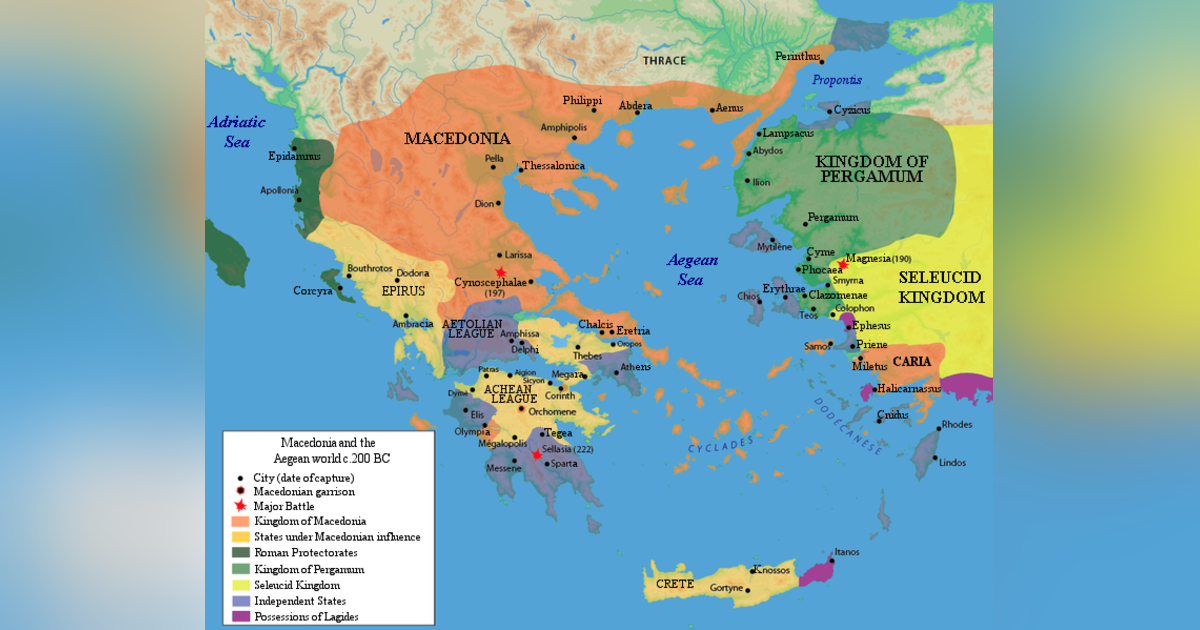
The Kingdom of Macedon was a political descendant of the kingdom of Alexander the Great.
He had conquered the entire Persian Empire and added it to his demesne but, after his death in
323 BC, Alexander’s generals had carved the empire up into several personal realms. By 306
BC, the Kingdom of Macedon was established by Antigonus, a Macedonian general who had
served under Alexander. This realm basically consisted of the older Macedonia over which
Phillip II had ruled, along with many nearby territorial additions.
The history of the dynasty established by Antigonus is as troubled as any Greek history.
Nevertheless, by the time of Rome’s involvement in Greek affairs nearly a century later, the
descendants of Antigonus were still in charge, and always trying to assume control over other
parts of Greece, which had since broken away.
There were numerous break-away realms in Greece by this time, among them the Achaean
League, the Aeolian League, the kingdom of Illyria, from whence had come Alexander’s mother,
Athens of course, and also Sparta, which had regained its independence after Alexander’s
death.Polybius devotes many pages to these events in Greece, and to the development of the
Achaean League. This makes sense because Polybius was a Greek from a city in the Achaean
League, so he naturally is able to provide a great deal of commentary and detail about these
matters.
I myself have considered adding another episode to the Greek Sun, my podcast series about
ancient Greece, which would focus on the Achaean League. It is a fascinating political and
military drama. Someday, I may add such an episode to that series as a coda, but, for the
moment, it is sufficient to know that the appearance of the Romans in Greece marks the
beginning of the end of the history of these squabbling successors to Alexander.
However, Polybius’ description of the Illyrian Wars does a great job of characterizing Roman
political and military attitudes. By 229 BC, a decade before the Second Punic War, Rome had
become heavily involved commercially and diplomatically with the Greek states along the
Adriatic coast, essentially where today we find the modern nation of Albania.
The Illyrian peoples had a long history of piracy. Independent seamen from Illyria would set out
and raid trading vessels crossing the Adriatic and the government of Illyria typically did little
about this. At this time, in 229 BC, Illyria was ruled by a Queen by the name of Teuta, a
famously fierce woman, and fierce she would have to have been to rule over a nation of such
wily and aggressive men.
Anyway, the long and short of it is that the Romans sent envoys to this Queen Teuta to
complain of this piracy and to seek rectification of the situation. The Queen declared that it
was not the custom of the Illyrian kingdom to control the activities of its private citizens. In
other words, the Roman Republic had an issue with private citizens of Illyria, not with her or
with her kingdom.
One of the Roman ambassadors responded thus:
"Queen Teuta, the Romans have an excellent tradition, which is that the state should concern
itself with punishing those who commit private wrongs, and with helping those who suffer
them. With the gods’ help we shall do our best to make you reform the dealings of the Kings of
Illyria with their subjects.”
This enraged the Queen. In response, as the ambassadors were on their way back to their
ships, she sent men to assassinate them.
Big mistake. Perhaps, as a Greek, she was thinking that the Romans might only reply in a tit-
for-tat fashion, killing some Illyrians or sinking one of their ships, etc, or simply escalating the
situation a little bit.
But that’s not how the Romans roll.
When the Senate heard about all this, they immediately declared war and called for the
recruitment of additional legions to invade Illyria and organized hundreds of ships for the
attack. The end result of it all was the First Illyrian War. Teuta was sent into exile, and the
Romans established a “protectorate” over several coastal cities on the eastern side of the
Adriatic, placing garrisons in several places. One of those places, by the way, was the city of
Epidamnus, which was the location in which the Peloponnesian War got started.
Anyway, Teuta eventually bought her own safety by paying the Romans off and giving up much
of her territory.The continuing saga in this area is long and complicated and we will avoid it for the purposes
of this podcast. If the nitty-gritty of it all intrigues you, read the third book of Polybius’ history of
the Rise of the Roman Empire.
Rome, though, having established a foothold in Greece, would never retreat. Her involvement
would continue throughout the Second Punic War as well, until the eruption of the First
Macedonian War.
Naturally, Rome came into conflict with the kingdom of Macedon, whose rulers aspired always
to resume something of their past glory and acquire dominion over more of Greece, and who
were at constant war with one or more of the other realms in Greece.
Enter Philip V, King of Macedon. Even when Rome had only begun to suffer at Hannibal’s
hands, even before Cannae, this aspirant to glory, who bore the name of Alexander’s father,
had plotted to take advantage of Rome’s distraction and seize territory from her in Greece.
Earlier in the episode, I mentioned ambassadors arriving at Hannibal’s camp in Italy after
Cannae. Phillip’s envoys were among them. There was agreement in principle between the
two powers, Carthage and Macedon, in their hatred of Rome, but little coordination, Phillip had
no plans to invade far-away Italy and fight alongside Hannibal.
But, Phillip soon invaded Illyria by sea, and set a challenge for the Senators of Rome, who
were mostly concerned about kicking Hannibal out of Italy, but also did not desire to lose any
of their overseas dominions. A grueling, low-intensity war continued in Greece for many years
as a result. The Romans made alliances with various Greek city-states, such as Sparta, and
dueled with Macedon for many years. The conclusion of that conflict I leave for a future
episode, when I bring the history of the Second Punic War to a close.
Now, all of this may seem like a distraction from the greater story about the conflict between
Rome and Carthage. But I refer you again to previous statements that I have made about the
Punic Wars.
Rome and Carthage were two big fish in a small pond. Not small geographically, but small
culturally and financially. True, Western Europe would someday be the locus of culture and
wealth, but that future was still close to two thousand years away. It is important to remember
this to maintain that perspective. The West is, at the time of the Second Punic War, a
backwater when compared to the East. There is a reason why Alexander’s first goal was to
conquer Persia. Because Persia controlled the vast majority of the world’s wealth, even if it
did not control the actual geography of the world. Conquering the West was an unfulfilled
afterthought for Alexander because this would have amounted to conquering little more than
territory.
So, Rome’s interest in Greece is long-sighted. They knew that they must defeat Carthage in
order to survive. But after ensuring their survival in the West, the road to vast wealth lay
Eastward. The Greek mainland is wealthy in many respects, but it is Greeks also who control
Egypt, under the Ptolemies, and most of the Near East under the Seleucid Empire.
But conquering Greece and Greek-ruled territories is something that will take the better part of
the next two centuries. This first Macedonian War that broke out in 214 BC, would end not in
the conquest of significant portions of Greece, but rather in a peace pact. Still, it was the next
step in taking over Greece.Because once the Romans are on your doorstep…
In the meantime, though, let us turn our eyes back westward, and see how the war developed
in Sicily and Africa in the years immediately after the terrible losses at Trasimene, and Cannae.
(Music)
Sicily. For nearly four decades, since the very beginning of the First Punic War, King Hiero of
Syracuse had been Rome’ strongest ally. He had concluded a pact with the Romans, after
beginning that war as one of their enemies, and had stayed remarkably true ever since. By the
end of the First Punic war, the rest of Sicily had come under Rome’s power. The island had
become a literal breadbasket for Rome, supplying her with the grain needed to feed her people
and her legions.
But, in 215 BC, when Rome was still trying to rally mainland Italy against the invader Hannibal,
and to retain her league of allies and subject-states, Hiero died. His son having already
preceded him in death, the powers in Syracuse rallied around his grandson. And they rallied to
the cause of rebellion, and alliance with Carthage. Not all of Sicily went over to the
Carthaginians, but, if Syracuse was allowed to escape Rome’s embrace without repercussions,
it was obvious that the rest of the island would soon go.
The factionalism that was going on inside Syracuse was a complicated as any that you hear
about in any ancient Greek city. Without going into detail, I will only note that, while the city
was preparing to resist Rome, the new young king, the teenage grandson of Hiero, was
assassinated by a republican faction which vied against the monarchist factions in the city. The
internal disorder that followed in Syracuse may have given Rome the time she needed to
respond to the worsening situation in Sicily.
Again, one is amazed at Roman survival here. Everything was going wrong. Hannibal roamed
southern Italy freely, ransacking and pillaging, and receiving city after city into his cause, the
legions were caught up in overseas battles in Greece and Spain, and now the most important
resource in Italy’s empire, her food sources in Sicily, were being wrenched away from her by
sedition.
Possibly the Senate of Rome understood what Pericles had told the Athenians centuries
before. They could no longer simply put down the crown, could no longer simply relinquish the
empire and return to being a minor republic in central Italy.
Their choice was between ruling an empire, or becoming slaves.
So Rome did what Rome always did best. Punch back harder. They ordered Marcellus, the
great hero of the decade before, to leave Italy as well-defended as possible against marauding
Hannibal, and to organize forces to head south into Sicily and bring it back into Roman
possession.
This was no easy feat because most of Southern Italy had now gone over to Hannibal. Places
like Capua, a city on the same coast as Rome and only about 120 miles away. This large,
prosperous city was one of the jewels in Hannibal’s new crown as resistance leader.
Thus it took Marcellus until 213 BC to reach and besiege the city of Syracuse, after brushing
aside the Syracusan army.Until this point, Carthage had amazingly not bothered to intervene. The Carthaginians
welcomed the betrayal of one of Rome’s most integral allies, but didn’t bother to rush in and
support this new territorial gain. Instead, they waited until Marcellus had already besieged the
city to marshal a new army under the general Himilco and send it to Sicily to relieve the siege.
Marcellus battled this enemy army while maintaining the siege of Syracuse and then Himilco,
with a characteristic Carthaginian inability to see the crux of the matter in military situations, set
off to conquer the rest of the island, thinking perhaps that Syracuse would hold on until he
could bring the resources and manpower of the rest of Sicily to bear on the besieging Romans.
But the Romans knew what came first. Possession of Syracuse as a secure base from which to
operate would soon bring back all of Sicily under their control. So they dug in and plotted and
watched. Seaborne attempts at infiltration failed due to the presence of the Greek
mathematical and engineering genius Archimedes, who lived in Syracuse and designed a
number of ingenious machines and techniques to defend his home city.
The reports that have survived about his inventions are sometimes hard to believe, such as a
giant lever and claw that reached down from the sea walls to pick up attacking Roman ships
and cast them down to their destruction or a heat ray created using mirrors to literally set fire to
enemy ships and sailors. Down through the years, researchers of all kinds have attempted to
theorize or even replicate how Archimedes might have devised such miraculous defenses.
Nevertheless, Roman tenacity won out. In 212 BC, Marcellus found an opportunity to scale a
lightly-guarded portion of the walls of Syracuse during an important festival inside the city.
Anyone who has listened to my Greek Sun series knows how important such religious festivals
were to the Greeks, and how often their celebration complicated their own efforts to defend
themselves. History repeated itself here. Marcellus’ men scaled the walls and captured the
Epipolae, a plateau within the walls and above the city proper. From there, it was easy to seize
the rest of the city.
It is said that Marcellus wept as he looked down on the streets of the city below and knew that
he would not be able to restrain his men, who had fought and gone hungry and survived
disease for years and were now set to unleash their pent-up frustrations on the populace. He
gave orders limiting the massacre but to little avail. Especially, he ordered that Archimedes
should be preserved, but that brilliant Greek was also murdered in the sacking of the city.
The Carthaginians would soon come and camp outside the walls in an attempt to besiege the
Romans who were now inside the city. But the victory at Syracuse was not simply a territorial
addition in war. It was a morale booster as well. Though the Carthaginians, in a classic example
of too-little, too-late, now poured more forces into Sicily, by 210 BC, the Romans were back
in complete control of the island.
Just across the sea from Sicily, tantalizingly close, was the Carthaginian homeland. Rome had
devised typically ambitious plans at the beginning of the war to immediately invade Africa and
teach the Carthaginians a harsh lesson. The series of immediate disasters in northern Italy,
though, had forced the Senate to redirect troops to fight for the very homeland of Rome
instead.
So Rome’s grand plans for Africa did not come to fruition, not yet. During these middle,
deadlock years of the war, though, the Roman Senate did not completely forget about
possibilities in Carthage’s homeland. They encouraged the Numidians on the borders of
Carthage to seize the opportunity to turn on their oppressive neighbor. In 213 BC, Syphax, aNumidian king, openly allied with Rome and set off an African war. Syphax received some
Roman support in the form of a military advisor to help train his soldiers to fight Carthage.
It's a move that sounds exactly like some modern-day proxy war, in which “advisers” train and
supply local troops as part of a greater, global war.
So the war effort staggered on in Greece, in Sicily and in Africa, with few clear victories, for
several years. In Spain, though, the Romans were unknowingly brewing a new kind of formula
for war, and cultivating an army and a general who would find the way to finally defeat the
Carthaginians.
(Music)
You might recall how I described the beginning of this war and Hannibal’s invasion of Italy, how
Hannibal was first detected by a consular army under Publius Cornelius Scipio at the river
Rhone, and how Scipio then sent his army on to Spain, it’s original intended destination, while
he himself retuned to Italy to prepare for Hannibal’s invasion.
Let’s get back, now, to that army which Scipio sent on to Spain. Commanded by Scipio’s
brother, Gnaeus Cornelius Scipio, this army landed in northeast Iberia and made alliances with
local tribes, some of whom were certainly still upset about Hannibal’s rampage through their
territory on his way to southern Gaul. Over the next few years, things went back and forth in
Spain, but even stalemate there was positive for Rome. Whatever kept Hasdrubal from
reinforcing his brother Hannibal in Italy was a good thing, as far as Rome was concerned.
Victory in Spain was desirable, of course, but not necessary. So long as the conflict continued
there, it allowed the Senate to focus on saving the Roman heartland.
After Publius Cornelius Scipio recovered from the wounds he had suffered fighting Hannibal in
218 BC, he went on to Spain and resumed command of the army he had originally been
intended to lead. The military stalemate endured until 215 BC, each side possessing roughly
25,000 soldiers of all kind, just to give you an idea of the forces involved. Definitely a side-
theater of the war, you might think.
But that year, the Scipio brothers soundly defeated Hasdrubal and scattered his army.
Hannibal’s brother escaped the battle, and sent an appeal to Carthage for more troops. And
so, while Hannibal lingered on initially with virtually no support from home, Carthage sent to
Spain Mago Barca, another younger brother of Hannibal’s, along with nearly 15,000 infantry,
cavalry and elephants, as well as 1,000 talents of silver to fund the recruitment of local
mercenaries.
Spain, as the source of Carthage’s silver, was much more important to the Carthaginian rulers
than victory in Italy, even though such a victory in Italy would have ensured them all the wealth
of the West in the long run.
You may shake your head at such obtuseness, but remember that you live today surrounded
by such examples, in a world where both governments and corporations chase after short-term
gains and profits at the expense of their long-term survival. Carthage’s management of the war
really should not surprise us. It was very predictably human. It is Rome’s ability to overcome
such human failings, to think in terms of long-term survival rather than immediate satisfaction,
which should astonish us.
But, these reinforcements did save Spain for Carthage. Hasdrubal and his brother Mago
managed to hold on to Southern Spain with these reinforcements. In the coming years, theBarca brothers would receive more reinforcements, and so would the Scipio brothers. Both
sides suffered, however, from varying levels of lack of support.
Both navies, Carthaginian and Roman, for instance, were hard-pressed to find sailors and to
build ships, such were the demands that the war was making on their populations and
resources. Rome was now manning skeleton fleets in a handful of theaters, Greece, the
Adriatic, the waters around Sicily, around Sardinia and Corsica, where rebellions threatened
constantly, and along the coast of Spain. As it was, there were no great fleet battles during this
period. The Carthaginian fleet that brought reinforcements to Mago could not stay in Spain and
help because it had to return to the capital where it was also needed.
Every army, on both sides of the war, was struggling with insufficient supplies, insufficient men,
and often, insufficient morale.
In the winter of 211 BC, though, the Scipio brothers decided that it was time to break the
deadlock. Both sides had swollen the sizes of their armies with the additions of local allies as
well as help from their respective homes. As Spring approached, the Carthaginian forces were
spread out in three camps where they had wintered. Before they could unite, the plan was that
a large portion of the Roman army, under Publius, would find and destroy one of these smaller
Carthaginian armies while a smaller Roman force, under his younger brother’s command,
would contain any other enemy army that tried to interfere. Later, the two brothers could unite
and destroy the remaining inferior Carthaginian forces.
Early that spring, then, Publius marched with his legions and allies into the upper valley of the
Baetis river, which is today known as the Guadalquivir, while his brother Gnaeus held station
with a smaller force and kept watch for Hasdrubal.
(Music)
Some weeks later, the Senate in Rome received a strange message from the field command in
Spain. It came not from the Scipio brothers, nor even from one of their commanders. The writer
of the letter identified himself as Lucius Marcius Septimius. He was from a knightly family, not
from a senatorial family, and one of the lower-ranking officers in the legions.
Septimius announced in the letter that he had succeeded to the command of the remaining
Roman forces in Spain. His patched-together units, he told the Senate, contained less than half
of the former Roman numbers in Spain, but they were still holding on to the northern bank of
the Ebro river. He urged the Senate to send clothing and food, to supply the remaining soldiers
as they guarded against any Carthaginian movements into northern Spain.
What had happened? The Senate was overwhelmed. They were used to good news from
Spain.
It turns out that Publius had been caught between two enemy forces, and he and his army
were destroyed. HIs younger brother, Gnaeus, was pursued by Hasdrubal, who now had the
preponderance of forces which the Romans had intended to have. Unable to escape,
Gnaeus retreated to a hilltop in the Tader river valley, deep in Carthaginian territory, and made a
last stand. There were few trees on the hilltop, so the legions quickly built fortifications with
baggage and saddles and thus received the Carthaginian charge.
In the chaos of the disaster that followed, a number of Romans and allies escaped singly and
in small groups. Gnaeus Scipio, though, lay dead somewhere among the broken Romandefensive works. These remnants regrouped, hurrying north to Roman territory. Once across
the Ebro river, they elected Septimius as their commander, and he sent that letter to Rome.
Septimius would save northern Spain for Rome, and hold on until new forces and a new
commander were sent by a Senate desperate to hold on to what was left in Spain. The Senate,
though would not forget what this novus homo, this new man, Septimius, had done for Rome.
Later in the war, he would be given a command in Spain, and see it all through to the end.
Again, with the benefit of hindsight, we see the errors in Carthaginian strategy. Now was the
perfect opportunity to mop up Roman defenders in Spain and then march to Italy, reinforcing
Hannibal. But, for whatever reasons, the commanders in Spain disagreed, and wasted time,
while Septimius reorganized his forces and stiffened defenses in northeastern Spain.
The new commander in Spain, Gaius Claudius Nero, and the reinforcements sent with him, did
not arrive until late that year, simply because Rome had had no men to spare until then. Based
on what little we know about the next few months, Nero only engaged in skirmishes with the
Carthaginians, but, critically, he continued to stabilize and secure the region.
What happened next, politically, is still a matter of debate. There was apparently a popular
vote, in the lower Assemblies of Rome and not in the Senate, to elect Publius Cornelius Scipio,
the son of the same Publius who had died fighting in Spain, to take command of the army in
Spain.
We can only speculate on how this came about, or why the vote occurred in the lower
assemblies and why the Senate decided to simply not take a side in the matter. It does not
appear that Nero had fouled things up. He would actually be elected consul in 207 BC. And
Scipio was very young for such a command, possibly not even 25 years old when he was
shipped over to Spain with 10,000 reinforcements. Not only was he young, but he had never
even held high office in Rome, yet now he would be in command of an entire theater of war.
However it came to be, it was Rome’s best decision yet.
Over the next five years, Scipio would batter the Carthaginians in Spain into near submission,
and leave trusted commanders behind to finish the job,
so that he could return to Rome, seek election as consul, and bring a decisive end to this long
and bloody war.
In the next episode, we will hear all the details about Scipio’s war in Spain, and how he came
to invade Africa and to earn the nickname by which he is still known today:
Scipio Africanus.
Until then, I thank you for listening to the Western Traditions podcast.
(Music)