Episode III.11 - Carthage


A look at the great counterpart of the Roman Republic: Carthage. How the Phoenicians colonized the Western Mediterranean and what little else we can learn about this ancient culture that the Romans destroyed completely by the end of the Punic Wars. A meditation on child-sacrifice in ancient cultures.
RECOMMENDED READS: Click Image for Link
(Music)
Carthago Delenda Est
— Loosely translated, this is Latin for Carthage must be destroyed. According to legend,
Marcus Cato, also remembered as Cato the Elder, ended all of his speeches to the Roman
Senate with this phrase or something like it. Whether or not the speech had anything to do with
Carthage did not matter. Cato simply felt the notion important enough that he ended every
oration with this demand, reminding his fellow senators that he still considered Carthage to be
a threat to Roman survival.
(Music)
Hello and welcome to the Western Traditions Podcast. This is the eleventh episode in my
podcast series about the Roman Empire. Today we will step back for a moment from the
trajectory of Roman expansion, and take a look at Carthage, the great counterpart and enemy
of the Roman Republic.
The century-long war with this Mediterranean merchant empire would not only transform Rome
into a global superpower but also come to define Roman culture. The Romans, in a way, were
Romans in the way that they were not Carthaginians. In the same way, for example, during the
20th century, the way that the United States was defined was sort of based on how different it
was from the Soviet Union, in terms of government, culture, morals and so on. And vice versa.
The Soviets were in some way publicly defined in the way that they were unlike Americans. The
Romans and the Carthaginians, in hindsight anyway, were similarly characterized as opposed
counterparts in the war not only for political, military and commercial power in the ancient
Western Mediterranean, but also in winning the hearts and minds of their neighbors.
This same dichotomy between opponents in war happens all the time. The battle between
Greece and Persia was turned into, accurately or inaccurately, a war between freedom and
slavery. The Peloponnesian war is often seen as a war between democracy and oligarchy.
Now, just as we look at Carthage, we will also go on in future episodes to look at a number of
other cultures and societies in the Mediterranean region - cultures and societies that would
soon be swept up into the Roman milieu and lose much of their ethnic and cultural identities.
But I will probably not set aside entire episodes to do so. Carthage gets its own episode
because, prior to Roman expansion, the Carthaginians were the dominant force in the region.
The cultural impact of Rome’s conquest of Italy, Sicily, Africa, Sardinia, Spain, France and other
areas cannot be overstated. Because these were not simply military subjugations that the
Romans accomplished. Rome turned the subjects of its conquests into new Roman citizens,
sometimes right away, sometimes after a period of occupation. Regardless, a few centuries
after the Roman conquest of the Mediterranean and the areas surrounding, people born in
France, born in Croatia, born in Tunisia, born in Britain, born in Palestine and people born in
Spain would all call themselves Romans. They would do this without hesitation, even if they
preserved certain vestiges of their ancient patrimony in their local culture.
In fact, for many years, even after the city of Rome and the Western Empire fell in 476 AD,
people in pockets of Europe and Africa, areas completely out of contact with the Eastern
Empire based out of Constantinople, these people would continue to call themselves Romans.
It would be a long time before people began to see themselves as inhabitants of new nations
born in the wake of Rome’s decline.It will be up to you, as you make progress through Roman history, to determine for yourself if it
was Rome that actively sought to erase the cultural identities of its subjects, or if it was simply
that these subjects, these new Roman citizens, over time, embraced Roman values and
culture to the exclusion of their own.
So, given that Rome, one way or the other, obliterated many ancient cultures of Europe and
North Africa, it is fitting that we stop and discover what we can about the ways of life that
characterized the people of these lands.
And, as always, I encourage you to stop and discover the website for this podcast, at western-
traditions.org (repeat). Head on over there if you are not already on the website. There you will
find all the podcasts in their various series, as well as pictures and maps and links to good
books. If you wish to support the podcast, please consider buying some merchandise, or
contributing directly through the PayPal or Patreon options. Patreon members get insider
access to behind-the-scenes developments in the podcast and extra links to interesting and
pertinent historical topics.
(Music)
In my first series of podcasts about the Ancient World, I devoted episode 16 to studying
ancient Phoenicia and Canaan. In that episode, I mentioned how the ancient Phoenicians
would reappear at points throughout history. Their cities of Tyre and Sidon were then
mentioned in the Old Testament.
And, later, Alexander the Great encounters them during his conquests. Alexander was the first
ruler to ever truly subjugate these people, as the Phoenicians’ well-defended coastal cities and
powerful navies forced even the great rulers of Mesopotamia and pharaohs of Egypt to settle
for merely accepting these people as subjects in a sort of league, without ever really mastering
them the way that they did the remainder of the people in their empires.
But, even after Alexander forced the Phoenicians into servitude, a remnant of their culture
remained free in Carthage. And, actually, to call it a remnant is an injustice. Carthage may have
been far away from the ancient and wealthy civilizations of Egypt and Mesopotamia, but that
city ruled over and probably influenced a much larger region of the world and surpassed in
many ways the city that originally founded the colony.
But how did the Phoenicians come to Carthage? I described in that 16th episode of the first
series how the Phoenicians were the first to roam the Mediterranean, and probably also the
Atlantic, at will. Phoenician merchants first set out in their sturdy longships from the Levantine
coast thousands of years ago. Over the centuries, they made contact with peoples as far away
as Spain, and with peoples along the Atlantic coasts of Europe and Africa. Among these
distant peoples they sometimes established outposts for trade and commerce.
In fact, Cadiz, a modern Spanish city on the Atlantic coastline was founded by Phoenicians
from the city of Tyre over 3,000 years ago. Like the great cities of the Phoenicians back East,
Cadiz was built on an extremely defensible, seaside location, on a peninsula whose only
connection to mainland Europe is a narrow isthmus.
The Phoenicians who colonized Carthage did not have the exact same opportunities for
finding such a defensible location. They did manage to place the city on a peninsula, though
the isthmus connecting it to mainland Africa was quite wide and they were forced to build great
walls to defend their city, rather than rely on the sea to deter enemies, as it did at Tyre and
Cadiz.And they named their freshly settled North African colony Kart-Hadasht, which means New City
in Phoenician. The Romans would someday pronounce it as Carthago.
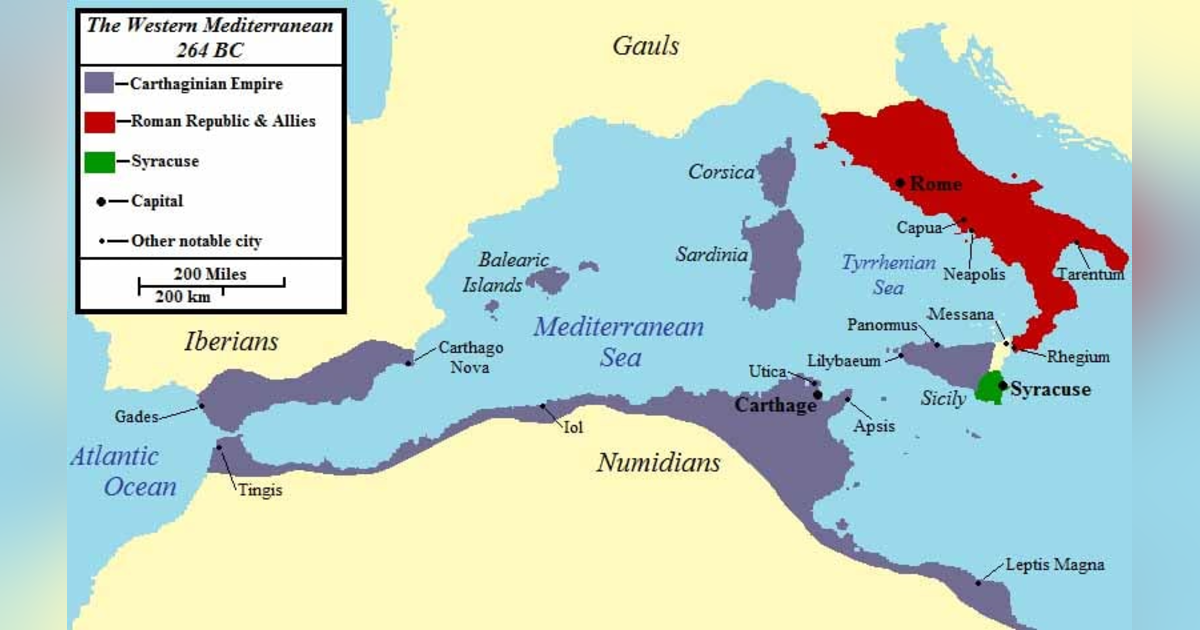
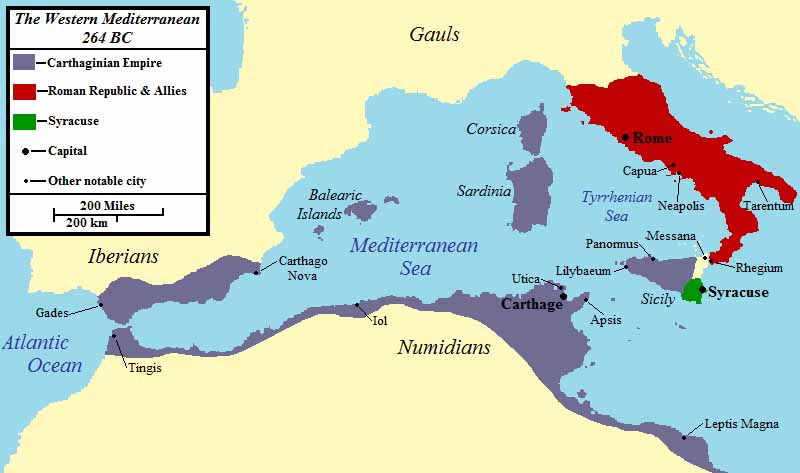
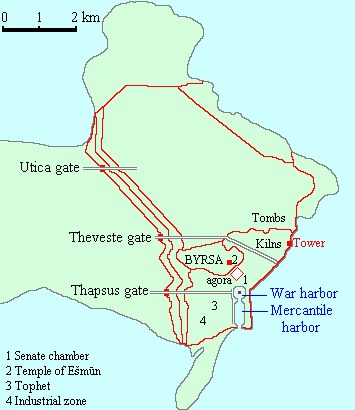
A map of the city on its peninsula can be found on the website at western-traditions.org.
Now, I mentioned that the city was in Africa. This word, Africa, is important. Where the actual
word comes from is uncertain. A Greek word, aphrikė, meaning “free from cold,” may be the
origin. But, during the Roman era, the word Africa did not apply to the continent of Africa as
we use it today. That is one reason why I pause to consider the word now. When the ancients,
particularly the Romans, spoke of Africa, they were referring mostly to what we would today
call the country of Tunisia. In other words, the more fertile lands of the northern African
coastline.
This region of the continent would continue to be known simply as Africa for centuries. In AD
293, the Roman Empire will be divided among four emperors in a political arrangement known
as the Tetrarchy, which was instituted by Diocletian probably as one of many solutions applied
to the crises of the Third century but more on that later.
Anyway, the empire was at that time divided into four portions, one for each imperial executive
to manage, and one of those portions was made up of Italy and Africa, meaning this northern
coastal area of the continent that we now call Africa. It was considered to be a vital Roman
possession due to its crucial location near the straits of Sicily, essentially chokepoint in the
Mediterranean. It was also valued for the fertility of its soil.
But what exactly did this region, known as Africa, consist of?
To the East of it, in those days, along the Mediterranean coast of Africa, were Cyrene and
Libya, before you reached Egypt. These lands were notoriously barren, though not completely
devoid of life or civilization.
To the West of ancient Carthage, there was the coast of modern-day Algeria and Morrocco,
also not known for their welcoming geography, at least, not if you wanted to farm the land or
graze your livestock and support a large population.
Carthage, though, and much of what we essentially call today northern Tunisia, was a different
matter. The land here, while not as fertile say as many other European coasts of the
Mediterranean, was much more welcoming. Here you could grow a variety of crops, including
olive trees and wine grapes.
There was, at the time anyway, also much more lumber available in the Mediterranean
woodlands of this region and this would be naturally important for a maritime power like
Carthage.
And a maritime power Carthage was. Perhaps due to their central location, the Phoenicians
who inhabited the city were able to establish their own network of outposts and trading
partners throughout the western Mediterranean. The Eastern Mediterranean had been densely
populated for thousands of years, and the markets were long-established. The Western
Mediterranean, though, 3000 years ago, was still the frontier, with little in the way of any kind of
international law or rules regarding trade and politics.
It was probably the Carthaginians, not the Romans, who first brought civilization to places like
Africa, Spain, France and Sicily.But how much land did they actually rule over? Like many city-states of the time, Carthage’s
rulers held most of their direct power just over the city itself and the land immediately
contiguous to it. But we have to see political power in the way that the ancients saw it. When
we spoke of the extent of the power of the Persian king, for example, his was not some sort of
legislative or executive power the way that we see it.
Most of us today live in centralized states with some sort of federal power structure and we are
bound to obey laws which are passed hundreds or even thousands of miles away, by a
government whose agents are everywhere and are ready to enforce those laws and inflict
punishment on those who do not obey.
During most of our history, though, power was something more like influence. The Persian king
relied on the loyalty of his satraps, his political lieutenants, to run things appropriately in their
specific regions. He counted on them to manage things and provide him with taxes, troops,
etc. But they could conspire and rebel and sometimes did. And, really, people might do as they
please in more far-flung regions of the Empire without much worry of intervention from the
capital, provided that they sent whatever was required of them at the right time to their king.
Furthermore, there would be regions outside this more-or-less direct extension of the central
power, other city-states which paid tributes to it, or furnished troops for it, or were otherwise
obligated to serve that central power somehow, even if they were not actual subjects of that
central power.
If we look at power this way, as both direct control and strong influence over another state, we
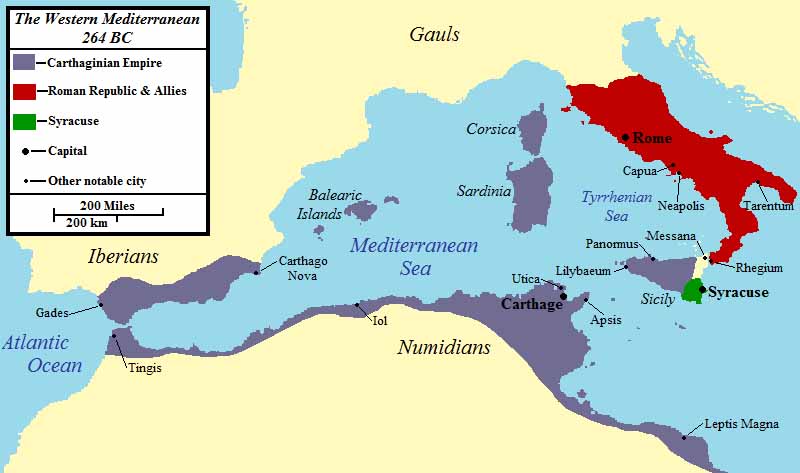
see that Carthage ruled, in a manner of speaking, over a very large realm by the time that the
confrontation with Rome came about in the 3rd century BC. Now, much of northern modern-
day Tunisia was directly part of the city’s domain, and lieutenants of the city government
directly managed those areas.
Beyond that, though, there was a whole world of dependent cities, with varying degrees of
freedom but all tied in one way or another to the city of Carthage and bound to obey her. Much
of that otherwise barren coast of northern Africa belonged to Carthage, in that sense.
East, all the way to the limits of Egypt, the peoples of those lands obeyed Carthage and
provided her not only with trade partners but also with the mercenaries that the city needed to
survive. In a coming segment, I will describe why Carthage did not rely on its own people to
supply its army with soldiers.
And West, all the way to the Atlantic coast of the Africa continent, Carthage also ruled and
drew upon the populace to supply soldiers.
Furthermore, much of coastal Spain, the Balearic Islands, Corsica, Sardinia and parts of Sicily
also were under Carthage’s “protection” at this time.
Now, whenever I hear of such protectorates, such states under the protection of more powerful
nations, I think of a darkly humorous meme that I saw on social media some time ago. The text
of the video states that the people of a third-world country say to themselves: We’re gonna be
rich! We discovered oil!”
And then, to the tune of some very heavy music, you see a bald eagle, clearly representing the
United States, turn and stare at the viewer and these words appear: “Yes, we did.”So, the protectorates of Carthage may or may not have been very grateful for the protection
she provided. Protection usually came at the cost not only of the sovereignty of these subject
cities, but it also required either direct payments, exclusive control of resources handed over to
Carthage, extremely favorable tariffs and privileges for Carthaginian citizens in the protected
city, and so on.
When this sort of arrangement happens at the street level we call it a protection racket and its
illegal. Local criminals make your business or home pay a fee, and you maybe give certain
privileges to them, in order for you to be “protected” from crime. I lived in San Pedro Sula in
Honduras for a year, and I paid a security company to protect my home and my family from
crime. Most of the other homeowners did as well. Those that didn’t would inevitably get
robbed.
So governments crack down on protection rackets because they don’t want the competition.
Now, we know a bit about the extent of Carthaginian influence and power in the Western
Mediterranean. But what were they like, these Carthaginians? How was society among
themselves organized? Who were their gods? Why were they able to rise above their neighbors
and enforce their will on the Western Mediterranean until the Romans came along?
(Music)
It will probably always be difficult to understand anything about Carthaginian culture.
Remember that nearly all the descriptions of their civilization which remain today were written
by their enemies. Romans, such as Cato the Elder and others, heaped scorn on Carthaginian
morals and their general character as people. For a long time, then, historians have been wary
about accepting the morbid stories of infant sacrifice, of sexual immorality, of gluttony, and the
greed which the Romans depicted as central to Carthaginian life.
Even the viewpoints of most of the Greeks who write about Carthage must be regarded with
some distrust. Plutarch lived a few centuries after Carthage was wholly destroyed and, while
he was Greek, he lived in a completely Romanized world. So, as with most of his essays, we
must take his accounts with a grain of salt.
And as for the Greek historian Polybius, he did, in fact, live during the era of the Punic wars
but he was a Roman hostage and he was also known to be eager to please his Roman hosts.
So when even these non-Romans depicted the Carthaginians as possessing some profoundly
disagreeable traits, we must question their motives in telling us so.
If we look to much earlier writers, however, we get a much less vehement take on
Carthaginian society. For instance, Aristotle, who lived in the 4th century BC, long before the
Punic Wars, he writes that the Constitution of Carthage was "in many respects superior to all
others.” Given that Aristotle had studied and written so much about various Greek styles of
government, this is high praise.
In describing the Carthaginian state, Aristotle also reflects his approval when he reminds us
that "a state is proved to be well-ordered when the commons are steadily loyal to the
constitution. when no civil conflict worth speaking of has arisen, and when no one has
succeeded in making himself a dictator.” So, the government had been stable there in
Carthage for some time.In fact, Carthaginian government sounds quite a bit like Roman government. There was a
lower and an upper house of legislature, with the upper house being made up primarily of
representatives from the upper classes. And the government was led by two elected leaders,
much like the consuls in Rome. Except that these two executives were known as shofetes,
which is a Phoenician word that we typically translate into English as "judges."
Since we have already learned that other Italian societies also had similar governmental
arrangements, and now we hear of a completely different culture on the African side of the
Mediterranean with a similar political organization, we must believe then that the Roman
system of democracy, however anomalous it appears to us when studied on its own, was not
unique.
So, therefore, Rome did not overcome the surrounding cultures in the Mediterranean simply
because it was somewhat democratic and the other cultures were despotic failed states, as
some might allow themselves to think. Everyone else in the Mediterranean, it appears, was also
part of some sort of democracy.
Although, as I have stated constantly in this series and in the Greek series of podcasts,
democracy back then was not universal suffrage for any of the ancients. In almost all cases,
suffrage was restricted to men who owned land, and by that I do not just mean they owned a
personal home but rather quite a bit of land to use for farming and pasturing animals and so
on.
Most of us listening to this podcast, no matter how well we think we have done in life, most of
us would have been slaves in antiquity, even those of us who are professionals, or we would
have lived just above the level of slaves, as freedmen plying a trade. Most of these so-called
democracies that I describe in the podcast were something more like expanded oligarchies or
aristocracies.
And permit me now another brief digression about that word shofet, or judge. This was the title
used for each of the two men who held executive power in Carthage. Instead of consuls, they
were the shofetes, or the judges. Now, this is the same word used in the Bible to describe the
early leaders of Israel. Hence we have the Book of Judges.
You see, the Jews, the Phoenicians and the Carthaginians were all Semites with a similar
language background and, presumably, with similar cultures. I'll get more into the possible
implications of this later in the podcast but it is interesting to wonder about how much the
culture of Carthage may have resembled that of ancient Israel.
For example, the Old Testament speaks more than once of people sacrificing their children to
Moloch, who was indeed a Canaanite god and who had a counterpart in the divine pantheon of
Carthage.
And we have come back to that one particular aspect of Carthaginian culture which has
darkened opinion on them for thousands of years now. Child-sacrifice.Now, it is fair to be suspicious of the Roman characterization of Carthaginians, given the strong
feelings that they had about the importance of family and children. But it should be noted that
most Greek writers do also describe this most hideous detail remembered about Carthaginian
culture - the infamous rituals of child-sacrifice. Since the Greeks were themselves notably
indifferent to the practice of infanticide, it is less likely that they would be motivated to try to
slander the Carthaginians with such descriptions and so we can put a little more stock into the
believability of their stories.
Nevertheless, regardless of whether these characterizations of Carthaginian culture were true
or not, it is still valuable to hear the Roman view of Carthage because these characterizations
of others tell us something about the people providing the descriptions, about the Romans
themselves. Recall that psychological phenomenon of projection. I’m not merely suggesting
the idea that the Romans were projecting their own views or desires on someone else, but
rather that when they focused on the perceived flaws of their enemies, they focused on those
areas of life which were most important to they themselves as Romans.
So the way that Carthaginians handled things like economics, sex, family and so on received a
lot of attention from the Romans perhaps because these things were deemed so vital in Roman
society and the Carthaginians observed those aspects of life distinctly. Note that the Romans
say little about Carthaginian politics, perhaps because their governments were so similar.
(Music)
The following history of Carthage, anyway, will be drawn from all sources, even those whose
motives are suspect.
The Phoenicians had spread all around the Western Mediterranean by 1,000 BC. According to
their own legend, Carthage was founded in 814 BC by Dido, the daughter of the king of Tyre,
which was the great Phoenician city on the coast of Canaan in the Eastern Mediterranean. We
have heard also of Dido in the Aeneid, the great epic about the founding of Rome. In that story,
the Roman hero slept with Dido but eventually abandoned her, causing her to take her own life.
The significance and symbolism of the Roman hero using the Carthaginian queen sexually and
then tossing her aside cannot be overlooked.
However the city was actually founded, it was not immediately the leading city of the
Phoenicians in the West. The Phoenicians were more commercially-minded than other cultures,
and initially were not not terribly interested in conquest or military organization. They founded
and settled scattered cities that traded with the local natives around the Mediterranean and
maintained a network of trade and wealth among themselves.
Less than a century after Carthage itself was founded, though, the Greeks began appearing in
the Western Mediterranean, looking to establish their own colonies. The greeks were less shy
about military confrontation, and soon came into conflict, both military and commercial, with
the Phoenician colonies in the West. The Greeks were not yet a credible threat in the Eastern
Mediterranean, where great powers like Egypt, Assyria and Persia deterred any inroads against
their long-established trading power.So, faced with these aggressive Greek newcomers, the Phoenicians of the Western
Mediterranean rallied around Carthage. And after a century or two of conflict, Carthage had
organized the other Phoenician city-states of the Western Mediterranean into an Empire of her
own. It was made up mostly of subordinate cities who paid tributes, dues and taxes of various
kinds to her. The Greeks had, by then, for the most part, been kicked out of the Western
Mediterranean and the Carthaginians had essentially established a new order there, along with
the Etruscans and with some Greeks who remained stubbornly in places like Sicily and the city
of Massilia, which is modern-day Marseilles in France.
And then, slowly, the Carthaginians began to extend their power inland, into modern-day
Tunisia. This is an important moment of transition. Until now, all Phoenician cities had been
coastal settlements, placed on peninsulas and islands, and easily defended with a minimum of
troops. They relied rather on naval power to protect them from enemies, and even that naval
power was not primarily martial. Their ships were manned by merchants and sailors who were
capable of military violence, yes, but most of their activity was devoted to trade.
Now, though, little by little, as they expanded into mainland Africa, the Carthaginians became
landowners. In the couple centuries prior to their famous conflict with Rome, the upper
classes of the Carthaginians, the collective rulers not only of the city but of the entire network
of Phoenicians and their dependents around the Western mediterranean, these powerful
families, once merchant sea princes, now became a landed aristocracy. The historian
Diodorus describes the inland homes of the elite, with vast landscapes over which their
livestock roamed, intersected by olive trees and grape vines and channels of water irrigating
this paradise.
But this should not distract us from the primarily seaward and commercial focus of
Carthaginian wealth. Even though the Carthaginians became more involved in agriculture, we
should not forget that they were still primarily a maritime people, with their faces turned toward
the sea and their minds engrossed in profits.
Indeed, this commercially-minded character explains a lot about the Carthaginians’ later
struggles in facing the Romans and even just in maintaining their empire. The military forces of
the Carthaginians, you see, were made up primarily of mercenaries. Yes, we will hear of
famous Carthaginian generals and admirals during the course of the Punic Wars. Carthage was
careful to keep supreme military leadership mostly in the hands of her own people. But the
lion’s share of the fighting was done by foreigners.
There are at least a couple of reasons for this that have nothing to do with the valor or the
cowardice of the average Carthaginian. The free population of Carthage, and of other
Phoenician cities in the Empire, this population was always small. It had been small from the
beginning. When they arrived centuries before to found their colonies, only a handful of
merchant families had come, bringing with them mercenary troops for defense. So there were,
comparably, far fewer actual Carthaginians than there were Romans.
Remember that the Romans had been rapidly expanding their citizen population, both by
accepting more and more middle classes into the voting ranks and also by turning the people
of conquered lands into citizens. The same had not happened with the Carthaginians.But we should not completely underestimate the number of free Carthaginians. By 300 BC,
the city is estimated to have held at least 500,000 people, making it the one of the biggest
cities, if not the biggest, in the world. Even if their free population was limited in size, there
were still plenty of Carthaginians.
But, more significant perhaps, was that most of those free citizens of Carthage and other
Phoenician colonies were simply not a bunch of farmers. They were sailors, merchants,
tradesmen, fishermen. They maintained the precious trade networks that kept the cities of their
commercial league fed and supplied and thus they were basically too valuable to lose in battle.
Which is not to say that no Carthaginians fought in battles, only that they never made up the
majority of Carthage’s armed forces.
The men and women working the fields beyond the city were usually foreigners and, if they had
any autonomy at all, they were still share croppers and, thus, just barely surviving on the
fringes of society and not participating in government.
Furthermore, when speaking of their ultimately disastrous confrontation with Rome, regardless
of who made up their army and navy, the Carthaginians were fundamentally not militaristic. I
am not saying this out of some revisionist-history bent, I’m not trying to upend the traditional
Rome-good, Carthage-bad narrative, however flawed it may be. I’m not trying to say that the
Carthaginians were peace-loving pacifists. It’s just that the Carthaginians understood what all
oligarchies must understand if they want to survive. That militarism is ultimately bad for
business and bad for the status of the oligarchs.
History has proven, endlessly and without exception, that war leads to two results for
oligarchies: If an oligarchy relies on mercenaries in its military, like Carthage, and it engages too
often in war, this will eventually lead to a coup and to a mercenary-supported tyranny. This had
already been attempted in Carthage and had been put down some years prior to the Punic
War.
If an oligarchy uses its own citizens too often in combat or otherwise abuses their services,
they will eventually revolt and impose a democracy. Consider the history of Greece. The
Spartan constitution addressed just this issue. They were discouraged from venturing out to
war too often because the drafters of the constitution, possibly Lycurgus but likely others as
well, they understood that going to war too often would bring about disastrous changes in their
culture. And this was proven by history. Listen to my five-part sequence of episodes on the
Peloponnesian War to see how Sparta and Spartans were ultimately changed by engaging too
long in war.
Perhaps the Carthaginians understood what a wise man once told me: violence is not a tool
that you can just pick up and put down. When you use it, it uses you back.
So Carthage thought of the military primarily for defensive purposes. Whenever the city did find
itself in conflict, it always looked to resolve the issue as quickly as possible, either through
negotiations or quick victories. They were not afraid of short bursts of violence, not afraid to
strike a hard blow in battle, but this sort of thing would also typically be followed quickly by
offers of truce and a new treaty, showing their desire to achieve their goals through means
other than combat, even if those other means still involved coercion of some sort.It will be important to consider these apparently diametrically-opposed natures of Carthaginian
society when compared to the Romans. The Roman upper classes were almost entirely a
landed-aristocracy and had been for some time. There was no history of a class of ruling
merchants there as there was in Carthage.
And by the start of the confrontation with Carthage in 264 BC, the Romans were long-
accustomed to solving their political issues with violence. It would not be until after the Punic
Wars that they realized how much the long war had altered their society and their government.
Furthermore, as a society, before the Punic Wars, Rome almost completely ignored the sea.
This seems hard to believe, given that they were not some land-locked culture but rather had
decent access to the sea. But perhaps that old saying attributed to Cicero, in which he said
that the best estates were used to raise cattle, can enlighten us here. The Romans were just
interested in land and its uses, and not the opportunities that the ocean presented.
Of course, perhaps this Roman disinterest was also a product of the already existing
monopolies that the Greeks, Carthage, and other Phoenicians had over the sea lanes when
Rome was still rising up.
Regardless, Rome was a land power, with a large citizen population of rural peasant-farmers.
And Carthage was an urban society ruled by a small merchant elite who derived their wealth
from trading over the ocean waves.
Nevertheless, watch closely as we progress through the Punic Wars in the coming episodes.
Just as Roman culture will be changed by the long conflict and their eventual victory,
Carthaginian culture will be changed by the lengthy engagement and by their defeats. And
when Carthage finally does take somewhat seriously the importance of a land army, they will
put forth a man, Hannibal, the son of Hamilcar Barca, who will be remembered, even by his
enemies the Romans, as one of the greatest generals of all time, rivaling even the skills and
perseverance of men like Pyrrhus of Epirus and Alexander the Great.
Even if, in the end, he was defeated.
(Music)
But about the baby-killing. There’s just no getting away from that one so we’ll have to look into
it.
Let’s start, though, with an overall look at the Carthaginian people, their religion and their
culture.
Genetically, they were a Semitic people, transplants from Canaan and the region known today
as Lebanon.
As far as we know, not just relying on Roman accounts but also on archaeology, ruins and
other sources, Carthaginian men wore beards and went about in long, flowing robes andsandals. While the climate of the northern coast of Tunisia is more moderate than much of the
rest of North Africa, it is still warm and loose fitting clothing would have been required. In
Egypt, where it was even warmer, people handled the heat by frequently going about naked.
As with their Roman counterparts, there were, originally anyway, not a lot of names to go
around in Carthaginian society. As you read through the Punic Wars, it is not simply that you
will hear many names repeated over and over again. After all, in English, how many men are
named John or Peter or Mark or David. But you really won’t hear many different names at all.
There are men named Hannibal, men named Hamilcar, men named Hanno, men named Mago,
men named Hasdrubal, and a few others. But the same handful of names just seems to be
passed around among the upper classes of Carthaginian society.
So do not be alarmed the first time you hear the name Hannibal in the coming episodes about
the First Punic War. It will actually still be quite a while until we get to the Second Punic War
and the most famous of all Hannibals.
These men may have been parsimonious with their names but they reputedly wore colorful
clothes, and they adorned themselves with with jewelry or other accessories.
Such public show, however, was only for men. Carthaginian women were mostly kept in
seclusion, except for a small number who became priestesses. Otherwise, women wore veils
and mostly lived in the home.
We know these things from more neutral sources and from surviving ruins and artwork.
Unfortunately, about their personal lives, we can only rely on the Romans and they have little
good to say about the Carthaginians.
“Heavy eaters and drinkers, loving to gather in dinner clubs, and as loose in their sex relations
as they were corrupt in their politics.” Thus Will Durant eloquently sums up the Roman view of
the Carthaginians. But this seems too easy an aspersion to cast on an enemy. I suspect that,
just as there were among the Romans, there were probably some very decadent
Carthaginians. And there were probably some pretty strait-laced ones, too. It seems a shame
to me that the Romans could not do as the Greeks did when writing of their ancestral enemies
the Trojans. Many passages in the Iliad and in later Greek plays do justice to the honor of
Trojan characters, even though they were the enemy. The Romans seem to find it difficult to
say anything good about the Carthaginians.
Like virtually all men of the time period, the Carthaginians worshipped a variety of gods.
Among them was Tanith, their local version of Astarte, the Phoenician goddess of fertility, love,
and the feminine realm. There was also Melkart, whose name meant key of the city, and there
were many minor gods as well.
Perhaps most important of them all was Baal Haman. Yes, his name was Baal, (spell it), just like
the hated Canaanite god often mentioned in the Old Testament. Baal simply meant “Lord” in
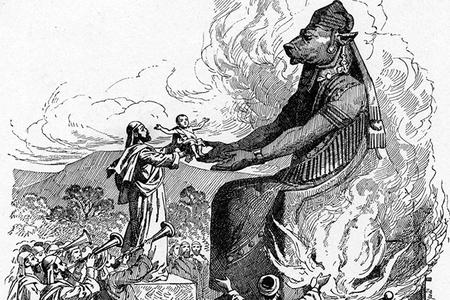
Canaanite languages. He was probably the local version of the Canaanite god Moloch.According to what we are told, the Carthaginians were accustomed to sacrifice children,
specifically infants, to Baal Haman during certain times of crisis, sometimes offering hundreds
of babies at a single ceremony. In one depiction of this hideous sacrament, each wailing child
was laid on the outstretched arms of the massive idol, whose arms were inclined toward the
god’s open belly, where a fire continuously burned. And so the child would roll down the arms
into the fire, to be followed by another, and then another.
Over time, aristocrats would seek to preserve their own children from these sacrifices and they
would purchase the children of poor people as substitutes.
Now, as much as we may be disinclined to believe such a tale, we should remember that it is
not just Romans but others who, at the very least, confirm this custom of child-sacrifice among
the Carthaginians. And, though the consensus was once divided, more and more
archaeological evidence has come forward to confirm that the Canaanite ancestors of the
Carthaginians also did indeed sacrifice children. This was once thought to be simply a
calumny of Canaanite culture described by the authors of the Old Testament. But evidence
shows that it was a reality, one way or another.
Now, I am not going to pretend some sort of moral neutrality when I consider this religious
practice. It appalls me. But we should consider that people around the ancient world practiced
a wide variety of methods to deal with unwanted children and populations that sometimes
surged beyond the society’s current capacity to feed them.
We have already heard about the Spartans disposing of inferior children or deformed babies by
throwing them off a cliff. And it should perhaps not surprise us that some people, making the
same choice, might try to attach a religious significance to infanticide, to make it part of a
religious ritual and not a personal choice. And also remember, among the Canaanites and even
among the Jews of the Old Testament, sacrifices were burnt upon the altar. So, if children
were to be sacrificed, burning them would obey a sort of internal logic to the whole scheme.
Recall Abraham in Genesis, chapter 22. While he raises the knife to dispatch his only son
Isaac, he also has the boy laid out on a pyre of firewood atop the makeshift altar he has built in
the wilderness, all ready to burn the corpse as a sweet-smelling sacrifice to his God.
And it also makes sense that the Romans were loath to do such a thing in their culture. They
had not yet reached the civilizational point at which children are being born too frequently,
when population has become a burden and not a bonus. Up and coming societies, which are
fighting all the time for survival, like the Romans, they have a need for every child.
Recall how often I stated in the last couple episodes that the Romans seemed to be always at
war, always fighting to survive or to conquer or both. It was probably unimaginable to Romans
how someone could do such a thing, how they could sacrifice a child who could otherwise
grow up and work the fields or fight in the army. Not only did child-sacrifice likely seem evil to
them, it also probably seemed stupid and perhaps a sign of Roman superiority, both moral and
intellectual, over their enemies.
To be clear, I am in the Roman camp on this one. I would not countenance this practice in my
own culture. But I put up some defense for the Carthaginians for a few reasons.First, I am convinced that, in general, people seek to do the right thing. They desire to order
their lives and their societies to benefit the general welfare, even if they hope that a little more
of that welfare comes their specific, individual way. But, all in all, I don’t think the Carthaginians
woke up every day thinking about how to maximize evil and suffering in the world. Instead, I
think they reacted to their circumstances with different choices than I would make, and
perhaps, once the tradition of child sacrifice was publicly well-established, they found it hard to
break the habit, felt pressured, so to speak, to keep up the ways of their fathers, which had
apparently already worked quite well.
Secondly, we should not rush to judge the Carthaginians when we live in a culture that deals
inhumanely with other people on a regular basis, and in which abortion is legal, anyway. In any
given year, the Carthaginians probably disposed of far fewer children per capita than we do,
even if they did so in a more shocking way.
Finally, I do not want us to approach the coming Punic Wars with a caricature of Carthaginian
life in the back of our minds. This will not be a conflict between righteous, upright Roman
defenders of order and a bunch of depraved, money-grubbing, devil-worshippers from Africa.
The Punic Wars will be perhaps the most significant and momentous conflict between
civilizations in Western History. It is hard to judge how consequential the wars in the East
between Mesopotamian powers were for our Western Traditions. But the Punic Wars, along
with the Persian War chronicled by Herodotus, will be among the most remarkable conflicts,
with an undeniably huge impact on the timeline of our history.
And these wars should not be reduced to cartoon-like battles between virtuous Romans and
shady Phoenician villains tweedling their mustaches and cackling in contemplation of their own
wickedness. The Carthaginians have built a civilization. They have promoted art, financed
architecture, smoothed relations between warring parties in order to further trade, and replaced
military conflict with commercial competition. However, complex and disturbing we may find
certain facets of their culture to be, I think we must respect their contribution to the ordering of
human life in the Western Mediterranean three thousand years ago.
And the Romans, though we reserve a place of honor for them in our ancestral memory, are
semi-savage upstarts, who have no philosophy, little art, and a complete lack of regard for the
finer things in life.
In the coming centuries, the Romans will bewail the encroachment of barbarians on their
delicate civilization.
But for now, they are the barbarians.
(Music)
I should not over-emphasize at this point the coming victory of Rome. It will take a full century
for Rome to defeat Carthage completely, and the matter will hang in the balance for decades.
During the Second Punic War, in fact, things will look very grim indeed for Rome long before
they begin to look better.
But all that is to come in future episodes. In the meantime, Carthage is still the superpower in
the region, and Rome just a rowdy upstart. But thanks to the ultimate Roman victory in this
conflict, we have lost a great deal of what we might have learned about this people who were
perhaps the first to bring civilization, as we recognize it, to the Western Mediterranean.In the next episode, we will see how Rome first began to chip away at Carthaginian supremacy
in a theater close to home, on the island of Sicily.
Until then, I thank you for listening to the Western Traditions podcast.
(Music)