Episode III.07 - The Roman Kingdom


The seven kings of Rome. Numa Pompilius succeeds Romulus. The line of kings ends with Tarquinius Superbus. Some background on Roman institutions, practices and vocabulary.

RECOMMENDED READS - Click Image for Link:
(Music)
-(Numa Pompilius) strove to inculcate fear of the gods as the most powerful influence that
could act upon… a barbarous people. But as this effort would fail to impress them without
some claim to supernatural wisdom, he pretended that he had nocturnal interviews with the
divine Nymph Egeria; and that it was on her advice that he was instituting the religious ritual
most acceptable to Heaven, and he was appointing special priests for each major deity.-
-A quote from the Roman historian Livy, who lived in the first century AD, and who also showed
us that revisionist history is nothing new.
(Music)
Welcome to the Western Traditions Podcast.
When most people think about an episode in Roman history, whether they know it or not, they
are usually thinking about something from the period of the Republic. For example, the story of
CIncinnatus, the life and death of Julius Caesar, the Punic Wars, the invasion of Hannibal, the
love story of Mark Antony and Cleopatra, the writings of Cicero, Cato, and more, all these are
people and events from the era of Republican Rome, not the Empire.
Imperial Romę came after the fall of the Republic. The history of Imperial Rome includes
things like the writings of Marcus Aurelius, the violent rule of Emperors such as Caligula and
Nero, and the rise of Constantine, the first Christian Emperor.
Today’s episode, however, will review what we know, or what we think we know, about the
Roman Kingdom. That is, the period which preceded the Republic, when the Roman people
were ruled by kings.
However, as we shall see, though it may have technically been a monarchy, there was always a
tension between the kings and the Roman Senate. The Senate was the ruling council of Roman
elders who, for the most part, actually guided the ship of state. Here is what 20th-century
historian Will Durant had to say about the roles of king and senate in the early days of Rome:
“Probably the real power of government…was in the hands of these elders, or senatores,
while the functions of the king…were chiefly those of the highest priest.”
This latter remark, about the king being a high priest, is an enigmatic statement for those of us
in the West today, when religion and state are supposed to be held separate. But, in most
cultures of the past, the king was always held to be the high priest of the state. That is, the
hands of the king were seen as in some way sacred. Recall, if you will, the passage in the
Odyssey when Telemachus comes to Pylos in Greece, and he sees the king, Nestor, leading
the sacrifice there, and not some priest.
The Lord of the Rings is a famous work of fiction but it was written by JRR Tolkien, a man
steeped in the classics. And if you read this work closely, you will see that Aragorn, the true
king of Gondor in the book, he has this quasi-religious bearing about him. And his hands are
also capable of healing, just due to being the hands of the king. So the way that the ancients
actually viewed kings tends to differ from the story book way we today tend to imagine kings,
thanks perhaps to fairy tales and the films that we see.
The king, in ancient cultures, you see, was more often the spiritual leader rather than the
temporal leader of the state.Speaking of temporal things, if you would like to support this podcast, please head over to the
website, if you're not already there, and take a look at the shopping page, where you can buy
Western Traditions T-shirts, hats and more. If you wish to support my work directly, you can
contribute using the PayPal or Patreon buttons. Patreon members get access to my patreon
page, where I announce podcast updates, publish brief essays and share other historical
resources with my supporters.
The Western Traditions podcast is also found on Amazon Music, on Spotify, on Youtube, on my
Podbean account and a number of other platforms. Wherever you listen, please remember to
at least give a like to every podcast you hear. This is free, it helps spread the word, and it will
also, of course, cause the algorithms to send you similar content.
And now, let us continue our journey through history with Numa Pompilius, the semi-legendary
man who followed Romulus at the helm of Rome’s ship of state in the 8th century before
Christ.
(Music)
After the death of Romulus, there was naturally a period of uncertainty in Rome. I have
mentioned before in this podcast that the idea of seamless transition of power through a policy
of primogeniture was the exception and not the rule in our western traditions. The generally
peaceful and respectful handing-down of power in, say, the kingdom of Judah in the Bible is an
ideal rarely attained in other kingdoms throughout history.
No, generally, after the death of a king, there was a power struggle, even if it was sometimes
brief and bloodless. Just so, after the death of Romulus, there was contention among the
people of the new city that called itself Rome. Those original romans, who had ceded land in
order to share it with the defeated Sabines, whom they had let into their city as full citizens,
these Romans felt that the crown belonged to one of their number. As for the Sabines, when
their king Tatius had died, after sharing power for some time with Romulus, they had gracefully
submitted to the sole rulership of that Roman hero, who had now become a god. They felt,
with some reason, that it was their turn, the Sabines turn, to choose the ruler.
The senate appears to have wished to rotate powers among its members, in something of a
rough draft for the future republic, but the people were not happy about this. In the end, after
about a year of interregnum, the compromise solution that everyone agreed on was for the
Roman inhabitants to choose from among the Sabine inhabitants the man that would rule
over them. The Romans chose Numa Pompilius, the son-in-law of the late Tatius, the Sabine
king who had ruled alongside Romulus for a short time. Numa, per the legend, had been born
on April 21st, 753 BC, on the very day that the city of Rome had been founded.
But, however auspicious his birth, Numa was an unusual man to follow in the footsteps of
Romulus, a man who, while quite religious, was also quite warlike. In fact, Numa initially
refused the office of king, on the grounds that the Roman state was essentially still at war,
trying to grow as it was while surrounded by plenty of other hostile city-states that were equally
interested in territorial growth.
And Numa was not a warlike man. To give you an idea of what he was like, consider that his
beloved wife died after 13 years of marriage, yet Numa, unlike most other men still young and
capable of producing and providing for a growing family, Numa chose not to remarry. Instead,he had essentially retired from life after his wife’s death, and spent much time alone, outside
the city, allegedly in communion with the gods.
Here is Plutarch’s depiction of Numa’s monkish preferences:
“He was endued with a soul rarely tempered by nature, and disposed to virtue, which he had
yet more subdued by discipline, a severe life, and the study of philosophy.
“He banished all luxury and softness from his own home…in private he devoted himself to the
worship of the immortal gods.”
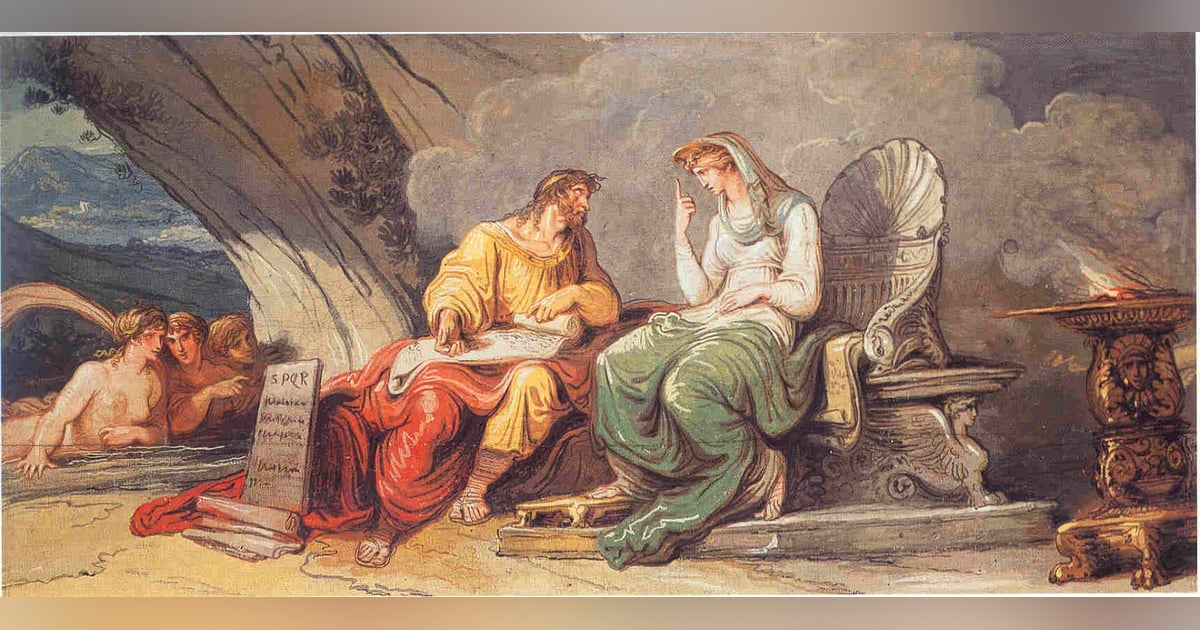
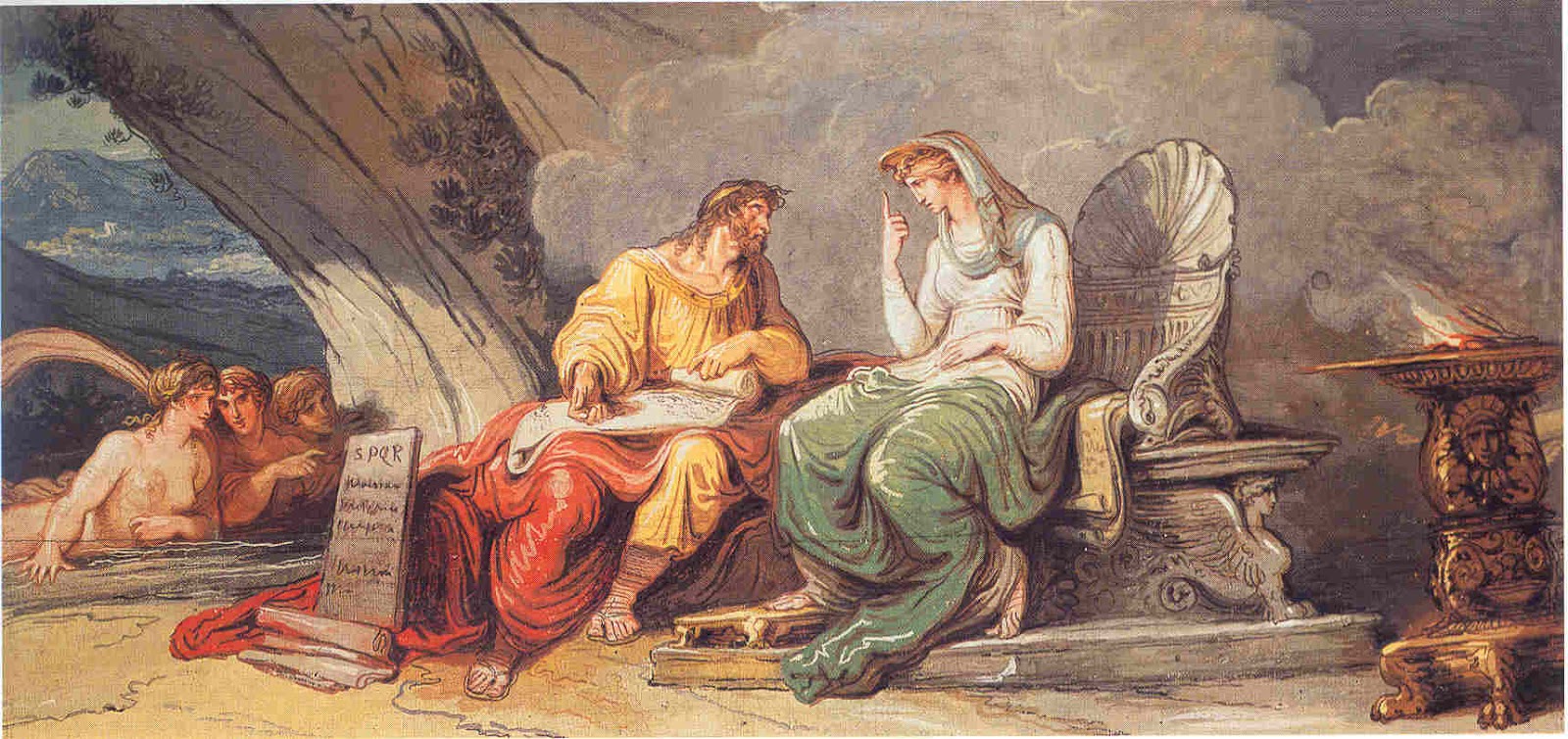
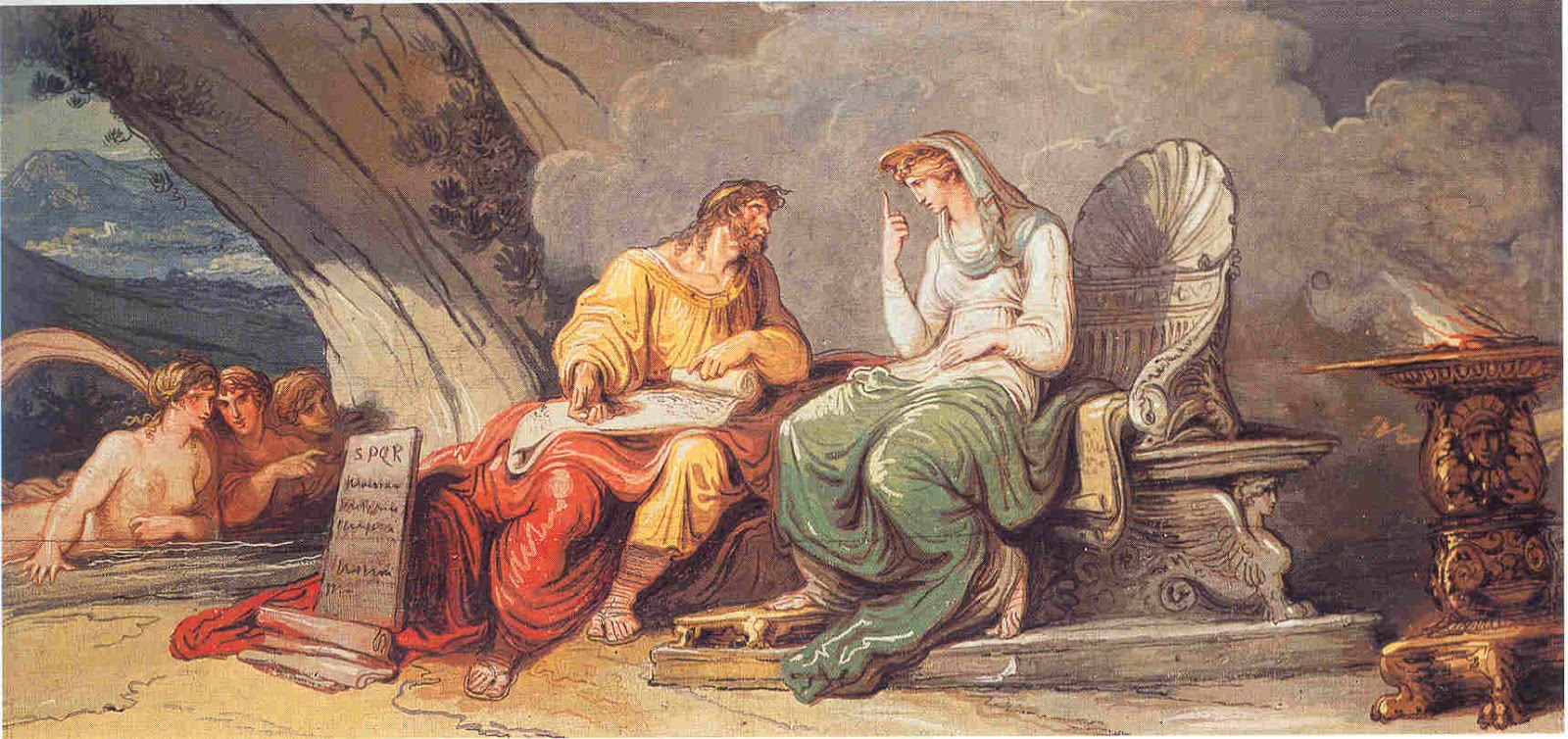
Indeed, in his monkish seclusion, Numa was said to have obtained a spiritual marriage of sorts
with a wise nymph, or goddess, named Egeria, with whom he would often converse on matters
spiritual. I have placed a painting of one such imagined conversation on the web page for this
episode.
It was from this spiritual retirement that the Romans were trying to recall Numa and he was
apparently not very happy about it at first. He actually refused, quite firmly, the honor of
holding royal power until his father convinced him to not turn his back on the people, who
needed a leader to defend them from the violence and uncertainty of the surrounding world.
And so Numa came to Rome and entered the city, acclaimed publicly by the crowds of people
and received into the forum while sacrifices of gratitude to the gods were made. Nevertheless,
Numa still refused to accept the robes of authority until the gods revealed some sign of their
approval.
And here, we encounter again the importance of bird flights in Roman culture. The future king
stood in the middle of the forum, surrounded by the gathered people, all in silence, waiting for
some sign. And then, a flight of birds came and passed him on his right. Only then did Numa
accept the royal robes and the people broke out in wild acclaim of their savior.
(Music)
And so was set in motion the events, the themes, the cultural traits and the historical impetus
that would become the unforgettable, eternal Rome, whose memory still inhabits the minds
and stirs the hearts of Western men to this day.
Yes, Romulus had founded the city, and given Rome its first push in the direction of future
glory. But that potential could have all been squandered in an ugly succession squabble, when
Rome’s surrounding friends and enemies might have taken advantage of the chaos and
partitioned the realm amongst themselves. Many upstart kingdoms had filtered away their
potential in such struggles for power.
It was Numa’s preservation of this young city-state that affirmed its destiny. And with his
kingship and in the reigns of the men that followed him, we see emerge many of the emblems
and attributes that we associate with Rome to this day.
Now, many of these characteristic features of Roman life and politics and expression have a
complicated past and some may have certainly come from cultural insignia originating long
before Rome. And other attributes of Roman culture and politics may have developed after the
reign of Numa. But all have their origin and popularization from this now murky historical era
that preceded the Republic. What we do know, in general, is that most of the demonstrationsof Roman culture with which we are familiar are already present and common in the Republican
period, which begins after 509 BC, when the last king is dethroned.
Now, one of the most easily-recognized such insignias of Rome is the fasces (spell it). This is
an axe wrapped in a bundle of wooden rods. I have included the symbol on the web page for
this episode.
This fasces was a symbol of Roman power but it may have very well been inherited from the
mysterious Etruscans. In the opening episodes of this series of podcasts about Rome, I
investigated the possible connection between Romans and Etruscans, even to the point of
considering that the Romans may have simply been descendants of the Etruscans. Either way,
they most likely either inherited or adopted this sign of political sovereignty.
Such fasces were typically carried by lictors, which were something like heralds who preceded
high government officials when they went about on their business, but they also acted as
bodyguards and personal assistants. Essentially, lictors were the entourage and staff of
powerful men in Roman politics.
And if this strange word, fasces, sounds somewhat familiar, it is because we derive the term
fascist from fasces. Since the fall of Rome, the fasces have been adopted by various groups
as their emblem, but most recently this was done by Benito Mussolini and the Italian Fascist
Party after World War I. They so named their party as fascist as a direct reference to the great
days of Rome’s past glory.
In addition to the fasces, the king’s power was also represented by the diadem. He wore a
white diadem on his head and this word, diadem, is simply a word for crown but the Roman
diadem was more lightweight, a little more delicate, than the typical, heavily bejeweled image
that appears in one’s head they hear the word ‘crown’.
Along with this tiara, the king also wore red shoes and we see here more enduring connections
to the modern Catholic Church, in which the Popes, up until the last few decades anyway,
would wear a papal tiara and don red shoes for certain ceremonies.
You also hear a lot about the toga in Roman history. The king wore a purple toga but there were
specific togas for specific offices in government and also for specific occasions. In the same
way, in the Roman Catholic Church, priests and monks have different robes and other
garments for different functions and even for different times of the year. A Roman priest would
sometimes wear something called the Toga Praetexta at religious ceremonies. It was made of
wool. The priest would use the togas fold’s to cover his head when he prayed, when he
poured libations or when he made sacrifices. It is not exactly known why the head covering
was necessary.
Interestingly, the priest would only do this during specifically Roman ceremonies, but when
certain Greek gods were honored they would use Greek customs in their rites and leave their
head uncovered. Again, this detail seems particularly pertinent in the context of the New
Testament, in which St. Paul, living in the Greek portion of the Roman Empire, insists that men
leave their heads uncovered during worship.
The king was himself the high priest for the whole state. When acting in this role, he was the
pontifex maximus. Pontifex comes from the latin word for bridge and some interpret this title to
mean that the priest was the bridge-builder between the gods and humanity. Thus the king was
the most important and powerful bridge between men and gods.But there were other offices in government besides the kingship and the priesthood and, as in
any monarchy, the king probably delegated his offices, likely to trusted men in the senate. The
pontifex maximum seems to have been an office delegated by the king to other high-ranking
men at some point in time, but the office, like all government and religious offices, always had
its origin in the office of the king.
Office-holders appointed to more secular roles were known as quaestors or praefects. but
those who acted in religious roles on behalf of the king were known as sacerdos (Spell), the
latin word for priest. When such priests were assigned to conduct worship for particular deities,
such as Jupiter or Mars, or Minerva, they were known as flamen.
Quaestors, on the other hand, were men appointed, in later times elected, to hold specific
offices or to oversee or investigate certain issues. The name quaestor comes from the latin
word for query, so a quaestor was an inquirer, someone who looked into matters for the
government, whether that was for the king, the senate or the emperor. In some cases, a
quaestor might be more like a cabinet member, but he could also be a prosecutor in a legal
case, or an auditor of some sort. Crucially, though, when this quaestor acted, he did so with
the backing of the government: king, senate or emperor.
Typically, a man given a very high role, though, would have the title of praefect, related to the
slightly more modern term prefect, which is hardly used any more outside of certain religious
roles. For instance, the Praefectus Urbanus was the prefect charged with the day-to-day
management of the city of Rome itself, while the king or senate or emperor was overall
responsible for the entirety of the territory belonging to Rome.
These quaestors and prefects would often be chosen from men of the senatorial class but
certain high-ranking men from outside the senate might aspire to lower-levels of such
officialdom. Opportunities to walk these roads to government leadership for people outside
the upper classes would increase with the passage of time.
Later, as the lower classes begin to acquire more state power, we will hear about tribunes, or
tribal representatives.
Now, in order for a man to be elevated to high office in Roman society, it was not enough to be
a patrician, or a member of any upper class. That was a good and necessary start, but what
mattered more than anything, as we have seen and heard already, what mattered most was his
character.
In particular, what mattered was the man’s virtue.
Now, today, when we hear the word virtue, we think of things like honesty, kindness,
mercifulness, patience, fidelity. And the Romans would have agreed with us but their idea of
virtue went beyond these traits. To fully understand the Roman idea of virtue, we must first
investigate the etymology of the word.
The modern word virtue comes from the latin root vir, V-I-R. However, in classical latin, I should
pronounce that word as “weer.” There is no V sound in latin, nor is there a J sound, so it was
Iupiter, not Jupiter, and it was Iulius Caesar, not Julius Caesar.
Anyway, Vir, or weer, means man. We continue to use this root in modern English, in words like
virile, meaning manly.Now, to be virtuous for the Romans meant to be manly. But you have to extract from your mind
the image of some hairy, athletic guy beating his chest. This is not, for the romans, something
vulgarly macho. For the romans, a man was much more than that.
Yes, strength and bravery were important, and they were virtues, but, as I have stated in
previous episodes, a man for the Romans, or for the patricians anyway, was someone who
also possesses those things that we still more commonly associate with virtue today, things
like patience, wisdom, fortitude, etc.
So, virtue, or manliness, for the Romans, meant a variety of things all together, the now
traditionally understood list of traits of like patience, kindness and so on, but also manly
characteristics like bravery and physical endurance.
Notice that, while wisdom is mentioned, I nowhere made mention of anything like braininess.
Intelligence was certainly prized, the kind of intelligence that led to good decisions in battle or
in buying land or sowing a crop. But not the kind of intelligence that meant reading a lot of
books and sitting around talking about philosophy or other high-flown ideas.
There will be very little philosophy in Rome as we progress through the next several centuries
of history. For the Romans, good philosophy was mostly good politics, good business. There
was little point in speculating about the “nature of being”. They were focused on managing
their land, fighting wars, marrying good women, procreating, worshipping the gods properly,
and dying without staining their family name with dishonor. That kept them too busy to worry
about things like platonic ideals. As for Plato’s republic, they had no need to study such texts.
They already had the perfect society.
Now, I have mentioned and defined a lot of words with which we should become familiar in
order to understand the coming series of episodes, but I haven’t yet told you about names.
That is, the Roman naming system.
This system of naming is known as tria nomina, or three names. Now, I should warn
Westerners, particularly English speakers, to not confuse this naming system with their own. It
is also common today, particularly in English, for a person to have three names: a first, middle
and last name. If, like me, you belong to a high-church christian tradition, you might also have
a fourth name given to you at your confirmation ceremony.
The last of these three names is your paternal name, the name of your father’s family. Usually,
the first name and the middle name are given at birth or perhaps at your baptism.
In other western traditions, such as the Spanish naming system, there is a fourth name, or
second “last” name, which is really just the person’s maternal name, that is, their mother’s last
name. So when you hear someone is named Miguel Ricardo Gutierrez Duarte, Gutierrez was
his father’s family name and Duarte was his mother’s. You can achieve the same thing, if you
are an English speaker, by simply adding your mother’s last name to your own as a fourth
name and you get the same arrangement.
The Roman naming system, the tria nomina, has nothing to do with this, really. The three
names that most romans had are broken down into the praenomen, the nomen, and the
cognomen.
Praenomen, the first name of a Roman man, was something like our own system of given
names. The parents gave a praenomen to their child on the eighth day after birth if it was a girl,and on the ninth day, if a boy. On this day the child was purified in a religious ritual, not unlike
christian children are baptized.
Yet, these praenomen were unlike our own first names in that they were rarely used, and then
typically only by people within your close family. They were usually not how you were
addressed in the regular world, while interacting with others. And while there is some record of
women receiving these praenomen, the tradition of giving praenomen to women seems to have
fallen off many centuries before the entire tria nomina system disappeared entirely, during the
early middle ages.
And there were not a lot of praenomen. There were maybe three dozen total male praenomen
to choose from in the early years of Rome, and by the first century BC, there were apparently
only twelve left in circulation. Examples include praenomen like Agrippa, Gaius, Gnaeus,
Lucius, Marcus and Octavius.
Nor was there any sort of silliness associated with choosing a name like there is now, where
people spend hours and days trying to figure out what to name their kids. A firstborn son
would generally receive the same praenomen as his father, and any sons born after him would
be named after uncles or cousins, etc. A particular family might only make use of three or four
total praenomen down through the centuries, with nearly everyone just running around with the
same handful of praenomens.
In fact, there is a well-known praenomen among the Romans from this time, Sextus. Sextus
means sixth in Latin. It is speculated that this praenomen simply resulted from some family
having six sons and, having run out of possible names, they simply named him sixth. And the
trend caught on.
The second name in this naming system was simply the nomen, the name. This was your
family name, in the same way that I am named Robert Paxton, and my “family” name, my
paternal name, that is, the name of my father’s family, my nomen, is Paxton.
Examples of Roman nomens were Aurelius, Claudius, Fabius and Julius. That’s right, the Julius
in Julius Caesar was actually the family name and not the man’s particular name, not how he
was addressed by friends. It was his paternal name or last name in modern English custom.
Caesar’s praenomen, if you are curious, was Gaius.
Finally, each individual had a cognomen, the name by which he was known. You can see the
root of cognoscere, the latin verb meaning to acquire knowledge about, or to get to know,
combined with the latin word for name.
Cog-nomen.
The cognomen, in some ways, was a sort of nickname, but the cognomens also became
hereditary and, in some cases, came to indicate the specific branch of a family to which one
belonged within the greater family indicated by the nomen. So Gaius Julius Caesar belonged to
a branch of the Julian family known by the cognomen Caesar.
Of course, it wasn’t pronounced Caesar, but I think it will be too jarring, after us being so
accustomed to the name Caesar, to start pronouncing it now in classical Latin as Cai-zar.
But, in another little digression, if the properly pronouncd name sounds oddly familiar, it
because that is what the Germans were calling their leader in World War I. Kaiser Wilhelm. You
may have thought that it was some German world, but they were actually applying the Latinword Caesar, properly pronounced Kaiser, to their leader, because he was the new Caesar for
them, the new Emperor.
Anyway, a cognomen could also be earned and added as a fourth name or replace the
original cognomen. Scipio Africanus, of Punic War fame, was actually known as Publius
Cornelius Scipio before his military successes in Africa, after which he was known as Scipio
Africanus.
Thus naming system was usually but not always respected, and there were exceptions, and
instances in which praenomen were used also as nomen, etc, but the tria nomina is generally a
good way to understand most Roman names that you encounter in history.
Of course, at the beginning especially, this was more of a naming system for the upper classes,
and we have less of an idea about how commoners were named, since they tend to pass
anonymously beneath our historical microscope as we usually, for better or worse, are
interested only in the deeds and words of the upper classes who lived in the ancient world.
Now, speaking of the upper class, we should also talk about class divisions in ancient Rome as
well. We have heard about the patricians already. They were the wealthiest class, the Roman
1%, so to speak. In the beginning, to them were reserved seats in the senate and the highest
political offices.
There was another class of Roman citizen known as the Equites, which might be translated as
knights or horsemen, more literally, from the latin word Equus, meaning horse. These were men
who could afford a horse but they were able to do so because they were the business class,
with more wealth than the commoners. You could think of them as the middle class but it
would not have been as sizable a portion of the population as a modern western middle class.
More likely, it would have just been a few more percentage points of population than the
patrician class. These were men who aspired to enter the patrician class, in much the same
way as middle class people today might aspire, through hard work, marriage or luck, to gain
their way into the patrician class and become one of the one-percenters.
Commoners made up most, but not all of the rest of the roman population. Amazingly, at the
start, these commoners were not considered “the people”. That is, when the Romans spoke
of the populus, the population, the people, they were only referring to the patricians and
possibly the equites or knightly class as well. The plebs were all those regular working men and
their families: the carpenters, masons, farmers, storekeepers, etc. They didn’t count as people.
Over time, these commoners, called the plebs by the romans, would gradually become
accepted as “people”. But that would take centuries.
This should not actually surprise us, though. It was the custom not just for ancient people but
until very recently for even modern nations not to consider the working class, or the average
person, anyway, as a citizen.
In the 20th century, when you heard the titles of communist countries, in particular when they
used language such as “the people’s republic,” this was never even intended as a reference to
the entire population of a country. Critics of socialism would try to call out the communists for
hypocrisy because they were not democracies, but they were democracies, in the traditional
sense. They were democracies of the people who counted as people.
In these cases, people meant the individuals who were officially-recognized members in the
communist party, which was always a limited number of individuals.And don’t forget that the same was also true in the young united states. “We the people”, the
famous phrase from the American Declaration of Independence, did not refer to the whole
population, nor was it ever meant to, but rather, for the most part, this referred to adult males
who owned land and could vote in the assemblies that ruled over the colonies. It was only over
the course of decades after the revolution that universal, white male suffrage became
common. Black men did not have voting rights until eighty years after the writing of the US
constitution, and women did not get the vote until 1920, nearly a century and a half after “the
people” declared independence.
Anyway, from this early phase of Roman life we also get the famous acronym, SPQR, which
you can see in many places and references to Rome. If you look closely, you can see that it is
on the painting of Numa and Egeria that I posted as well.
SPQR stands for Senatus Populusque Romanus. In English, the Senate and the People of
Rome. Such an emblem would be attached to documents and engraved on walls and pillars to
declare that something had the support of the entire government of Rome. But the People part
of that phrase, initially, only represented a small portion of what we would call the true
population of Rome.
And among the population there was another, large class of “individuals”, to avoid confusing
use of terms like citizen or “people.” These were the slaves and the freedmen. The slaves
would never be counted as people and for freedmen, that is, emancipated slaves, the rocky
road to recognition would take several hundred years to travel.
And again, this is not unusual when compared to other societies. The supposed democracy
of Athens was actually composed demographically of more non-voting slaves than citizens,
even during the time of Socrates.
But, in the West, the story of the last centuries before Christ, however, is very much a story in
which various societies grudgingly accept the “personhood” of the lower classes.
Regardless, at the start of things, those who were counted among the populus, were
recognized as belonging to three tribes, the Ramnes, the Tities and the Luceres. The Ramnes
were, most likely, the original Romans, whoever they were, while the Tities was the tribe of
those Sabines who had been accepted into Roman society early on. The Luceres may have
been the Etruscan element of early Roman society, but there is much uncertainty about this
matter.
Initial membership in these three tribes may have been limited only to patricians, if you can
believe that, but probably expanded to include the equites class, as time passed. The lower-
class plebs, the actual demographic majority of the kingdom, were not considered to be
among any of these tribes.
These tribes were further broken down into curiae, (spell) a word meaning assembly or group.
Each curiae was initially composed of about 30 adult men, and I think it is reminiscent of the
way that Spartan men belonged to clubs which would eat together and fight together for their
entire lives and which carefully guarded their membership.
Now, one great organization to which all able-bodied Roman men of the upper classes
belonged was the legions. The legions were also a very important part of Roman society, but Iwill save description of the legions’ formations and members for the first episode in the next
unit of episodes, which will be about the Republic of Rome.
Keep in mind, though, that any hard-and-fast definitions of all these things, these offices, these
roles, these organizations, these definitions, these classifications, they will all eventually
change, evolve, break down and even disappear as the history of Rome develops, as the
commoners gain more power, and the institutions that once supported the Roman state begin
to lose public respect, and the nervous populus looks increasingly to dictators, or men with
dictatorial powers even if they did not possess the actual title of dictator, to preserve the
welfare of the SPQR.
(Music)
Numa Pompilius is credited, according to legend, with instituting many features and
improvements of Roman life and culture.
To him Plutarch attributes the first attempt to regularize the calendar. Apparently, prior to
Numa, the people of Rome had a calendar of only 360 days and had no understanding of the
cycles of the moon and sun. Numa reordered the months, and allegedly ended the tradition of
starting the year in March and made the turn of the year fall on January 1st instead. Previously,
the years in Rome, and in many other cultures, had begun in March because that was the
month on which the Spring equinox occurred.
Numa is credited with a number of other calendar changes as well, including the addition of
extra days on every second year to keep the calendar in sync with the seasons.
He also helped to reorganize Roman society to further lessen factions among the patricians
and the people.
I mentioned earlier that Plutarch, in his essays, paired Numa with Lycurgus, the stern lawgiver
of the Spartans. However, Plutarch does this by way of contrast as well as by way of
comparison. Plutarch notes that both were lawgivers, but Numa’s laws are kinder, and more
inclusive, seeking to encourage harmony through mutual respect rather than obedience
through fear.
Numa’s reign was, however, but a brief respite from the warlike nature of early Roman culture.
According to the legends of Rome’s kings, Numa ruled for 43 years, dying in 672 BC.
Forty-three years is a long reign, and that is another thing about the king list of early Rome that
makes historians suspicious of the history of the Roman Kingdom. This history may have been
tampered with after the Gauls sacked the city in 390 BC and all official records of previous eras
were lost. It seems unusual for virtually all the kings to have such long, uninterrupted reigns.
However that may be, Numa was followed on the throne of Rome by a man named Tullus
Hostilius. As the name suggests, he was a more warlike man than Numa. Tullus Hostilius
renewed hostilities with Alba, the realm which had warred against Rome when it was under
Romulus.
Now, it seems strange that there is virtually no mention of any hostilities under Numa, who
reigned for more than forty years. That is an extremely long period of peace for any nation,
ancient or modern. In the US, we consider ourselves accustomed to peace but we’ve been at
war at least every couple decades since World War I. And then suddenly, with the rise of a newking in Rome, Tullus, hostilities break out again. This sort of scheme in the ordering of Rome’s
kings is another thing that makes historians very suspicious of this whole arrangement.
Regardless, it appears likely that during this time period, anyway, as a result of Tullus’ wars,
that the region of Alba Longa came under roman control as a vassal state of sorts. Alba Longa
would have been one of many neighboring realms to the southeast of the original city of Rome.
Tullus is said to have ruled for 32 years. Again, this is a long rule for any king, especially one
who was reputedly in so many battles. But make of it what you will.
Tullus was followed by Ancus Marcius, who ruled for 24 more years. He was a grandson of
Numa Pompilius. This king expanded Rome greatly, and founded the port city of Ostia on the
Tyrrhenian Sea, giving Rome maritime access. He also reputedly oversaw the building of the
first bridge across the Tiber River.
Nevertheless, when I say that Rome expanded greatly, you must limit your understanding of
size here. Rome had begun, even under the great Romulus, as a very small city on the banks
of a bend in the Tiber River in west-central Italy. Even by the end of the reign of the fourth king,
Roman expansion had probably only acquired territory that wasn’t much bigger than the actual
sprawl of the modern city today. Still, for its time and location, that was a sizable kingdom, and
Rome’s institutions and its martial discipline probably made it a much more fearsome enemy
than it’s size might imply.
The fifth king of Rome was an Etruscan man by the name of Lucius Tarquinius Priscus.
However, his background is confusing because he also allegedly had a Greek father who hailed
from Corinth originally and had moved to Etruria, the Etruscan homeland to the north of Rome.
Regardless, this Lucius Tarquinius ruled for 38 years and the expansion of Rome continued, as
it would continue, unabated, for seven or eight more centuries. Legend credits him with the
construction of the Circus Maximus, the great stadium in which the famous games of Rome
would occur.
Apparently, this Etruscan king was assassinated by the sons of the previous king, Ancus
Marcius, who felt that they had the right to the throne. But, in the tumult that followed, a man
named Servius Tullus rose to power. There is controversy about his ascension. Some sources
would tell us that he was the first man to take the kingship on his own without being elected
and approved by the Senate. But other sources say that he was actually the first to be so
chosen.
His background is intriguing as well. He was apparently the son of a prince whom the previous
king, Lucius Tarquinius, had defeated in war. The boy, Servius Tullius, had been brought into
the royal household and raised to manhood among the king’s children. And then, in the chaos
following the assassination, he had, one way or another, seized power.
Regardless of the truth of the matter, controversy was part and parcel of his rule. According to
the stories, he was often in conflict with the patricians. Servius reorganized the demographics
of Rome, and, according to some sources, it was actually he, Servius Tullius, who created the
middle class, the equites, by raising up certain wealthy members of the plebs.
He further divided the Roman people into many smaller tribes, based not on ethnicity but on
geographic location, much like Cleisthenes would do in Athens a century later, and thus began
to erase the ancient ethnic rivalries that had always disturbed public unity.However Servius had done it, he had elevated many men into citizenship and even into
leadership positions in the new Rome.
Thus he had their loyalty.
When one of late king Tarquinius’ grandsons accused Servius of usurping the throne and
ruling illegally, Servius declared a plebiscite. That is, he conducted a polling of opinion among
the people, among the plebs. He won unanimous approval from them.
The royal grandson who had charged Servius with illegal rule was not moved by this show of
support from the lower classes. He had Servius assassinated and declared himself king.
The name of this final, murderous king was Lucius Tarquinius Superbus.
(Music)
The story of the seven kings of Rome has a familiar ring to it. We begin with “good” kings, or at
least competent leaders who are admired, but then the kings lessen in value somewhat over
time, until there is a final, wicked king. The stories of the kings of Israel and Judah in the Bible
is somewhat similar. David and Solomon start out well, and then they are followed by
successors who are often incompetent, and, in some cases, just plain evil.
Lucius Tarquinius Superbus was that last evil king. His cognomen, or last name of the three,
Superbus, it meant Proud. And proud he was. But, in his case, the pride was overbearing.
The Senate had always intended for the kings to serve as a sort of executive over their council
as well as function as the high priest of the state religion. Like any such body throughout
human history, the Senate was loath to obey a dictator for very long. The senators had
probably killed the first Tarquin, Lucius Tarquinius Priscus, the fifth king of Rome. And they had
done nothing to stop the assassination of his successor, Servius Tullius.
But this latest king was an even greater thorn in their side. He made freedmen perform forced
labor for his own intentions, he went about everywhere with a force of bodyguards. He
crucified people in the forum, and even had many men of the upper classes killed.
But he was not a coward. This last Tarquin led Roman forces successfully in many battles with
nearby tribes. It was while he was away campaigning with the legions that the Senate made
their move.
And the Roman Republic was born.
Sources differ as to the date. This may have occurred in 508 or 509 BC. Modern consensus is
509 BC for the end of the Roman Kingdom and the birth of the Roman Republic.
The final end of the kingdom came as a result of a marital tragedy. In the words of historian
Will Durant:
“Here the tradition becomes literature, and the prose of politics is fused into the poetry of
love.”
The men of the legions were away fighting the Rutuli, maybe 30km to the southeast of Rome.
In their camp one night, a group of highborn men were discussing and comparing the virtues of
their wives. Each man, naturally, insisted on the superiority of his own wife and they could notelect any female champions in this contest of virtue just by way of discussion. So the men in
the group returned to Rome to visit their wives in the late hours of the night and to surprise
them in whatever activity was keeping them busy while their husbands were away.
All the wives, except one, were busy feasting with friends and enjoying themselves frivolously.
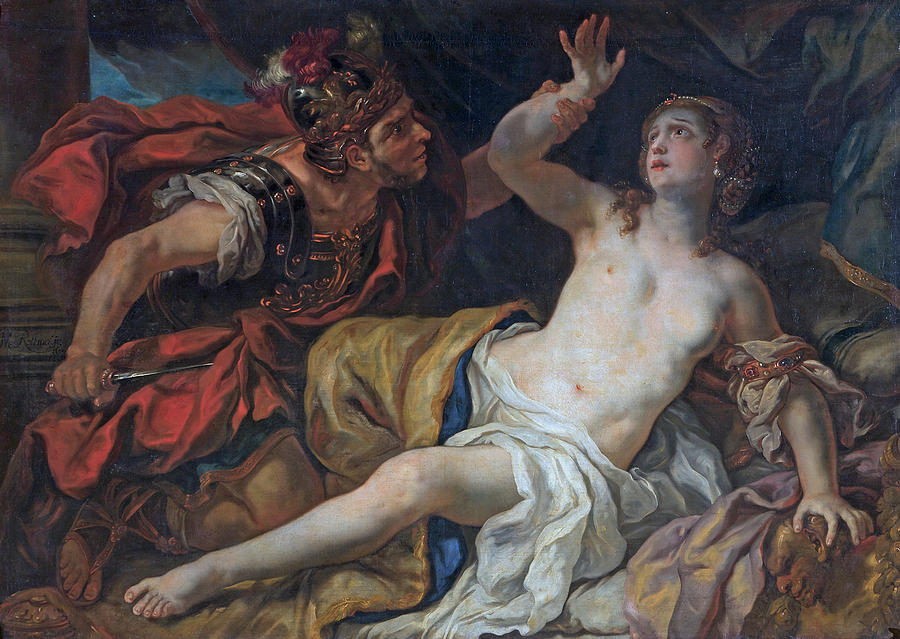
But Lucretia, the wife of a man named Collatinus, was busy at a traditional task of patrician
wives, spinning wool in order to make clothing for her husband.
Now, besides clearly winning this contest of virtuosity, Lucretia, in that moment, also won the
secret love of one of her husband’s friends, who had been disappointed in his own wife’s
frivolity. Here was a true Roman wife, an attractive, submissive and obedient woman sacrificing
her time to support her husband’s needs. The man’s name was Sextus, and he was overcome
with desire for Lucretia.
A few nights later, unable to control himself after days of thinking about the woman, Sextus
returned to Rome and offered her his love. When she refused him, he became angry. He told
Lucretia that, if she didn’t physically surrender to him now, he would kill her and one of her
male slaves and then tell her husband that he had caught the two of them in the act of adultery
and had executed both of them on the spot, which was permitted under Roman law.
So, Lucretia gave in, and let Sextus have his pleasure with her. When he got up and left, she
sent her servants to summon her father and her husband, Collatinus. In what must have been a
gut-wrenchingly emotional scene, she told them what had happened, and, despite her father
and husband’s protests, Lucretia then stabbed herself to death.
Now, how did this tragedy bring about the end of the Roman kingdom, and bring forth the
Roman Republic? Well, Sextus was the perpetrator’s praenomen. His nomen was Tarquinius,
and he was the son of the king, Lucius Tarquinius Superbus. As a matter of fact, the nomen of
Lucretia’s husband, Collatinus, was also Tarquinius and he was a cousin to the king’s family.
A friend of the now-widowed Collatinus, who must have been overcome with grief, went to the
Senate with the story.
This friend’s name was Lucius Junius Brutus, and he had his own axe to grind with the king.
His father and brother had been put to death by the king. Brutus, in fact, had earned his
cognomen by pretending to be a lunatic and making it unnecessary to kill him. This is why he
had the cognomen Brutus, or brute, someone lacking wit.
If this story seems familiar, in the Bible, David also pretends to be a madman in the presence of
the Philistine King of Gath in order to avoid detection and execution.
The Senate was appalled by the story and ordered the king and his immediate family to be
banished. The king, by then, had learned of the scandal and was on his way back to Rome. So
Brutus rode out to the army and told them the story. The legions also revolted against the king.
King Tarquinius, now without ally among Senate or Army, fled north to Etruria, the land of the
Etruscans. Here, he would appeal for aid and gather from among his allies an army of
vengeance.
In the meantime, in Rome, Tarquinius had not been replaced. Not with another king, anyway.
No, the Senate had bided its time for centuries and now it did not hesitate to grasp the power it
had always sought. But the senators also knew that no state could function without anexecutive of some kind. Centuries before, they had considered something like a weekly
rotation among their own members to prevent any of their members from possessing too much
power or influence.
Now the Senators made a momentous choice that would characterize Roman leadership for
centuries to come. They chose two consuls to lead simultaneously. The first two consuls
chosen were the aggrieved men, the widower Collatinus and his orphaned friend Brutus. Their
first task was to rally the legions and defend the Republic from the angry, exiled Tarquinius.
(Music)
Thus the Kingdom of Rome came to an end, and the Republic of Rome was born. Thus also,
ends the first unit of this series on Roman history. The next episode will open the unit about the
history of the Roman republic.
This will be a great drama, beginning with the struggles against the exiled king Tarquinius, and
ending, centuries later, when the Republic has asserted control over most of the civilized
societies known to the West, and as a result, has become too large, too corrupt, and too
decadent to be managed under anything but supreme power vested in a single man, the very
thing that the Senate had abhorred for so many centuries.
Until then, I thank you for listening to the Western Traditions podcast.