Episode III.03 - The Aeneid
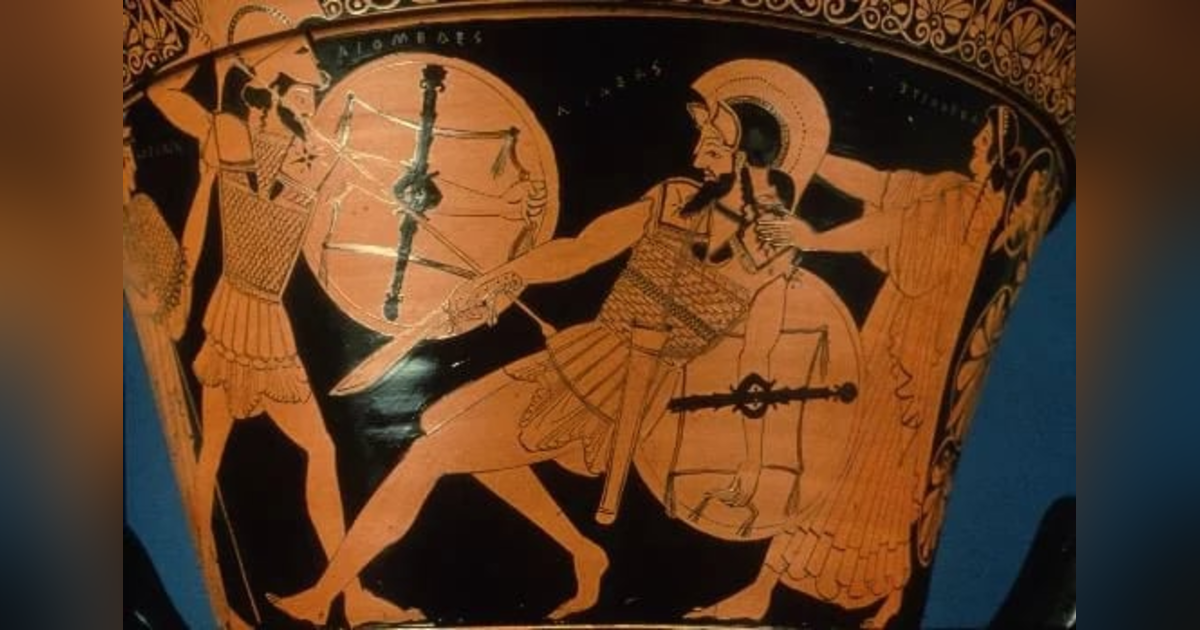


Virgil writes of Aeneas and the Trojan origins of Rome. The tale is both distinctively Roman and notably Greek. Heroes such as Odysseus and Achilles are recalled, as are monsters such as Scylla and Cerberus. The relationship between Roman mythology and Greek myths.
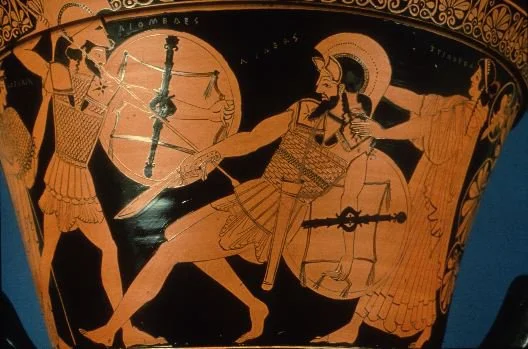
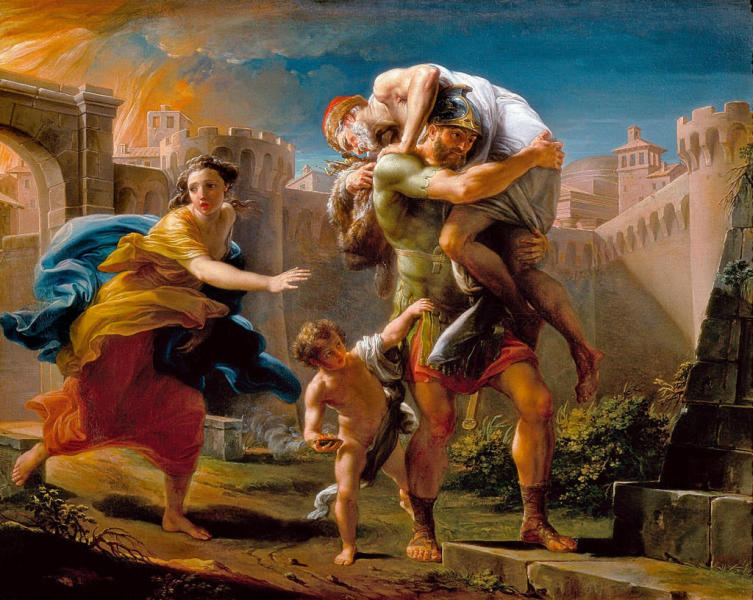
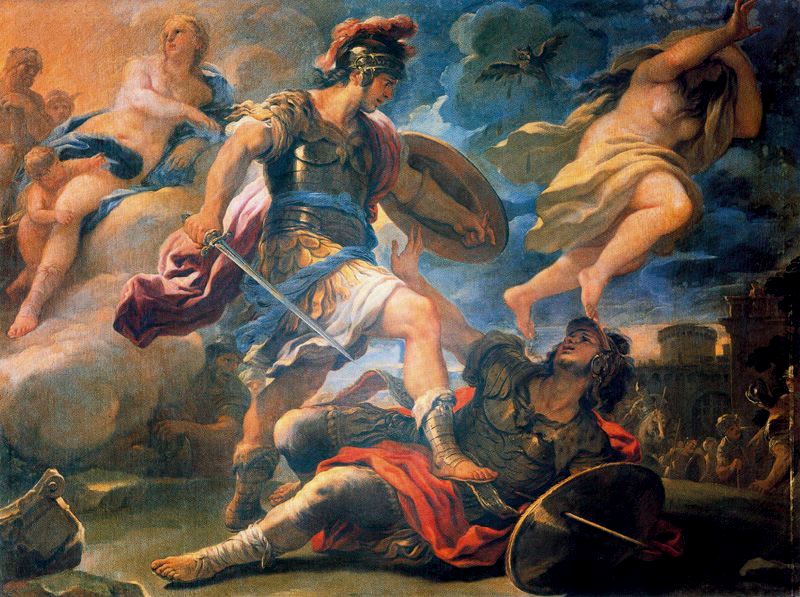
RECOMMENDED READS - Click Image for Link:
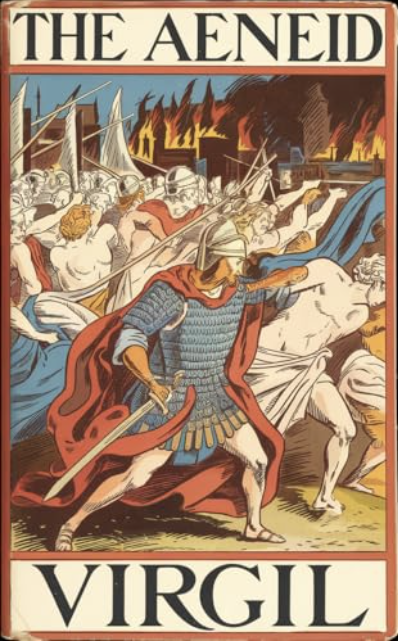
(Music)
-Comrades, hardly strangers to pain before now, we have all suffered worse. Some god will grant us an end to this as well. You've threaded the rocks resounding with Scylla's howling rabid dogs, and taken the brunt of the Cyclops' boulders, too. Call up your courage again. Dismiss your grief and fear. A joy it will be one day, perhaps, to remember even this. Through so many hard straits, so many twists and turns our course holds firm for Latium. There Fate holds out a homeland, calm, at peace. There the gods decree the kingdom of Troy will rise again. Bear up. Save your strength for better times to come.-
- The Trojan hero Aeneas, to his fellow refugees, in the first book of the Aeneid, an epic poem by the Roman poet Virgil.
(Music)
Hello and welcome to the Western Traditions Podcast. This is the third episode in the Roman Empire Series. So far, we have learned what archaeology and genetic science can tell us about the origins of the Romans and of their immediate neighbors. This episode will begin the investigation into what the Romans themselves thought about where they came from.
Specifically, this episode will look at an epic poem called the Aeneid. Now, technically, there would be good reason to include this episode much later in the podcast chronology because the Aeneid was actually written late in the 1st century BC, when the city of Rome had already stood for over 700 years, and the empire had already been inaugurated under Augustus.
However, I include it here at this juncture because, for one, it deals entirely with mythological events that occur just after the Trojan War, long before there is any historical record regarding Rome, and, two, it appears that the story of the poem, composed by the Roman poet Virgil, was not an original idea but rather the poet’s reorganization of already existing material about an ancient hero’s journey.
The Aeneid may not have been exactly what the ancient Romans, the Romans of the early Republic, told themselves about their origins, but portions of the story, at least, are likely authentic folk tales from the earliest periods in Rome.
Now, before we begin today’s episode, I want to thank my Patreon supporters for helping to make this podcast possible. Their support helps me to pay for this podcast’s website, western-traditions.org. If you also wish to support my work, you don’t have to be a patreon supporter. There are also many free ways to support the podcast. You can become a Youtube subscriber, or follow on Spotify, share the podcast with others, leave a like for the podcast on my Facebook page, or just leave a comment or question anywhere that you listen.
If you do want to contribute financially, you can do so directly through the PayPal option, or you can buy Western Traditions merchandise on the shopping page at the website.
If you do become a Patreon supporter, you will have access to my Patreon page, where I publish weekly updates about the podcast. I also take questions and suggestions about future episodes there and provide suggestions for further investigation into historical topics.
And now, with that plug for the website out of the way, let’s start our journey with the hero Aeneas, whose name you may remember from the pages of the Iliad…
(Music)
Normally, when introducing a work so seminal to history, I would start with a biography of the author. In this case, I will refrain, for the most part, because the actual author, or final composer, anyway, of the work lived so long after its events.
Virgil, that is, Publius Vergilius Maro, as his full Roman name was, was a Roman poet of the 1st century BC. He lived through a remarkable series of political and military events which brought into existence the Roman Empire, and wrote many great poems during this period. However, all of that is far into the future, and so I will leave a detailed description of the man for that unit of episodes.
Now, Virgil would be, for much of the Middle Ages, more well-remembered than Greek authors such as Hesiod, Homer, Herodotus and so on. And that fact is worthy of note here, because it speaks to the medieval primacy of Roman mythology over the ancient Greek mythologies, which we have already covered in the Greek Sun, the second series of this podcast.
What do I mean by this? During the Middle Ages, when educated men in the West spoke of ancient mythological figures, they almost exclusively used the Roman names, and they told the Greek stories, or versions of stories, that were handed down by Roman tradition. This is largely due to the almost complete loss of facility in the Greek language in the West by the start of the Middle Ages. Even educated men could only read the Latin versions and rewrites of such tales.
Consider that, during the period of writing and canonization of the New Testament, the first few centuries after Christ, Greek remained as a sort of common language around the Mediterranean, particularly in the East but even in Rome. Recall that the Gospels were written entirely in Greek, not in Latin. Even the Gospel of Mark, which was composed in Rome itself, was written in Greek, so as to be intelligible to a wider audience, even though latin was the court language, the official language of the state.
But, by a few centuries later, in the west, Greek usage had faded. By AD 500, Greek is known only to a very small educated elite, if even then. Latin had become the international language of the west. So, when people turned to topic like mythology, they were only able to access such stories as had been translated into Latin, and those, naturally, used the Romanized versions of names, and the Romanized versions of the stories.
So when the authors of Roman mythology, like Virgil, speak of the Gods, and of the heroes of the past, they use the Roman versions of their names. Thus, in this episode and in this entire series from now on, Zeus will be Jupiter, Poseidon will be Neptune, Heracles will be Hercules and Odysseus will be Ulysses. Some of the names will remain the same between the two mythologies.
Anyway, when Western people thought of ancient, epic poetry during the Middle Ages, they thought of the Aeneid before anything else. Because the Aeneid was their Iliad, their Odyssey, and Virgil was their Homer.
This was not by accident, either. While the roots of the Aeneid, the fundamental portions of the story, were likely handed down from the earliest days of the Romans, there is no doubt that, when crafting the published work, the poet Virgil was consciously trying to imitate the rhythms and the themes of the Iliad and the Odyssey.
Virgil was not just some bard, naturally romanticizing a certain old story in order to entertain his listeners. He was a widely recognized, published author who was commissioned, by the first Emperor Augustus himself, to create a national epic, something to revive the spirits of the Romans after more than a century of social decay and civil war had crumbled the old Republic.
But this is not just some cheap piece of propaganda, churned out at a moment’s notice to instill patriotism in a populace crushed by oppression. Virgil spent over a decade polishing what would become his masterpiece. Whatever we may think of the motives behind the work, it’s writing was so masterful that Dante, in his Divine Comedy, would spare Virgil, pagan though he was, from the tortures of Hell. In his medieval trilogy, Dante travels through Hell, and Purgatory and Heaven itself, but he places Virgil, as well as Greek philosopher Socrates, Muslim leader Saladin, and many others, in a blessed existence in Limbo, a special place where virtuous nonbelievers spend eternity free from suffering even though they are denied entrance to Heaven.
One of the things Virgil did, besides tell a story that sanctified Roman suffering and justified Roman rule, was to glorify the character of Aeneas. If you remember the Iliad, you may recall that Aeneas was a minor character in that story, though obviously marked even by ancient Homer, as somehow exceptional. Aeneas is the son of the goddess of love, Aphrodite, known as Venus in Roman circles. Twice, during the Iliad, the gods mysteriously save Aeneas from death, but Homer never elaborates on why this particular character, son of a god though he is, why this Aeneas should be saved or what he is being saved for. Virgil may not have been the first to pick up on this epic exception and elaborate on it.
But Virgil did not create his story out of whole cloth. There were already stories among the ancient Greeks about the Trojans fleeing West after the fall of their capital. And the Romans appear to have long believed in at least core of this story: that they were descended from Aeneas and the Trojans somehow. And, as I have pointed out in a previous episode, there is archaeological and genetic evidence to support the idea that immigrants from Anatolia, where Troy was located, came to Italy thousands of years ago, possibly after the time of the Trojan War
But, by the time of Virgil, in the late first century BC, there already was a widely accepted Roman origin story: that of Romulus and Remus, which we will come to in the next episode of this series.
What Virgil may be responsible for is the neat tying of the ancient story of Aeneas and the Trojans to the characters of the founders of Rome, Romulus and Remus. The Aeneid turns Aeneas into the distant ancestor of those two brothers, and thus makes the Trojan hero not just a mythological character but a forefather of all Romans.
Now, the character of Aeneas, as presented by Virgil, is striking. One has to remember while reading that, while the Aeneid is a masterpiece, it is also propaganda. Virgil is writing something to bolster the spirits of the Roman people and to impress the Emperor, Augustus.
We are, at this juncture in the series, far away from the troubled state of Roman politics and culture in the 1st century BC. We are still looking at the earliest ideas about their origins in the 2nd millennium BC or before. But, in brief, understand that, by the beginning of that last century before Christ, centuries of comparatively stable, democratic politics had deteriorated into bloody power struggles and civil war. The Roman empire came about, after all, because Julius Caesar defeated Pompey, his greatest enemy, and was assassinated in order to prevent a dictatorship. Caesar’s heir, Octavian, was eventually victorious over his political enemies and, after taking the name Augustus, reunited the fractured state into what later became known as the Roman Empire.
But, along the way to becoming an Empire, Rome had lost more than a democratic style of political system. There was an open, public concern that the Roman people had lost their way, that they had lost their integrity, their character. People looked back, with good reason, on the men of the past, on the great military leaders and statesmen of centuries past, on even the common roman people of the aboriginal state, and yearned to be like them: to be stolid, trustworthy, honest, brave, with simple tastes, to be reliable.
To be pious.
Now, the word “pious” possibly evokes imagery in your mind of someone meekly praying on their knees. The word certainly can imply that. But, for the Romans, the word “Pietas”, which could be translated as piety, meant more than simply saying your prayers and attending religious worship regularly. The word also carried the sense of duty, of adhering to a code, even when it wasn’t convenient to do so. And there was a transparency to this integrity. The Romans were not furtive people, or they did not promote secretiveness, anyway, they publicly reviled sneaky characters.
As we move through these episodes and into the era of the Roman Republic in the next unit, you will see how Romans prided themselves on their tenacity. In this, they were very much like the Greeks, but the Greeks, in addition to being tenacious, were also what I like to call, joyfully duplicitous. Remember how sly and shifty Odysseus was, even though he was also heroic. And great heroes of the classical period, like Themistocles, were also praised for their wiliness, for their self-interestedness. They communicated with the enemy in secret and made underhanded deals.
These things were abhorrent to the Romans of the Republican period. I’m not saying that Romans never engaged in trickery or lies. But their publicly lauded attributes were always those of pietas: integrity, bravery, forthrightness, and so on.
But much of this appeared to have been lost by the 1st century BC. Romans had long before begun to decline into decadence. Birth rates among native Romans had plummeted such that the state was making it illegal for men to be single, but Roman men refused to marry anyway. There was a widespread concern that even the core population of Rome had lost something of its character, that they had become more like the nations that they had conquered, more effeminate, more deceitful, more vain, cowardly. That they had surrendered to the pleasures of a comfortable life. That they were no longer the hardy race of conquerors that had brought the entire Mediterranean into their possession.
So, when Virgil wrote the character of Aeneas, he did so purposefully. As you shall see, progressing through the book, Virgil created a character who was quintessentially Roman. An antique Roman, the kind of man who does his duty, who obeys the gods and maintains his integrity, no matter how much he dislikes it. As he says in book IV of the Aeneid, when he could choose to stay with the beautiful Queen Dido of Carthage, but instead obeys the gods,
“Against my own will, I set sail for Italy.”
Aeneas, like a good Roman, does what he has to, not what he wants to.
(Music)
Virgil had more than one important purpose in writing the Aeneid. The character of Aeneas, as written by the Roman poet, reminded Romans of their historical character, their strength, integrity, honesty, their piety. There had been much criticism in recent years, in that 1st century BC, of the decline in Roman morals, in their growing decadence and loss of integrity. The character of Aeneas would remind the Roman people of their roots, and provide a model for those who wished to return to those roots.
A future episode will deal with how successful or unsuccessful this idea was.
But the character of Aeneas also reaffirmed the connection of the Roman religion with Greek mythology. Roman mythology is, in some ways, close to Greek mythology. Many of those few who are familiar with Roman myths will often think that the greek and Roman gods are the same, just with different names. Zeus is called Jupiter, Poseidon Neptune, Hera Juno and so on. but there are actually significant differences between the way that the Greeks viewed the spirit world, so to speak, and the way that the Romans did, which I will get into in the next episodes. For the sake of reading and understanding the Aeneid and our purposes today, it is largely enough to know that the names will be different.
So, Virgil re-establishes this close link between Roman religion and Greek mythology. I use the word ‘religion’ here pointedly, by the way, rather than mythology. The English word religion is from the Latin.
Now, in modern languages, religion can mean something organized but it also carries a mystic flavor, even though we often hear today the false dichotomy, I am spiritual not religious. Still, religion carries a number of meanings, both involving concrete observances and abstract yearnings of the heart.
But, make no mistake, in early Roman terms, religion referred directly and specifically to the observance of the state-sponsored rituals and ceremonies that celebrated, petitioned and appeased the gods. To be religious was to observe meticulously the mutually accepted sacred rites of the state. This doesn’t mean that Romans had no sense of the mystic, that they felt no awe of the divine. Not at all. But religion was absolutely something that valued physical observance over any mental, emotional or psychological state of being. We will come back to this idea when we discuss the medieval Roman Catholic Church and the Protestant Reformation.
And, while it had an individual sense, while there were individual observances and rituals that mattered in Roman religion, blessings and prayers and so on in Roman religion, nothing was more important than the state-sponsored ceremonies over which the highest ranking politicians presided. In Rome, as in Greece, religion and state were one.
But, going forward, for the purposes of understanding the transition into the Christian Rome a few centuries later, it is most important to understand that the Romans were scrupulous about their public, religious duties. And so I will typically say, Roman religion, rather than mythology.
Still, it was valuable for Virgil’s purposes to tie this Roman religion closely to Greek mythology. Greece was more ancient than Rome. With this podcast’s foundation so far in so much near eastern mythology and in the Bible, that idea may not have the resonance that it did for the Romans, that the Greeks were “ancient”. Compared to Egyptian history and mythology, all modern and even most ancient religions stand as recent newcomers. But, for the Romans, way out West in Italy, Greece was a piece of history, something with roots deep in the human past. A certain sort of legitimacy could be acquired if you could tie yourself to the comparatively ancient compilation of legends and myths that had originated in ancient Greece.
And Virgil did this, that is, closely associated Roman history with Greek mythology, with the opening of his epic poem, the Aeneid. He accomplishes this in a general fashion, by including the interventions of the famous gods in the plot of the story, but Virgil also uses many of the same literary devices that the Iliad and the Odyssey use, trying to complete a trinity to epics, possibly, by adding the Aeneid to the company of those two famous works of Homer.
The very first word of the Aeneid, in the original Latin, and the first line, harkens back to those earlier epics. The first word of the Iliad, the first word of the first line of poetry, is the Greek word menin, RAGE in English, referring to the rage of Achilles. The first word of the Odyssey is Andra, man in English, referring to the man Odysseus. And the first lines all are petitions to the muse, to sing of these things, to sing of the rage of Achilles, to sing of the man Odysseus.
The first word of the Aeneid is Arma, referring to the arms, or weapons of Aeneas. And the first phrase actually is Arma virumque cano, I sing of arms and the man. The line continues, “the man who first from Trojan shores came to Italy…”
So, this line, in its formulation, simultaneously calls to mind those more ancient epics of Homer’s, while also making a very distinctively Roman start, singing of his arms, because it was through their arms, and their disciplined character, that the Romans would accomplish everything that they had by the time of the Empire’s birth much later in 27 BC.
Right away, the story transitions to the destruction of Troy, which has already happened as the story opens. And we learn of the intrigues of the gods: Juno, queen of heaven, who seeks to delay and destroy the escaping Trojans, who have set sail in a fleet of wind-battered ships, and Neptune, god of the sea, who counters her will and spares the beleaguered heroes of our story.
And, almost immediately, actually, we are confronted with another piece of propaganda. Before we even get into the struggles of the gods, we learn that Juno is trying to destroy the Trojans because of a prophecy which foretold that, from the blood of this defeated people would rise a race of men who would destroy one of her favored cities, the city of Carthage.
In future episodes, we will learn more about the rivalry between Rome and Carthage. Suffice it so say, at this point, that the Roman Republic had battled Carthage over the course of more than a century, and had soundly defeated that city and its empire over a hundred years before the writing of the Aeneid. But, for the Romans, the defeat of Carthage was something like victory in WWII for Americans, though even that really understates its value in Roman hearts.
It was an historical touchstone. It was a defining moment, this long war with Carthage, won definitively in the year 146 BC, when the Romans burnt the city, enslaved the survivors and allegedly salted the land around the ruins so that it would never be populated again. You can still see the ruins today, over two thousand years later, on the east coast of Tunisia.
And, really, it was brilliant of Virgil to wrap up so many important themes into the very opening of his work. The connections to Greece and Greek myth, to Homer and the Greek heroes, the distinction of Rome, and the conflict with Carthage, all presented in the first few stanzas. In a few lines he has told us that Rome is a branch sprouting from the trunk of ancient Western history, that the Roman people are descended from noble, even divine blood, he has reminded his listeners of their victory over the Carthaginians, and so he has remedied, or attempted to do so, anyway, the Romans’ growing sense of ennui, a carelessness and hopelessness that eventually poisons every successful society. But more on that later.
But, what is this story that Virgil tells us about the origins of the Romans? As always, I want to avoid doing a cliff’s notes summary of the text so that you can take an exam or anything, but I do want to point out some more of the major themes and images of this epic poem.
In the first book, we learn briefly of the struggles that faced the fleeing Trojan fleet, led by the hero Aeneas, as they sojourned in the Mediterranean. This is reminiscent of the Odyssey and the way that the hero endeavored to come home after the war. Aeneas even references some encounter with “Scylla’s fury and deep bellowing rocks,” suggesting that they had their own encounter with the dangers run by Odysseus.
Quickly, though, the Trojans come to the shores of Libya, which is a general reference to the whole coastal area of North Africa west of Egypt, including modern day Tunisia, which is where ancient Carthage was actually located. And Aeneas receives counsel from his mother, Venus, the goddess of Love. This is the Roman Aphrodite, and she is something like the capricious Greek original, though not entirely so.
Anyway, she counsels Aeneas to seek refuge with the Carthaginians, who themselves are new arrivals from Phoenicia. This fits archaeologically, too. The Carthaginians were Phoenicians, from the coastal cities to the north of Palestine in the Eastern Mediterranean. They have the same Semitic language and the same gods.
Here, Aeneas meets the beautiful Queen of the city, Dido, and, in book two of the Aeneid, he begins to recount the adventures of the Trojan refugees since the war. He takes up the tale, fortunately for the student of mythology, right after where the Iliad left off. Recall that the Iliad does not tell of the whole Trojan war, only of a few weeks, maybe, of events late in the ninth year of the conflict. Nor does the Iliad tell of the famous Trojan horse episode.
The Aeneid does tell that story, which is well-known enough that I don’t need to to repeat it here. Aeneas also tells Dido of the death of his wife during their flight from the city, of founding a city on Crete only to abandon it after a plague, and of then encountering the island of the Cyclops and even meeting and saving one of Odysseus’ own men, who was apparently left there after that Greek hero’s famous escape. After sea storms and more deflect them from their intended destination in Italy, the fleet has come to Carthage, but not before Aeneas’ father dies of natural causes en route.
Now Venus, the Roman Aphrodite, is perhaps not as capricious as her Greek counterpart. There is a thin veneer of respectability, of Roman propriety, about her. But she is still a troublemaker, as is romantic love, in an authentic Roman’s eyes. So, naturally, Venus causes our hero trouble in the city of Carthage, even though she is his mother. She instigates a love affair, causing Dido, a widow, to fall in love with Aeneas. The two make love in a cave and Aeneas is inclined to stay with the Queen of Carthage, until Jupiter sends Mercury, the Roman Hermes, to remind the Trojan hero of his destiny in Italy.
When Dido discovers that Aeneas is planning on leaving, she importunes him to stay, but to no avail. So she stabs herself to death with Aeneas’ very own sword, and swears that there will be enmity between their peoples in the future. Aeneas then assembles his fleet and resumes his journey to Italy.
And all of this is just perfect for a Roman audience. Not only does it provide a foundation for the Roman and Carthaginian wars of centuries past, the wars which define Roman character, but it is also a story in which, basically, Rome, personified by Aeneas, sticks it to Carthage, personified by Dido, both literally and figuratively.
But the tale goes on to continue to turn Aeneas, the Roman forefather, into a Greek-style hero, a pseudo-Odysseus. I mean, think of his stay with Dido in Carthage like Odysseus’ time on an island with Calypso or with Circe. And when the Trojans come to Sicily after they depart Carthage, they compete in athletic games, just as did the heroes in the Iliad. There is even a passage in which Aeneas descends into the underworld, as Odysseus did, and there he meets the shades of the dead and hears their stories.
But, all these passages are also distinctly Roman, as if Virgil took the chaotic, emotional, roiling mass of confusing and contradictory Greek mythology and strained out the disorder and any shameful passages and churned out a Roman final draft: an orderly, disciplined procession of a heroic tale, in which Roman values and views are promoted.
Consider Juno and Venus. These female gods, being gods, are shown the proper respect in the poem but they are also shown to be troublesome women whose emotional intentions must, ultimately, be ignored by strong, disciplined men. A very Roman attitude.
And Aeneas, as I said before: viscerally, he wants to stay with Dido, and enjoy physical and marital love. But duty calls, and he obeys. In the Odyssey, the hero stays a long time with the sorceress Calypso, and only leaves for love of his family, because he misses them, not out of any sense of duty to god or country.
Because Odysseus was Greek, and Aeneas is really a dutiful Roman, in Trojan disguise.
(Music)
The last half of the Aeneid, books seven to twelve, are devoted almost entirely to war. Again, note that transition from Greek to Roman substance: the beginning of the poem was an Odyssey, but the last half is serious warfare. The Romans had achieved their empire, even when they were still a republic, through martial force. And that historical fact is respected in the tale.
And now the book is also in familiar territory for all Romans, as the main character now wages war in mainland Italy, in the environs of Rome, in a territory known now as Latium, where the Latin-speaking tribes of central Italy lived.
But the Greek echoes continue in the tale. During the war, a council of the gods is held, as in the Homeric epics, to discuss the outcome of events. Jupiter, as always, dominates. As in the Iliad, Vulcan, the Roman Hephaestus, forges weapons and armor for Aeneas, including an impossibly ornate shield, much like that prepared for Achilles after the death of Patroclus.
And the Greekness of the text is also strangely continued by its unfinished nature. Unfortunately for Virgil, and perhaps for all of us, the poet did not live long enough to complete the poem, and thus the tale ends somewhat unexpectedly, unusually, without a clear denouement, just as the Homeric epics, really.
Virgil was still working on the poem in 19 BC, though he had apparently read aloud portions of it to the Emperor Augustus already. In certain passages of the poem, Virgil made it clear that the great hero Aeneas was also the founder of the Julian family, that is, an ancestor of Julius Caesar, who had adopted Augustus before his assassination, which brought about the events which led to the founding of the Empire. So the work was propaganda not just for the Roman state, but it was also a means of acquiring favor with Augustus, the hero who had recently saved the Romans from chaos.
As the text stands now, the tale comes to an end suddenly with the last lines of Book 12. Aeneas engages in single combat with Turnus, the leader of an enemy people already living in Latium. The Trojan wounds his native opponent, and Turnus begs for mercy on his knees. But Aeneas, who was the personification of Pietas, of piety, of honor and duty, now becomes the personification of fury, and he sinks his sword into the pathetic supplicant’s chest.
That is literally the last line of the poem. There is no epilogue or coda relating how the Trojans lived happily ever after or anything. We know that Virgil was not finished with the tale, and that there were many portions of the text throughout that he wanted to edit and revise further, but we do not know how he intended to finish the story.
For our purposes today, we do not need to get into this. We will come to Virgil again when we reach the third unit in this series on the Roman Empire.
What is most important is that the Roman idea about their origins has been established. Now, some of the tale as presented in the Aeneid may very well be some sort of reverse engineering of history, or revisionist history before the term became popular. But already well-known to Romans was their founding story, in which the twins Romulus and Remus are born and then nursed by a she-wolf and then Romulus goes on to establish the actual city of Rome in 753 BC. And the two brothers, Romulus and Remus, were known to be descendants of Aeneas, as well as sons of Mars, the god of war, the Roman version of Ares.
We will come to them, to Romulus and Remus, soon, when we come to the episodes on the Republic of Rome. For now, we will continue to examine what has come to be called Roman mythology. As I have said before, many today simply think that Roman gods were just Greek gods with other names. But, as the next episode will show, Roman religion, and Roman spirituality, while sharing Indo-European roots with Greek myth, was also quite distinct.
Until that next episode, I thank you for listening to the Western Traditions Podcast.
(Music)