Episode III.02 - Introduction to the Roman Origins Unit
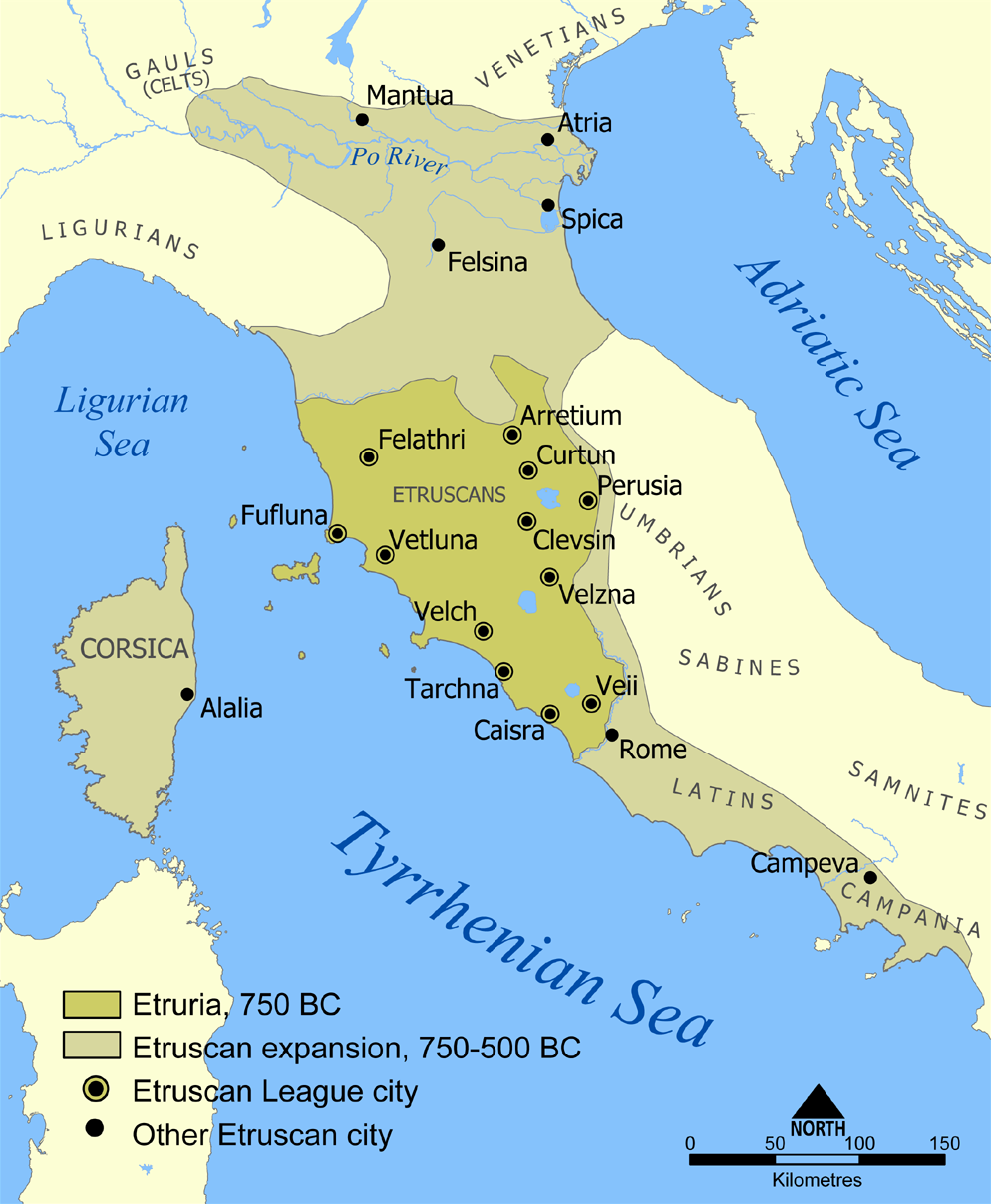


The Proto-Indo-European diaspora pours into Italy in the Second Millennium BC. Meet the Etruscans, the original nemeses of the Romans.
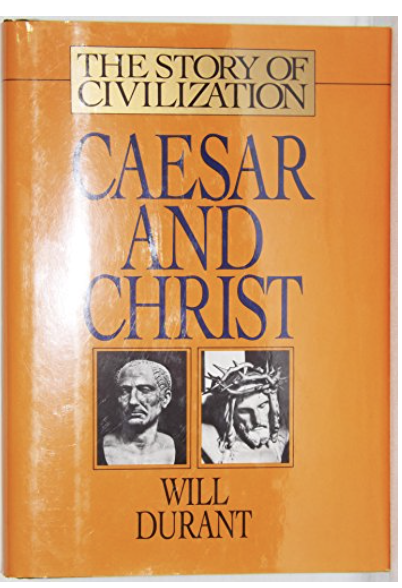
RECOMMENDED READS - Click Image for Link:
Episode III.02 - Introduction to Roman Origins
(Music)
-Throughout the whole earth, and wherever the vault of heaven spreads, there is no country so fair.-
-The Roman philosopher and soldier, Pliny the Elder, describing his homeland, of Italy.
(Music)
According to Roman legend, the story begins in 753 BC, with the founding of the city of Rome. But even the ancient Romans knew that the story of their people extended farther back into the past than that. For one thing, they believed that even before the brothers Romulus and Remus founded the city on the Palatine hill, even before then, that there was more to their story. An even more ancient legend told them that they were descended from refugees who had fled Troy, while the victorious Greeks plundered the fallen city. Among those refugees was the great Trojan warrior Aeneas, who appears in the pages of the Iliad.
But, in order to come to an understanding of the Roman culture, we also have Roman mythology that tells us more about ages past, and these tales also belong to the roman people.
And there remains even today the mystery of the Etruscans, that powerful civilization that, according to legend anyway, vied with the Romans for dominance in the central lands of the Italian peninsula for centuries before the romans overcame them and began their steady, centuries-long conquest of the surrounding world.
And, thanks to modern archaeology, anthropology and genetic science, we can also examine the origins of the Roman people before they even came to Italy.
This first unit of episodes in the Roman Empire series, then, focuses on the earliest days of the roman people, from their origins in the proto-Indo-European diaspora all the way down to the death of the last Roman king in 509 BC.
Before we begin, though, let me remind you to visit the website, western-traditions.org, where you can find all the episodes, as well as pictures, maps, source lists and some good books to read. You can also buy Western Traditions merchandise on the shopping page, or contribute directly to the podcast by using the PayPal or patreon options.
And now, let’s go back, all the way back, perhaps as far back as four or 5000 BC, to the late Neolithic period, when the Proto-Indo-Europeans may have first appeared, emerging from the mysterious backstage of human history, in their homeland somewhere in central Asia.
(Music)
To some extent, these stories that we tell ourselves about ancient humans, like the Proto-Indo-Europeans, The Anatolian farmers, the Australasians, the people who crossed the Bering Strait, these stories are our own modern myths. Scientists will speak with confidence about the characteristics and the appearances and the movements of these groups. But, the truth is that these are really just stories that we tell ourselves based on the smallest shreds of evidence. Sometimes, really, without any evidence at all.
Nevertheless, we need some kind of story that precedes known history.
Think of known history as a tapestry and at both ends this tapestry is ragged and unfinished, the right edge of the tapestry is where the threads that lead into the unknown future are still warping and weaving their way together and creating a new design.
To the left of the tapestry, there is another ragged edge. Here the threads extend into the past, into ignorant darkness. In that darkness live the Aurignacians, the Gravettians, the Yamnaya culture, the Corded Ware people, the Anatolian Farmers, and the proto-indo-europeans.
And so, gathering up a few threads of knowledge and a handful of assumptions, pieces of broken pottery and discarded tools and weapons, we weave and blend those threads into the the tapestry and try to make a larger picture that makes sense to us.
Thus it is with the Proto-Indo-Europeans. Everything that I’m about to tell you is really just based on some threads that we have discovered, some relics and engravings, things we have tried to weave into something comprehensible, something that ultimately comforts us in its intelligibility, in the agreeable way that it intertwines with the tapestry that we do know.
So here is the myth.
In the twelfth episode of my first series on the ancient world, I introduced the concept of the Proto-Indo-Europeans, a tribe or nation or a collection of tribes in central Asia somewhere that all spoke the same language, and probably had the same culture, and probably had achieved the same technological developments, such as the domestication of the horse, the design of the wagon wheel and the axle, the implementation of purposeful agriculture and the herding of animals, and so on.
In this story that we tell ourselves, sometime before or after 4000 BC, this culture began to slowly expand outward, perhaps due to it's superiority over surrounding peoples, who were either still hunter-gatherers or still living according to the habits and traits of the much simpler European farmers who had received their agricultural knowledge, and possibly their genetic heritage, from ancient farmers in Anatolia, and who had already populated much of Europe at that time.
Many of these Indo-European speakers moved due East from their central asian homeland and eventually reached the borders of China. Their descendant culture became the Tocharians and they eventually disappeared. We have only their bones, and eastern rumors of a caucasian people wandering central and eastern asia long ago, to attest to their existence.
Some others of this Proto-Indo-European diaspora moved east and then south. They became the Persians in Iran and they also became the Aryans who invaded northern India, and who brought new gods and new blood into the Hindu sphere.
Others moved into Anatolia and became the Hittites, and some may have even come into Mesopotamia, though the powerful, ancient cultures there probably absorbed them anonymously. Some of them may have become leaders among the Hyksos that conquered and briefly ruled Egypt.
Still others moved north and some of those migrants would have become the Norse peoples, about whom you can learn more in the fourth series of this podcast about the Middle Ages.
Finally, though, some of these Indo-European speakers flourished in the west, and they populated virtually the entire European continent.
We learn in the Greek Sun, my second series of podcasts, about Ancient Greece, how some of these migrants became the Greeks. The ancient Indo-European sky god, Dyeus Pitar, became Zeus, and he and his brethren replaced the Titans, the gods who had been worshipped before their arrival in and around the Aegean Sea.
Other migrants from central asia moved deeper into Europe and became the Celts, about whom we will learn later in this third series of episodes, when they come into conflict with the Romans.
But, finally, some of these Indo-European speakers moved down into the Italian peninsula. Into a verdant, fertile land, that also presented challenges with its central mountain range, its earthquakes and volcanoes and what must have certainly been an already populous terrain, full of successful Neolithic farmer cultures that had been there thousands of years perhaps, enjoying the verdant, fruitful soil and telling their own stories, about their own gods, making their own art, designing and building their own architecture and so on.
According to our myth, remember, this is all a myth that I am telling you, a modern myth, but a myth nonetheless, in this story that some of us tell ourselves, these migrants into Italy would have had to fight to find a place. Fortunately, for them, we suspect that the Indo-European migrants were probably quite aggressive and uniquely capable of decisive, organized warfare, since most everywhere they went they appear to have replaced the existing populations to a great degree, such that only traces of hunter-gatherer genes and earlier European farmer genes remain today in modern European blood.
Now, the research on all of this is quite broad and deep and fascinating, but it also has no place in this podcast, which is more of a survey of western history and not a scholarly plunge into deep learning about every stage of pre-historic European development.
For our purposes, let it suffice to say that sometime during the late second millennium BC, probably about or just after the time that the Greeks were moving into present-day mainland Greece, sometime in that millennium, Indo-European speakers came down into the Italian peninsula.
It is important to understand that we are NOT speaking about the Romans quite yet. The Italic cultures and peoples that developed out of this era of migration formed many different cultures and nations that would later surround the Romans when they founded their kingdom in 753 BC. The Romans would be just one expression of this cultural and populational shift that occurred thousands of years ago.
Amid this maelstrom of peoples and cultures that flourished in ancient Italy, the Romans were just one people that established themselves in central Italy, along the river Tiber, perhaps some 3000 years ago.
This is the story we tell ourselves now. Not everyone tells the same story, and the romans themselves had other ideas about their origins. Many of the Romans considered themselves descended from Trojans who had fled the Greek siege of their city during the Trojan War as depicted in the Iliad and these refugees, after a long and torturous odyssey of their own, wound up eventually in Italy. This is the underlying theme of the Aeneid, an epic poem by the Roman poet Virgil, which we will also discuss in a future episode of this series.
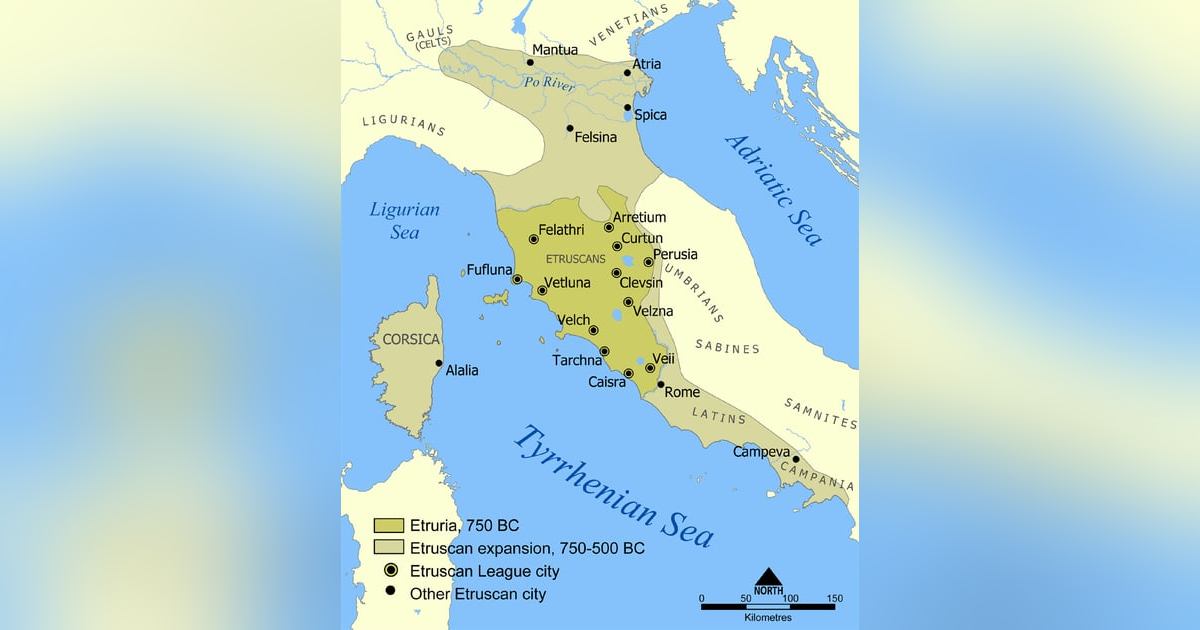
Indeed, even some other ancient historians, the Greek Herodotus among them, believed that certain people living in Italy were descended from immigrants who at least came out of the Greek sphere of influence, even if not from ancient Troy. Indeed, when you read in the histories of the greeks and they refer to the Tyrrhenians, they are most likely speaking of the Etruscans, who lived alongside the Romans for centuries.
And, as so often happens with these ancient stories, which many scholars for a long time assumed to be complete fantasy, archaeology has begun to substantiate them.
In 1885, a stele, which was an ancient type of engraved stone marker, was discovered on the island of Lemnos, which is in the northern Aegean Sea, not all that far from ancient Troy, actually. And the mysterious language found on that stele bears resemblance more to the language of the ancient Etruscans than it does to ancient Greek.
But just who were the Etruscans?
That is a matter of central importance to Roman identity.
(Music)
Down through the centuries, the Romans had a variety of nemeses. The Carthaginians, the Celts, the Vandals, the Persians, and so on. But the first enemy of all was the Etruscans.
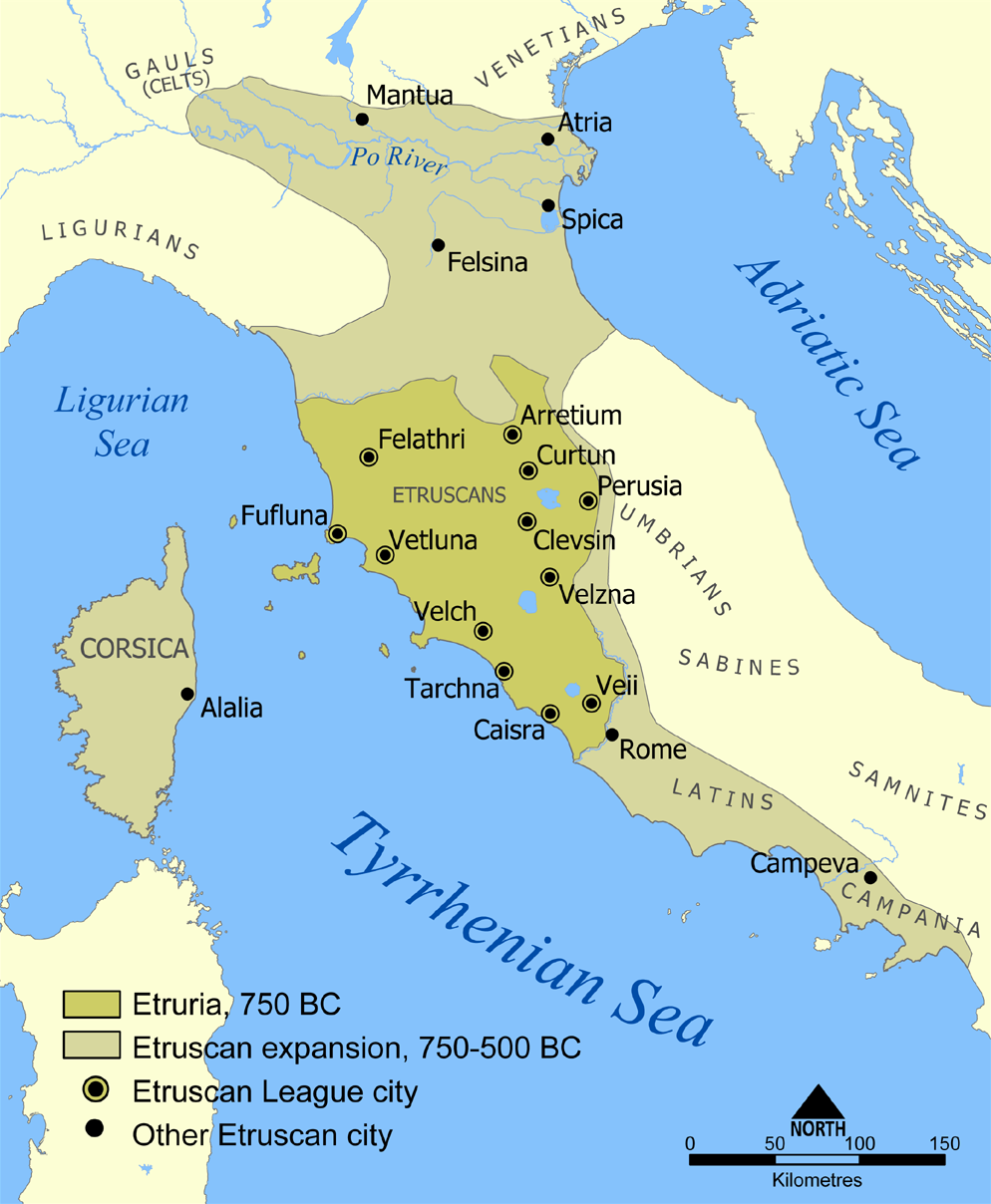
The Etruscans loom large in the early history of the Romans. The kingdom of Rome was mostly centered around the city of Rome itself, long before it became a world power spanning the Mediterranean Sea and dominating portions of Europe, Asia and Africa. And during the days of the kingdom, Roman histories present the Etruscans as the primary menace to Roman independence.
This seems natural, since the territory of the Etruscans bordered the Romans to the north originally and may have actually encompassed Rome at times.
Now, Roman history presents a line of kings in the earliest days of the city, distinguishing themselves from the Etruscans. And many things about the Etruscans do seem distinct from the Romans. Their language, for example, for long indecipherable, now appears to be a Paleo-European language, that is, a language pre-dating the arrival of Proto-Indo-Europeans. So the consensus view for some time has been that the Etruscans were an indigenous population.
And, since we know that the Romans are Indo-Europeans, this sets the stage for a nice, predictable drama in our heads, right? It gives us a beautiful myth to contemplate. The invading proto-indo-Europeans meet and conquer the more peaceful indigenous folk of Iron Age Italy.
Unfortunately, for historians, but fortunately perhaps for Roman propagandists, most ancient Roman historical records were destroyed in 390 BC, when the Celts invaded Italy and sacked the city of Rome. Modern scholars suspect that this was an opportunity for Romans to essentially rewrite their own history, giving us now the very neat, clean story of the city being founded in 753 BC, of seven kings ruling in succession over the romans until 509 BC, when the last king, an evil Etruscan tyrant, was overthrown and replaced with a republic.
That story seems to fit with another one of those mythical narratives that we like to compose in our heads in order to force the past to make sense, to make it fit into a familiar storyline with a beginning, a middle and an end, and a plot that we can understand. The story we have told ourselves for a long time goes like this:
That the ancestors of the Romans were Indo-European speakers, descended from the diaspora that came out of central Asia as previously described.
The Etruscans were indigenous, perhaps descended from a mixture of Anatolian farmer culture and the original hunter-gatherer population that had been living there since time immemorial, perhaps also with an admixture of blood from the Trojans, if we wanted to accept a little bit of Greek myth about the local population.
After centuries of conflict between the two cultures, during which time the Etruscans actually ruled over the Romans for some hundred years, the Indo-European speaking Romans won out and the Etruscan population was subjugated and assimilated, never to be heard from again.
But modern science and technology love to shatter these fragile myths that we weave in our minds. If only science was as obliging about replacing these broken dreams with something else, something tangible and intelligible.
Anyway, in 2021, DNA analysis was performed on several dozen sets of ancient remains found throughout Tuscany, which was the ancient territory of the Etruscans, and they performed the same tests on remains in Latium, the ancient homeland of the earliest Romans.
The analyses had some surprising results.
The Latin Romans and the Etruscans were not that genetically different.
All the remains, Etruscan and Latin, had mixtures of Steppe ancestry, as well as signs of descent from local hunter gatherer genes, with a few signs of Anatolian farmer blood. So, not only were the Etruscans and the Romans essentially brothers, if we are to believe these results, this new myth that we are telling ourselves about the past, but they also both seemed to be descended primarily from the steppes, that is another way of referring to the homeland of the Indo-European speakers from the plains of central Asia, those horse-riding, wagon hauling farmers and pastoralists who had started spreading into Europe thousands of years before.
In terms of genetics, this leaves us a confounding story. There are so many signs that the Etruscans were distinct from the Romans. And the roman story about the struggle against the Etruscans is so compelling.
The confusion gets worse, though. Other studies, based on mitochondrial DNA, the kind passed down only from mother to child, these studies actually support the idea that the Etruscans were, in fact, indigenous, with strong connections to the Anatolian farmers, possessing the Neolithic package of agricultural tools and techniques, and that they had come out of Southwest Asia. For more information on the neolithic package, listen to the eighth episode of my first series on the ancient world, about the Neolithic age.
So we will just have to embrace the mystery, as I like to say, when we run out of solid information and must simply go by what we see and read and hear. Many of the coming episodes will have very clear things to say about the Etruscans, opinions and stories told to us by the Romans, who certainly seemed to consider themselves distinct, and apparently were distinct in terms of culture and language, even if their blood seems to have flowed from the same river. And we will just have to juggle that ancient roman perspective with the conflicting scientific and archaeological data that we continue to discover.
I have mentioned so far the genetics and the Roman legendary references to the Etruscans. What does archaeology tell us about them?
(Music)
Let us begin with the Villanovan culture.
Now, the Italian Peninsula has been inhabited for at least 30,000 years and probably longer, by hunter-gatherers who probably descended from the earliest archaic humans who wandered the earth for hundreds of thousands of years. And the anthropologists have a cascade of names for each succeeding culture that lived there, based on their pottery and other relics from those lost ages of man.
But the Villanovans can be considered the fathers to the Etruscans. They may have come down into Italy from Germany sometime around 1000 BC. They shared certain cultural traits with the tribes that lived in ancient Germany at that time.
For our purposes, the remains of Villanovan culture consist of some pottery, vases, helmets, and other items made from bronze and iron, as well as architectural remains of rectangular huts that show signs of cooking and family life.
The most interesting thing about the Villanovans is that the locations of their ancient settlements overlap both the Etruscans and the Romans’ territory, further supporting the idea that contentious idea that the Romans descended from the same cultural group as the Etruscans.
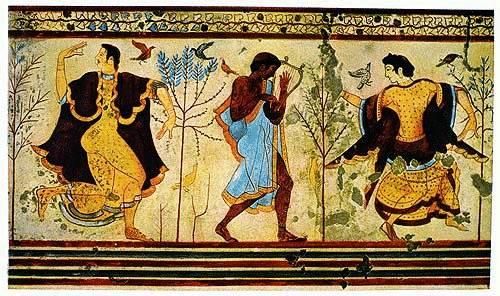
Most of the archaeological evidence that we have from later Etruscan civilization is from graves. This is probably because everything else that the Etruscans used or made was assimilated in later years by the Romans and converted to their use, even the paintings and other artworks often being overlaid with fresher, Roman work.
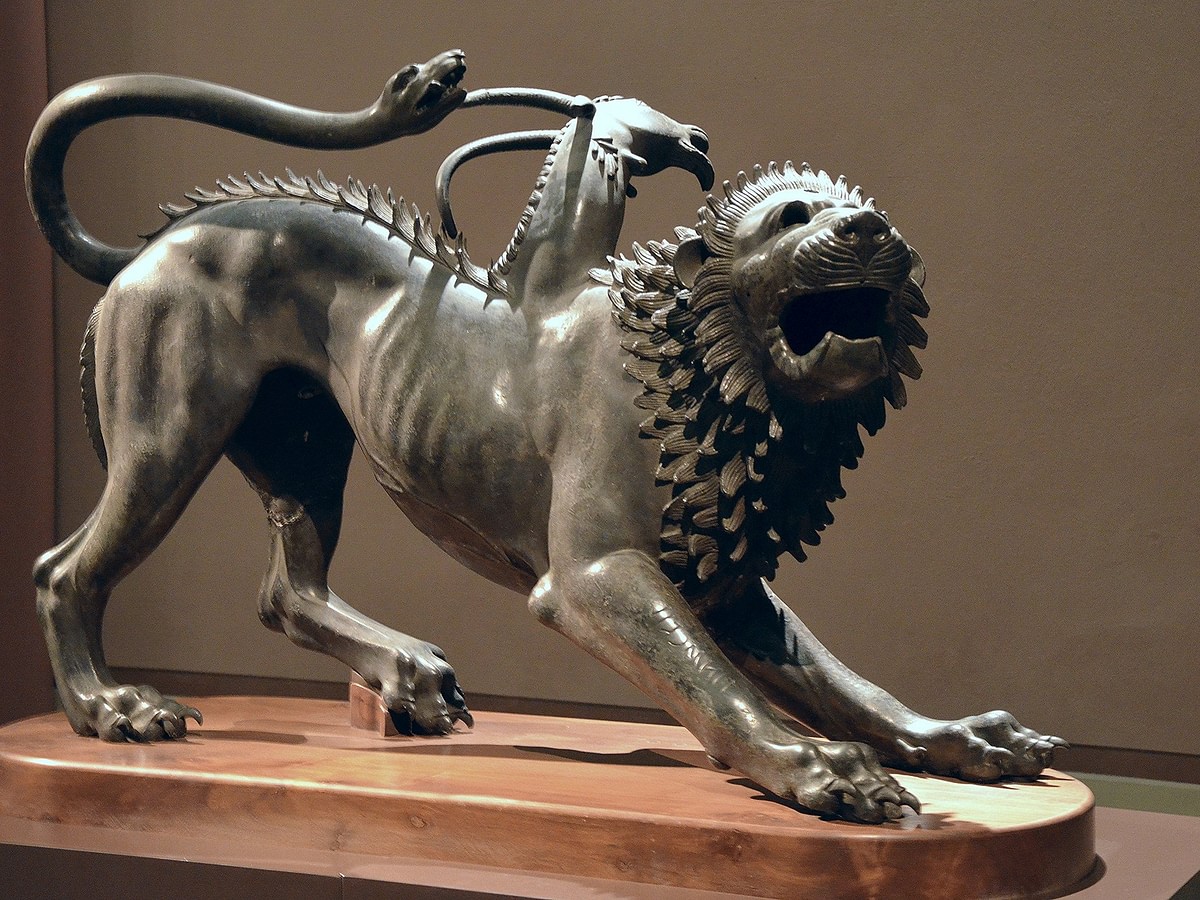
One startling, authentic remnant from the Etruscans is an intact bronze statue known today as the chimera of Arezzo. I will include a picture of this piece on the website, at western-traditions.org. This chimera is a bronze lion with a venomous serpent in the place of its tail and a ram’s head jutting awkwardly out of its back, probably referencing the ancient and presumably Greek myth about the hero Bellerophon.
Other artwork that survives from the Etruscans often depicts people who were, in the words of historian Will Durant, “short and stocky, with large heads, features almost Anatolian.” Again supporting that mysterious connection to the Anatolian farmers and perhaps the Trojans.
The Etruscans dominated much, but certainly not all, of the Italian peninsula beginning around 800 BC. This is what archaeology tells us.
But how did they live?
The Etruscans enjoyed mass entertainment in the form of bull fights and chariot races. They also engaged in familiar Olympic sports, such as foot races and pole-vaulting and boxing and discus throwing. They also held gladiator games.
And this was a wealthy culture. According to our grave findings, Etruscan women wore gorgeous amber necklaces and gold jewelry of every sort.
The artwork of their tombs also tells us a little about the religion of the Etruscans. Their gods were both similar and different when we compare them to the Greeks and the Romans. They worshipped a sky god by the name of Tinia. Like Zeus, Tinia spoke in the thunder and threw lightning bolts. He was lord over a pantheon of 12 great gods.
Among these 12 gods was a husband-wife couple named Mantus and Mania, and they jointly ruled over the underworld, where they were surrounded by winged demons. In their underworld, the dead were judged. Those deemed good enough ascended to enjoy the company of the gods. The damned, on the other hand, those whose lives were deemed unworthy of the gods’ company, were tortured. Their suffering could be relieved by the prayers of the living.
And here is an excellent subject for more research concerning the connection between the later Christian conception of Hell and this Etruscan, and later Roman, idea of suffering, both temporary and eternal. Already here we see hints of Dante’s Inferno, Dante who considered himself both a faithful Roman and a Catholic.
Other gods seem to either have been borrowed from the Greeks or vice versa. There was Aritimi, who was a carbon copy of the the virgin Artemis, whom the Greeks worshipped as the goddess of the hunt and whom the Romans named Diana.
There was also Menrva, whom the Romans called Minerva, their goddess of wisdom, a renamed Athena.
The Etruscans also had a strong-man hero named Hercle, who ascended to godhood and whose name seems quite similar to the Greek Heracles and the Romanized Hercules.
The list of such similarities goes on.
The Etruscans apparently practiced animal sacrifice and occasionally sacrificed humans as well, as we have seen elsewhere, among the greeks and the Phoenicians and the carthaginians. At a yearly festival, the Etruscans reportedly sacrificed children into the care of the lady of the underworld, Mania.
They are often contrasted, however, as being more refined than the romans, as a more ancient civilization, its people possessing more of the social graces than the simpler, straightforward Romans. Later Romans would comment on the finer things in their culture having come from the Etruscans.
The Romans admired the Etruscans enough that, even at the height in their rivalry, a wealthy Etruscan who had migrated to Rome in the mid-7th century BC, by the name of Lucius Tarquinius, later became the fifth king over the Roman people. He is remembered to history as Tarquinius the Elder, since one of his descendants, also named Tarquinius, would be its last king a century later.
(Music)
We leave behind now the Etruscans, whom we can only portray according to what truth we can parse from the existing archaeological and scientific evidence. Future episodes will relate almost entirely the Roman perspective on their Etruscan rivals.
Before we move forward in time, though, before we get into the nitty-gritty details of Roman politics and class struggles, we are actually going to move back, into the past, into myth, as we look at Roman mythology and their oldest stories about their own identity.
Until the next episode then, I thank you for listening to the Western Traditions podcast.