Episode II.42 - Greek Twilight


Pyrrhus, Greek king and general, fights the Roman tide that threatens to wash over the entire Greek world. The Seleucid Empire and Ptolemaic Egypt flourish and endure. The Maccabees revolt in Judea and start the Hasmonean dynasty of kings in Jerusalem.
(Music)
“Arius, king of the Spartans, sends greetings to Onias the high priest. A document has been found stating that the Spartans and the Jews are brothers, both nations descended from Abraham.”
-Chapter 12, verses 20 and 21, from the first book of the Maccabees, which describes an alliance between the Jewish rebels of the 2nd century BC and the king of Sparta, versus the Seleucid empire.
(Music)
Perhaps every society has its ending written into its beginning. The Constitution of the United States of America contains language accommodating slavery, and it would be this very matter, the matter of slavery, some four score years later, which provoked the civil war that would shatter that first attempt at democracy in the New World.
After the conquest of Persia and the death of Alexander the Great, the vast dominion which existed in its wake, this Greek-ruled polity stretching from Egypt and Macedon all the way to the Himalayas, this too would perhaps come to an end as an inevitable consequence of the very elements of its foundation.
Because these were Greeks after all. Haven’t we seen that, for centuries, the ancient Greeks were happiest living in a collection of small city-states, ever at war with one another, and ever conniving in a variety of changing alliances against one another?
So, instead of falling in behind the heirs of Alexander, whoever they turned out to be, and holding together the largest empire to have ever existed on Earth at that time, the Greeks fell into faction and fratricidal warfare.
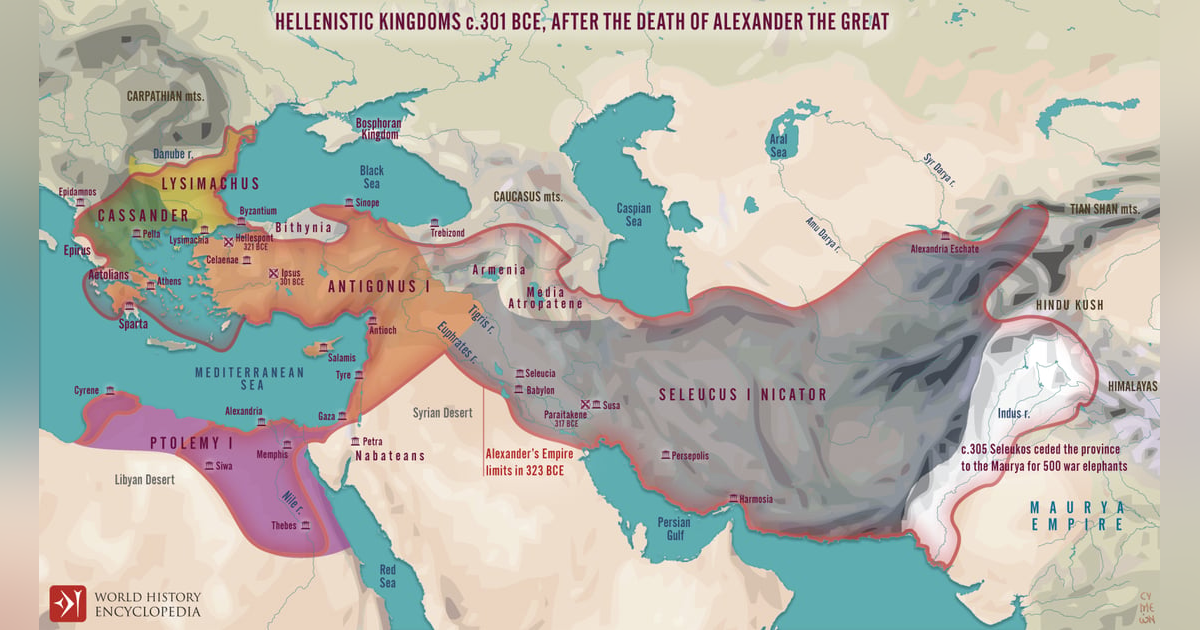
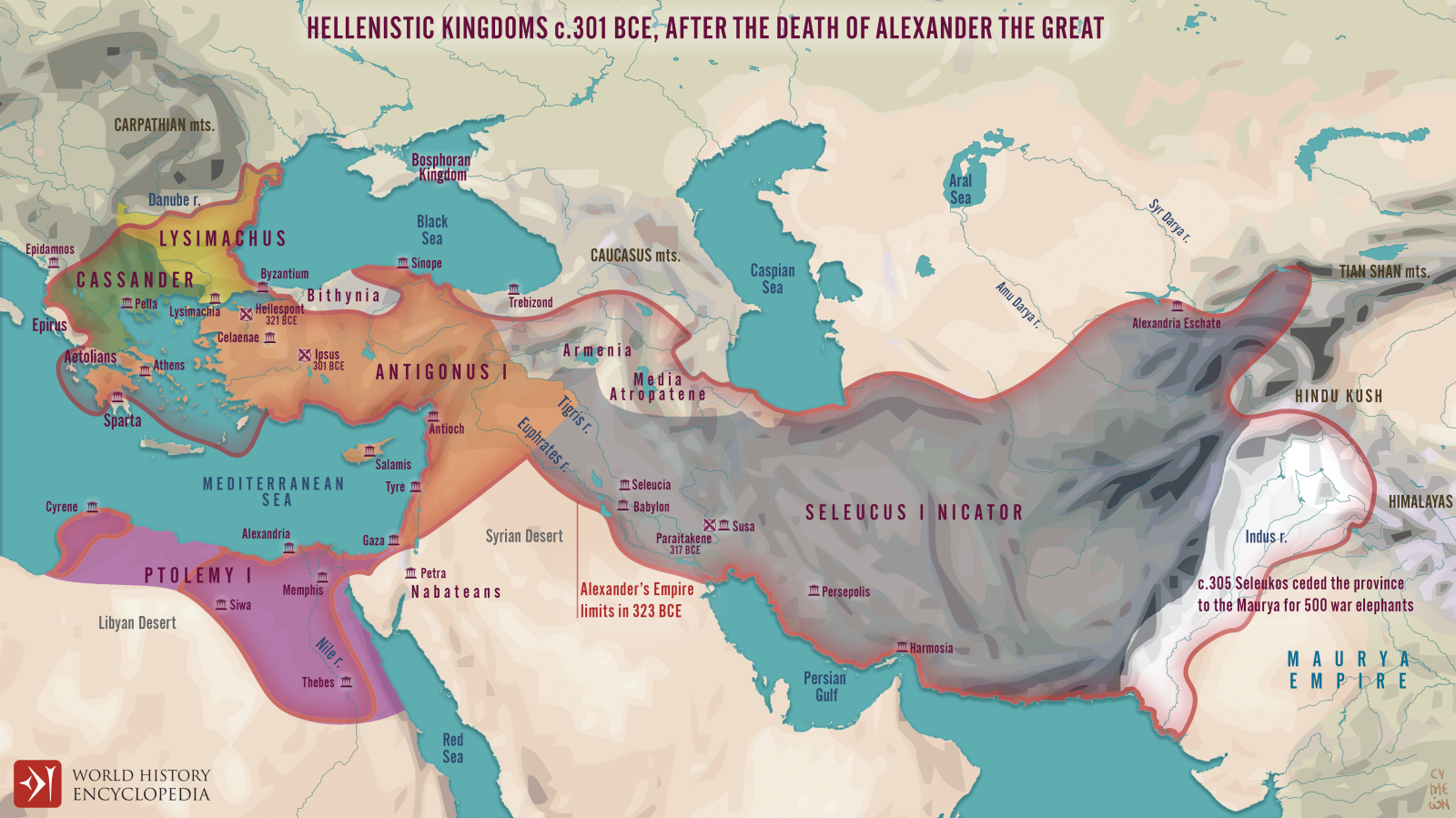
As I outlined at the end of the last episode, less than a decade after Alexander passed, there came into being several large, Greek-led states across the ancient Near East. These included those in the traditional Greek homelands, but also encompassed Egypt, all of Anatolia, Mesopotamia, ancient Persia, and other locations now found today in Iran, Pakistan, Afghanistan and India.
Perhaps now, it makes more sense why I began this podcast, whose focus is our Western Traditions, with a series about the ancient Near East, even though that region of the world seems quite unrelated to most of those things that usually make up our idea of Western civilization, things like the Roman Empire, the Middle Ages, the Industrial Revolution and so on. I began with the Near East because Western Society has always been involved, to a greater or lesser degree, with the culture and politics of that region of the world. Just look at how things stand now, as I produce this episode, here at the end of 2024. The West and the Near East, in places like Syria, Iran and Palestine, cannot seem to let go of the death grip that they have on each other.
Anyway, I should not try to give you the idea that the Greeks were really all that unusual in their failure to maintain unity after finding themselves with so much power and influence. It would be easy, yes, to compare them to the Romans and then suggest that the latter were simply more disciplined, better-organized and more prone to coordination rather than competition, and this explains why the Romans held their Empire together longer.
But that would be disingenuous. The Romans did, in the end, yes, maintain the integrity of their empire more successfully than the Greeks did.
But only just barely. The Romans, too, suffered many civil conflicts, many divisions of their empire, many warring emperors turning different parts of the empire against one another. It’s just that, in the end, by the skin of their teeth, the Romans, again and again, managed to keep that empire intact.
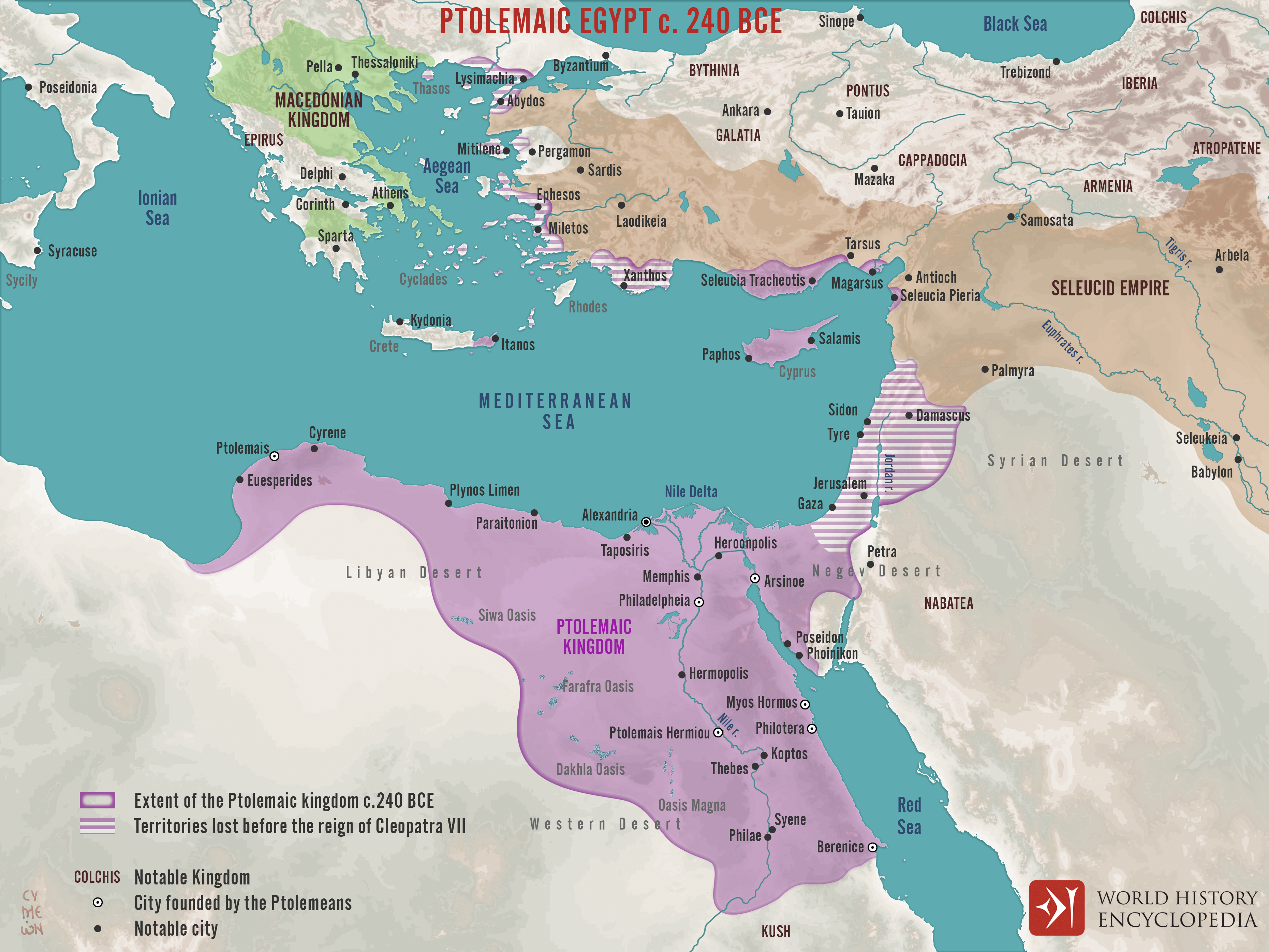
And, you must admit, the Greeks, within their multiple realms in the Near East, they did manage other retain power and control for a long time. The Seleucid empire and especially Ptolemaic Egypt attest to the endurance of greek political will.
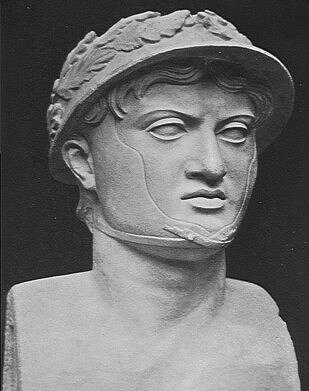
Before we get on with some study of these empires, in the twilight of Greek power and influence, we will look first at a famous general of the immediate post-Alexander era. I speak here of Pyrrhus, who will, incidentally, in his many battles, come into contact with the Romans, and, just barely, stay and delay their encroachment on the Greek sphere of influence.
As we turn to Pyrrhus and the period directly after the death of Alexander the Great, please remember to turn to my website, at western-traditions.org. There you can find all the episodes from every podcast series, as well as some great book recommendations, and some helpful pictures and maps. While you’re there, you can help support the podcast by purchasing merchandise on the shopping page or you can contribute directly through the PayPal or patreon options. Patreon supporters get access to my patreon page, where I share behind-the-scenes developments and recommend a variety of different resources for fellow history lovers.
(Music)
I mentioned the Molossians in the last episode. They were a tribe of Greek-speakers living in the regions northwest of the Greek mainlands, a region known as Epirus. Alexander the Great’s mother, Olympias, had come from the ruling bloodline of these people.
In 319 BC, Pyrrhus was also born into this bloodline, and he was actually a second cousin of Alexander’s. After Alexander’s death, but prior to Pyrrhus’ birth, his father had supported Olympias against Cassander, the son of Antipater, who desired to rule over Macedon and all of Greece. Just after Pyrrhus was born, however, a coup managed to expel his father from Epirus. Pyrrhus himself was nearly killed as an infant when he was transported, separate from his family, to the land of a neighboring king, who raised the boy as his own and later helped restore him to the throne when Pyrrhus was just 12 or 13 years old.
Pyrrhus would grow to manhood and become one of the most-highly regarded generals of the ancient world. Hannibal Barca, the Carthaginian general who would terrorize Rome a few generations later, rated Pyrrhus as the greatest of all generals, second only to Alexander, to whom there was no comparison, of course. Scipio Africanus, Julius Caesar and others would all share in this appreciation of Alexander’s cousin.
Yet, Pyrrhus never ruled a great empire.
Unlike his cousin Alexander, Pyrrhus would never have handed over to him a pre-made army, ready to strike at his ancestral enemy, like a newly sharpened sword placed in one’s hand. Instead, Pyrrhus would have to cobble together armies from what soldiery was at hand, and he would never really have a steady home base behind him, like Alexander had. In fact, Pyrrhus would essentially be ruler over a few different realms at different times in his busy life.
When Pyrrhus was still a teenager, Olympias, and Alexander IV, mother and son of Alexander the Great, they both died, and thus removed any hope for unity among the Greek states. There was no clear successor anymore to the empire anymore, and the diadochi, the generals of Alexander, fell to fighting among themselves for a generation, until a handful of separate, independent kingdoms were carved out of the briefly-lived Macedonian Empire.
Pyrrhus himself allied with Demetrius, ruler of Macedon at that time, and warred with him in Anatolia versus Lysimachus, one of many other Greeks now ruling over formerly Persian lands. During this conflict in Anatolia, Pyrrhus was taken as a hostage and delivered over to Ptolemy in Egypt.
Ptolemy, one of the last still-living generals from Alexander’s army at this time, was now ruling as Pharaoh over the Egyptians. He took a liking to this hostage, to Pyrrhus, who perhaps reminded him of his old king. So much did he admire the lad that he offered the young man his step-daughter in marriage, and then, in 297 BC, Ptolemy put together a small army for Pyrrhus and helped return him to his throne in Epirus.
Pyrrhus had not yet done much in the way of battle to earn him accolades as a great general, and he was already in his 20s, the age by which Alexander had already conquered a great empire. Perhaps that was because young Pyrrhus was busy devoting his energies elsewhere. He would have five wives over the course of his life, many of them simultaneously, and these were just the legal wives.
His second wife, Lanassa, daughter of the Greek king of Syracuse in Sicily, abandoned Pyrrhus only a few years into their marriage, after giving him one son. She claimed that she could not tolerate sharing a home with his other barbarian women. So she fled to the island of Corcyra, where the Peloponnesian War had gotten started some 150 years before. From there she sent a message to Demetrius, the current king of Macedonia, and she offered herself and the island to him. Demetrius accepted the offer and now, with the addition of this island to his domains, as well as his possession of the body of Pyrrhus’ ex-wife, he was encroaching on Pyrrhus’ territory.
This led to the long and complex conflict between Pyrrhus and Demetrius. By the year 285 BC, though, Pyrrhus had fought in several engagements both small and large, with or without allies, and he eventually found himself overlord of not just his own kingdom of Epirus, but much of Greece and Macedon, and he had many allies spread throughout the greek world.
Yet, this was really a small world over which Pyrrhus ruled, when compared to the great things happening all around the Mediterranean. In Egypt, Greek learning and scholarship in places like Alexandria was attaining its zenith. And the Greek Seleucid Empire ruled over the true locus of wealth in Mesopotamia and Persia, even if it had begun to lose some of its far eastern lands to the Indians.
And far to the West, Carthage and Rome were consolidating control of their portion of the Mediterranean.
Finally, though, in 280 BC, the way to greatness was opened for Pyrrhus. The Romans were beginning to seize territory in southern Italy and Sicily, threatening the Greek cities there. The endangered Greeks living in these cities invited Pyrrhus to come to their aid.
So Pyrrhus put together an army of some 20,000 infantry, a few thousand cavalry and 20 war elephants loaned to him by the Greek pharaoh in Egypt. With these forces, he landed in Southern Italy, and came into direct conflict with the Romans.
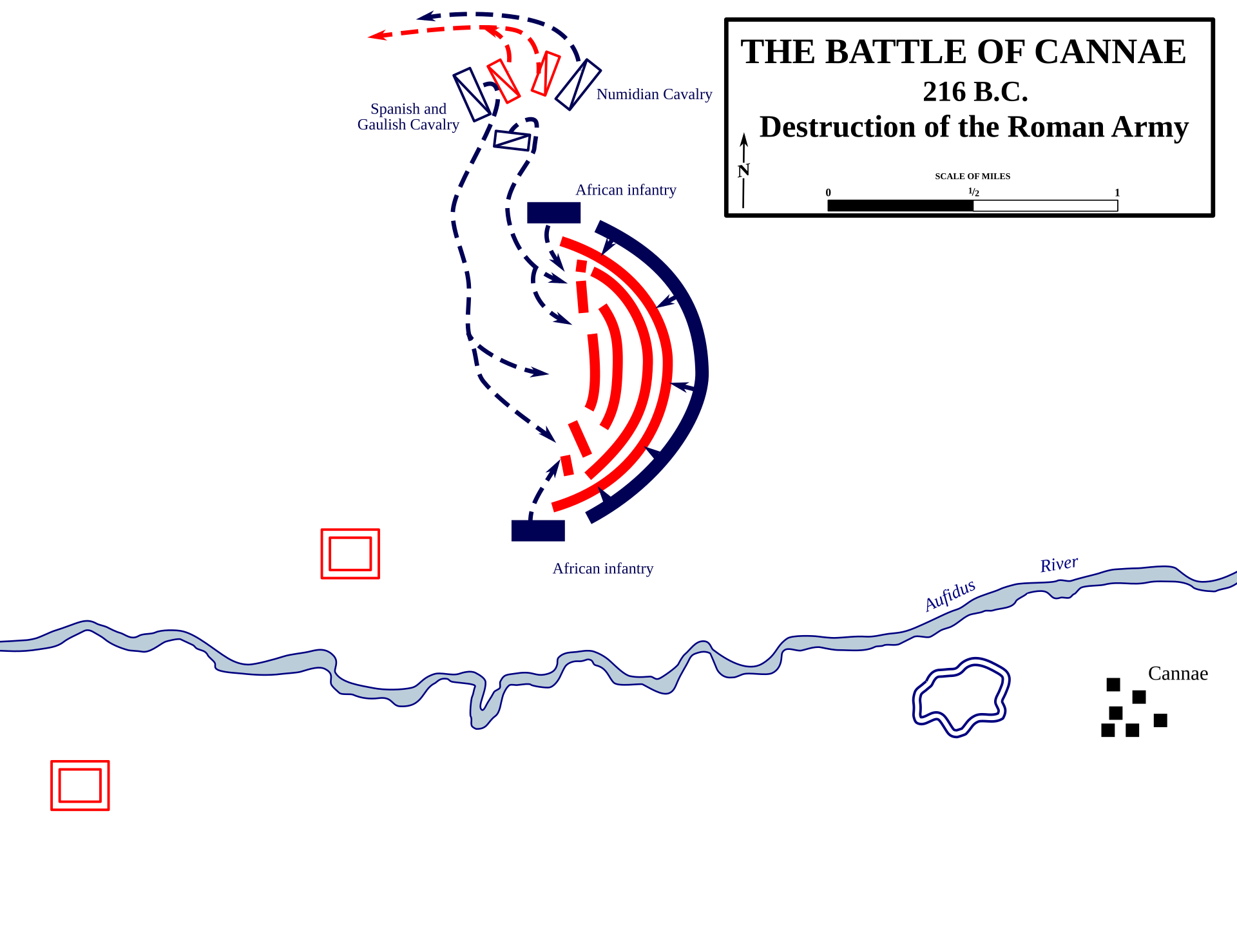
Pyrrhus was victorious everywhere. Greek cavalry, the highly trained phalanxes and the war elephants were all superior even against the formidable Roman legions. He even approached Rome during his campaign in southern Italy, but, as many invaders would find over the years, Rome’s defenses were simply too strong to be overcome, even by a superior army. Pyrrhus, like Hannibal a few generations later, eventually had to withdraw and continue the war in the south of the peninsula.
It was one of these battles in southern Italy, versus the Romans, which brought into being the famous saying about winning a “pyrrhic victory.” Pyrrhus and his troops fought here against the army of the Roman consul Publius Decius at the battle of Asculum in 279 BC. The greek army was victorious, but the Romans fought to the bitter end and Pyrrhus lost so many troops and experienced officers in the effort that, after the battle, he reputedly told his remaining lieutenants:
“If we defeat the Romans one more time, we’ll be finished.”
In the aftermath, Pyrrhus became overlord of much of Sicily. Here, he warred also against the Carthaginians, who were also becoming interested in attaining greater control over this island placed between Italy and their their home in Africa. But in the end, after years of overcoming many extreme challenges, Pyrrhus was forced to abandon Sicily and return to Greece.
Now, the nitty-gritty details of all the numerous military engagements of Pyrrhus were perhaps interesting only to the ancient Greeks and Romans. Plutarch describes them in his biography of the man.
For our purposes, let it suffice to say that Pyrrhus was in many battles, petty or ambitious, toward the end of his life, usually in mainland Greece somewhere, usually surmounting difficult circumstances, overcoming political complexities and surviving tragedies, such as the loss of his firstborn son, Ptolemy, who died leading troops in the rearguard when on retreat from an assault versus the Spartans.
But it was all downhill from there for Pyrrhus. Later that year, in 272 BC, he found himself in the city of Argos in a street battle. A woman atop a building that oversaw the conflict threw a roof tile down on Pyrrhus and he fell from his horse. Laying on the ground, injured, he was beheaded.
Thus was repeated a phenomenon that I remarked on in earlier Greek episodes, how many great warriors of Greek history often met their end in some petty squabble, or in some ignominious death, like Alcibiades fleeing his burning house and being shot down with arrows. So died Pyrrhus, great general of greek history, stunned by an angry woman that threw a roof tile at him and beheaded by a common soldier while lying incapacitated on a dirty street in Argos.
It is perhaps difficult, at this great distance, to see how such great generals, Greek, Roman and Carthaginian, would hold Pyrrhus in such high regard. Especially in light of what Alexander the Great had accomplished, and what many Roman generals would do in their military careers, and in light of the decades of terror that Hannibal the Carthaginian would unleash on the Romans.
Pyrrhus seems petty in comparison, never commanding nearly as many forces, and never ruling over territory anywhere near as widespread as those men nor possessing significant wealth or other resources. But, perhaps it was the difficulty of his circumstances, which he overcame only with the frenetic energy that seemed common to all the Greeks of the ancient world. He had an amazing capacity to continually struggle, to always further his own ambitions. Pyrrhus was not given the same resources as so many other great generals, and typically had to cobble together a fighting force from what soldiery was at hand.
Like so many heroes about whom we have read so far, Athenians like Themistocles and Pericles and Cimon, Spartans like Brasidas and Lysander, Macedonians like Alexander, just like them, Pyrrhus was apparently as tireless as he was ambitious.
During that brief period when Pyrrhus ruled over his domains in Sicily, the Greek world may have finally reached its zenith, if it had not already done so with the conquests of Alexander. But certainly, after this juncture, the Greek world, in terms of political power, would only diminish. The Indians, Parthians, Romans and others would eat away at the borders of the Seleucid empire until it fell in the last century before Christ. The Romans would slowly take control of the Greek mainland during the century prior to that, defeating even the Spartans finally. Greek Egypt would hold out the longest, succumbing to Rome’s seemingly invincible advance only in 30 BC.
Perhaps the most significant thing about Pyrrhus’ adventures in Southern Italy and Sicily, was the encounter with both Rome and Carthage. After the Greeks lost power in the cities of Italy and Sicily, Rome and Carthage would come face to face for the first time, in prelude to the Punic wars which would begin a generation later.
In the meantime, mainland Greece, during the Hellenistic period, continued to carry on its factionalism and its internecine warfare between city-states, forming various small alliances against one another.
In the 3rd century BC, several cities in the Peloponnesus formed an alliance known as the 2nd Achaean League, there had been another such league two centuries before. This league joined the now numerous political bodies that fractured mainland Greece, such as the Aetolian League to the north, the still extant Macedonian kingdom, a newly revived Sparta and an independent Athens among others.
Eventually, Rome would become involved in the struggles between these leagues, and these independent city-states and petty kingdoms. Perhaps the Greek cities did not have the foresight to see that Rome would just play them, one against the other, until they all came under Roman control. Or, perhaps, when the time came to stop the process, they simply didn’t have the stamina anymore to defend their freedom.
Perhaps Greek tenacity, after so many centuries of ambition and warfare, finally faded to acquiescence.
During one conflict with the Romans, one of the Achaean statesmen, Polybius, would be taken as a hostage to Rome. Remember that such hostages were not taken away in blindfolds and fetters but generally lived a good life with their “captors”, and were intended to help integrate two allied causes.
This Greek hostage, Polybius, would then go on to write a famous history about the rise of Rome. He would also, in his writings, describe some now-familiar apparatus of government, expounding on such things as the separation of powers between branches of government and the importance of checks and balances in administration for the first time in history.
I mentioned the US constitution quite pointedly at the beginning of this episode, because the writings of Polybius would be a resource for the framers of that Constitution, some 2,000 years later. Such is the long reach of Hellenism.
So, strangely perhaps, it was mainland Greece that would fall first to the Romans, rather than their colonies, so to speak, in the East. This was not due simply to the proximity of Greece to Rome, but also due to the innate lack of cohesion among the Greeks in their ancestral homeland.
The Greek-ruled kingdoms of the East would also suffer from such political instability. But the two largest, the Seleucid Empire and the kingdom of Egypt, would remain surprisingly intact until they, too, fell to the Romans and others in the last centuries before Christ.
(Music)
The time of the founding of the Seleucid empire is given as 312 BC, eleven years after the death of Alexander. That was the year that the Greek general Seleucid established himself in Babylon and declared himself ruler over that vast swath of land extending from the shores of the Eastern Mediterranean all the way to the Indus River.
Seleucus had been a cavalry general of Alexander’s. You might consider him the winner of the power lottery after the conqueror’s death, because Seleucus, remembered to history now as Seleucid Nicator, certainly ended up with the richest portion of the spoils, ruling as he did over the largest remnant of the the Persian Empire. His lands stretched from the shores of the Eastern Mediterranean to the Indus River, which lies in modern-day Pakistan. The Seleucids, at the height of their power, may have led over as many as fifty million people in their empire.
Seleucus continued Alexander’s multi-cultural vision. He encouraged immigration from Greece into his empire. He and his successors granted these immigrant greeks good lands and various privileges. In general, they were expected to provide in return to the Seleucid empire their military service and their utmost loyalty. Numerous such settlements appeared around the Levant, in Mesopotamia, in Persia and elsewhere during his reign.
The Seleucids also encouraged the mingling of religions. Deceased kings were publicly elevated to divinity, becoming gods worthy of temples and worship.
This was the form that Hellenism took within the lands of the near east. From these outposts, over time, Greek Culture spread into the ancient lands of the Persian Empire, into Mesopotamia and deeper into Anatolia and Persia and modern-day Afghanistan and Pakistan.
Here, in the east, though, Greek Culture also had its least impact, when compared to the progress of Hellenism in Anatolia and Egypt. Most Greek culture occurring in the East occurred only in greek enclaves. The Greeks tended to see themselves as superior to the “barbarians” over whom they had been placed in command.
This is very much a colonial endeavor, little different from the colonialism of recent times. The Greeks came to rule these lands, and to benefit from their wealth and natural resources. And just like during our more recent bout of colonialism in the 19th and 20th centuries, the culture of the colonists spread to the locals in differing degrees.
These Greek colonists in the Seleucid Empire rarely intermarried with the locals. And the cultural interchange was limited. In the Greek settlements, the farms produced olives, grain, and figs, they made wine from their own grapes and cheese from their goats, raising sheep for meat and essentially creating little pieces of Greece to inhabit. The Mesopotamians around them, on the other hand, tended to grow barley and collect figs, and raise sheep to shear their wool and keep to their own ways.
Still, Greeks and natives certainly worked together within the confines of the military. The size of the Seleucid army was generally somewhere between 70,000 at the smallest and perhaps as large as 200,000 troops at times, meaning that the Seleucids fielded bigger armies than any Greeks before them. But, of course, they had to, given the size of their dominions.
Greeks formed the backbone of this imperial army but there were never enough Greeks in the empire to man such a force entirely. The phalanxes and the cavalry remained, through the centuries, almost entirely Greek, while the light troops were natives of the various regions of Mesopotamia, Syria, Persia and so on.
The Greek language, of course, became known throughout the land, as it was the court language. This opened the way for at least some familiarity with Greek literature, art and philosophy. These things first became known among the upper classes of the empire and slowly, over the course of centuries, filtered down to the lower classes.
The Greek language, in fact, became so well-respected and so widely used in these realms that the Jews of Judea even translated their sacred scriptures into Greek. I speak here of the Septuagint, a translation of what we know today as the Hebrew Old Testament, specifically that collection of biblical books still in use in the Catholic Church. This translation, though, most likely was prepared in Greek Egypt.
Still, so widely used was the Greek language, that even the isolationist Jews of Judea, when they eventually revolted against the Seleucids, they still called their new Jewish leaders kings using the Greek word: Basileus.
Now, with regard to that revolt of the Jews in Palestine, this event is depicted in the books of the Bible known as 1 and 2 Maccabees.
The Jews had long been a thorn in the side of the Greek rulers of the Seleucid empire. The Greeks had always been fairly respectful and tolerant of conquered people’s religious beliefs, and they encouraged syncretization, that is, the combining of creeds and faiths. For the Greeks, it was easy to do this. They saw in other nations’ gods simply reflections of their own. They saw their own pantheon reflected in others. So, for example, Marduk, the Babylonian sky god, was just a local version of Zeus for Greek eyes.
How well this ecumenism was received by the Babylonians is not really known. But there was a problem with this arrangement in lands not far away, on the Levantine coast, in the land we know today as Palestine. There, the ancient Jews, whom I have not discussed since the end of the 25th episode of the first series of this podcast, they worshipped only one God.
Now there is a great deal of controversy about just how monotheistic the people of that region were in ancient times. I have also discussed this matter in the episode on Ancient Israel in the first series of this podcast. But, there can be no doubt, ever since their return from exile in Persia, in the late 6th century BC, the Jews, or at least the orthodox believers among them, had been increasingly devoted to their one God and dismissive of all the gods of other religions and peoples. And they detested the presence and worship of foreign gods in their own land.
The first book of the Maccabees outlines the conflict for Jews of the 2nd century BC, beginning with a brief description of the death of Alexander the Great. There was apparently little conflict between Greek and Jew about these religious matters initially, though, because the books of the Maccabees do not mention any trouble until about the year 175 BC, when the region had already been under Greek rule for nearly 150 years.
At this time, it seems like certain Jews and other locals in Palestine began to appropriate Greek customs and lifestyles. A gymnasium was built, and Greek athletics became popular. The text of 1 Maccabees declares that these Jews who ran in Greek circles were ashamed of their culture, of their jewishness, because they covered the marks of their circumcision when the undressed before the Greeks. Undressing would have been part of the athletics at the gymnasium, and perhaps the greeks found the sight of a circumcised penis to be revolting.
There is some later speculation, though it is not mentioned in the actual text of the books of the Maccabees, that Greek sexual habits also upset the Jewish religious leaders.
But, what certainly angered the Jewish population was the desecration of their temple. In 169 BC, the Seleucid king, returning from a successful war against Egypt, stopped his army near Jerusalem and ransacked the temple there, which the Jews had begun rebuilding four centuries before, after their return from the Babylonian exile. This Seleucid king, Antiochus IV, took away the Jews’ sacred vessels, as well as everything that was made of gold and silver and basically everything fine and precious in the temple. Two years later, perhaps due to some rebellion brewing, Antiochus came back and even occupied Jerusalem with an army.
Apostate Jews, as they are described by the biblical text, aided the Seleucid king Antiochus in controlling Jerusalem. Pagan altars began to multiply in the land, and people who refused to sacrifice to foreign gods were put to death, including women and children. The text of 1 Maccabees describes babies being hung from the necks of their mothers, if they were found to be circumcised.
This sparked a rebellion which the pages of the books of the Maccabees detail. The greatest hero of the rebellion was Judas Maccabeus, or Judas the Hammer. He eventually was killed during the conflict, but not before recapturing and purifying the sacred temple in Jerusalem. This event is commemorated in the Jewish feast of Hanukkah, which generally falls around the time of Christmas, before or after, every year.
Judas’ family would carry on the war and, after gaining independence from the Seleucids, eventually come to found a new Jewish dynasty of kings, remembered to history as the Hasmonean dynasty. Ironically, though, Jewish Hasmonean rulers would publicly refer to themselves as Basileus, the greek word for king.
But the ability of a small nation like Judea to break away from the Seleucid empire, testifies to the growing weakness of Greek control in the Near East. In fact, the Jewish kingdom would expand throughout the next century, eventually becoming larger than the ancient Kingdom of Israel probably ever was, even under Kings David and Solomon.
At this time, there were already Jewish mercenary bodies employed by the Ptolemies in Egypt, because this people was already known for producing capable fighters. But the Israelites accomplished their independence not only with their increasing military acumen, but also with the help of alliances with the Spartans and with a distant people that called themselves Romans.
Interestingly, the Spartans write a letter to the Jews in Palestine, stating that they are brothers descended from the same father. This passage in the Bible has contributed to the idea that the Spartans were either a lost tribe of Israel, or that they were descendants of Keturah, a wife of Abraham mentioned in Genesis, chapter 25.
But perhaps the most interesting passages in the books of the Maccabees are those detailing the intrigues with the Romans. The books of the Maccabees are valuable historical documents for this reason above all others, because they show the increasing involvement of the Romans in politics farther and farther east from their own republic in the 2nd century BC, after they had finished conquering the Carthaginians and essentially became undisputed overlords in the Western Mediterranean.
Still, even though the Jews ousted the Greeks and asserted their Judean nationalism, even they exemplified the effects of Hellenization. As I have referenced before, consider how the scriptures of both Hebrews and early Christians in these regions were being written in Greek, and not in Aramaic or Hebrew. And the upper classes of the newly independent kingdom would continue to take on Greek names in addition to their Hebrew names. So Joshua might call himself Jason, or Saul, the letter-writing apostle of the New Testament, might call himself Paul.
The Hasmoneans were not the only ones to successfully break away from the Seleucids. In the East and in Anatolia, the Seleucid empire would fragment during the 2nd century BC, paving the way for Rome to eventually come in and take advantage of their division and their weakness.
(Music)
The process of Hellenization was almost certainly most successful in Egypt.
Here, in 305 BC, Ptolemy, the former general in Alexander the Great’s army, became the first of his line in the last dynasty of pharaohs in Egypt. This would also be the longest-lasting of all the dynasties of pharaohs, enduring on the throne in unbroken succession through the same family line for nearly 300 years. Each male pharaoh would always take the name Ptolemy, and many, but not all, female rulers were named Cleopatra.
Ptolemy, also known as Ptolemy Soter, or, in English, Ptolemy the Savior, and his first successors so wisely guided this newly-founded state that it became the wealthiest and most successful of the Hellenic kingdoms. He and his successors encouraged Greek immigration, as was done in the Seleucid empire as well, giving them lands and privileges in exchange for military service and loyalty.
But, uniquely among the Greek-ruled nations, in Ptolemy’s Egypt, Greek colonists more often intermarried with the Egyptian populace. This did not happen all at once, but slowly, over the course of the passing centuries. Initially, the new upper class in Egypt was almost entirely made up of Greek soldiers and other colonists, and, as happened in the Seleucid empire, native Egyptians were only able to hold lower government posts. Over time, though, a biracial, bicultural and bilingual society emerged, as the locals learned greek language and ways in order to ascend in society and the Greeks took on Egyptian habits through long exposure and through the mingling of bloodlines. However, it does not appear that any Greek ruler, anyway, bothered to learn Egyptian until the time of Cleopatra VII, the last queen of Egypt.
The Ptolemies, as these Greek kings are remembered, renovated the ancient temples of Egypt and built newer ones to encourage worship of both old and new gods. In fact, Ptolemy I even invented an entirely new god, named Serapis, who was essentially a conglomeration of attributes belonging to the Greek god Zeus, the Egyptian god Osiris and other deities. This god was the patron of the dynasty and his public worship would actually endure, as a testimony to the lasting power of Hellenization, until the fourth century after Christ.
The royal family also adopted the customs of the pharaohs, going so far as to have their kings marry their own sisters frequently and to have children with them.
But, as much as this cultural diffusion was encouraged, no matter how much Egyptian blood may have intermingled with the Greek, it was Greek culture and Greek thought which predominated in the Egypt of the Ptolemies.
The famous library of Alexandria was inaugurated at this time, and here the great works of Greek philosophy and science would find their home for centuries. It is believed that there were hundreds of thousands of books and scrolls contained in the library at any given time during its history. The presence of so many books in that age naturally drew in also many great minds, who needed to be close to these sources in order to read from them and acquire knowledge. And, of course, maintenance of such documents and their copying required the employment of educated scribes. So Alexandria in Egypt became an intellectual hotspot for many centuries to come. We will hear about Alexandria again, especially during episodes on the rivalries of christian factions in the late Roman period.
Due to the ties of blood and culture with other rulers around the Hellenic world, Ptolemaic Egypt would remain heavily engaged with the Greek world politically, in a way that the previous regimes in Egypt had not been. And the Ptolemies would be fairly successful in political and military terms for the first 150 or so years of this dynasty. By 200 BC, the kingdom would expand into the Levant and also possess territory across the sea in Anatolia.
A slow reduction in the quantity of Greek immigration over the years created some difficulties for the Ptolemies, who primarily relied on the Greek population to supply hoplites for their phalanxes and their cavalry forces. But, if you’ve been following along, you might already guess that the presence of several greek city-states in a realm intended to be unified could present a problem. And Egypt was always, always, whether Greek, Egyptian, Roman, Christian or Muslim, always a hugely centralized and bureaucratic state.
If you think, like many people do, that bureaucracy is simply an inevitable accretion to government and society over the course of time, imagine Egypt 2,000 years ago, when it had already been a continuous civilization for 3000 years, with the same government from year to year, even if its rulers changed. It must have been the very definition of a bloated bureaucracy.
Nevertheless, as much as you might have expected trouble from the stubborn, independent, republican-minded greek settlers in their semi-autonomous city-states, the rebellions, when they came, actually came from the native Egyptians. From the priesthood, actually, the very heart of the Egyptian deep state.
It was during the reign of Ptolemy IV that rebels fell in behind a priest who declared himself pharaoh in 205 BC, perhaps making the last ever attempt at an Egypt for Egyptians, so to speak. It took 20 years to finally put down the revolt.
And it was a sign of a growing weakness. As the next century passed, the Egypt of the Ptolemies would become more and more dependent on an alliance with Rome in order to defend itself against the Seleucid’s and against other Greek powers.
By the time that Rome had solved all of independent Egypt’s problems, Egypt’s independence had become a problem for Rome.
But we will come back to this death rattle of Greek political power in the third series, when Julius Caesar sails the Nile with Cleopatra, becoming her lover as he aspires to ultimate power in Rome.
(Music)
But, perhaps death rattle is a little strong when it comes to describing the denouement of the Hellenic age. As you already know by now, Greek culture will continue to be seen as superior even when Rome achieves supreme political power shortly before the birth of Christ. And as the centuries pass, the Greek language will make a resurgence, becoming, in the 6th century AD, the official language of the Roman Empire in the East that endures in Constantinople until AD 1453.
And the echoes of Hellenism remain everywhere today, from the ruins of the Near East to the political documents of the United States of America.
Now, this 42nd episode is the end for the Greek series. I have called this second series the Greek Sun, to reflect not only the brilliance but also the life-giving nature of Greek history and culture.
If the West’s deepest roots are in the history of the ancient world, anchoring the trunk in the Earth, then Greek history is the Sunlight which shines on the tree and energizes it.
But now that we have been nourished and invigorated with the light and life of Greece, let us turn to the sturdy trunk of the West, the history of Rome.