Episode II.41 - The Rise of the Diadochi


Alexander the Great dies and leaves behind a fragmented world of multi-cultural states led by Greek soldiers. The Hellenistic period which follows brings western ideas in to East. More than anything, it paves the way for Eastern religions, like Judaism, Buddhism and Christianity, to infiltrate the West.
(Music)
- To Kratisto, These were Alexander’s last words to his generals, in response to their question, “To Whom, o king, should your throne pass?” To kratisto, to the strongest.
(Music)
Hello and welcome to the Western Traditions Podcast. This is the forty-first episode of the Greek Sun, a podcast series about ancient Greek history.
Diadochi is the term used to reference the group of men who took control of Alexander the Great’s empire after the conqueror’s death. These men would oversee the dispersal and flowering of Hellenic thought in the near East and as far away as the borders of India. They would also establish greek language and culture in all these realms, and Greek influence would then last in those regions for many centuries afterward.
The New Testament is a collection of documents mostly about the life and thought of a Jewish prophet named Jesus. If you have ever wondered why it was was originally written in Greek, then this is your answer. Alexander and his greek army planted Hellenic seeds all around the former Persian Empire and turned Greek into an international language, in essentially the same way that English has become an international language today, or how French was the international language in centuries prior to this.
For centuries, thought and philosophy and science had fermented in Greece, like water coming to a slow boil in a small pot. And now, in the wake of the Macedonian conquest, all of those ideas would overflow their container and pour into the surrounding lands.
Before we proceed with this inundation of Greek culture, please head over to my website, western-traditions.org, if you’re not already there, where you can check out all the episodes and all the pictures, maps and books that I have associated with all of the podcast content.
You can also buy western Traditions merchandise on the website to help support my work. Alternately, you can contribute directly through the PayPal option. There is also the option to become a Patreon supporter.
Patreon supporters have access to weekly updates, bulletins, essays and links to interesting topics that I discover while creating these episodes. They can also ask questions and make suggestions.
And with that financial plug aside, let’s return to Alexander the Great, as he prepares to march out from Babylon and complete his conquest of the Persian Empire, bringing with him the men, many of them his personal friends, who would break up that empire and administer its portions in the coming years.
(Music)
It is the spring of 330 BC. Alexander is setting out from Babylon with his conquering army. Most could agree that it was wise to remove his soldiers from the luxury and decadence of that fabled city. One can only wonder, though, how difficult it must have been to tear them away from that city of pleasure and resume martial activities.
Nevertheless, part of Alexander’s alacrity was due to his desire to track down Darius, the Persian king who had fled, from his most recent defeat, into the Persian heartland, where he could feel more certain of support. In much of the rest of the empire, in Mesopotamia and elsewhere, cities were going over to Alexander, often without resistance. They were partly impressed by his military prowess, but also responding to his very liberal policies in dealing with enemies who surrendered.
Generally, Alexander caused little change in the lands that he conquered, and allowed surrendering military and political leaders to keep their lives and even their positions of power. They were mostly just required to start paying their taxes to Alexander and to provide any logistical support his army requested.
Nevertheless, the coming year, and the next six years to come, while they would bring more victories, they would also bring betrayal and disappointment.
Darius, the fleeing king, learned that he could not count even on his Persian brethren to support him. As Alexander charged into Persia, he easily captured the ancestral capitols of Susa and Persepolis. At the battle of the Caspian Gates, in the Zagreb mountains of modern-day Iran, Alexander defeated the last field army of the Persians. And later that year, in 330 BC, Darius was assassinated by one of his own Persian officers.
Alexander was NOT gladdened by this betrayal, though it was in his favor. Always, the young greek conqueror had imagined defeating Darius honorably in combat or capturing him alive and therefore sealing his claim to the throne in public eyes. Alexander would eventually hunt down and kill Darius’ betrayer.
The next six years took Alexander and his army on a grand tour of south-central Asia, going as far East as modern-day Afghanistan and Pakistan, even reaching the Indus River. Where ever he went, Alexander had a strategy of founding new cities on ideal sites, usually uninhabited or sparely inhabited. He would usually name these cities Alexandria. Modern-day Alexandria in Egypt is perhaps the greatest testimony to Alexander’s lasting stamp on our contemporary period. Iskandariya in Iraq, and Kandahar in Afghanistan are among those cities who owe their origins to Alexander’s march through central Asia.
None of the battles that the Greeks fought during this long campaign were of the magnitude that had been fought in earlier years, but they were often deadlier in many ways. Alexander would be injured again and again during these conflicts. Once, he was the first to go over the wall of a city they were besieging and his adoring soldiers scrambled in after him, terrified that their glorious leader would be killed fighting in their vanguard.
What is remarkable about this one of many instances of valor in Alexander’s career is that it wasn’t for anything really important. After all, he had already conquered the lion’s share of the Empire, and he had seized all the richest, most valuable cities. But, with an attention to detail that I have mentioned before, Alexander was willing to spend blood, treasure and time on defeating every last possible bastion of resistance to his supremacy.
However, by the time Alexander reached the Indus River, the glory of his march had been stained by disappointments and betrayals
Nicanor, one of the sons of Parmenio, Alexander’s strategos, had participated in the dramatic chase after Darius, but he died of an illness during this journey.
Those who don’t study military history may be surprised to know that, before WW II, the majority of wartime deaths inflicted on soldiers were due to disease, not combat.
Hear that again: most soldier deaths in wartime, before the mid-twentieth century, were caused by disease, not by combat. This was true in the American Civil War and in all the wars of Europe as well. Disease in the war camps, whose sanitation was often terribly inadequate, and the inability to treat wounds and simple infections, beside the fact that soldiers often endured long periods with frightfully inadequate nourishment, led to most soldiers having more reason to fear death due to typhus, malaria, and intestinal diseases than they feared death by enemy arms.
Nicanor’s particular death, though, was fortunate in one respect. He never had the opportunity to hear about how his brother and father were killed by Alexander.
The young conqueror learned that Philotas, the other son of Parmenio, was plotting against him. Alexander, as adept a politician as he was a soldier, had Philotas immediately killed. He then sent assassins to kill Parmenio, not because Parmenio was guilty of anything but because he would never be able to be trusted after Alexander had his eldest son executed. Parmenio was then assassinated before he even learned what had happened to his son.
Thus, in one campaign, ended an entire family of men who had been loyal to Alexander when he had been just a lone prince against the world and without any recourse besides the arms of his companions.
And in the bloody struggles with the native peoples of these lands, in the mountains and badlands of Afghanistan and elsewhere, Alexander would, in some ways, betray himself, and his usually liberal policies toward enemies. Here, he was met with such stubborn resistance, that Alexander is known to have wiped out entire towns, men, women and children, after they forced him to take their territory inch by inch, instead of surrendering to him as others had done.
In 326 BC, Alexander began to campaign in the region of the Indus River. Here he would come into more frequent contact with Indian troops and with their war elephants, and begin to realize that, beyond the borders of the Persian Empire was not some barely populated hinterland, but in fact an entire other region of the world, with its own empires, its own cultures, its own long history, all with their own fierce desire to manage their own destiny without the oversight of a Greek interloper.
So, perhaps Alexander was most frustrated here by the mass betrayal of his army. At this juncture, his men, some of whom had started out with him a decade before, were ready to go home, to see children grown up and wives grown older. These men demanded that he end his endless conquest, that he turn the army around and head home, as fast as possible.
Of course, by now, the army had greatly expanded, and had come to include many foreign elements, but Alexander knew that, without the loyalty and moral support of his Greek phalanxes and cavalry, he would not possess an army that could hold his empire together.
Alexander resisted this idea of return as strongly as he could, but ultimately even his highest-ranking generals were in agreement. It was time to return, to Babylon at least, and to begin to consolidate the vast acquisitions that the army had made for Alexander over the last ten years.
In the end, Alexander had to obey his army, instead of the army obey him.
The return was an adventure in itself, and continues to demonstrate the high level of versatility and resilience that our ancient ancestors possessed. One portion of the army was placed under Nearchus, a man who had risen up from the lower officer ranks to one of the highest posts in Alexander’s administration. Nearchus and his men constructed themselves an entire fleet of ships and sailed down the Indus to the Indian Ocean, conquering more cities for Alexander along the way, and then returning to the region near Babylon via the Persian Gulf and the Tigris river.
While this element of the army had its troubles, it was certainly the more fortunate. Alexander himself led an overland return to Babylon with the other half of his army. They marched through the Gedrosian desert of southern Iran. Thousands of men, including those who had survived the greatest battles of history, thousands died of simple thirst, marching through this hot, waterless land on the way back to Babylon.
Perhaps it was while Alexander and his men withered and died in this wasteland, that another friend failed him.
In 330 BC, before leaving Babylon to chase Darius and to expand his empire, Alexander had put Harpalus, a companion from his childhood in Macedon, in charge of the finances of his new and growing empire, bringing him all the way from Macedon and installing him in the Babylonian capitol.
In 324 BC, though, under exactly what influence we cannot be sure, Harpalus fled Babylon with a large sum of money and came eventually to Athens, where he became involved in intrigues with Demosthenes, that old anti-Macedonian thorn in Alexander’s side. Later that year, Harpalus would die on the island of Crete, himself betrayed by men he had trusted.
(Music)
Perhaps the worst betrayal of fate came when Alexander had already returned to his new capital. After their retain from the East, his closest friend, Hephaestion, one of his most stalwart companions since childhood, had married in the ancient Persian capital of Susa. In the fall of 324 BC, Alexander and Hephaestion and his new Persian wife and many others traveled to the city of Ecbatana and there celebrated with games and festivals on a mass scale. But during the festivities, Hephaestion fell ill with a fever and, after enduring many days, died.
This may have been the cruelest blow for Alexander.
Not only was this the loss of a childhood friend, but Hephaestion, like many of Alexander’s friends over the years, had risen through the ranks and had become commander of the Companion cavalry, the most elite arm of Alexander’s military.
Indeed, many of the young men who had come with Alexander now, ten years later, were truly coming into their own in their 30s. They were commanders of brigades and divisions and cavalry squadrons, or governors of cities and territories. Like Hephaestion, they were men who had fought and struggled and risked their lives multiple times throughout their 20s, and now they were set to enjoy the fruits of their ambitions.
But Hephaestion had died when he had only just tasted the joys of a comfortable life, married to a Persian princess and destined, for sure, to start his own noble dynasty in this new Greco-Persian state. He died without issue, as they used to say, and his bloodline, like his life, was extinguished.
There were other disappointments, Alexander, the new young ruler of the Greco-Persian Empire..
Once returned from the wild lands far east toward India, where he and his army had spent some six years securing the borders of this new Hellenic empire, Alexander found that his new dominions had already been in unrest while he had been away. There had been much corruption, much greed, like that of his friend Harpalus, and he had to punish malefactors.
In short, Alexander, after a decade of conquest, finally had to sit down and govern.
He was now ruler of a vast, multi-ethnic realm, and not simply king of the Macedonians, or hegemon of the greeks. Alexander, for his part, took this new role seriously and tried to incorporate the people of his newly acquired territories into Greek culture, and also tried, in the brief time allowed him, to expand Greek perceptions as well. These efforts were not terribly well-received.
Alexander may have started to incorporate Persians and other foreigners into his army as early as the march out from Babylon in 330 BC. By 324 BC, though, he had definitely begun to form new units made up of Persians and others and include them in his army. He had left one of his generals, Seleucus, in Babylon years before to build and train such forces.
But the Macedonian veterans, those who had fought for years at Alexander’s side, were not happy to see their one-time foes, men whom the Greeks had always called barbarians or strangers, now rewarded with such favor, with inclusion in their sacred army.
Worse, their hero-king, Alexander, had begun to change his dress, to apparel himself as Persian royalty might do, in finery and jewels, rather than in the simple dress of a soldier as he once had, stained with the dust of long marches or the blood of his enemies.
When his friend Hephaestion had died, Alexander had given his friend divine honors, that is, declared him to be a deity, to have ascended to a god-like status. It appeared that Alexander was considering such an appraisal of his own living self now. That he was not simply Alexander but something like a god, if not, in fact an actual god.
Indeed, at the funeral of Hephaestion, Alexander had cut short his hair and dedicated these shorn locks to his late friend, just as Achilles had done with Patroclus in the Iliad. More and more, it seemed that Alexander was forgetting his humble roots.
As a side note, in 2014, archaeologists discovered a magnificent tomb from this period in Greece. Initially, there was some suspicion that it might have been Alexander’s tomb, but it was finally determined that it was a memorial to this Hephaestion, the beloved companion of Alexander.
But Alexander had apparently begun to think of himself as something more than a man, perhaps inspired originally by some epiphany he had in the Temple of Ammon many years ago in the deserts of Egypt. Thinking himself a god, Alexander had begun to draw away from his soldiers, with whom he had once been so closely bonded.
Alexander’s marriages did not help the growingly tense situation with his soldiers. In 327 BC, while conquering the northeast region of his empire, Alexander had captured and married Roxanne, the daughter of Oxyartes, a Bactrian nobleman. Later, Alexander would also marry one of Darius’ daughters. Both of these marriages, though they may have been for romantic reasons as well, were also politically in nature, intended to unite the Greek and Persian bloodlines and their cultures. The issue of such unions would be both Greek and Persian, and thus ensure a kind of continuity of dynasty for both cultures.
But Alexander’s friends and his troops would have preferred a Macedonian or other Greek woman to be his wife. Indeed, nowhere in the literature do I find the term directly associated with Alexander, but do you remember how, in the previous century, the worst thing that a Greek could be accused of, was Medizing? Of siding with the Persians, whom the Greeks also called Medes, of taking part in Persian customs and culture?
It certainly seems like, suddenly, Alexander, the Greek hero par excellence, was medizing, becoming Persian before their very eyes. And he was forcing his army to Medize, to incorporate Persian and other elements.
The historian Theodore Ayrault Dodge estimates that as many as 200,000 Greeks had fought in Asia with Alexander. The marching army had rarely numbered more than 50,000 at any given time, but over the course of ten years tens of thousands had rotated in and out of that army, split off to form garrisons, manned the fleet, returned home, et cetera.
And now all those who had survived the bloodshed and sacrifice of ten years were watching their king turn into a Persian.
Which makes some sense, when you look back on it all. After centuries of fighting, the war between Persia and Greece had finally been decided. And the result of victory perhaps should not have been unexpected: A new, unprecedented Greco-Persian empire. The soldiers, with good reason, clung to their own culture, but it was unrealistic to think that the entire world would become Greek. Instead, while some elements of Greek culture would spread into and take root in the lands that they conquered, the world itself, all its ideas, and many of its people would flood back into Greece, and into the Western world.
A few centuries later, this running flow of ideas between the Greek and Eastern world would permit the Christian religion to spread to Greek-speaking cities throughout the Mediterranean.
Perhaps the greatest disappointment, then, the greatest sense of betrayal at this inevitable medizing of their leadership, and this unalterable alteration of their ancestral Greek culture, would have been felt by all those dead men who, since the start of the Persian War, had given their last full measure of devotion to Greece, and whose blood had spilled into countless lands and seas as they sought retribution for Xerxes’ invasion more than 150 years before.
(Music)
In AD 520, more than 8 centuries after Alexander’s death, the Roman philosopher Boethius would write about what he called the Rota Fortuna, the wheel of fortune, in his famous book The Consolation of Philosophy. The Wheel of Fortune refers the turning wheel of fate, which brings each man in turn, multiple occasions of success and plenty, as well as times of defeat and loss.
The wheel of fortune had spun in Alexander’s favor for so long, perhaps it should not be surprising that his death came upon him before he could truly enjoy his success. Less than a year after returning to Babylon, having only begun to govern that vast territory which he had conquered, Alexander grew ill and died. Some stories say that he died of drinking too much, that the city of Babylon had the effect on him which he had feared would happen to his soldiers several years before when he pulled his army out and resumed his conquests. That he died of indulgence, decadence, luxury.
Others say that, like so many other soldiers, he grew ill from some disease, such as typhus, and died. Finally, there are stories about poison and assassination.
We only know for certain that he died, probably at the age of 33.
When he was dying, his generals and friends, his companions, gathered about him. There are legends about his last words. Most significant, perhaps, is the story about his generals asking him,
-to whom should your throne pass?
In this version of Alexander’s death, he replies to the question with his very last words: To the strongest!
Dying with Alexander were his many ambitions.
He had not been satisfied with ruling over more land and more people than any other Greek ever had. The young king had already given orders to Craterus, one of his most trusted generals, to build a massive fleet in Phoenicia. This fleet was meant to carry the war West, to Carthage and Rome, and to bring the entire Mediterranean under his control. There were also plans to invade the Arabian peninsula.
These dreams would never come to be. None of his successors would ever have the martial capability, nor the cult of personality, to take on such an endeavor.
Just before Alexander’s death, Roxanne, his wife, had revealed that she was pregnant. Alexander wouldn’t live to see the birth of his heir. Instead, this child would be born into the dynastic chaos that ensued after Alexander’s death.
Now, there was an attempt to maintain stability and continuity. Some among his surviving generals wanted Alexander’s half-brother Phillip to become the king over Greece and Persia. Others wished to wait for the birth of Alexander’s child. Were the baby male, then he would be the rightful king. The baby was male, and was named Alexander IV. Initially, in a compromise verging always on chaos, both Phillip the half-brother of Alexander the Great, and the conqueror’s infant son Alexander IV, were recognized as co-heirs to the kingdom.
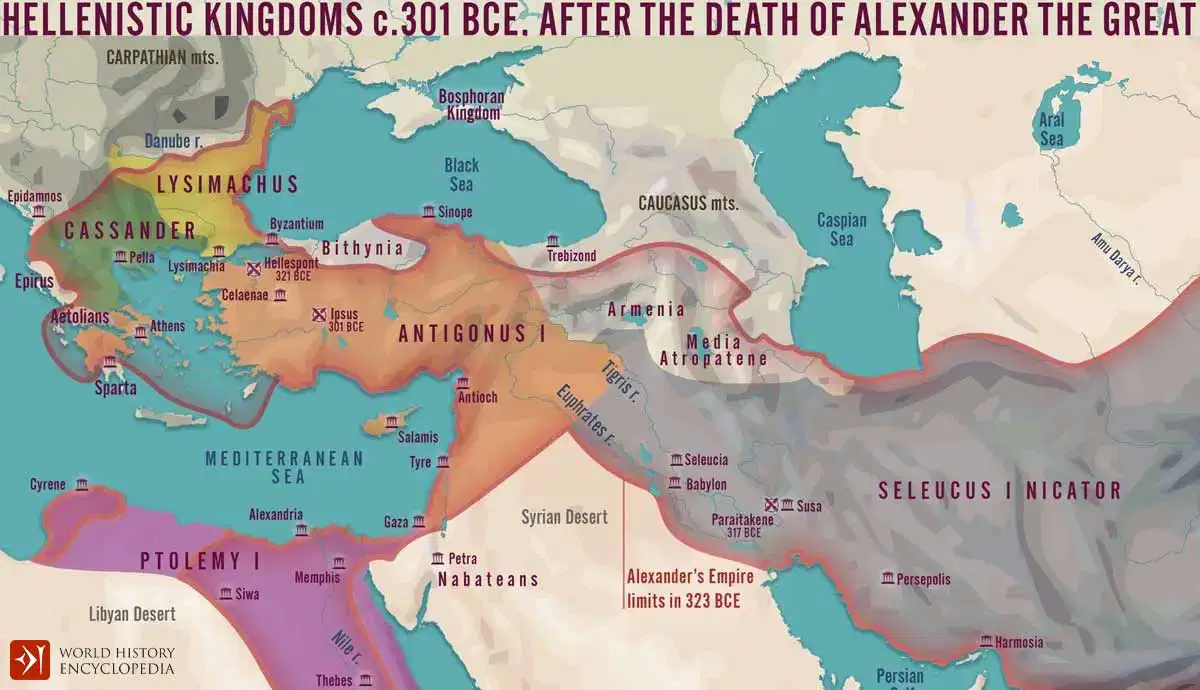
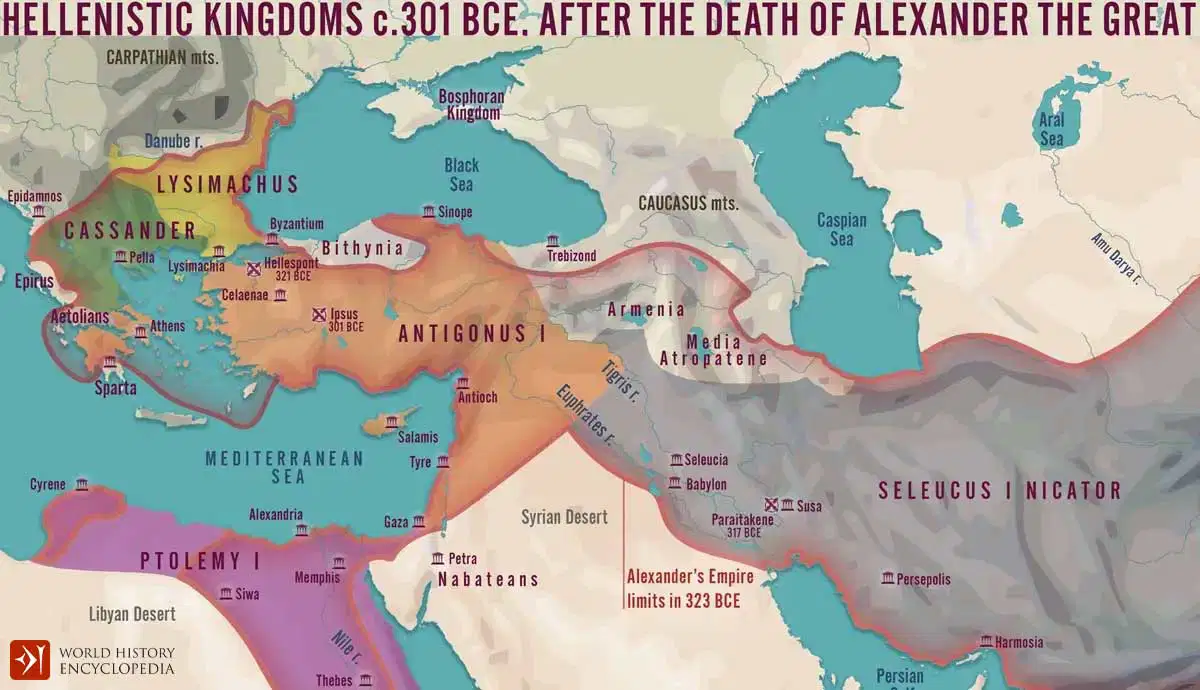
But, as is often the case when so many strong men are present, they could not keep themselves from taking as much power and territory as they could. These men, all generals from the Macedonian army or men of noble Macedonian blood, they eventually partitioned the Empire amongst themselves. When Alexander IV was 14 years old, he was assassinated, making it easier for these men, known to history as the Diadochi, a Greek word meaning “Successors”, to assume power in their respective realms.
There were a few years of chaos then, but soon things settled down and lines were drawn respecting the territories of these men.
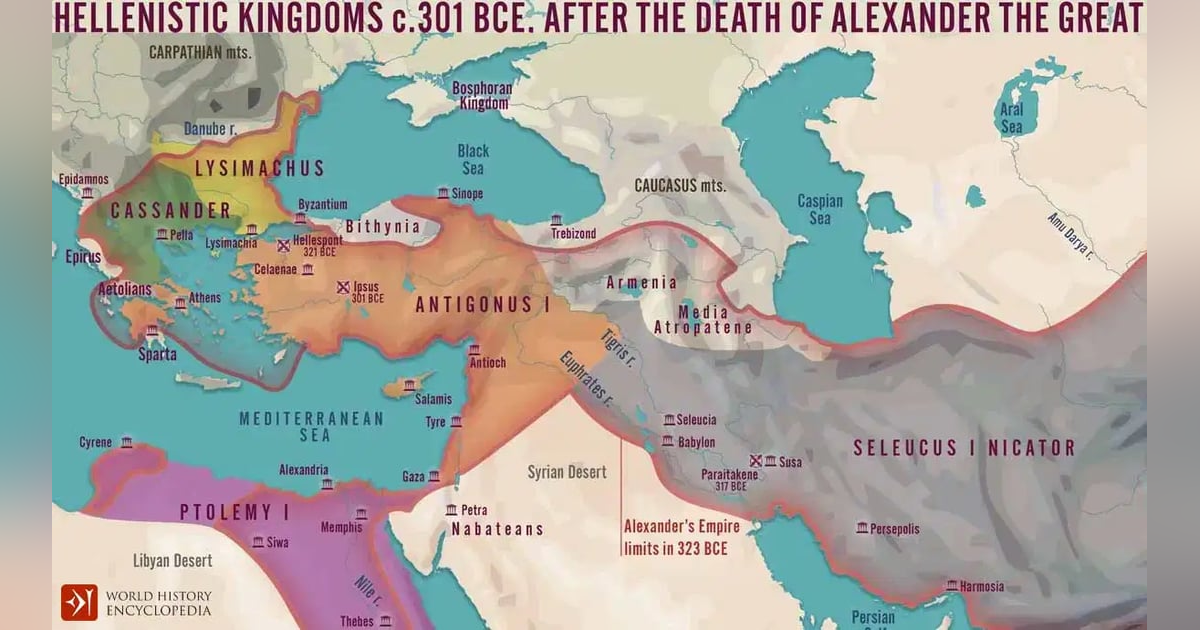
At the time of Alexander’s death in 323 BC, a general named Antipater, had been holding the fort in Macedon. His son, Cassander, would go on to rule over the ancestral homelands of Macedon and much of Greece. Lysimachus, an experienced general who had accompanied Alexander into Persia, took over much of Thrace and Anatolia.
Seleucus, a general whom I mentioned before, ended up taking the greatest portion of the Empire for himself, ruling over much of Anatolia, Syria, Palestine, Mesopotamia, and Persia all the way to the Indus River. This new kingdom was known as the Seleucid empire, and we will hear about this man’s successors again when the Jews throw off Greek rule and form an independent kingdom under the Maccabees.
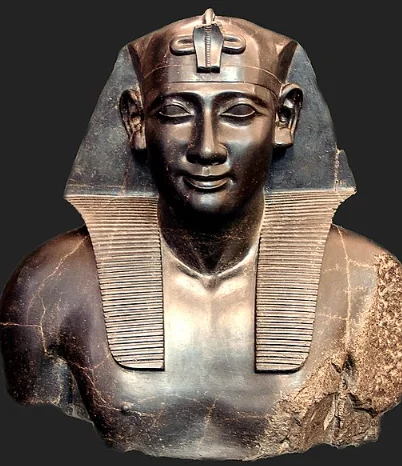
Ptolemy, another of Alexander’s generals, would take Egypt for himself and start his own line of pharaohs. This dynasty of Greek rulers in Egypt would not come to an end until 30BC, when Cleopatra VI committed suicide, after the death of her lover Mark Antony, rather than face the retribution of Julius Caesar.
There were other pockets of Greek rule here and there, including in the far east, where statuary and figurines and other cultural remnants of greek gods can still be found in archaeological ruins of this period, mixed in with the relics of hindu deities.
As these new kingdoms formed, three more deaths marked the passing of Alexander’s life.
Alexander’s mother, Olympias, had stayed behind in Macedonia during her son’s conquests. She had essentially been co-ruler of Greece that whole time, with Alexander’s general Antipater. After Alexander’s death, her situation became more precarious, and in 316 B.C., she was besieged by Cassander. Antipater’s son, and murdered after her capture.
Demosthenes, the Athenian statesman who had so often agitated against the Macedonians, called for revolution when he heard that Alexander had passed. But this attempt to free Athens failed quickly, and Demosthenes fled to an island off the coast of the Peloponnesus. His pursuers, loyal to Macedon, were approaching when the famous orator poisoned himself in 322 BC.
Amid the anti-Macedonian unrest in Athens which Demosthenes stoked, the old philosopher Aristotle, who had been Alexander’s tutor, suddenly found himself no longer wanted and, indeed, in danger for his life. He fled from Athens to the island of Euboea, where he died the following year, most likely due to natural causes.
And so the endeavor that had begun years before with such hope and such Macedonian discipline, had apparently disintegrated into a chaotic handful of warring kingdoms, and the last of the greatest voices of the classical era in Greece had passed away..
But amid this dissension among the Diadochi, these successors to Alexander, amid all this began the great flowering of culture known today as the Hellenistic period.
(Music)
With greek rulers and their soldiers now spread around so much of the world, it was inevitable that Greek culture would follow. And so began the flowering of Greek thought in unexpected places, such as Egypt and Babylon and even distant Persia, Afghanistan and India.
Alexander himself had actually planned not only this seeding of Greek ideas in the East but also the transfer of Eastern culture and blood into the West. He had intended to colonize in both directions, bringing Greeks into Mesopotamia and beyond, and sending Persians and other to the West. In the end, with some exceptions, this cultural sharing was mostly a one-way street.
Greeks call their land Hellas in their own language, and so this transformation of the Near East became known as the Hellenistic period. A time in which many facets of Greek culture became commonplace among peoples who otherwise had nothing in common with the Greeks.
The most lasting relic of this period is, of course, the Greek language. As I mentioned previously, the New Testament of the Christian bible would be written in Greek due to the way that the Greek language became the international language of the entire region, stretching from Sicily and the Greek mainland in the West, down to Egypt and then East all the way to the borders of India.
Even the Jews of Judea, often seen as xenophobic, even they embraced the Greek language. Jewish priests, scholars and rabbis produced the Septuagint in the centuries that followed. The Septuagint was a Greek-language version of the Old Testament. So popular was this text that, in the New Testament, Jesus and all the apostles make direct quotes from this Greek Old Testament and not from the Hebrew original. The Greek Septuagint would even remain the basis for Christian translations of the Old Testament for 15 centuries, until the Protestant reformation abandoned it in favor of the Hebrew Masoretic text.
Note, however, that this international version of Greek that everyone used was based on Attic Greek, the dialect of Athens. Even though there had been enmity between Athens and Macedon, the court language of the Macedonian kings had long been Attic Greek, and this might help explain why Athens so frequently escaped retribution even when it openly rebelled against overlords from other regions of Greece. By now, everyone in Greece had come to recognize the value of the literature, philosophy, art and other ideas of Athens, and so they brought the works and the ideas of many Greek masters with them into their new cities.
The standardized, international version of Greek which became used throughout the Eastern Mediterranean and in the Near East was known as Koine Greek.
And, for this reason, in the distant future, when people went looking to recover Greek books and plays, they would search for them in the libraries of the East. Alexandria of Egypt, in particular, would become a center for Greek scholarship, as would the city of Antioch in Syria. Antioch, in fact, would remain a great center of Greek population and culture well into the medieval era, until long after it was conquered by Muslims.
Many great philosophical strains of thought would also be dispersed into the world during this period, and many new philosophical schools would appear around the Hellenized world. The stoic philosophers, the epicureans and others would all flower during this period of Greek cultural and political domination.
Greek artistic ideas and products would also flourish around the world. For example, the world-famous Venus de Milo, a partially intact sculpture of Aphrodite, dates from the 2nd century BC.
Sport and gymnastics may actually be the most disruptive things that were introduced to the East during this period. Recall how the Greeks frequently celebrated victories by holding games, that is, competitions similar to many Olympic activities in which we still engage today. The Greeks adored athletic competitions and the Olympics probably would not have become a worldwide phenomenon today if these games had not been popularized thousands of years ago all around the Mediterranean.
While females were generally restricted in much of the Greek homeland, in the Hellenized regions, female sports actually became more common.
These sports would also prove to be controversial though, as we shall see in the coming episode on the decline of Greek influence in the region. The books of the Maccabees, which are still found in Catholic bibles in the West, and which were never removed from Bibles in the East, these stories from scripture relate how the gymnasiums of the Greeks were particularly offensive, and symbols of oppression, in the eyes of some local populations like the Jews of Judea in the 2nd century BC.
Greek mathematics and science may have been the most fertile of all the academic subjects in this era. Euclid, Archimedes, Apollonius and others all published their great works during this period of history.
But as much as this cultural exchange may seem to have been something progressive and radical, Greek tendencies were, as always, actually quite conservative. Some new strains of thought were developed during this period, but much of what happened was really a canonization of the Greek past. The great epics, the Iliad and the Odyssey, spread around the region and became not just literature but objects of pseudo-religious appreciation. The great plays of the greek dramatists, such as Sophocles and Euripides, were copied and spread around this new world. Much work could be found during this time period as a copyist, someone who sat at a desk all day with papyrus and quill pen and made, by hand, copies of the great classics of our Western Traditions.
(Music)
Religion is the one area in which the cultural exchange of this period was much more mutual. In fact, it was ultimately much more in favor of Eastern religion.
Greek religion spread into South-central Asia with the Greek population and remained as long as there was an identifiable Greek populace. However, in many of these areas, the Greeks began identifying the local gods with their own Greek deities. Thus the Egyptian Ammon was seen as a version of Zeus, and Isis became just another form of the Greek grain goddess Demeter. Even Hindu deities in the far East were treated this way. Indra, one of the high gods of the Hindu pantheon, wielded a lightning bolt and thus was seen as just an Eastern depiction of Zeus.
This may appear to many modern readers and listeners as strange but it is actually quite appropriate. After all, if you look at the deep past of all these peoples, you realize that the Hindus were Indo-Europeans, and these gods from Greece and from India probably do have some relationship based on whatever the earliest Proto-Indo Europeans were worshipping in central Asia thousands of years before.
But this conquest of Asia also opened the door to migrations from the East into the West, not only migrations of people but more importantly, migrations of religion. Now is when worship of the Egyptian mother goddess Isis begins to spread in the West, even as far as Rome eventually.
Buddhism had already appeared in the East at least a century before Alexander arrived, and it, or at least some if its ideas, also spread Westward.
And the jews begin to build synagogues around the Greek world. It must be remembered that Judaism is an eastern religion, though its association with the Bible causes many to identify it with the West. And Christianity is also something of an Eastern religion, hybridized with Greek elements, which would eventually spread around the Mediterranean, with the help of these many synagogues placed around the Greek and Roman world.
But, perhaps even more striking during this period, simultaneously with the religious pluralism, was the turning against religion among the more educated classes of Greek society. While Greeks consequently became familiar with a greatly expanded pantheon of foreign gods, they also, or at least their upper classes, began to embrace agnosticism. There is even a name for the philosophy behind this sort of light atheism, and the description of it should sound familiar to us today. Euhemerism is the official term for it and this stands for the belief that most or all mythological stories of the gods, while they still retained value in some moral or inspirational sense, are really just stories about ancient, prehistorical heroes and kings.
Perhaps this can help us understand something which characterized the end of Alexander’s life and the end of many future men’s lives, after they won great military victories or ruled over great empires. The roman emperors would sometimes be declared gods after their deaths. In the case of Caligula, this deification would be self-proclaimed and take place long before death.
So, it is difficult sometimes for someone, like me, who admires so much about a man like Alexander, when he then reads of such a man declaring himself a god, or being declared a god. This riles us all up a little. It seems outlandish, ridiculous. Comparing himself to Zeus, to Apollo? To a divine being with supernatural powers? Was it a sign of psychopathy to even consider such a reality?
But then, when you recall the way that many people in this era considered the gods to be simply great men of the past, maybe this makes a little more sense. I have pointed this out before, more than once in the podcast, that we make assumptions about the religiosity of our ancestors, and their credulity, without comparing them to ourselves.
Consider how, in the United States, a great many people hang effigies of ghosts and carve pumpkins and light candles in them every year on the evening of October 31st. I imagine that far less than one percent of any Americans engaging in this ritual actually believe that any of it has any meaning beyond amusing our children and do it simply because there is joy in ritualistic behavior.
But, an archaeologist living a thousand years from now and digging through our ruins might come to the conclusion that 21st century Americans believed in ghosts and goblins and witches flying on brooms and that we also believed in the efficacy of jack o’lanterns in warding off evil spirits.
So, when we hear of our ancestor’s rituals and beliefs, of declaring themselves gods, we should take it all with a grain of salt. Even by the time of Alexander, people were considering the supernatural world with a certain amount of skepticism, and participating in religious rites for social reasons rather than for fear of divine wrath. Perhaps this attitude is even older than that. And perhaps, when men like Alexander declared themselves divine, they were simply recognizing their own greatness among their contemporaries.
As we might say now in admiration of a personal hero, he was a god among men, but we do not say this and intend to erect a church to the man so admired.
Nevertheless, I should not influence you to think that all people at this time were cosmopolitan doubters of faith and simply partaking in religious rites for social appearances. At the same time that some in the upper classes were becoming skeptical, things like astrology and the practice of magic also became common throughout the realms of Alexander’s successors.
There is no one theme, really, no one particular social, religious or artistic trend that characterizes the Hellenistic period. It was close to three centuries of both fruitful activity in the sciences, in philosophy and in the arts and three centuries of a growing traditionalist mindset which set out to canonize and codify the great works and ideas of the past and conserve them as things fundamental to learning, and fundamental to society.
(Music)
Greek dominance politically and culturally would endure in some regions, but simply fizzle out in others. There were Indo-Greek kingdoms in the far east after Alexander’s death, but these were quickly reabsorbed into the surroundings. Some of the Greek kings are actually known to have converted to Buddhism before their realms lost their Greek character entirely.
Other realms would endure much longer. The Seleucid empire, occupying Mesopotamia and lands East, would be probably the strongest and last centuries, but it would leave less of its Greek character behind when it’s territories finally fell into the hands of the Parthians, Romans and others.
Without question, though, in Egypt the Hellenic seeding of the world would sink its firmest roots. After his death, the Greek general Ptolemy would leave behind a dynasty that would endure until Cleopatra killed herself in 30 BC. These Greek kings and queens would be the last pharaohs of Egypt, and with them would die the last vestiges of an ancient world which the Romans would eventually incorporate into their own Empire.
In the next episode, we will look at the way that the Greek influence over the Near East and other realms slowly waned and eventually succumbed to Roman and other cultures which would rise to take their place on the world stage.
Until then, I thank you for listening to the Western Traditions Podcast.
(Music)