Episode II.40 - Alexander the Great: The Conquest of Asia


Alexander the Great at the Battle of Granicus, the Battle of Issus and at Gaugamela. Jerusalem and Gaza. The Temple of Ammon in Egypt. His horse Bucephalus. His strategos Parmenio. Darius III flees to the East.
RECOMMENDED READS - Click Image for Link:
(Music)
“Alexander liked hard work and dangerous enterprises, and could not bear to rest. He grudged the time given to sleep, and said that sleep…made him sensible that he was mortal.”
-the historian Will Durant, describing Alexander the Great
(Music)
Hello and welcome to the Western Traditions Podcast. This is the fortieth episode of the Greek Sun, a podcast series about the history of Ancient Greece. In today’s episode, we will continue to learn more about Alexander the Great and his conquest of Asia.
Now, I use the word Asia in the way that the ancient Greeks may have understood it, not in the modern sense of the continent of Asia. In fact, often, among the Greeks of the time, Asia was a word used to reference what we call Anatolia today, the peninsula-like piece of land on which modern-day Turkey sits. Later, this region came to be called Asia Minor, perhaps when a better understanding of the true size of the entire Asian continent was understood.
As far as Alexander knew, though, he was setting off to conquer Asia. He knew that the Persian Empire was vast, that there were lands under its control which were far to the East, farther than any Greek had probably ever traveled. He may have even known that there were lands east of it, which he would also have to conquer. That he planned on doing this with some 40,000 Macedonian and other Greek soldiers speaks to his confidence in his new model army.
But he, like many in his day, did not understand just how much land there was beyond Persia, to the East and the North of it. At his conquest’s end, many years later, he would stand with his army on the banks of the Indus River, in modern-day Pakistan, and lament that he would never go farther. He wanted to conquer India, if you can believe it, but his troops had had enough, and forced him to turn back to Babylon, that they might enjoy the power and the wealth that they had certainly earned.
Did he even know about China, the southeast Asian Empires, Japan, Australia, Korea, Russia? Probably only in the vaguest way. In attempting to conquer Asia, the Greeks perhaps realized that the world was a much bigger place than they had ever imagined.
Before we move on with Alexander and his army into Asia, please take the opportunity to visit the website, Western-traditions.org. There you can find all the episodes of every podcast series. You can also shop on the merchandise page and help to support my work through your purchases. Additionally, you can support the podcast with contributions through the Paypal option, or you can become a monthly Patreon member. Patreon members get immediate notice of new episodes, and access to essays and behind-the-scenes information on the Patreon site.
And now, Alexander and his army are marching away from his capital, from Pella in Macedonia, marching East, toward the Bosporus, and destiny.
(Music)
Let us acquaint, or reacquaint, ourselves with the primary actors in this unfolding drama.
About Alexander, we know much already and will continue to hear more. A descendant of both Achilles and Heracles, and one of many sons to Phillip II of Macedon, he seized power after his father’s death, subjugated Greece, and now, in early 334 BC, at the age of 21, he set forth from his capital city of Pella for the East, for Anatolia, for Mesopotamia and Persia and beyond.
He would never come home.
Nor would his horse come back, if we can believe the accounts that we have. Now, Alexander, like any rider, would have had several horses available to him. Fictional stories about men and horses often portray a man riding a single horse for countless miles, charging and galloping, fighting, etc, without any relief. The truth is that horses cannot be used that relentlessly and mercilessly, not even the strongest ones. Cavalrymen generally need to have access to multiple horses if they expect to be able to ride every day, because horses suffer health setbacks and injuries just as we do, and they also need rest.
However, such men have always had their favorite horse, and Alexander’s favorite was Bucephalus. He had first met this horse as a teenager, when his father, Phillip II, had bought a horse of particularly fine lineage, but no one could tame the beast. Alexander, though he would become a great warrior, did not try to break the horse physically. He instead, according to legend, spoke calmly to the horse until the animal settled down and the two became friends. Bucephalus would be Alexander’s friend and most-favored horse for many years.
Opposing Alexander was Darius III, King of Persia. Of him, we have not yet learned much. He was a successor to the all the Achaemenid kings, that is the dynasty of kings founded by Cyrus the Great centuries before. He was a descendant of Xerxes the Great, who had opposed and invaded Greece during the Persian wars. Darius, however, was not the son of the king who had preceded him.
As I have said before in this podcast, we have to shed ourselves of that neat, clean idea of transition from father to son in ancient royalty. The sons of ancient and medieval kings did not automatically follow their fathers on the throne, even though every king tried to ensure this straightforward kind of succession. Darius, like many other kings, Greek, Persian, or otherwise, had seized the throne by force after the death of the previous king.
When Alexander lies on his deathbed in Babylon in 323 BC, only eleven years after setting off to conquer Persia, his generals and friends will ask him, who should inherit his empire? Legend says that he simply replied. “The strongest!” This was the rule, that the strong claimed power and meted out justice. Alexander himself had not taken over Macedonia because everyone had meekly accepted that he had some right to the throne, via primogeniture. No, he had secured kingship because he had earned it, and he held on to that power because he was strong enough to defend what he had earned.
Fictional depictions of Persian kings, like that terrible movie 300, the one with Gerard Butler, often go out of their way to show these kings as insanely decadent, effeminate, evil, power mad and so on. There is no evidence that Darius was different than any Persian king that had preceded him and many historians and commentators opine that he was essentially a good man and a good leader for his time.
Darius had acted in a number of roles in service to the Empire prior to becoming King in 336 BC. He had been a satrap, or local governor, and he eventually became the head of the royal post service, which doesn’t sound impressive to modern ears but this essentially put him in charge of communication and of all the royal roads in the Persian Empire, so this was a very high ranking position.
After ascending to the throne, Darius tried to forestall a Greek attack, just like his predecessors did, by bribing and sowing dissension among his enemies. By 334 BC, though, these efforts had failed, and he found himself staring down an invasion force.
Now, among the invaders were many friends of Alexander but the young Greek king primarily relied, initially at least, on the war staff that he had inherited from his father.
Most prominent among the men who had served Alexander’s father was an old soldier named Parmenio. At the time of Phillip’s death, Parmenio had been in Anatolia, leading the greek forces already over there fighting the Persians. When he learned that Alexander had taken power, Parmenio showed his loyalty by putting to death Attalus, the general who had scorned Alexander’s claim to the throne.
Alexander would subsequently place Parmenio in charge of his army, as strategos, or supreme general, and thus return the man’s loyalty.
For a time.
Each highly-trained, well-equipped soldier in Alexander’s fine-tuned army was important, of course, but the most important troops were this known as the companions. These were the Greek elite. Now, in our day, the best and brightest often command armies from a distance and avoid danger themselves, but this was unthinkable for our ancestors. A good leader, no matter how bright and charismatic he might be, garnered no respect if he did not put his life in danger, at least occasionally.
So the companions were, for the most part, warriors from the noble classes of Greece, and their core was mostly Macedonian. These men did not usually possess a particular office or rank within the army so much as they were ready to fill any role that required leadership or diplomacy. In general, they rode with the army as an elite cavalry force, but from their numbers Alexander could pick any of them to command a portion of his army, or to take over from another lesser general.
Alexander’s close friends were among these companions. Their loyalty being unquestioned, they could be left behind as governors of newly conquered territories while the army marched on. And since they had grown up among royalty and nobility, they were well-versed in politics and could be given charge of diplomatic duties. The companions were well-rounded, ready to fight savagely one moment and then have dinner conversation with a king the next.
Some of their names I have already told you, Hephaestion, Harpalus, Clearchus, Ptolemy. Among them also were Philotas and Nicanor, the sons of Parmenio, Alexander’s supreme general.
We will hear all these names and more in the future, when Alexander’s empire comes into their hands and they must decide what to do with it.
But the most numerous and most overlooked actors in this drama about to unfold are the people of the Empire, the Persian Empire.
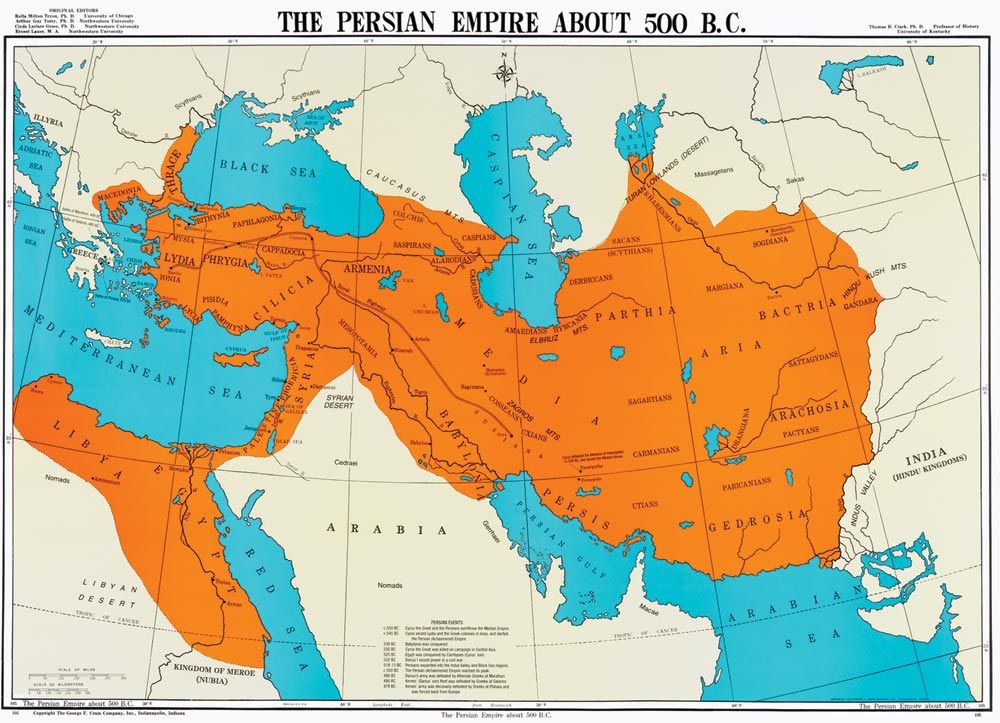
Now, not many of these people were actually Persians. It was a vast governance, this Empire. Based out of Babylon in Mesopotamia, it stretched as far West as Egypt, and as far East as the borders of India. It included the Persian heartland in modern-day Iran but it also included several realms on its northern frontier, like modern-day Afghanistan and other central Asian regions.
Like the massive army that went forth to meet Alexander when he invaded the Empire, the people of these realms were fragmented and splintered with many different backgrounds, religions, cultures and other beliefs and goals.
Alexander, like his father before him him, understood very well that it would only take one or two hard punches to shatter this coalition of disparate groups and then to scoop up the prizes that fell to the ground.
(Music)
It is Spring of 334 BC. Alexander, at the head of the core of what will be his invasion force, marches out from the Macedonian capital, the city of Pella. They head east, through Amphipolis and along the coast of the northern Aegean Sea, toward Sestos, a port city on the modern-day peninsula of Gallipoli.
Here the army would make the only sea crossing it would ever need to make. At his disposal, Alexander had less than 200 ships, which were all he needed to defend the narrow sea passage from Europe to Asia at the Bosporus and to ferry his troops across.
Alexander had made a clear decision, early on, to not turn this conflict into a sea battle with the Persians.
The significance of this decision, in the wake of his magnificent land victories, is generally overlooked. After all, the Greeks had dominated the Persians at sea now for some 150 years, ever since the Persian War. Why not crew a massive fleet of Greek vessels, clear the seas of the Persian threat, seize the coastal cities, turn the Eastern Mediterranean into a Greek lake, control traffic, profit from commerce, etc?
Perhaps the answer lies in the Macedonians’ own particular expertise, which was the head-to-head clash of heavily armored phalanxes and the brutal overrunning of a shattered, exhausted enemy. A defeat at sea, however unlikely, would have been terribly demoralizing for the Greek effort. And victory at sea would have still left unfinished the primary task: the destruction of the Persian army.
Alexander preferred to trust his strength, his army. He wanted, as soon as possible, a decisive battle between his army and the Persian forces. After that, everything would be a matter of cleaning up.
Another consideration may have been financial. Alexander was deeply in debt. And ships and sailors were expensive. To support a fleet would have compromised support of his most precious possession, the army that his father had passed on to him.
Once across the straits and landed in Asia, Alexander joined his forces with the portion of the Macedonian army already in Anatolia, where they had been engaged in minor conflicts with Persians for years, battling for control of various Greek colonies.
Alexander then visited the ancient site of Troy, where his ancestor Achilles had fought so gloriously. He ran naked around the tomb of Achilles, according to the religious custom, and openly praised the hero of the Iliad.
And then he marshaled his army: Accounts differ as to the numbers, but it was probably some 35 thousand infantry, most of them hoplites, and perhaps 5,000 cavalry. Other sources give him a little more in the way of total troops but it must be remembered that many would have to be left to keep control of those Greek cities in Anatolia that he already counted among his alliance.
Out there, somewhere in the distance, the Persians were gathering hundreds of thousands of soldiers, more than a million, according to legend, to counter his next move.
Among those Persian forces were many Greeks. Tens of thousands of Greeks, in several different units, were presently fighting as mercenaries on behalf of the Persian King Darius. Nearby, in Persian-occupied Anatolia, the Greek mercenary general Memnon was actually advising the Persians to fall back and practice a scorched-earth policy. He well understood Alexander’s only real weakness: economics. If forced to march through a barren, burnt land, emptied of resources, on his way into the heart of Mesopotamia, Alexander would be able to neither to support nor finance his army and his precarious alliance would fall apart before he was ever able to even threaten a battle.
But the Persians were not about to listen to Greek advice. Spithridates was the local Persian in command. He put together a force of 20,000 Persian cavalry. That’s right, the Persians were able to field 20,000 cavalry in just a regional effort to stop Alexander. This wasn’t anything like the main Persian army, just a departmental force. The horsemen were not just Persians but represented a sampling of the Empire: some from as far away as Bactria, a region near the interlinked borders of Iran, Afghanistan and India today. In addition, Spithridates had with him some 20,000 mercenary infantry, mostly Greeks wearing their heavy armor and carrying their long spears.
In terms of numbers, this force was only approximately equal to Alexander’s, but they had far more cavalry and the Persian force was going to meet the Macedonian army at the Granicus river. The plan was to play defense and keep Alexander from crossing the river and penetrating further into Persian-controlled territory.
But the best defense at a river crossing is clearly infantry. This has remained true, this superiority of infantry in defense, throughout military history. Spithridates, however, wanted his Persian horsemen to have the glory and he lined the shore of the river with his cavalry.
When Alexander came to the river, and saw the Persian cavalry waiting for his men on the other side, he never hesitated. He rallied his men and ordered an advance. The Greeks cried out “Euryalius!”, an ancient name for the war god, Ares, and then began to chant the paean, the Greek war cadence.
They forded the river under enemy fire, infantry and cavalry coming under fire from the Persians, who hurled javelins from horseback as the Greeks waded up onto the opposite shore. Greeks met Persians here in frontal combat, and only met Persians, as Spithridates had ordered the Greek mercenaries to remain in the rear.
Alexander himself, as always, throwing himself into the melee, slew two relatives of Darius in this battle, including one of the King’s brothers-in-law. The young Macedonian hero himself, however, was almost killed when the Persian general Spithridates himself approached and went to strike at Alexander who was distracted by another opponent. But Clitus, one of the Macedonian companions and a cavalry commander, cut off the Persian’s arm in mid-swing.
Their leader slain, the Persian forces immediately scattered and fled. All that was left of the enemy now was the Greek mercenary force fighting for Darius. The Persian commander had not trusted them completely, and had left them off the battlefield. Though they were Greek, however, they were good mercenaries and they remained loyal to their employer. The 20,000 mercenaries stood their ground as the Macedonians surrounded them and annihilated them. Only two thousand of these men survived and were captured.
Alexander had his first major victory. But he knew that much greater challenges lay ahead. In the meantime, it would be a while before the Persians could gather their main army to come meet him. So he wasted no time and began consolidating his gains.
Over a year would pass as Alexander took control of virtually all of Anatolia. Some cities surrendered or gladly allied with him. Others resisted and were besieged and quickly stormed. Eventually, Alexander and his well-blooded army made their way toward Syria, in order to turn south on the Mediterranean coast toward Phoenicia and eventually Egypt.
Here, then, at the gulf of Issus, in November of 333 BC, the King of Persia, Darius himself, would arrive with his massive army to face Alexander for the first time with all of Persia’s might.
(Music)
Alexander made a rare mistake.
Turning south, about to head down the levantine coast of the Eastern Mediterranean, it appears that he did not realize, first of all, just how close Darius was, nor did he notice that there was an mountain pass into Syria to his rear as he headed south.
When the Persian army poured through this pass, behind Alexander, the Greeks were not only coming face to face with the full power of Persia for the first time, they were also cut off from retreat. To the south was the unconquered and openly hostile territory of the Phoenicians. To the west was the sea, dominated here by Persians and their sympathizers because Alexander had disbanded most of his fleet to save on expenses. To the east, mountains and Persian-dominated Syria. And to the north, the Persian army forming.
How many Persian soldiers were there? Along with their numerous allies and subjects, there were at least 100,000. Some sources give much larger numbers, such as 250,000 or even more. Modern critics say that such numbers were impossible, that the logistics to support such a force were not feasible, but modern critics, writing from the comfort of their tenured offices in universities, they never think that anything can be done. The pyramids cannot be built, Gobekli Tepe cannot exist, there cannot be trade between Chaco Canyon and Central America, the ancient Polynesians cannot reach the Americas.
Regardless, however many troops that the Persians could logistically support here or not, the Greeks were badly outnumbered. They had received reinforcements from Greece during the last year of fighting in Anatolia, but they had also had to leave garrisons in many captured cities, and they had to send home the badly wounded, and so on. At the battle of Issus, therefore, Alexander probably had less than 40,000 total troops available to him.
Worse than being outnumbered, though, was the fact that the Persians had cut off the Greek’s only possible route of retreat. And there was no place to maneuver, no source of supplies, no options anymore. The huge Persian Army was waiting for them on the northern banks of the Pinarus river, and the Greeks would be forced to go on the offensive against greater numbers, and would have to cross a river as they attacked.
But this was also ideal for Alexander. Now there was no avoiding it or putting it off. No negotiations to be made. Now the Macedonians had to fight for their lives. Defeat would simply mean what it had always meant: death or ignominious capture and imprisonment, maybe torture. But victory? Victory today would mean that the empire would be theirs. Victory today meant that every fight in the future would be easier, against demoralized enemies, and that many enemies would just surrender in the face of a Greek army that had already demonstrated its invincibility.
As news of the sudden turn of events spread among the ranks of the Macedonians and their Greek allies, Alexander spoke to his men. He urged them to remember Xenophon, who had fought his way out of the very heart of the Persian Empire under much more difficult circumstances. He praised the Greek soldiers with him as vastly superior compared to the slaves of the Persian army, who were driven to fight here by force. And, of course, he reminded them of the rewards of victory: Each man, from noble cavalryman down to the lowest foot soldier, would receive treasure unimaginable if they defeated the Persians.
The historian, Theodore Ayrault Dodge, describes the reaction of the common Greek soldiery at this moment: All crowded around Alexander, eager to grasp the king’s right hand and swear to do or die.
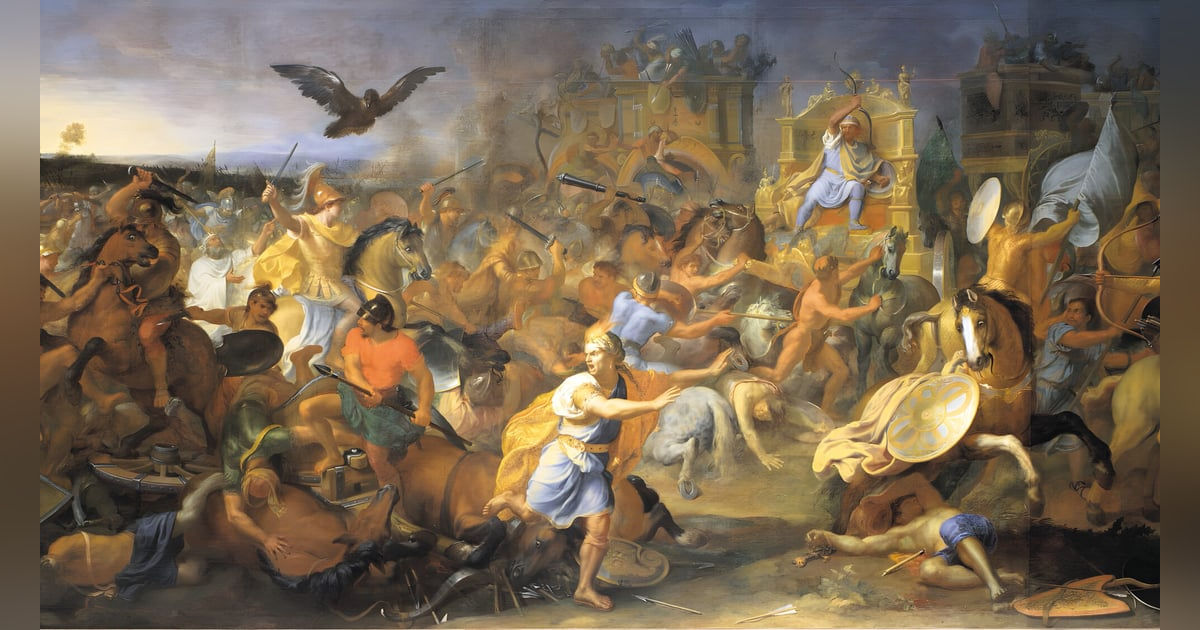
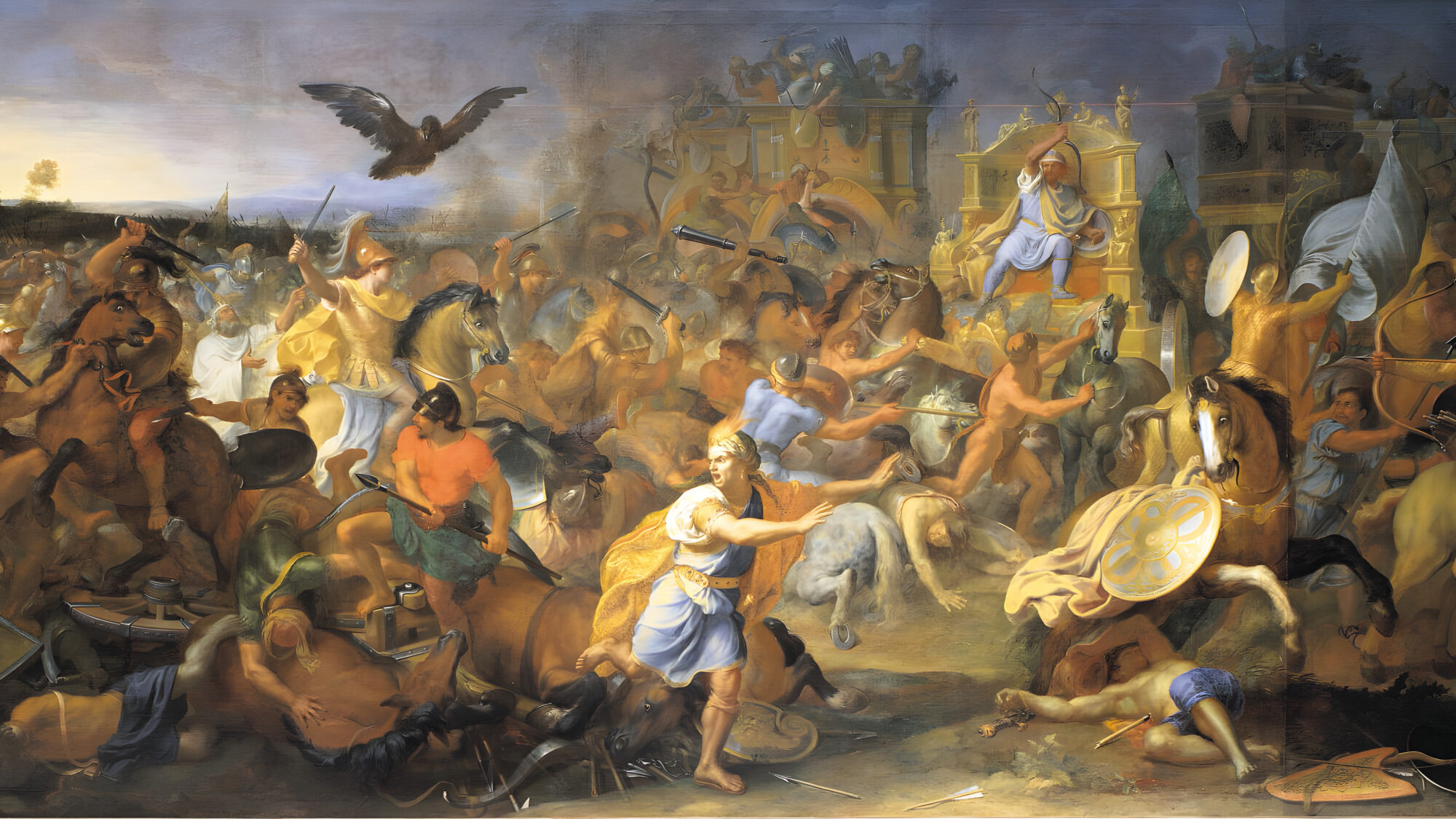
Darius, for his part, also brought confidence to the battle field. He had, in fact, brought his mother, his wife the queen and their young children with him and his massive army, which seemed more than capable of defending the royal family. He himself awaited the onset of battle in a gorgeous, heavy chariot pulled by four magnificent horses.
Indeed, luxury accompanied the army. A shadow army of women in harems, civilian attendants and other camp followers brought with them their finery and so much gold and silver that hundreds of pack animal were assigned to carry all of it.
The details, nevertheless, are much the same as all of the great battles in this saga. The armies formed for battle. The Persians had with them Greek mercenary infantry as well as tens of thousands of mercenaries from other lands. The Persian cavalry was at least 30,000 strong. There were tens of thousands of light infantry. And all these crowded into the limited space between the seashore to the west and the rising foothills less than two miles inland. A compact, hugely powerful force that seemed certain to crush any opponent.
Indeed, it was not news to the world that Alexander and his men were likely to be defeated here. For the last year, at least, Demosthenes, the Athenian statesmen and thorn in Alexander’s side, had been telling everyone who would listen that the Macedonian upstart would be eliminated at some inevitable battle with the Persian behemoth.
But this circumstance, the crowding of the Persian army between sea and mountains, this also strangely favored Alexander. Forced into this small space, Darius could not use his larger numbers to outflank the Greeks or surround them. And into the short front-line available to both armies, Alexander’s army could easily occupy all the space, and meet the Persians head on, man-to-man.
Parmenio, Alexander’s strategos, the steady elder soldier, led the left wing on the sea shore. Here allied Greek cavalry charged across the stream. The phalanxes pushed across in the center. On the right, Alexander led his elite companion cavalry. The complete, detailed story of the battle is enough for a novel itself, but, after the Greeks crossed the river and engaged in many episodes of bloody combat, the Persian forces melted before their withering attack. And then Alexander turned toward the center of the Persian army, to where he knew that Darius would be found.
As Darius’ army panicked and disintegrated around him, the Persian King saw Alexander’s small but efficient killing-machine cavalry coming toward his chariot. The ground here was too rugged for a chariot to move quickly enough to escape pursuers riding horses, so the King of Persia stepped down from his carriage, mounted a fast horse, and fled the field of battle.
Witnessing their glorious king depart the battlefield in fear, the Persian army came completely apart. It is reported that Alexander lost only a few hundred soldiers total in the battle, and that the Persians lost tens of thousands.
Behind him, Darius left not only all the treasure sufficient to support his immense army, but he also left his family, including his mother and his queen and children.
In the weeks and months that followed, more treasure was acquired by there Greeks when the city of Damascus fell and an enormous amount of imperial treasure was captured. And so Alexander’s financial difficulties were resolved.
The consequences of this victory were also significant in terms of public relations.
Alexander’s standing among Persian populace at-large soared. He was no longer seen as a barbaric invader in the public eye. He was now both a skilled warrior and general, and he had gained fame as a good and principled man. He took excellent care of the family of Darius, even his children, and treated them as royalty. They were captives, certainly, but they suffered nothing, lacked nothing. People could now speak of both Alexander’s battle prowess and his gentleness toward his defeated enemies.
And soon Demosthenes, the Athenian, would send a groveling letter to Alexander, begging pardon for his predictions of doom.
There was a lasting military impact of this victory, as well, in terms of strategy. Numbers now meant nothing on the battlefield. It did not matter who had the greater number of soldiers, though Darius would continue to believe this as he recovered from this loss and spent two years in the East gathering a newer, larger army to strike back at Alexander. What mattered more now was how well-trained and how dedicated your soldiers were. Alexander’s men possessed a certain confidence in their own superiority over all enemies, especially now that they had defeated the most powerful military in the world.
And they were willing to die for him, to die for his dream.
(Music)
Alexander made a crucial decision now. He could have turned his army right then and marched Eastward into the heart of the Persian Empire, to chase after Darius and to seize Babylon, the capital of the world. This was certainly fitting with his usual verve and audacity. So far, Alexander had never held back when given the opportunity to be bold, to strike first, fast and hard.
But he was also now a global leader without a navy. To the south, in Phoenicia and Egypt, were realms still loyal to Darius, and they were armed with vast navies. By seizing their cities on the coast, he could essentially claim all those navies, because they would have nowhere else to go, no ports from which to operate. And he could secure his rear.
So, listening to such reasoning, Alexander and his army marched south, down into Phoenicia, and besieged the city of Tyre.
It has been some time since I have mentioned this city. In the sixteenth episode of the first series in this podcast, I described Phoenician and Canaanite culture. They were Semites, and remembered darkly for their worship of, among other gods, Moloch, to whom they apparently sacrificed babies by burning them alive.
The greatest city of the Phoenicians was Tyre. Today, the Lebanese city of Tyre is located on a tiny peninsula that juts out into the Mediterranean from the shore. In 332 BC, when Alexander arrived in its environs with his army, the city of Tyre itself was actually located on an island a little less than one kilometer from shore.
Alexander proposed, once again, an impossible task for his army. To seize that port city, defended by not just high walls and a fleet, but also by the very ocean itself. There would be no fording the sea here, the soldiers could not march to seize Tyre.
So Alexander and his men turned the island into a peninsula.
Initially, Alexander had tried to negotiate with the city of 40,000 inhabitants. But, after they killed one of his diplomats and threw the body over their walls and into the sea in front of the whole army, the Macedonian king decided to waste no more time. Over the course of seven months, his men built a mole, or a causeway, to extend from the mainland to the island. They dumped rocks and earth and tree trunks into the sea and built with this mass of debris a land bridge, right before the eyes of the Phoenicians, a land bridge that reached almost to the very city. The depth of the water right around the island was too much, though, and the causeway remained just short of its goal.
By then, Alexander and his men had withstood the harassment of enemy ships, and artillery from the city, while they themselves had built siege towers and rolled them to the end of that artificial land bridge to fire boulders and other forms of ancient artillery into the city. Fortunately, by this time, months after his incredible victory at Issus, other cities and local leaders had also decided to ally with Alexander, including the King of Cyprus, who sent a fleet to support the Macedonian upstart.
Though the story of the siege of Tyre is worthy of its own podcast, I won’t slow down any more for it. But just think, Alexander’s whole conquest of the entire Persian Empire only took ten years. He spent an entire seven months just on this one city. That this stubborn defense irritated him greatly is evidenced by the aftermath. Inside the city, after the Greeks stormed the walls, something like 6,000 fighting men were killed. All those who took refuge in the Temple of Melqart, a Phoenician God whom the Greeks identified with Heracles, all these were spared automatically. Nevertheless, two thousand other survivors were crucified on the beach. Thirty thousand were sold into slavery.
There was permanent result of this conquest, an earth-altering one. Nature had made Tyre and island. Alexander made it a peninsula. The mole, the land bridge that his men built, it was so sturdy that the ocean sands built up against it rather than wash it away. And today, more than two thousand years later, you can still walk to the city of Tyre because Alexander changed the face of the earth to accomplish his goals.
While the siege was underway, Alexander had received an emissary from Darius in the East. The Persian King was gracious, grateful that his family had been so well cared for. He offered Alexander treasure equivalent to 10,000 talents of silver, that’s more than 500,000 pounds of the metal, as ransom for his family, and to give to Alexander all the lands West of the Euphrates river, and to give the young Macedonian king his own daughter in marriage.
Parmenio, Alexander’s sage advisor in all things military and political, thought that this was a good deal. “If I were Alexander,” Parmenio said, “I would accept.”
“And if I were Parmenio,” Alexander replied, “so would I. But, being Alexander, I cannot.”
Alexander formally replied to the ambassadors that he, Alexander, was already the King of Asia. There was no one with whom he need negotiate. And he would marry Darius’ daughter if he wished, without seeking consent.
And so Darius resumed building an army, an army even bigger than his first one, an army bigger, in fact, than any that the earth had ever seen.
Southward the Greeks marched then. Jerusalem surrendered without a fight.
The next city to fall to Alexander was Gaza. The rest of Syria had already submitted to Alexander but the Persian forces holding Gaza believed they need not surrender, that some Persian military relief would find them and destroy or drive off Alexander. Another two-month siege proved otherwise. Ten thousand men were killed during and after the battle. The women and children were sold into slavery. The Persian commander of the city, by the name of Batis, was slain and then Alexander dragged his body around the city walls, just as Achilles had done to Hector’s corpse at Troy.
And then, in December of 332 BC, Alexander and his army marched into Egypt. There were few battles or even skirmishes now to slow the army. Egypt as a whole surrendered to Alexander, and here the young king was heralded as a god. He personally went as far West as the Temple of Ammon in the Libyan desert. The Greeks identified the Egyptian god Ammon as Zeus. Alexander had always stressed his divine background, his descent from Achilles and Heracles and through them descent from the gods themselves. He had done this to impress the masses, it is said.
Here, though, the Egyptian priests hailed Alexander as the new Pharaoh.
Was it here, in the desert of Egypt, at the Temple of Ammon, was it here that maybe he began to think it might be true? That he might actually be divine? We will revisit this topic in the next episode when Alexander finally pauses from conquest and begins to consider his public image.
From this sunset vantage, too, Alexander could consider the lands farther west. Carthage, and some place called Rome. They were on his to-do list, but they would have to wait.
He had to finish conquering Persia first.
(Music)
In Spring of 331 BC, Alexander left Egypt and turned his vision East, toward Mesopotamia, toward Babylon, where the King of Persia was marshaling an even greater host to defeat and expel the Greeks.
The Greek army paused at Tyre, now their own port. Here a newly formed fleet of Greeks and allies greeted Alexander. He also received reinforcements from Greece. And he learned that the Spartans, funded by the Persians, had risen up in rebellion against Alexander’s deputy, Antipater, who had been left behind in Macedonia to keep a watch on Greece. The Spartans were crushed, though, at the battle of Megalopolis and one of their kings, Agis by name, was also slain in the battle.
The direct path from Phoenicia to Babylon would have been through the regions of modern-day Jordan and Syria. But then, as now, this land was almost entirely desert and offered no way to sustain even a small army. So Alexander, to reach Babylon, followed a time-honored path northward through Palestine and Phoenicia and then turned eastward to travel through the northern portion of Mesopotamia to reach the upper branches of the Euphrates river. From there, it would be easier to travel and supply an army on the road south to Babylon.
Darius, obviously, knew this as well. That is why he was there, in northern Mesopotamia, ready for Alexander and the Greeks with his new army. This reconstituted Persian army numbered, some sources say, more than one million soldiers. Modern scholars suggest that it was much smaller, but still much larger than Alexander’s. Drawing as it did on levies from the farthest reaches of the Empire, and including troops from India and modern-day Afghanistan, and splayed out on the great plains, this vast horde of men could easily outflank Alexander at both ends, could surround his army entirely and consume it.
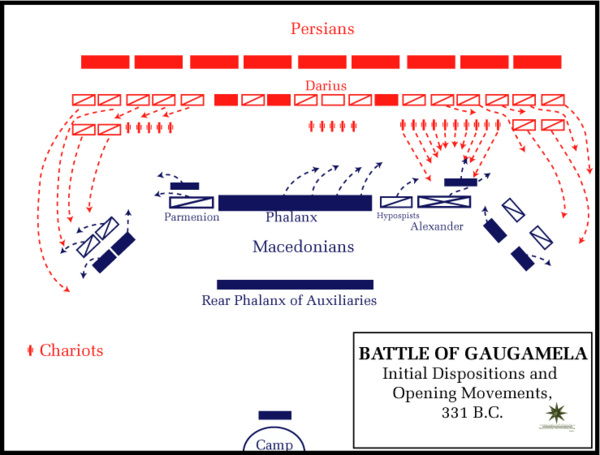
It is called by two names, this battle. Arbela, it is to some, Gaugamela to others, both are names of nearby villages. Here, Alexander brought an army that probably numbered close to 50,000 Greeks and allies, now that he had been reinforced somewhat.
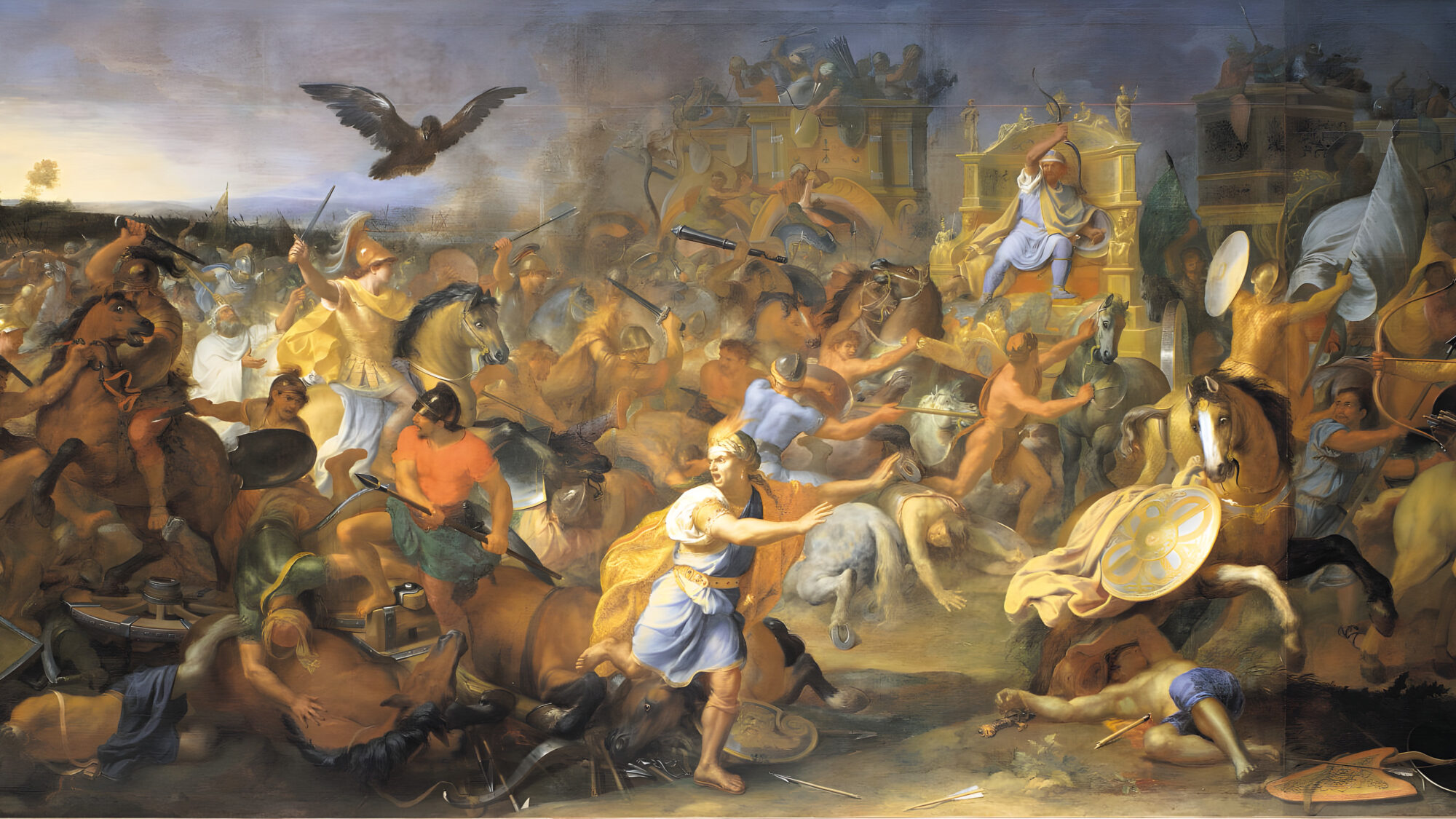
Darius himself came to the battlefield with more than superior numbers, though. He also brought 200 scythed chariots, that is chariots on whose wheels were mounted long, curved blades made to shred opponents as the chariots went past. And he brought a contingent of 15 war elephants, which the Greeks had not yet ever met in battle.
But none of it was of any avail to the Persian King. The Greeks formed for battle with their customary discipline. They chanted the war song and marched forward. Alexander unexpectedly charged to the far right with his companion cavalry. The Persian cavalry followed him, while the core of the two armies met head-to-head. On the outskirts of the main battle, then, Alexander drew off the enemy cavalry before turning and attacking them vigorously. Then, suddenly, he turned his cavalry back toward the center of the battle, where the phalanxes were fighting. Forming a wedge with his horse troops, Alexander slammed into the enemy center, and collapsed it.
All this time, the scythed chariots and the war elephants had done little to disconcert the Greeks. Nevertheless, the phalanxes, and Parmenio and the Greek allied cavalry on the left, had their hands full.
Darius once again fled the scene on horseback before Alexander could reach him. Alexander’s intent, as before, was to reach the king in combat and to either kill him in combat or to take him prisoner. But Alexander could not chase the fleeing King of Persia because, just at that moment, he received word that Parmenio and the entire left wing of the Macedonian army was struggling, surrounded by Persian cavalry.
Alexander chose to save his army and turned his victorious right wing to rescue the left. And now the Persian surrounders were surrounded, and annihilated. It is said that so many of the enemy soldiers were slain here, tens of thousands lay dead or dying in the Mesopotamian sun that afternoon, that Alexander was forced to move his army far away as soon as the fighting stopped, for fear of pestilence from all the rotting flesh lying in the open.
But he was also compelled to march onward to establish his new capital. There was some worry that the city of Babylon would require a siege. Its walls were 70 feet thick and 300 feet high. But Mazeus, one of the Persian commanders who had fought at Gaugamela against the Greeks, he had retreated here and, seeing the writing in the wall, so to speak, he opened the gates to Alexander and welcomed the conqueror in as the new rightful King of Persia.
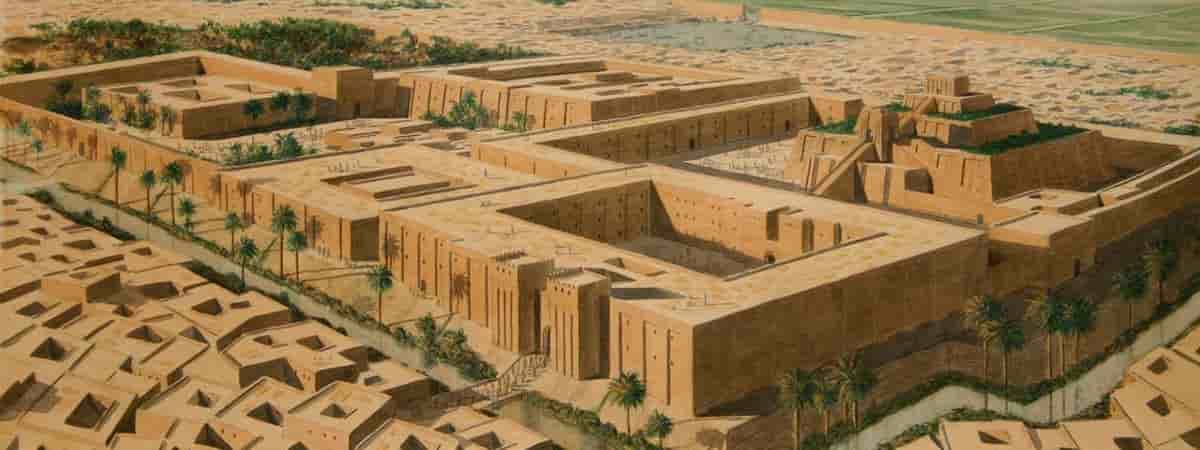
And so, in late 331 BC, the Macedonian army, which had been on the road and engaged in battle off and on for some five years now, marched through the gates of the greatest city on the planet. Some two hundred square miles were contained within its walls. Of that, only a third was urban, the rest was farm and forest land. Babylon, amid the buildings of its urbanized portion, had some fifty main streets, each of them 150 feet wide. There was nothing in the greek world to compare. And it was full of treasure, delicious food, and beautiful women. The soldiers of the Greek army had finally acquired everything that they had ever dreamed of.
For a month, while his army enjoyed a well-deserved rest amid the luxuries of Babylon, Alexander portioned out rewards to his men, and plotted his next move. It is easy to imagine the victorious warrior, his body seamed with numerous battle scars, walking amid the gardens of this fabled city at night, carousing under the stars with his battle-proven companions, always in the back of his mind, that Darius was out there somewhere, that beyond Babylon still lay more than half of the Persian Empire yet to be conquered.
Indeed, Alexander had not even reached Persia yet. Babylon was an old Mesopotamian city which had served as capital because of its great age and wealth. But the Persian heartland itself was actually further East, in places like Susa and Persepolis, and beyond that there were many more lands, lands for which there were not even any maps to navigate them.
All this must have preoccupied the mind of this young, new ruler.
But he must have also been a little proud. Ever since the Persian War, 150 years before, the Greeks had dreamed of finally getting revenge on the Persians for their occupation of Greece. Now, the Persian king was on the run and victorious Greek soldiers wandered and reveled in the streets and gardens of Babylon.
But something more than revenge had been accomplished. Poets and philosophers and artists that had accompanied the army now perused the libraries and galleries of the eternal city and mingled with the minds and souls of Eastern thought.
And all the world was seeking their king to offer their submission and their loyalty.
Alexander was 25 years old.
(Music)