Episode II.38 - Introduction to the Hellenic Period


Phillip II of Macedonia. Alexander the Great. The Sacred Band of Thebes. A brief digression on Greek sexuality. Olympias. Leuctra, Mantinea, Chaeronea. Epaminondas. Pelopidas
RECOMMENDED READS - Click Image for Link:
(Music)
All early history is but a record of wars.
-Theodore Ayrault Dodge, from the opening words of his book about Alexander the Great
(Music)
Hello and welcome to the Western Traditions podcast. This is the 38th episode of the Greek Sun, a podcast series about the history and culture of ancient Greece. Today’s episode is the introduction to the third and final unit of podcasts, which will focus on the Hellenic period that began in the 4th century BC, and came to an end during the Roman conquests a few centuries later.
Before I get started, I ask you to head over to the website, western-traditions, org, if you’re not already there, and leave a comment or pick up some western traditions merchandise on the shopping page. You can also contribute directly to support the podcast through the PayPal or patreon options.
Patreon members receive weekly updates and bulletins through the Patreon app, where they can get some behind-the-scenes information about the podcast and they can ask questions or even make episode requests.
Wherever you listen, on the website, on Spotify, Youtube, Amazon music, iHeart Radio or elsewhere, remember to leave a comment, like, share and subscribe. These are easy, free ways to support the podcast and I appreciate however you decide to contribute to my work.
For those who have already contributed, subscribed, left comments, shared the podcast with others or purchased merchandise, I profoundly thank you.
And now, let’s open the next epoch in the history of the world.
(Music)
Now, in strict terms of history, we left off the last unit of episodes with a Greek mainland that was dominated primarily by the city of Sparta. Technically, Sparta was hegemon over a league of Peloponnesian cities and functioned, really, as the representative of all Greece, especially with regard to the never-ending confrontation with Persia.
Episode 32 of this series about Greece was about the adventures of Xenophon as a mercenary in Mesopotamia. After Xenophon returned from this experience, he published an account of his doings over there. This account revealed, among other things, the supremacy of the Greek phalanx against enemies of all kinds. Greek readers of Xenophon also noted the innovative tactics and strategies that the ten thousand had used to survive amid the enemy heartland.
You see, for a long time, for most of human history, battles had frequently been decided by unique participants, by heroes or bodies of heroes, or by one particular accident of circumstance, by a superior position, or an act of God, such as the eclipse that dispirited the Athenians struggling on the island of Sicily during the Peloponnesian war.
In stories like the Iliad, powerful warriors engaged in single combat while the rest of the army looked on.
But Xenophon and the ten thousand had no heroes with them. Their officer class was nearly wiped out by treachery. In order to overcome both the human enemy and the unknown, rugged terrain of the Persian interior, they had to innovate. The new tactics they developed can be characterized in many ways but one feature of their overall strategy
was that of combined arms.
Xenophon and the ten thousand discovered and utilized a number of ways to cooperatively deploy their heavy infantry, their cavalry, their light infantry and more. If you study many battles both before and after this period, you will often see a set-piece sort of routine occur, both armies sort of adhering to a ritualized encounter rather than capitalizing on opportunities for victory. The light infantry goes forth from both sides and hassles their counterparts with slings and arrows, before falling back and letting the phalanxes of heavy infantry crash into one another while the cavalry harasses the flanks and tries to infiltrate the rear.
A great part of the difficulty in coordinating large bodies of troops was also communication. Even an army of just 20,000 men, like those you will hear about in this episode, even such an army, when deployed on the battlefield, might have a front line spanning for miles. And this is long before any form of modern communication, when only trumpets and flags could be used to send signals.
A tradition common to all armies back then was to put the strongest most honorable force on the right wing of the line of battle. Thus, when facing each other, each army’s strongest forces were posed against the enemies weakest, because one army’s strong right-wing faced the enemy’s weaker left-wing. And so frequently each right wing would be victorious over the forces in front of it, but, over all, there might be a clumsy, tactical draw, with each right wing doing well while each army’s weaker forces might be simultaneously fleeing the battleground.
Xenophon and the ten thousand, did not, though, have the luxury of adhering to any such traditional routines. They did not have anything even approaching equality with their various enemies, and rarely did they even have the chance to meet an enemy on a level field for battle anyway. They were usually on the run, or trying to seize a defended pass, and rarely prepared for such a set-piece encounter. They had to use every man, sometimes in more than one capacity. Infantrymen learned to be horsemen, to be archers. And when they went to battle, all engaged in combination. This army was a democracy on the run, with tactics and strategy often discussed and arranged at the campfire among all the men.
And they overcame.
They survived. They fought their way through and/or around an assortment of enemies. The men that made it back to Greek civilization brought with them their stories, their lessons, their expertise.
Unrelated to Xenophon and the mercenary army which he led, another phenomenon had started to change Greek military life:
The standing army.
Since the beginning of organized conflict, anywhere in the world, most armies had been cobbled together at the last moment, by kings and queens as a response to some threat. Larger, more ancient civilizations, such as the Egyptians and the Persians, had a certain number of select troops and officers who were nothing more than soldiers, meaning that they did not pursue agriculture or any other trade or profession, but only soldiered. But that was rare. In any given war, most of the troops on the field of battle had been plowing fields and harvesting crops before the start of hostilities.
In Greece, this had been the standard since anyone could remember. Only in Sparta had the standing army concept been applied, and that had required the entire state to be reorganized and reoriented to do little more than support that army.
But the Peloponnesian War, nearly three decades in length, had gone a long way to making soldiering a way of life for many men throughout Greece.
So, as the fourth century BC developed, so did Greek society. Power shifted away from cities in the South like Athens and Sparta, and new ways of fighting allowed previous backwaters of Greek civilization to rise to their feet
and to fight as equals against the Spartans and the Athens.
Their equals, and then their superiors.
(Music)
As the 4th century BC opened, Sparta was triumphant. Now, Athens was by no means resigned to submission after its defeat in the Peloponnesian War, but the sacred city of Socrates would increasingly find itself as little more than a partner, even if sometimes a major partner, in alliances, rather than leading as the Hegemon of the Greek cause.
Early on, though, there was an attempt to reverse this new arrangement of power. In 395 BC, King Agesilaus was leading Spartan and greek allied forces against the Persians in Ionia. The Persians themselves were led by the satrap Tissaphernes, a long-time foe of the Greeks who had played a pivotal role in extending the Peloponnesian war in an attempt to bleed Greece dry.
Here, in Ionia, the Spartan king had raised a brigade of cavalry in order to face Persian horsemen on the open ground. He also had with him the core, perhaps five or six thousand men, of that body of troops that had marched with Xenophon.
Agesilaus was so successful that the followers of Tissaphernes assassinated the Persian satrap and paid a huge bribe to the Spartans to turn away their ferocity.
But, just then, the Spartan king learned that Athens,Thebes and other cities had united against the allied league. They were supported in this effort by the Persians, who were ever ready to spread their wealth around Greece to sow dissent and thus weaken whoever was most powerful among their enemies.
So Agesilaus marched back to Greece, crossing the Bosporus and marching down through Thrace and Thessaly in 394 BC. The Spartans fought off the Thessalian cavalry with their new horsemen as they marched. Meanwhile, the Persians were victorious at sea over the Spartan-led fleet. As Spartan strength appeared to wane, Agesilaus sought to find and destroy the rebels who had taken Persian money and threatened the unity of Greece.
The armies involved were small, certainly in comparison to Persian armies. Neither side fielded more than 20,000 soldiers, the Spartans probably had considerably less. But, as Xenophon had shown, small numbers of highly disciplined hoplites could form compact phalanxes capable of dealing out death while simultaneously withstanding almost any kind of attack. They found one another, these armies, at Coronea, a city in south central Greece, in the province of Boeotia,
And, as so often happened, the Spartan right wing was victorious and so was that of the Thebans. But when Agesilaus heard that the Theban right wing had broken through his left-wing and was now ransacking his camp, he wheeled about with his own right wing and assaulted those looting Thebans, putting his phalanx in between them and their route of escape.
Though few have heard of it, this battle is remembered as one of the most deadly in the history of hoplite battle, in terms of percentages, anyway, even if the numbers involved were smaller than those that would occur a couple generations later in Persia. The Thebans in the Spartan camp were annihilated, and only a few managed to cut their way through the Spartan lines and make it to safety.
The Spartans, though they had been imperiled, had now strengthened their grip on Greek hegemony. And so they would remain, as Hegemon over Greece, for another 20 years. Athens would continue to connive and maneuver, and seek new alliances but would never lead their fellow Greeks again.
But they did eventually join again with Thebes in launching the Boeotian war.
Now, up until now we have focused mainly on the politics of Athens. That focus is due, in part, to the simple fact that democracies tend to have the most exciting politics. Oligarchies and monarchies, like the government in Sparta, tend to be more stable and boring. In Athens, there were oligarchs factions and democratic factions and the tension and conflict between the two usually led to dramatic confrontations.
Sparta apparently had little in the way of a democratic party. Instead, their society was essentially divided into the masters, that is, the Spartans, and their slaves, the helots. Their only form of political drama was the constant, bloody uprisings of the slaves.
Now, Thebes was more like Athens, in that it had democratic and oligarchic parties. In 382 BC, the Spartans sent an army to quell dissent in the northern city of Olynthus. While on the way, the oligarchic faction in Thebes asked the Spartans to leave a garrison with them to keep the democrats in check. Leading democrats in Thebes then fled the city and took refuge in Athens, where they began to plot their return and their revenge, with the assistance of the Athenians, who were ever ready to disturb the Spartans.
In 379 BC, the exiled Thebans, led by a man named Pelopidas, returned to their home city with an army and forced the Spartan garrison to surrender. They installed a democratic government and prepared for Spartan reprisal.
Agesilaus was still one of the kings in Sparta at this time. His co-king was more inclined to seek terms with the new government in Thebes, which asked only to be recognized as the official government of Thebes in return for rejoining the Peloponnesian league. But not Agesilaus. He demanded victory over the democrats.
The war dragged on for seven years. This itself was shocking, that the Spartans could be deterred for so long, instead of coming to instant mastery of the situation. Essentially, this was a redux of the Peloponnesian War, on a smaller scale, as Thebes and Athens battled Sparta and other allies in a variety of local theaters in mainland Greece.
But the greatest shock of all came in 371 BC,
at the Battle of Leuctra.
(Music)
Let’s talk, one more time, about the phalanx. And about the whole concept of an army at this juncture in history.
Now, there is a certain mystery about the development of the hoplite, and I have addressed this before in the introductory episode to the Classical period, the previous unit of Greek episodes.
But there is also something mysterious about the development of the phalanx, the body of hoplites fighting alongside one another, about the chronology of its evolution, by what time it had become the finely tuned, compact killing machine that it was in the days of Alexander. Just when did hoplites learn to keep themselves in these tight formations, with those particular shields, those long spears called sarissas, that coordination and cooperation among all the man that turned the phalanx into a single entity of armor and blade?
It is hard to say just how the hoplites of the Persian War or the Peloponnesian war engaged in battle. Was it more like the ancient days, with single warriors thrusting themselves heroically into danger and turning the tides of battle with their bravery, or their sacrifice? Or was it more like it would become in the days of Alexander, when the phalanx, a compact mass of troops acting in complete unity and coordination, would first encounter, then push, then overrun a brutalized, shattered enemy formation?
But, however, the phalanx developed, by the battle of Leuctra, in 371 BC, it had definitely become what we recognize as a phalanx today.
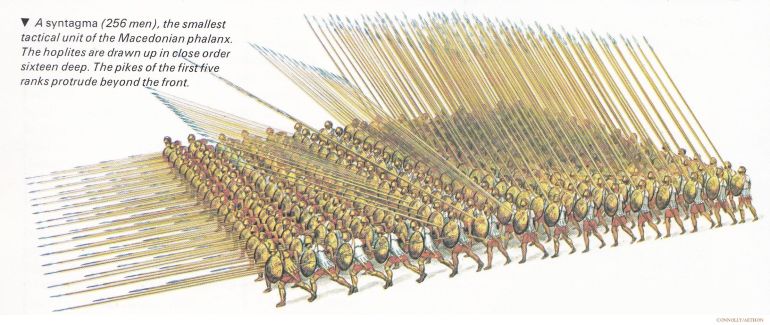
The core of an army was typically composed of a number of phalanxes. Each phalanx had a front line of battle. This line might be composed of ten hoplites or twenty or more, each evenly spaced, exactly even, from the man next to him. But this front line is not the unit of the phalanx. The units of each phalanx were the lines that stood behind each leading man in the front. Think of these lines as squads. Typically, that first man in the line, the one that stood at the front of the phalanx, was the squad leader, the sergeant. Standing in a straight line behind him, his squad might number four, eight, or 16 men or even more.
I have placed a picture of a phalanx formation on the website at western-traditions.org.
Now, typical phalanx depths were usually closer to eight or ten. In Alexander’s army, some four decades later, it would be sixteen. Every army had its own style, its own theory and also had to accommodate for its own numbers. Thus, a typical phalanx might be eight lines of eight men each, and each having its squad leader at the front. This body would form a compact square.
You might wonder how valuable or capable such a body of troops might be, with most of its troops prevented from contacting the enemy. Why, you might ask, only have the eight squad leaders at the front, and all these others standing uselessly to their rear?
Thanks to the long spears of the Greeks, these men were not useless. The sarissa, this long spear of which I speak, was initially only something like eight feet long. As phalanx tactics developed down through the years, the spears became longer. We can estimate that the spears of the Thebans and Spartans were probably 10 or 12 feet long at least. In Alexander’s highly organized and well-equipped army, the standard-issue sarissa would be 16 feet in length.
With such long spears, the men standing behind the sergeant were not useless. Depending on just how long the spear was, the men two, three or even four ranks behind the squad leader would also have their spears extending to the front line. The sergeant at the front, as he stood there, his own spear extended eight or ten feet in front of him, would also have at least the spear of the man behind him extending past him. In armies with longer spears, this number of deadly spear points bristling at the front of a formation would be increased.
This, when armies met, they met long before the men involved could even touch one another. Their spears met the opposing force first, and then another spear point, and then another, before the great mass of soldiers collided and clashed.
And this perhaps, is the greatest key to the effectiveness of the phalanx. That great mass of heavily armored men. They would meet an opposing phalanx, and push. And push. If you watch American football, you have probably seen a running back carry the ball and run into a wall of defenders, but before they can tackle him, the linemen from the running backs team rush up and begin to push him, and the ball, forward.
And it becomes a war of pure strength.
This is one way that the phalanx could literally crush an enemy. After piercing its front ranks with its deadly spearpoints, the massive weight of hundreds of men and armor would trample the enemy.
Unless the enemy phalanx was tougher, stronger, braver.
But, each man in the phalanx also carried other weapons, and each army differed in how it equipped the men. They might carry short swords for close fighting, daggers, javelins, clubs, etc. Once the ranks closed, it came down to pushing, shoving, hitting, stabbing, until one side broke into retreat.
But there was more to an army than the phalanx, as critical as that element of the army might be. There were also many light troops. These were typically men from the lower classes, unable to provide and pay for the heavy armor and the training needed by the hoplites. The light troops, called peltasts or psiloi, (Spell those words), they carried javelins and daggers, short spears, some carried bows, or slings. They wore light armor, perhaps made of leather or even linen. Some carried small shields. Initially, centuries before, these may have been a disorganized mass of troops meant to carry out scouting, security and other tasks, but, by the fourth century BC, they also are highly organized into coordinated bodies of fighting men.
In terms of proportion, an army of, say, 8000 men total, might have a thousand or more of such light troops. In battle, they often went out before the whole, to harass the enemy front and try to create disorder that the advancing phalanx could exploit. They could also perform a variety of other tasks that heavily armored men could not, on more rugged terrain.
And then there was the cavalry. Comparatively, this body of troops was new to the Greeks. The Greeks had always admired horse riding, and the Thessalians of northern Greece were respected horsemen. But cavalry had never been a primary feature of Greek combat.
There are good reasons for this, too, that have nothing to do with the rocky, hilly nature of Greek terrain which generally made horsed warfare impracticable. Even in an open plain, it was hard to make cavalry particularly deadly. From our modern vantage, we must remember that the stirrup was not invented until nearly the middle ages.
This might be hard to imagine, but the stirrup as we know it was not used among the ancient horse riders. Not in Greece, not in Persia, not in India or China. With the stirrup, which was not really seen in action until the third century AD, cavalrymen like the crusaders who invaded Palestine in the 11th century, they became the tanks of the middle ages, the armored warfare of the time. Heavily-armored men, carrying heavy lances and leaning forward, supported by their stirrups, became virtually unstoppable juggernauts, and the Arab Muslim troops of the Middle East would need a couple centuries to determine how to counter this kind of warfare effectively.
But, prior to the 4th century BC, cavalry was not equipped thus. Initially, most cavalry had really been a form of mounted light troops. They were mostly good for scouting, harassing, tracking, and other duties. Large bodies of cavalry, like those used by the Persians, could be deadly, yes, but not in the way that we imagine, not by riding into enemy formations and trampling troops like modern day tank. What was worst about such cavalry was that they could attack, firing arrows and javelins at bodies of infantry, without ever getting into danger themselves. They could just stand off and attack again and again. But even the fiercest cavalry unit, prior to this period, could not seriously threaten a heavily armored hoplite formation, for example, with its long spears ready to skewer charging horses.
But a new type of horseman was appearing. The cataphract. Once, the chariot had provided the precursor or armored warfare in the ancient world. Lack of battlefield agility, its absolute requirement for a level battlefield, and perhaps its logistical requirements, had lessened the value of the chariot for armies in Europe and Mesopotamia over the years, though they continued to be used.
But the cataphract, a heavily armored horseman, may have first appeared among the Persians a century or two prior to the battle of Leuctra. By the fourth century BC, it was appearing among the Greek armies as well. The cataphract wore heavier armor, carried heavier weapons. And he trained to ride in compact formations of horse troops, almost like phalanxes composed of cavalry. They rode in wedge shapes and lozenge shapes
Do you recall how Xenophon’s hoplites, while they were harassed horribly by enemy cavalry, could also not be instantly destroyed such attacks? There was not enough power in the cavalry charge.
The story of warfare in the 4th century BC, is a trial of this new arm of weaponry and the final test of the phalanx against enemies of every kind.
(Music)
Before we proceed with the Battle of Leuctra, a brief digression on sexuality in ancient Greece.
This issue has already been addressed to some extent in a previous episode. The nature of sexual interactions between both men and women and men and men, and men and boys, were briefly explored.
I bring it up again because the Thebans will bring to the battle of Leuctra a special unit of troops known as the Sacred Band. Numbering only three hundred total warriors, this body of troops was said to be composed of 150 pairs of “lovers.” Now, I put the quotes around the word lovers because it is the controversial part of the account and the part most prone to misinterpretation.
The story that has come down to us, from some but not all sources, is that the men in this elite unit of Theban soldiers, were all homosexuals. The point of this composition of the unit was that the bond of love between the men made them fiercer, because they were fighting not only for a cause, not only for their friends, but for their lovers' well-being as well.
Now, I’m not going to involve this podcast in the culture wars of the present, but I do question the veracity of this idea. I have no doubt that homosexuality was practiced openly among the Greeks of this period. The textual evidence that we have leave little room for disbelief on this point. So I am not saying that there were not homosexual soldiers. This is well-documented as is their bravery.
What I do find unlikely about this story is the idea that somehow you would find 300 men, in the right age bracket for military performance, from the correct social background, who would also then join a group of men and also find the love of their life. It is as improbable as Alexander the Great conquering the Moon as well as the Near East. Do I believe that some men in this unit may have been homosexual? Yes. Do I believe that gay men can make good soldiers? Certainly.
But the idea as passed down to us by some modern sources is beyond belief. I wouldn’t believe that 150 random pairs of men and women would love one another.
I think that the story behind this group, and behind Greek sexuality as a whole, is simply more complicated than we can really understand today. For one, the Greeks had several words for love, and even each word could be used differently, with different connotations.
And, for another, in the past love simply meant something that we really can’t grasp anymore. In today’s world, the way in which men and women are “supposed” to love each other, romantically, like Romeo and Juliet, there is no reason to believe that that was in any way common.
We have every reason to believe that, yes, men and women married and could come to feel something called love for one another, but it seems likely, given the completely different circumstances of most of history, that it was not “romantic” love, but rather, a love based on mutual dependence, loyalty, the bond of the traumas that young couples would experience through childbirth and child-rearing and so on. In a sense, love came after marriage, not before.
And as for love between men, it was something that we cannot comprehend today. Today, in the West, men are generally not allowed to show affection to one another, even in more liberal circles, because such behavior immediately gets classified as homosexual. When, in truth, you can go to a variety of cultures around the world today, in developing countries, in countries where traditional masculinity is prized and promoted, and yet you will find heterosexual men holding each other, hugging, even kissing one another in shows of affection, yet these men are not practicing homosexuality, they are marrying women and raising children, but they are allowed to be affectionate with each other in expressions of love which are lost among Western Men, whose definition of love has been reduced to sexual orientation.
So, when I read that the Theban Scared band was composed of lovers, my first instinct is not to assume homosexuality, but rather to understand that these were men who were closely bonded to one another, and, yes, these were ancient greeks, so this love may have been expressed in homosexual terms among some of them, but I also believe that they were expressing a, love, a bond, that went far beyond sex.
To have reduced this term “lover”, to a matter of simple sexual relations, is really something that has neither benefited heterosexuals nor homosexuals.
And, when we come here shortly to Alexander the Great, whose sexuality is also a point of interest for modern historians, we must remember the same thing. We must be just as open to the possibility of his homosexuality as we are to the likelihood that, men who have been through combat, who have been raised in violence, who have survived together, are going to experience feelings for one another which cannot be classified with the impoverished language of love that we cling to today.
I guess that wasn’t a very brief digression.
(Music)
The final showdown between Thebes and Sparta came near the village of Leuctra, in Boeotia. The sizes of the opposing armies were small. The Spartans fielded just around 10,000 troops, of whom probably less than a thousand were actual Spartans, the rest being allied soldiers.
The Thebans were outnumbered. They probably only had around 7,000 total troops at this battle. Among them were the Sacred Band, that group of 300 elite soldiers controversially remembered for their alleged sexual preferences. This corps of Thebes’ finest was led by Pelopidas, the statesman already famous for liberating Thebes a decade earlier.
But Thebes, like Athens, preferred a democracy of generals and rotating command. That day, they were led by Epaminondas, the Theban general who had insisted most on fighting the Spartans that day, even though outnumbered. Pelopidas had given this man his vote and his confidence.
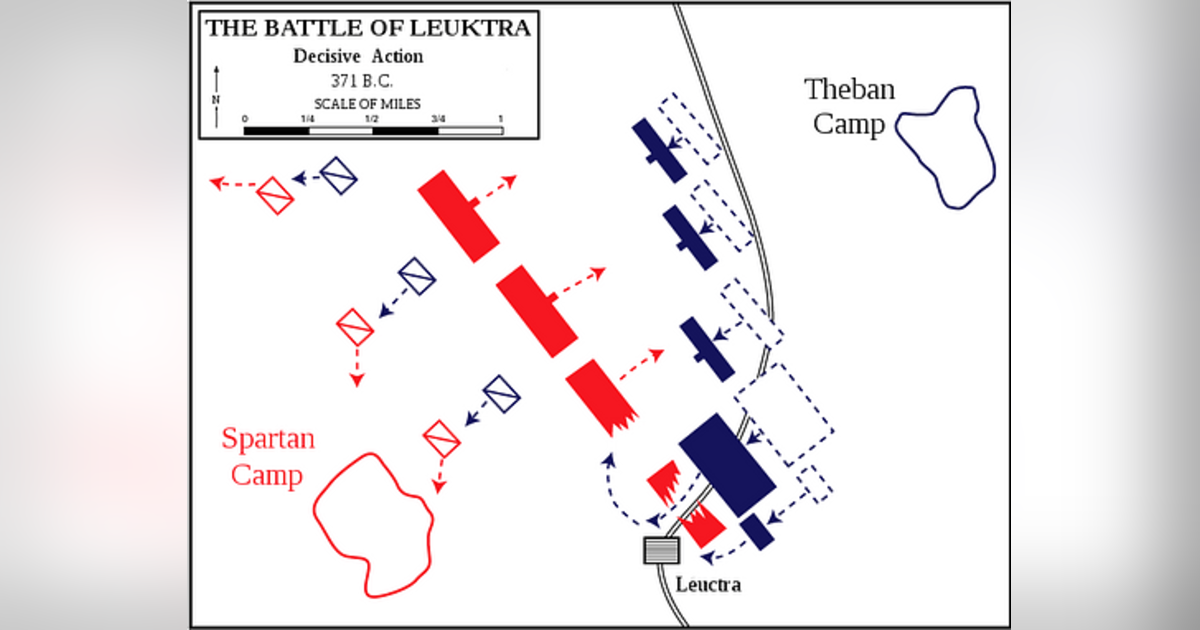
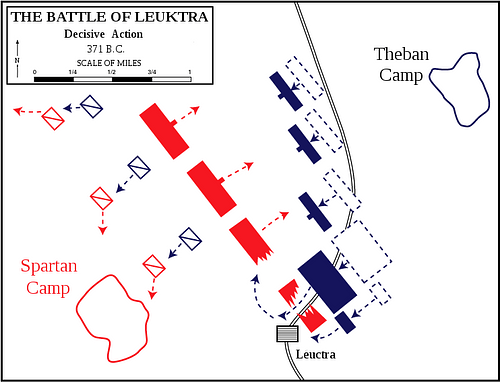
Epaminondas then did something completely unexpected. The Spartans, typically conservative and led that day not by Agesilaus but by their other king, Clemobrotus, they formed up as armies had been doing for some time. The light troops ready to engage first, the cavalry ready to create and exploit weaknesses, and the phalanxes in a line, ready to meet the enemy in parallel fashion. Their king and their finest soldiers formed the extreme right wing, ready to pulverize the enemy’s weaker left wing.
Epaminondas, the Theban general, innovated. He thinned out the ranks of his right wing, made it only eight men deep, and stacked his phalanxes on the left, 48 men deep. Here he also placed the Sacred Band and the Theban national hero Pelopidas. So his left wing contained more men, and was led by his strongest unit of men.
Not only did he make his left stronger than his right, he also made the first recorded attack in oblique order. Instead of advancing in parallel order, with all his phalanxes meeting those of the Spartans simultaneously, he pushed out his deep left wing first to meet the Spartan right and held back his own right wing.
At the same time, he placed most of his cavalry in the center, rather than spread evenly or along the flanks, and they visibly defeated the Spartan cavalry and sent the fleeing horsemen into the front ranks of the enemy, causing great disorder.
Adhering to orders and tradition, then, the dispirited and confused Spartan left wing stood and watched as the Thebans crashed into the Spartans on the right. Met by such a huge mass of men, the Spartan right could not stand its ground. King Cleombrotus died in combat, and the right wing gave way and retreated. Then Epaminondas turned this victorious portion of his army, his unexpectedly powerful left wing, and wheeled right against the remaining enemies.
The center and left of the Spartan allied force watched all this and, without ever even engaging the Thebans, turned and ran. Without even engaging his whole force, Epaminondas had shattered the Spartan army. Even if it had been made up mostly of allies and only a relatively few actual Spartans, the message was clear. The torch of combat superiority had been passed.
The age of Thebes had begun.
But it would be a brief age. The Thebans marched south and established the Arcadian League, an alliance of anti-Spartan cities, with its headquarters right in the heart of the Peloponnesus. A slap in the face to Spartan honor.
The Spartans did not submit to this. Defeated they were, but they had not surrendered to fate. Nevertheless, now the battle was on the Peloponnesus itself, their peninsula. Epaminondas seized Messenia, the territory adjacent to Sparta, and he freed the helots, the Spartan slaves, completely undermining the very basis of Spartan society.
Now, Athenians being Athenians, they could not stand Theban superiority any more than they could and Spartan supremacy. So they allied with the Spartans and others to challenge Thebes.
In 362, at the battle of Mantinea, a city on the Peloponnesian peninsula, the Spartans made a last-ditch effort to retain the integrity of their culture. They formed an army 20,000 strong, a force which included 6,000 Athenians, most of whom were hoplites.
Epaminondas met them with the army of his new alliance, a coalition of countries happy to see both Sparta and Athens suffer after their century-long duel had both elevated Greece and ravaged it.
Epaminondas met their army with an army estimated to be larger, perhaps 25,000 men. But he initially maneuvered away from the battleground, appearing as if he meant to make camp and delay battle for another day. But then he attacked, again in oblique order, his left wing possibly as much as fifty men deep. The Spartan force was again decimated and fled the field.
Only the Athenians managed to maintain their order and fight. They slaughtered over-eager allies in the Theban force who tried to repeat the victory of Leuctra and drive the remaining enemies from the field of battle in disgrace.
The Athenians held their ground, but the victory belonged to Thebes.
But not to Epaminondas. He died fighting the Spartans on his own left wing. As he lay dying, he spoke and wished that the Thebans might make peace, perhaps foreseeing what is perhaps only obvious in hindsight.
You see, Greek strength had been spent. The Spartans, disliked as much as they may have been, had always been, with the Athenians, the backbone of the Greek military body, especially with regard to Persia. The Thebans had suffered terribly, the Athenians were no longer in position to rule, and the Spartans were, in some sense, gone. Their warrior class was virtually destroyed at that battle, and their was no longer any Spartan homeland or culture to rear and train such men again.
All of Greece was ripe for the taking.
But it would not be the Persians who came to seize it.
It would be a Macedonian.
(Music)
Macedonia was, in some ways, just barely Greek. It lay to the utmost north of the Greek cultural homeland. Even their closest neighbors were really just, from the Greek perspective, barbarians.
And, indeed, at the time of the Persian War, you may remember, Macedonia was a Persian vassal, openly on the side of the King. When the Persian forces withdrew from the continent after the Persian War, though, Macedonia regained its independence and slowly began to increase its cultural contact with Greece.
They did speak Greek, these Macedonians, a form of it anyway, as every location had its own dialect. The Greek that we call ancient Greek today is really just Attica Greek, or the Greek of ancient Athens, but every locale had its own version of Greek, as did Macedonia.
They had Greek names, too, although Alexander may not seem like a name that we have heard much in our history so far. But remember that Paris, the one who stole Helen away from Menelaus and took her to Troy, he was really called Alexander in the Iliad. And we find among their kings some already familiar names like Archelaus and Phillip.
And they worshipped the Greek gods, though their worship practices may have differed. Alexander the Great’s mother, Olympias, was considered to be somewhat barbarian, with her background in magical practices. She was something more like the wild women that I tried to describe in previous podcasts about Greek religion, part of a snake cult apparently devoted to Dionysus, and very superstitious.
Indeed, Olympias was something like a throwback to a previous period of Greek mythology. Her family claimed descent from Achilles, the hero of the Trojan War. And the night before her marriage to Phillip II, king of Macedon, Olympias reported that she dreamed that lightning descended upon her and kindled a fire that burst forth from her body and consumed the world.
Thus Alexander was born to a woman of legendary wildness.
Alexander’s father, Phillip, came from a long line of kings, which traced its heritage back to the mythological hero and demi-god, Heracles. He was the third son of King Amyntas II, and he only came to the throne, as many men did, through the force of his own personality. As King, he himself would be known as Phillip II
Now, Macedonia was a warlike region, surrounded by warlike peoples. Each of Phillip’s two older brothers sat on the throne briefly, and each died in combat. His second brother left a son and heir to the throne, named Amyntas IV, and Phillip assumed the role of regent to this child, to act as a guardian to guide the state until the boy grew and became ready to lead. But, as often happened in such regencies, this guardian decided that the state needed him to be king now and not wait for a boy to grow. Later the same year that Phillip became regent, he assumed the throne as king. He was apparently not afraid of his nephew, the rightful heir, who was just 6 years old, and Phillip let him live and even gave him one of his daughters in marriage many years later.
Phillip was well ready to lead. He had spent three years as a hostage in Thebes. Now, the term hostage probably brings to mind blindfolds, gags, hands tied behind one’s back, torture, ransom notes and so on. Such things certainly did happen and do happen, but, in the ancient world, and even more recently, exchanging hostages was a way for allied nations to trust one another and to learn about each other. The hostage usually led noble lives during their “captivity”.
Let us use Phillip II as an example. Macedonia decided, during the rise of Thebes after the battle of Leuctra, to ally itself more closely with this power in the south. One way for nations to trust each other in an alliance was to give hostages. Young men, typically men of noble birth, were sent to the capital city of the newly befriended nation. There, while technically hostages, these young men would grow and train with the young sons of that nation’s nobility. They would share a table, ride horses together, learn together, and even go to war together. After some time, these young men would be released and sent home, perhaps to be replaced by other “hostages.”
Thus, in the future, the leaders of each country would understand each other, understand each other’s culture, and have some amount of trust and even feel a bond with their counterparts in the other country.
It was beautiful foundation for diplomacy, but make no mistake, they were also really hostages. It did not have to be said that obviously, if the home country of these lads suddenly betrayed the alliance, it would not be hard to execute these young men and deprive the betraying country of their future, of their blood, to extinguish the bloodlines of that country’s kings and nobles.
But Phillip, during his three years in Thebes, certainly learned a lot. He studied the tactics of Epaminondas, learned the discipline that was fundamental to the phalanx and the critical coordination that was required to make all the portions of the army work toward victory. Phillip learned the art of combined arms, an art highly prized even today, over two thousand years later, by military leaders even though they possess a whole different set of combat tools.
Then, in 359 BC, at the age of 23, Phillip returned to his own country to rule as regent for his toddler nephew. Phillip soon seized the throne and began to build an army. Macedonia already had an army, of course, but Phillip intended to create a completely new model for his fighting force.
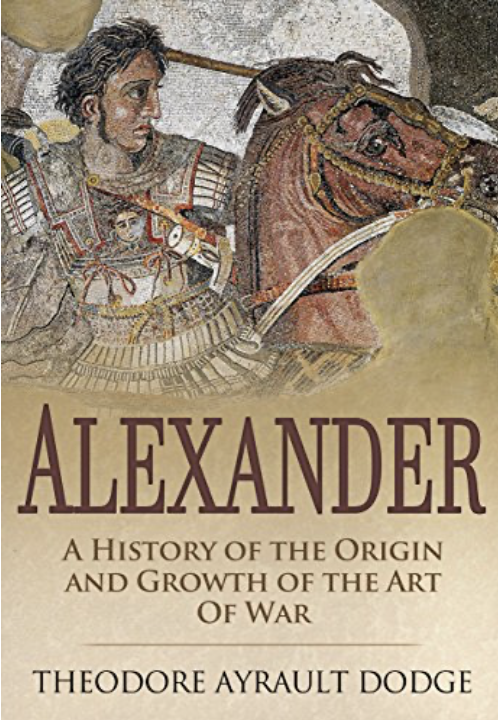
Theodore Ayrault Dodge, who wrote perhaps one of the greatest modern works on Alexander, had high praise for the father of the conqueror. Regarding his administrative skills, Dodge tells us the following.
“As the creator of an army organization, he has perhaps never had an equal.”
In 357 BC, Phillip married Olympias, a princess and daughter to the King of the Molossi, a barbarian nation bordering Macedonia.
In 356 BC, Olympias gave birth to Alexander, and Phillip’s claim to the throne grew stronger. As a powerful man in the ancient world, Phillip, of course, already had other wives and concubines, and other children, but Olympias and her son Alexander were, for a long time, his closest family.
But, it was his conquests that really secured his place at the forefront of the kingdom. Phillip II conquered to the West, in the Balkans, until his power reached the Adriatic Sea. And he conquered to the east, reaching the Black Sea and the Aegean.
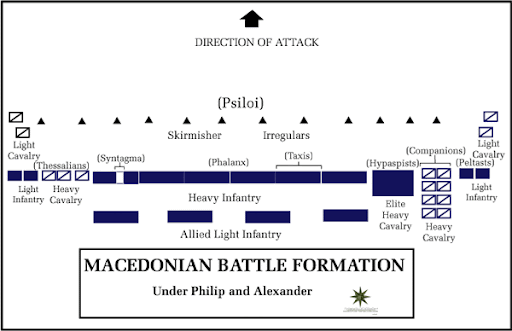
He did this with an army perfected from the Theban model. The phalanx was made up of hoplites. Each hoplite carried a sarissa, a spear 16 feet in length. Several such spear points thus extended out in front of the first men of the front line.
The hoplites of each phalanx ideally numbered 256, when not reduced by injuries or deaths in combat: sixteen lines of sixteen men each. The spears of this compact body of men could also be used defensively, held at different angles toward the sky to interfere with with falling missiles fired by the enemy. The soldiers learned to interlock their wielded and create a shell impervious to enemy arrows. In truth, this new phalanx was not a one-note song but was a versatile unit that could perform many maneuvers.
Several such phalanxes made up the front line of the army the ready to fight. A reserve was typically kept behind the lines to reinforce struggling friends or to exploit weaknesses in the enemy line.
Phalanxes formed the majority of the army, its indomitable core.
They were supported by peltasts and a variety of other light troops. And then there was, of course, the cavalry. Cavalry was the dreaded arm of the Persian military. Greece could outmatch Persia in the hillier country of southeastern Europe, and outsell them on the ocean waves, but, so far, no one had been able to match the Persians on horse.
Even while cementing and perfecting the phalanx as the backbone of the army, Phillip was already looking ahead to the next innovation in military power in Greece. Phillip’s goal, from the beginning, was the dream of many Greek adventurer-captains since the Persian War: to go beyond defending Greek territory from the Persians and to actually conquer Persia. And to conquer the wild lands of Persia, he would need cavalry.
He would need the best cavalry in the world. So he had formed small bodies of “companions”. These were elite bodies of heavy cavalry, formed by noble men of Macedonia, men who knew each other and trained together. Their numbers were small, but growing. And they learned to operate in highly disciplined fashion.
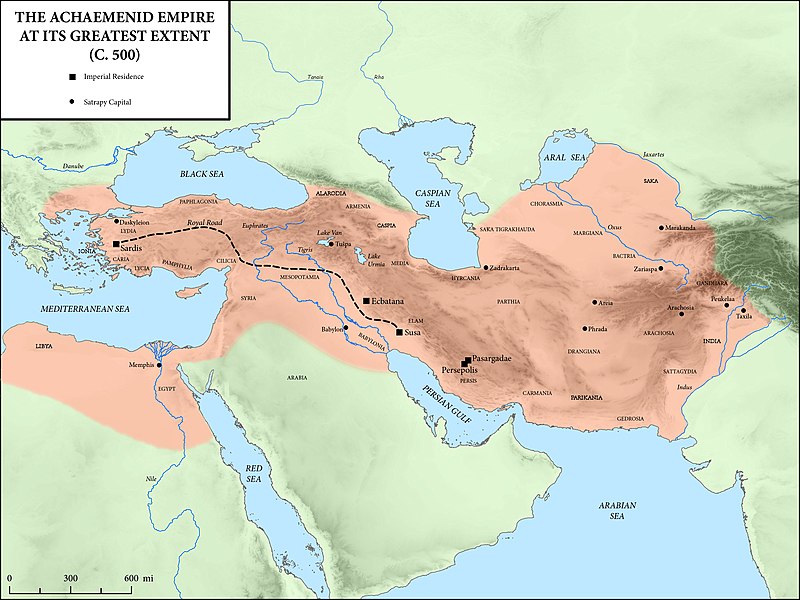
Now, the audacity of this idea, the idea of conquering Persia, is hard to describe to the modern listener. I will post pictures of the whole region and of the empire of Persia in its entirety on the website, at Western-traditions.org, so that you can try to understand the grandiose nature this ambition.
The lands ruled by Persia were vast. Persian rule stretched, from Egypt and modern-day Turkey in the West, all the way to India and Afghanistan in the East. A territory containing more varieties of people and terrains than the Greeks could even imagine. Truly, even at the start of Alexander’s conquests a few decades later, the Greeks could not be really sure how far they would have to go to conquer all of Persia. There is nothing, no comparable feat, that could face a conqueror today, there are no such challenges as big. You could conquer the whole world, today, yes, but this world is a known place, it is a smaller place than it was for Phillip.
Phillip was intent on conquering lands that hadn’t even been imagined.
And he envisioned this conquest when he was still just the semi-legitimate leader of a half-barbarous nation on the outskirts of greek territory, married to a mad-dreaming woman and despised by all the respectable Greeks to the south.
His army was not big. He never planned on a big army, He knew that even if he conquered all of Greece, and he had to do that before he conquered Persia, even with all greece supporting him, he could never field an army as big as Persia’s.
Instead, he focused on discipline. He would build a small, but professional, well-trained and highly-disciplined force, a fearless army, that would carve its way into Persia. Each branch of the army, phalanx, light troops, cavalry all would work together perfectly, in coordinated fashion, to be invincible.
And this would be a standing army. Most armies of the day had some number of professionals at their core, but most armies were composed, at need, from volunteers and conscripts, form people who were usually busy leading their own lives, working in trades if they were commoners or managing wealthy estates if they were form the upper classes or nobility.
But Phillip’s soldiers were 24-hour soldiers.
This was a slow process, starting almost from scratch. As I said before, Phillip added to Macedonian territory conquering barbarian lands east and west, and then adding the men of those territories to his own pool of talent and skill and bravery.
He expanded southward as well, and became recognized as military leader over these regions, stretching his hand toward the power of places like Thebes, Athens and Sparta.
And this was expensive. One primary reason that many rulers did not have standing armies was that they were expensive. You were paying a large group of men to do nothing productive: they weren’t sowing crops in the field, forging tools in the smithy, or sailing ships to trade with other nations. They were just training with weapons.
It took 20 years, twenty years of scrounging funds to support a legion of men who did nothing but fight and train for war. Twenty years of diplomacy, twenty years of small-scale battles, sieges, and the occasional grand conflict against one local enemy or another.
The first great test of this army, against similarly motivated and disciplined men, came in 338 BC, at the Battle of Chaeronea.
(Music)
Phillip’s rise to power had in no way gone unnoticed, of course. At the beginning, no one was likely to have taken his aspirations very seriously. Men had been vying for supreme power in Greece for centuries now, and most contenders had come from much more promising backgrounds. Men from cities of renown, like Sparta, Athens, or Thebes.
Macedonia has become great in our eyes and ears today because of what Philip and his son Alexander accomplished. But, prior to their time, Macedonia was simply a Greek backwater. No one was preemptively concerned about Macedonia interfering significantly in Greek politics.
But then, in 347 BC, during the height of the Third Sacred War, came the siege of Olynthus.
The Third Sacred War was a long, messy conflict that began sometime during the 350s BC, when the Phocians, of central Greece, seized the Temple of Delphi in response to a fine laid on them by the Amphyctyonic league, an alliance of nations that included Thebes. The Phocians sold off the treasures of the temple of Apollo and then used the money to fund mercenary armies to defend their interests against the League.
Phillip II cleverly insinuated himself into the conflict, on the side of the League, along with Thebes, in order to more deeply include his nation in the general doings of Greece. Eventually, over the course of years, with his increasingly disciplined and brave soldiers, Phillip became recognized as the leader of this alliance.
In 349 BC, Phillip was at war with Olynthus, in northern Greece. He defeated that city’s forces in the field and then besieged the city. During the course of the conflict, the Olynthians appealed to Athens for aid, and Athens sent a few thousand soldiers, whose actual part in the battle remains unknown. In the end, though, the city was apparently betrayed to Phillip, who knew how to fight when he had to, how to use diplomacy whenever possible, and how to use treachery when he had to.
As a result of this growing threat in the North, the figure of Demosthenes, an Athenian statesman, came forward. This Demosthenes, and his speeches, are remembered to history. He made a number of public speeches which decried the rising Macedonian power, and called for Athens to take a more active stance against this upstart, barbarian king.
The speeches of Demosthenes on this subject became known as Philippics, a term that we still use today to refer to speeches of denunciation. Demosthenes would go on to speak also against Alexander the Great, during his rise to international power following his father Phillip’s death.
Nevertheless, Phillip’s power and influence only grew. In 346 BC, he was able to bring about a general peace and an end of that Third Sacred War. Demosthenes continued to speak against Phillip, recognizing that, peace-bringer or not, Phillip’s true goal was complete supremacy over all Greeks. If there was one thing that Athenians cared about more than standing up to the Persians, it was their own independence and freedom. They did not want to play second fiddle to anyone.
Finally, in 338 BC, some 20 years after he had usurped the throne in Macedonia, Phillip came to battle against his remaining Greek enemies, Athens among them, at the battle of Chaeronea.
By this time, Phillip was actually already at war with Persia, fighting them in Anatolia on a smaller scale than he envisioned for the future. But Athens, among others, had openly given aid to the Persians in that conflict. Phillip saw his opportunity, and his justification, for a final war on the remnant of Greece that was not already under his power.
His army met an army composed mostly of Thebans and Athenians. The army of these allies was larger than Phillip’s. They had at least 35,000 troops and some estimates range as high as 50,000. Among them were the Sacred Band of Thebes.
Phillip came to the battle with only 30,000 infantry and just two thousand cavalrymen, many of them from Thessaly, a vassal state to Macedonia. The process to build a native cavalry force had gone slowly, but, as was characteristic of the Macedonian army, every soldier counted, every soldier was trained to be superior to his counterpart in any other army. Better trained, better equipped, and more disciplined.
The armies met in traditional fashion. Phillip commanded from his right wing. He put his son, Alexander, just 18 years old, in command of the left wing. Now, it is important to try to envision the size of such a battle. Thirty or forty thousand men does not sound like a lot when you have already read about armies much larger. But consider that these men were lined up in formation. Given what we know about the space between each line of men in a phalanx, the front lines of these armies probably each spanned two miles or more as they faced each other.
The allies, Athens and Thebes, had taken a stance between a river and a range of hills, so both flanks were secured. Phillip would have to face them head on.
There are, unfortunately, few surviving accounts of the battle, and none contain reliable details. It appears that the horsemen went out ahead and battled each other as the slower phalanxes advanced to meet one another. The Athenian horse was actually prevailing against the Macedonian cavalry at the start. Phillip personally commanded this cavalry force and he soon found himself leading his horse troops in retreat. But this may have been a trick, a retreat which soon reversed itself when Phillip turned and attacked the now disordered ranks following his cavalry off the battlefield.
What is reported is that Alexander, on the left, led the army to crush the Theban right wing. The Sacred band, though, did not fail to live up to its fame. Not a single one of them retreated from Alexander’s attack.
The Sacred Band stood and died to the last man.
Regardless of the details, we know that Macedonia was completely and totally victorious. Greek defiance of Macedonian supremacy appeared to be finished. Throughout the next year, Phillip made peace, harshly or gently, with each Greek city that had opposed him in the war. With the Athenians he was most lenient, not even occupying their city, the city from which Demosthenes had launched his anti-Macedonian tirades, not even occupying it with a garrison. Historians speculate that he was so lenient because the Macedonians did not have a navy and he knew that he would need Athenian ships in order to manage all-out war with Persia.
Only Sparta remained outside Phillip’s influence. The Spartans had been greatly weakened by the military setbacks of the 4th century BC, but they remained strong enough to deter Phillip from entering their homeland, Laconia, in the Peloponnesus. Philip might’ve conquered them, most certainly could have, but it would have cost blood and time and treasure that he could no longer afford to waste. He was now entering his mid-forties, and time was running out to fulfill his dream of world conquest.
He returned to Macedonia, to marshal his army one last time and to set out for Persia.
(Music)
But Phillip would not live to achieve his dream. He had always had a tempestuous, stormy relationship with his wife Olympias. Like many men of power, he had married several women, but it had long been understood that Olympias’ son Alexander, was the heir-apparent to Phillip’s throne.
In 337 BC, after returning from his victory sin the south, Phillip sent Olympias away. According to the Historian Dodge, she had come to disgust Phillip. But Alexander adored his mother, and sided with her. That he loved his father as well is well-known and not doubted. But the question of succession had come to the fore in 337 BC. Phillip had recently married Cleopatra, one of his general’s daughters, and she had given birth to a son.
In 336 BC, when he was finally ready to begin his conquest of Persia, Phillip was assassinated at a celebration of the marriage of one of his daughter’s, also named Cleopatra. One of Phillip’s bodyguards stabbed him to death and then fled, but he was caught by the king’s other bodyguards and himself killed.
The intrigue around this issue is immense. One ancient historian writes that this bodyguard-turned-assassin, whose name was Pausanias, he had been a lover of Phillip’s, and he had become jealous because Phillip had turned his attention to a younger man. There is speculation, of course, that the attack was arranged or at least encouraged by Olympias, and many wonder if Alexander might have even known. Absolutely zero evidence exists to corroborate any of this.
Regardless, Phillip was dead, and so was his dream of conquest, apparently.
Kingdoms run by strong men do not pass on authority easily. Another, equally strong man must seize that power. In Macedonia, there were many such men, experienced, mature, battle-hardened men, all of them ready to sit on the throne.
But Alexander was just 20 years old and his mother was an exile. Prior to the assassination, all of the his close friends had also been banished.
And the fate of the entire civilized world now hung in the balance.
(Music)