Episode II.36 - Greek Math


Pythagoras, Euclid, Archimedes and more. Over the centuries, the ancient Greeks separate Mathematics and other fields of study from philosophy.
RECOMMENDED READS - Click Image for Link:
II.36 - Greek Math
(Music)
-Let no one ignorant of geometry enter-
According to legend, these words were inscribed over the doorway to Plato’s Academy.
(Music)
Hello and welcome to the Western Traditions podcast. This is the 36th episode of the Greek Sun, a series of podcasts about ancient Greek history. Today’s focus is on the mathematical knowledge which the ancient Greeks inherited and then passed on down to all of us in the west, their heirs and cultural descendants.
Speaking of math and numbers, please remember to support the podcast in one way or another. Wherever you listen, Spotify, YouTube, Amazon Music or on my website, western-traditions.org, wherever you listen, please remember to like, subscribe, share and leave a comment.
On the website, you can buy Western Traditions merchandise, such as hats, coffee mugs, T-shirts and more. You can also contribute directly to support the podcast through the PayPal option. Patreon supporters get access to a weekly newsletter that shares behind the scenes information and forecasts upcoming episodes. I also answer supporters questions there.
(Music)
For the most part, the Greeks did not invent the math that they pass on to us in the works of people like Pythagoras, Euclid, Archimedes and others. Some of the theorems recorded in their books are the original developments of the authors, but, in most if not all cases, what we find in their works are proofs and axioms that were worked out by the nameless ancients, who built the pyramids and maybe even those who erected the monoliths at Gobekli Tepe over 10,000 years ago.
So old is man’s abstract thinking.
Thales of Miletus, whom I mentioned in the 23rd episode of this series, which was about the Pre-Socratic Philosophers, this Thales was born in the 7th century BC, long before Greece was anything but a cultural backwater in the Eastern Mediterranean. Among other things, Thales provided for us, his posterity, the earliest definition of number, which he learned from the Egyptians: According to them, a number was a “collection of units.”
This may seem pretty humdrum, but all of the complex math upon which we rely today, and which figures greatly in our technology, all of it relies on a foundation made up of very simple, yet very important, postulates, axioms and definitions such as this. It was also Thales who declared that the base angles of an isosceles triangle are equal, and that a circle is bisected by its diameter and much more.
Now, I mentioned in a previous episode, the thirteenth of the Greek series, which was about the concept of Magna Graecia, I mentioned in that episode a semi-legendary philosopher by the name of Pythagoras. Specifically, I mentioned him in relation to the quasi-religion that had grown up around his memory.
But I did also briefly mention in that podcast that, aside from his philosophical and theological ideas, Pythagoras is also, and primarily, famous today for his mathematical achievements.
Now, in the last episode about Greek sciences in which I introduced Aristotle, I mentioned how Aristotle was one of the first figures about whom we know specific things more or less certainly, such as the location of his birth, the year in which he was born, where he lived much of his life and so on. I also alluded to the fact that the lives of everyone that came before him, such as Socrates and Plato, were shrouded in a certain amount of mystery. We don’t know dates and locations. And the father back we go, the harder it gets to really establish firmly that such and such a person even existed.
That is definitely the case with Pythagoras. Walter Burkert, a 20th-century German scholar of Greek mythology, famously said that “there is not a single detail in the life of Pythagoras that stands uncontradicted.” For every single thing we think that we know about the man, there is an account somewhere which says something completely different about him.
As far as we can tell, though, Pythagoras was born sometime in the 6th century BC, and would have died sometime in the decade before the Persian War. So he lived and died in the era immediately prior to the great classical period about which so much has been written.
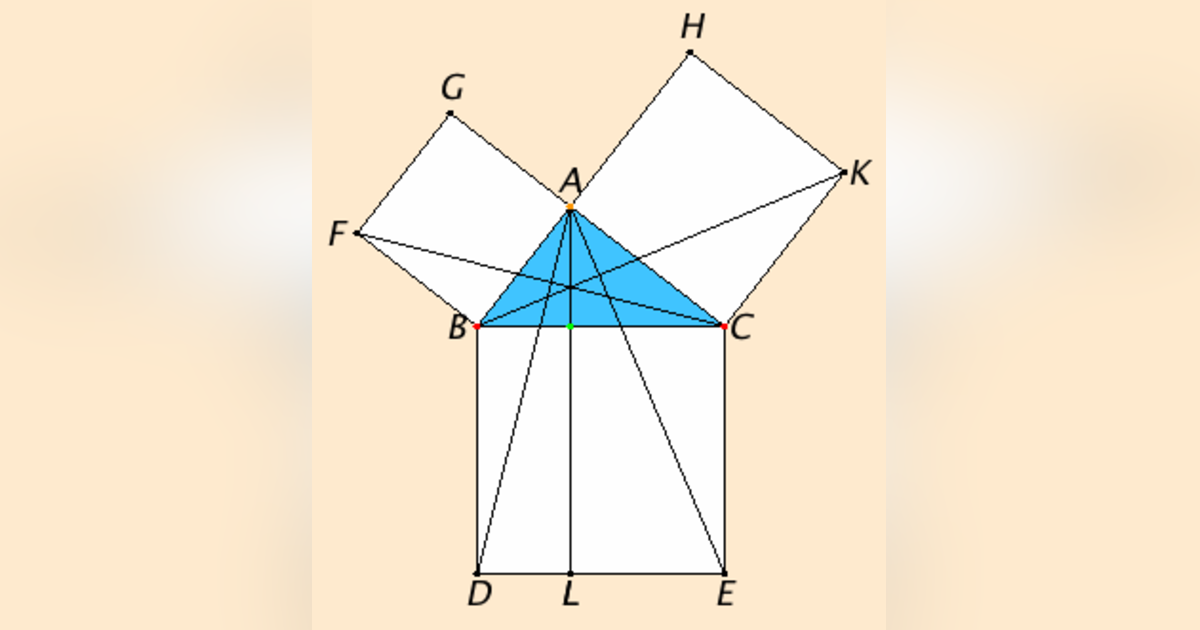
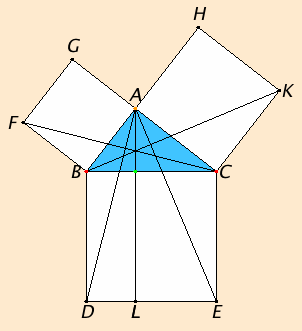
The ancients credit Pythagoras with a great deal of mathematical discovery. Most likely, if you have graduated from high school, you remember him from a geometry class. The pythagorean theorem is named after him. That is the one that says that the square of each side of a right-angled triangle, when added to the square of the other side, the sum of these two squares is equal to the square of the hypotenuse. That is, A-squared plus B-squared equals C-squared.
There are a number of other fundamental ideas, in math, geometry, physics and even music, which are attributed to Pythagoras by one ancient scholar or another. The five regular solids, often called the Platonic solids, are actually more closely associated with Pythagoras. These three-dimensional solids are made from the interlocking faces of regular polygons, the smallest is the four-sided solid, the largest has twenty sides. If you’ve ever played classic Dungeons and Dragons, like you see in the Netflix series Stranger Things, then you know these solids. They are the dice that you use to play the game.
Pythagoras is also often credited with being the first to declare and demonstrate that the Earth is a sphere.
However, as with most of the mathematical and physical concepts which I will mention in this episode, it is actually much more likely that these ideas existed in the scholarly community for many centuries, maybe even for thousands of years. It is hard to imagine that the Egyptians built the pyramids without some serious math, and there is increasing evidence for mathematical instruction among the Egyptians going back thousands of years before the classical era in Greece.
We do not have any written works of Pythagoras. Either they did not survive the ages, or he never wrote anything down.
Nevertheless, it is with Pythagoras that we begin tracing the line that leads from out of the darkness of the deep past and toward our modern day mathematics. Elsewhere, I have described the religious following that grew up around Pythagoras, and around his memory, but I won’t get into that here. It is enough now to recognize him as one of the grandfathers of ancient Greek math.
(Music)
Next in line is Euclid.
Knowledge about the man’s life is limited, but we believe that he was born after the time of Plato, in the late fourth century BC, and he probably died around 270 BC. Thus, he was really born as the classical period came to an end, and he lived during the opening of the Hellenistic period, when Greeks came to rule over most of the Eastern Mediterranean and the ancient Near East, in places as far away as modern-day Afghanistan.
According to what little we do know, Euclid opened and taught in a school in Alexandria, in Egypt, during the reign of Ptolemy I. Ptolemy was one of Alexander the Great’s generals and he took over Egypt, and became Pharaoh, in 306 BC. Cleopatra VII, the famous Queen of Egypt who ruled during the time of Julius Caesar, was a direct descendant of this Greek general Ptolemy.
Anyway, there are some alleged remarks of Euclid’s that have been passed down to us. Here’s my personal favorite:
A pupil of Euclid’s, at the end of his first geometry lesson with this mathematical giant, he asked Euclid what he would get, or earn, that is, in terms of money or other gain, what he would get by learning all these things. Euclid, in response, called for his slave to come and give the pupil a coin, since “he needs to make money from what he learns.”
A perfect response to someone who wanted to sully pure knowledge with the desire for wealth.
Now, much of the work attributed to Euclid survives today. Euclid’s Elements of Geometry, often just called the Elements or Euclid’s Elements, has been preserved down through the millennia. When even the published work of Aristotle has been lost and thousands of dramatic plays and more have been tossed in the trash bin of history, Euclid’s Elements have survived, completely intact.
A handful of other works, on topics such as optics and astronomy, have also survived, though not always as intact as the Elements. Several other books of his are mentioned by contemporaries and later scholars, such as a book on conics. The geometry of cones was a very popular topic among ancient mathematicians.
Now, the the name of his most famous work, the Elements, may seem unknown to you but, I assure you, you are familiar with its ideas if you have passed any high school math courses. Euclid’s theorems, axioms, postulates and proofs are fundamental to basic and advanced geometry.
I’ve included samples of these definitions and theorems both in the podcast here and I’ve placed pictures on the website, at western-traditions.org. But the value of Euclid’s Elements is not so much in its originality. Some of the ideas may have been original to Euclid but most are probably inherited from previous generations of mathematicians. No, the real value is simply in creating this encyclopedia of prior mathematical knowledge and preserving it for posterity.
In the very first page of the elements, you will find some familiar ideas, ideas which would not be familiar if they had not been inscribed on your cerebral cortex by math teachers for year after year.
Here we learn first that a point is that which has no part.
A line is a length without breadth.
A straight line is a line which lies evenly with the points on itself.
A surface is that which has length and breadth only.
And much more. But the Elements is not just a list of such assertions. Not at all. The elements is about proving that these assertion are true. Math is not a field of study in which feelings or even ideas have much or any value. No, for virtually anything to be taken seriously in math, it must be proven.
There are some conjectures, some mathematical assertions, and certain other phenomenon, some hypotheses, which arouse admiration in mathematics, but they are rare, however provocative they may be.
For example, prime numbers. Even after thousands of years of study and investigation, no one has come up with a formula to predict the appearance of prime numbers.
The Riemann hypothesis is another. If you enjoy math at all, or are just curious about it, I recommend that you look these ideas up. There are a huge number of math resources online, with great instructors, who can entertain while they teach you about some of the most profound mathematical theories.
However, in Euclid’s elements, we find not speculation but absolute, incontrovertible proof of a plethora of geometric statements, contained in the thirteen volumes of this book.
In volume four, in the seventh proposition of that volume, Euclid demonstrates how to circumscribe a circle with a square. To circumscribe means to draw one shape outside another shape or figure. To help you picture this, recall that famous drawing by Leonardo Da Vinci, called the Vitruvian Man, a man is pictured circumscribed inside both a circle and a square.
Now, this is not just a drawing lesson, though. Because Euclid is also proving in this proposition that what you create, when you draw that shape around the circle, that this shape is actually a square, not just something that you think is a square. In other words, the circle with which we begin is definitively a circle, a line drawn equidistant around a central point, and the square drawn around it is actually a square, with all sides of equal length. In the following eighth proposition in this forth volume, Euclid reverses this situation and circumscribes a square inside a circle, and again proves everything.
And what’s more, and perhaps most amazing about this work, is that there is not a single number in the book. That’s right, a math book with no numbers in it. Euclid proves all his mathematical theorems with just lines. There is no algebra here. No trigonometry. It is all just lines and logic.
There are over four hundred such propositions in the thirteen volumes of the elements. Certain books and individual propositions are certainly his but most are passed down from earlier mathematicians. Pythagoras’ theorem, about the sides of a right triangle, is found replicated in the forty-seventh proposition of the first volume in Euclid’s elements.
(Music)
Greek pioneering in math did not stop with the classical era, nor with the Hellenistic period which followed. As Rome began to encroach on traditionally Greek-dominated lands, eventually consuming all that had once been Magna Graecia, Greek mathematicians continued to not only preserve ancient wisdom in geometry and arithmetic, but also to break new ground and produce new proofs which we continue to utilize even today.
Archimedes was born in Syracuse, Sicily in 287 BC. Recall that this island had, by then, long been part of the Greek sphere of cultural influence, due to the many colonies that had been founded there over the centuries. Syracuse was the greatest Greek city in Sicily and had been the target of Athens’ failed attempt at conquest during the Peloponnesian war over a century before.
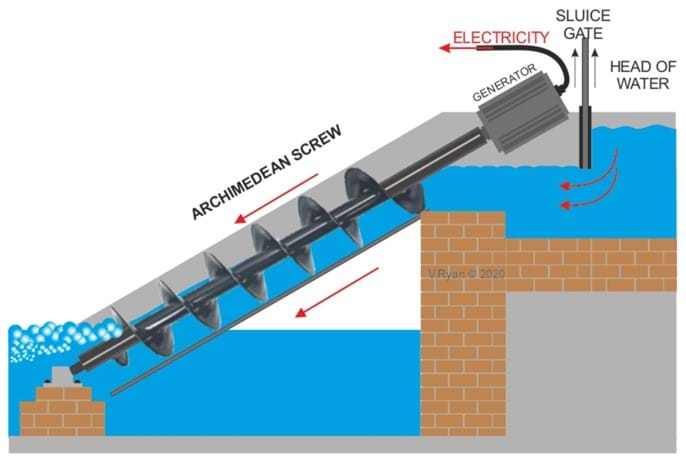
Archimedes is probably even more popularly remembered than Euclid these days, due to his inventions, rather than his mathematical innovations. He is credited with inventing the water screw, a marvelous device.
If you have never heard of it, I recommend that you look up how it works online. The device, made from simple materials, even just wood if nothing else is available, it draws up water, from a river or a flooded field, and spouts it from its upper end, thus enabling you to drain a swamp, to lift water from a lower altitude to a higher one without any need for modern technology. No suction or power is even required, beyond the strength of the man or animal turning the screw.
Now, it is likely that Archimedes did not actually invent the water screw, but rather more likely that he brought the technique back from Egypt, where he studied as a young men with the polis of Euclid.
It is possible that the hanging gardens of Babylon were irrigated by such devices in Mesopotamia, long before Archimedes was born. And the technology may derive from even a much earlier age. But Archimedes did introduce the western world to the device and help to popularize its use.
Later in Archimedes’ life, back in Syracuse, he demonstrated the powers of a lever. He is famous for saying that, given a big enough lever he could move the Earth itself.
He was also instrumental in fending off the attacks of the Romans, who were beginning their climb to world power by seizing first all of Italy and then expanding into Sicily. King Hiero put Archimedes in charge of designing al the engines of war which, again and again, repulsed the invaders. The Romans only managed to finally breach the walls of the city through treachery.
Marcellus, the Roman general commanding the invasion force, gave orders to capture Archimedes alive, since he was obviously such a precious resource. But Archimedes, as the city was being looted by the victorious Romans, was so intent on solving a mathematical diagram laid out in front of him, that he ignored the Roman soldier who ordered him to come see the general. The angry soldier struck and killed Archimedes on the spot. Marcellus, when he learned of this outrage, lamented the loss of such a great man, and ordered an honorable burial for the fallen genius.
Before his death, Archimedes discovered numerous other physical and mathematical laws and proofs. Tasked with discovering how to determine the purity of an object reputedly made from gold, legend says that he slid into a bathtub and, observing how his body displaced water, shouted “Eureka!”, which means, “I found it” in Greek. He realized that things displace a certain amount of water based on their volume, which differs depending on the basic elements from which they are made, which determine their density. So something mostly made from gold, but alloyed with lesser elements, would displace a different quantity of water than something made of pure gold.
In addition to all of his work in mechanical problems, those involving what we would later come to call the laws of physics, Archimedes also wrote several books on geometric problems. These mostly involved plane geometry, the study of circles, spheres and cones.
He did also produce one unique book called the Sand Reckoner. In this book, which he addressed to the King of Syracuse, Archimedes considers the ancient question of the reckoning of all the grains of sand in the world. But, instead of limiting himself to the sphere of the Earth, Archimedes decides to determine how many grains of sand might fill the entire universe.
The work is remarkable for many reasons. Only eight pages in length, in the Sand Reckoner Archimedes alludes to the sphericity of the Earth and to the likelihood that the Earth is not at the center of the universe. So his estimation of the grains of sand required to fill the universe contemplates a heliocentric universe. Thus we learn that the idea of heliocentrism is, in fact, quite ancient.
Then, not only must he make such an immense calculation, but he also must invent a new number system because exponents and scientific notation had not yet been devised. In fact, the number system available to him only counted as high as 10,000. This upper limit, this quantity of 10,000, was known as the myriad. Quantities involving larger numbers were simply referred to in terms of the number of myriads they contained.
Since it is awkward, difficult and time consuming to multiply numbers of several digits, mathematicians have long used scientific notation, replacing numbers such as 7,600,000 with the easier to handle 7.6 x 10^6. That might not seem like such a time saver with that small of a number, but the value of the notation becomes more obvious with larger numbers. Something like 3,000,000,000,000,000, that’s a 3 with 15 zeroes after it, can be written as easily as 3 x 10^15.
Understand, then, that Archimedes knew right away that, to calculate the number of grains of sand that would fit in the observable universe would require him to work with much larger numbers than that, and he had no calculator. He didn’t even have a slide rule, for those of us old enough to remember those doohickeys.
And he had to create new unit-names that went beyond the myriad, or group of ten thousand. He began by creating a new unit known as a myriad of myriads, or 10,000 x 10,000, the total being 100,000,000, or 10^8.
But that’s just the beginning. In the end, Archimedes determined that the number of grains of sand required to fill the observable universe, which he estimated to be the modern equivalent of roughly two light-years across, the number of grains required was 10^63, that is, a 1 followed by 63 zeroes.
Even more remarkable, in the course of his work in creating notation for large numbers, he named a number of immense size, a 1 followed by 80 quadrillion zeroes. Thanks to the notation system he had devised, Archimedes didn’t have to write out those 80 quadrillion zeroes, and neither do you.
(Music)
Something else about Archimedes: notice that I didn’t mention any philosophy that he produced.
Up until the time of Plato, anyway, virtually all learning, all book-learning, anyway, as we might call it, all this was encompassed by the study of philosophy. Philosophers were also mathematicians, scientists, psychologists, astronomers, biologists, even physicians and so on.
But, by the time of Archimedes, specialization is beginning to change the world once dominated by the philosopher. Increasingly, physicians are physicians. Mathematicians are mathematicians. Astronomers are astronomers - and astrologers. Often, right up until the dawn of the modern age, men like Copernicus and Galileo studied astronomy privately but practiced astrology publicly, because astrology paid the bills.
Anyway, men like Archimedes in his time were increasingly more interested in studying the physics, the mechanics, of the world. Archimedes himself and many other wrote extensively, for example, on things like the buoyancy of objects floating in water, but not about the meaning of life or about how to be just or how to create the perfect society.
A generation after Archimedes, Apollonius of Perga also traveled to Alexandria and learned from the mathematical masters there. He is most famous as a geometer, or someone who studies geometry, His surviving works are on conics, or cone geometry. Most of his work has been lost, and some of it was believed to have been about astronomy. But of all his lost works, not one is suspected of being about the meaning of justice or anything metaphysical.
Now, the mingling of these sciences, math, astronomy, philosophy, geometry and so on, did continue. Not everyone became specialized immediately, In the first century AD, we find Nicomachus, a Greek now living under Roman domination, still writing about a variety of topics, though he is most famous for his work in arithmetic. Still, though, he found time to write on metaphysical matters.
In the 2nd century AD, when Rome had long secured its control over the Mediterranean, over most of Europe and over much of the Near East, a Greek astronomer by the name of Ptolemy wrote a now-famous book about the structure of the universe.
Now, the basic idea behind Ptolemy’s book, the Almagest as it is remembered today, the basic idea is a geocentric universe. According to the Almagest, the earth is a sphere at the center of of the universe. The planets and the sun and the moon and stars all rotate around the earth.
I am going to get more into this perception of the universe in particular in the Medieval series of podcasts, the fourth series in this project. Because it is Ptolemy’s version of the universe, this geocentric universe, which the people of the medieval period will perceive when they look into the night sky. We will need to understand this perception to understand Dante, and to understand how revolutionary the ideas of Copernicus and, later, Galileo, actually were.
Ptolemy belongs in this episode as well, though, even though he lived so long after the Greek zenith, as a Roman subject even. He belongs here because the math involved in explaining the geocentric universe is so complex. Like his forebears, all the way back in the archaic period of Ancient Greece, he saw the universe through his geometric equations, through circles and lines and angles and cones and more.
We often pride ourselves on being more intelligent, or more educated than our ancestors. Most of us believe that the earth circles the sun and that the sun is but a grain of sand circling the distant center of a galaxy holding hundreds of billions of other stars, and that this galaxy is itself just a grain of sand amid trillions of galaxies just as large or even bigger.
But we believe this based on faith. Few of us have done the observational and mathematical footwork required to determine that the earth is NOT the center of the universe. We believe that the earth circles the sun because someone told us. Not because we know.
Indeed, determining that for sure, that heliocentric model, in which the earth circles the sun and not the other way around, determining that required geniuses like Copernicus and Kepler and Galileo and Newton.
The idea that the earth rotated around the sun had been around for some time and had competed with the geocentric view for centuries. The reason that the geocentric view was so widely accepted for so long was not due to stubbornness, but because it worked.
Yes, geocentrism works. If you use the equations in Ptolemy’s books, you can plot out and explain the positions of the planets and the sun every day of the year. All scientists recognize this, and minds as great as Einstein’s recognize that geocentrism works. You can use these mathematical formulas to accurately describe the universe visible to the naked eye.
And the math is not easy. Most people today could not handle the high-level mathematics involved in Ptolemy’s Almagest.
Now, I’m not making a case for geocentrism. I too believe in the heliocentric model. But heliocentrism was not accepted simply because the math involved in geocentrism didn’t work. If anything, heliocentrism eventually won the battle of opposing theories not due to superior math but because it is a more elegant explanation of the movement of the heavenly bodies. But more on that when we come to Copernicus.
The calculations in the Almagest are some of the greatest in Greek math history. Here, Ptolemy uses geometric concepts such as radius and the arc and details ideas like latitude and longitude, though not in exactly the same way that they would be used in modern times.
(Music)
With Ptolemy, though, we have gotten far ahead of ourselves. That astronomer lived long after Greece had fallen to the Roman imperial wave that conquered and consumed the ancient world. We have not yet come, in our chronological plodding through history, we have not yet come even to Alexander the Great, whose conquests will help to ensure that Greek ideas, such as geometry and astronomy, are spread throughout the civilized world and eventually preserved in books, some of which have survived down to our day, though most have, unfortunately been lost.
Indeed, while astronomy will survive as a profession, in some respect, for the next thousand years, we will see little dedication to pure mathematics in the western world for many centuries after these Greeks passed away. The Romans were less interested in theory and more interested in formulas that helped make sturdy roads and strong walls. And the medieval Christians would grapple with purely philosophical and theological ideas for centuries, until men such as Pope Sylvester II, in 1000 AD, would begin to orient minds of westerners once again toward things mathematical and logical.
But all that is for another episode.
Until then, I thank you for listening to the Western Traditions podcast.
(Music)