Episode II.34 - Greek Philosophy V: Plato’s Republic
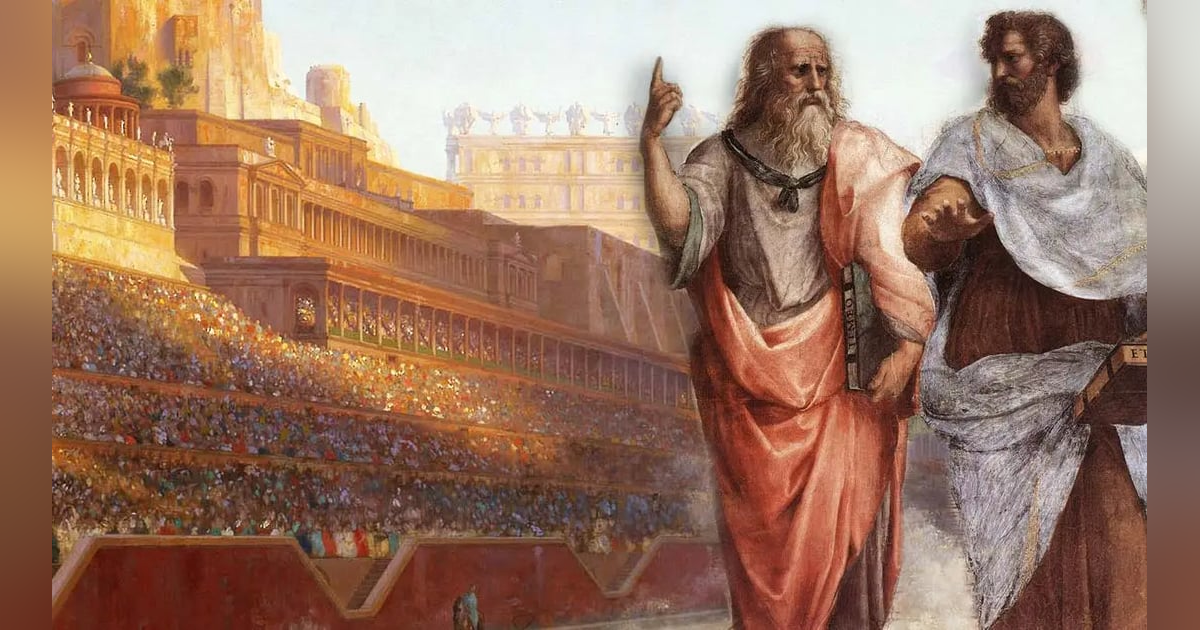
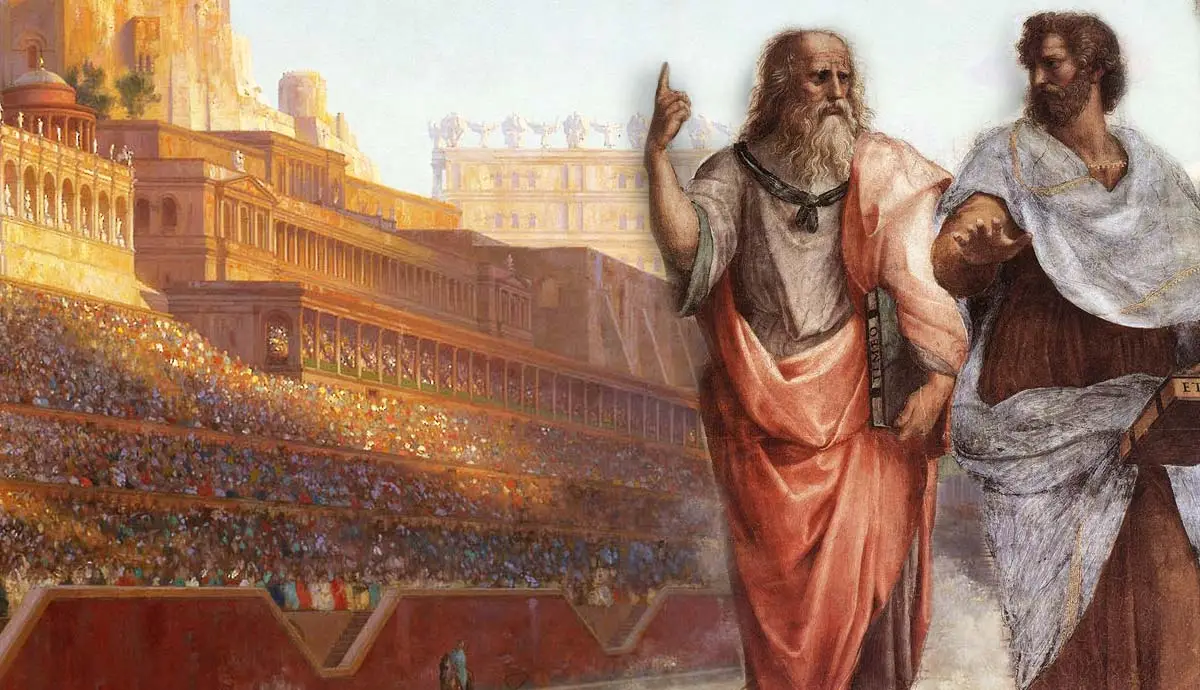


Socrates envisions a just society in which men and women are equals, and all are suited perfectly for their station in life. But is the cost of this just society too high? Censorship, lies and eugenics in the philosophy of Plato.
RECOMMENDED READS - Click Image for Link:
Episode II.34 - Greek Philosophy V: Plato’s Republic
(Music)
-Let us begin and create in idea a state.-
A quote of Socrates, from the second book of Plato’s Republic
(Music)
Hello and welcome to the Western Traditions podcast. This is the 34th episode of the Greek Sun, a podcast series about ancient Greek history and culture. Today we will look at what is possibly the most famous written product of Greek Philosophy, Plato’s Republic.
Before we get started, please remember to check out the website, western-traditions.org. There you can find all the episodes, as well as maps, pictures, and links to some good books to read. You can also support the podcast through the PayPal or patreon options. Patreon supporters have access to podcast newsletters and other extras available through the patreon app.
(Music)
Plato wrote dozens of dialogues which purport to record the conversations he and others had with the most famous of Greek philosophers, Socrates the Athenian.
In the first century AD, some four hundred years after Socrates died, an astrologer by the name of Thrasyllus, who worked for the Roman Emperor Tiberius, he put together a volume purporting to be the full collection of Plato’s dialogues. The total number of dialogues in this volume was 36, and Thrasyllus, apparently following an ancient custom, arranged these 36 dialogues in nine tetralogies, or groups of four, each group having some common theme or ultimate purpose, even if their individual content or schemes did not necessarily seem to align.
Interestingly, the first tetralogy, or group of four, were the dialogues that I have covered in this podcast series so far: the Euthyphro, the Apology, the Crito and the Phaedo. The four dialogues that end with the death of Socrates. So, if we read the remaining dialogues, would first read about the death of Socrates, and then read the remaining 32 dialogues as a sort of retrospective on his life and thought.
Now, as a modern person looking at these 36 dialogues, many hundred of thousands of words, you might doubt that Plato could really remember, word for word, every conversation that Socrates has in these books. And, while I usually stress the ability of the ancients to carry around a great deal in their minds alone, such as with the ability of ancient bards to recount the Iliad or Odyssey without reference to an actual text, I and many others would join you in doubting that all Plato’s dialogues are faithful recounting of the words of Socrates. But not simply because the number of words involved would be too many for the human mind. Rather, most scholars accept that the dialogues are mostly the ideas of Plato.
Now, there are also other doubts among moderns scholars about some of these 36 dialogues, doubts about whether Plato actually wrote them. So, today, if you open a volume of Plato’s “complete” works or something similarly named, you will likely only find 28 or 29 dialogues in the volume.
Nevertheless, in the Western Traditions Curriculum, which I lay out in the 12th series of this podcast, the syllabus for adult learners recommends all 36 of the dialogues as provided by Thrasyllus.
Now, Plato was a follower of Socrates and was no doubt strongly influenced by the ideas of his father in philosophy, but it is assumed that he used Socrates not just as a guide but as a mouthpiece for his own thoughts. Therefore, and this may come as a surprise to some, we do not have any real knowledge about what the actual Socrates thought. We are fairly certain that he existed, since other writers of the same period mention him, but, while Socrates is in nearly all the dialogues of Plato, we actually don’t have what we would today consider real evidence for what his ideas were.
But, and this is really important to understand, not just for the sake of understanding history but for the sake of your own thought and really, for the soul inside you which Socrates cherished, it is important to understand that it does not matter which dialogues, if any, represent the real thought of Socrates.
Nor does it matter if we get the details of his life and death right. Too often, as modern thinkers, we turn off our brains as soon as we run into a trace of doubt about “authenticity”.
I’m not kidding, we simply stop thinking sometimes when this happens. We think that these details have such significance that we become uninterested in reading or thinking any further.
Since I am not sure Socrates really said this, since I’m not completely sure Moses or Jesus existed, since Plutarch lived too long after the subjects that he wrote about, since we have no proof that Homer wrote the Odyssey, etc, then I’m not going to take this reading material, this dialogue, this scripture passage, this ancient text seriously. I can stop thinking critically and, instead, just engage in a brief and lame attempt at literary archaeology and criticism and then go back to scrolling the internet and telling myself how intelligent I am.
I assure you, the ancients did not trip themselves up this way mentally when they came to the dialogues of Plato. Did they sometimes harbor doubts about whether these were the exact words of Socrates? They might have. But it didn’t matter, because what mattered was the message. What mattered was whether or not you agreed with it and whether or not you could mount an intellectual challenge to the idea or come to accept the meaning as true.
When you read a text like the flood account in the Bible, it doesn’t matter whether you believe that Noah really existed or if a world wide flood ever happened and it doesn’t matter how smart you think you are because you found the contradiction regarding the quantities of animals taken on the ark in chapters six and seven of Genesis,
(like nobody else in the last 4,000 years spotted that one, no, just you, you genius, you legend).
It doesn’t matter because that story is trying to tell you something. That particular story is trying to you something about personal renewal, about the need to die to one’s former self sometimes, about faithfulness to a moral code, about hope in the face of destruction and about much more.
So you may disagree with some of the philosophical or moral message of such a text, as you may disagree with Socrates or Plato about what constitutes good government in the dialogue known as the Republic. I certainly disagree with Socrates here. But remember to engage the text, the idea, instead of simply detecting the fault, the doubt about authenticity, and then turning back to worshipping yourself while wearing the trappings of pseudo-intellectual superiority.
And as for engaging the ideas, you should prepare yourself when you read the Republic. Often today, people confuse philosophy and philosophers with left-wing ideas, with liberal politics, with the sort of soft-on-crime sorts of folks. Plato’s Republic is a dialogue that espouses a philosophy about the state that might shock you or surprise you. If this dialogue is at all even just reflective of Socrates’ thinking, then the powers-to-be in Athens had good reasons to be suspicious of the man.
What you will find here is a vision of a government that may seem quite contrary to your own notions and values regarding personal freedom and freedom of thought. Then again, you might think it’s all a good idea. You wouldn’t be alone if you did.
Now, though, let’s turn, one last time in this podcast series, let’s turn to the works of Plato, and learn what certain Athenians, in the wake of the spectacular failure of the Peloponnesian War, what they thought the perfect government would look like.
(Music)
The Republic is actually narrated by Socrates himself. So he is not simply one of many speakers in the dialogue but rather the lens through which we see the entire matter. He begins by telling us about his recent trip down to the Piraeus, that port and fortress on the shoreline of the city of Athens. He had gone there to offer up prayers to “the goddess”, presumably Artemis, as the Athenians referred to her this way. And to see the religious festival and the procession and so on.
Soon Socrates meets friends, and there is an amusing passage when one of the older members of the reunion, Cephalus by name, is asked to report on what it is like getting older. Though he himself disagrees with the remark, Cephalus recounts the words of the poet Sophocles, when asked about how love, or the sex drive, really, was treating him now that he was an old man. “I feel like I have escaped from the bondage of a madman.” He is reported to have said, apparently referring to the cooling down of the passions as one ages.
And this opening of the Republic is one of the more appealing and inviting characteristics of so many dialogues. They really begin like conversations between a handful of friends, getting together randomly and shooting the breeze and telling jokes. The dialogues are generally easy to slide into because of this.
But, as with many casual conversations between friends, eventually the topic turns a little serious.
Someone brings up the concept of justice, of what is just to do in a certain situation, and quickly Socrates, as he often does, moves away from the specific, away from the given example, and wishes to discuss and come to understand justice itself, not only what would be just to do in one or another situation. Socrates wants to establish first principles.
Let’s not sit around talking about whether or not is us just to do this or that. Let’s first figure out what justice is.
And so we begin. We begin to parse the word justice, perhaps the most important of the Socratic essences. For Socrates, as I’ve mentioned in previous episodes, certain concepts existed as absolutes. In the real world, we see imperfect examples of these essences: things such as courage, love, beauty and justice. A woman may be beautiful, a man may be courageous, a leader may be just. But each of them is simply demonstrating, humanly and to a greater or lesser extent imperfectly, each of those essences. I may be as just in my treatment of others as I possibly can, but, in the end, there is always perfect Justice as a superior example to my own.
It is hard to describe in what way these things, these essences, courage, justice love and so on, to describe in what way they exist for the socratic philosopher. After all, I exist, You can look me up, come to my house, talk to me, break bread with me. You can’t do that with Justice or Wisdom. But just as the perfect cube or sphere have their own existence, their own essence, so do Courage, Love and Justice.
The way in which they exist is sometimes called a-spatial. As in, without regard to space. They exist on some other plane, they are not hidden away somewhere in the physical universe but rather are templates of reality.
This latter-mentioned essence, Justice, is perhaps the most important for Socrates. After all, his goal is to find out how people can be happiest, how they can get along, and how they can cohere in a city-state peacefully and prosperously. Ultimately, citizens must treat each other with justice, they must be just to one another. This is really what underlies all of our constitutions, philosophies, moral codes, and religious mandates.
In the Republic, we get to the study of the state, of government, due to Socrates’ desire to determine what makes a man just. But, since the state is larger than a man, being composed of many men, he directs the conversation to first examine the state, to detect the examples of justice in a large body of men and women. In order to do this, since all earthly examples of government are so imperfect, it is necessary to dream up, to imagine, to create a fictional state in our minds as we talk, and to try to formulate a perfect manifestation of justice in this state. Justice at every level.
This sort of thing is fun, really, and you have probably engaged in this practice in some partial way, at least, in your own thoughts, at some point in your life. Surely you have seen some social, cultural, legal situation in whatever region of the world in which you live, and you have found something wanting in it, and desired or imagined how the situation might be improved. You have, momentarily, anyway, crafted some sort of society in your head in which something is legalized or prohibited, something is built up or brought down, some creed is encouraged, some idea villainized.
If you are in politics, then you actually do this for a living. That’s what the Republic is really about, as a dialogue, it is about statesmanship.
But, beware, this goes beyond crafting legislation about immigration, or about the drinking age or welfare. Socrates and his friends here in this dialogue, which is very long and divided into ten volumes, they take on the whole thing, they set out to build an imaginary society, a fully functioning city-state, in their heads, from top to bottom, and you might like some of what you hear, maybe even most. I doubt there are many people today who can hear the whole thing, though, without being somewhat disturbed.
And I say this with a dog in the fight. I love Socrates. I love reading Plato and considering the ideas put forth. I would give anything to sit with these masters and pass around a bottle of wine and just listen. But, I’ll be honest, the Republic horrifies me. Socrates’ vision for happiness is, to put it simply, Orwellian. It is not a society in which I would like to live.
But I am a little ahead of myself here. Socrates doesn’t actually get to the idea of the city state until well into book two of the dialogue. Prior to that is a useful lesson in dialectic.
Dialectic is the method of speaking and conversing and arguing. It is used in Plato’s dialogues and in the works of many other philosophers. AKA, the socratic method. This is a way of proposing questions and then exploring answers, not being afraid to pose challenges, even seeking these challenges, in order to purify the argument, much in the way that mathematicians prove their theorems by attacking them, by trying to find faults or errors in their thinking.
In this way, good philosophy and mathematics have much in common and, indeed, philosophy and mathematics are actually branches, so to speak, of the same tree that is logic. I know that many people consider philosophy today to be a a sort of airy, ethereal world of words that has nothing to do with reality, and is not useful in the way that mathematics is useful for making buildings, computers and space rockets. But the earliest philosophers were all mathematicians as well, and vice versa.
Anyway, the dialectic of Plato, of Socrates, sets forth an idea and then exposes it to attacks, to see if it can stand up to them. Because, and this is important, because truth needs no defense. Things that are true are unbeatable. If the proposition that you set forward in an argument is true, it will withstand all attacks. So, then, trying to explain what justice is, someone proposes the following to Socrates:
justice is giving to each man what is proper to him
Then the argument really begins. Soon, after some attacks, the idea is refined a little bit:
Justice is the art which gives good to friends and evil to enemies.
And this apparently simple idea, which, I will tell you right off the bat, which is not going to stand up to tests in this conversation, this idea might actually resonate with you. It rings a bell, so to speak. Yes, when we apply justice in criminal situations, in legal situations, we want the bad punished and the good rewarded, right?
But, Socrates points out, in his frustrating tendency to poke holes in every argument that might hold water, he points out that physicians do good to friends when they are ill, and pilots, or ship’s captains, do good when ships are in danger at sea, and when at war we fight with enemies and make alliances with friends.
And all present agree.
But, then, Socrates says, physicians are no good to friends who are not sick, as pilots are no good to men not on a sea voyage, and justice is useless then in time of peace, because we cannot do evil to our enemies or ally with our friends in such a time.
And so the conversation carries on, seeking to define justice. At one point, a bully by the name of Thrasymachus butts in, and insists that his own version of justice be examined and declared victor in the match of words.
His definition of justice?
Justice is nothing else than the interest of the stronger.
This is simply might makes right under another name. And there is an interlude, which you can enjoy for yourself, in which Socrates tears down this idea.
But, eventually in the conversation, it comes time to create the city, the just city, the exemplar of justice in the world. And what does that look like?
(Music)
Socrates is more Confucius than Buddha. What do I mean by this? At the risk of simplifying Confucianism, and I am absolutely oversimplifying here, Confucius was an ancient Chinese philosopher, he lived in the 6th century BC, who was more interested in statesmanship than individual morality, though personal ethics were definitely part of his philosophy.
What I’m trying to say is that people often come to philosophy, and also to religion, with one of two goals: to improve themselves or to improve society.
People come to Buddha, or to Jesus, among others, because they are convinced that something is wrong with them, wrong with them personally, they are suffering, and they want the suffering to end, they want to be happy.
Sometimes, though, people come to philosophy with the same goal, to fix themselves, to acquire existential peace, to figure out out how to be happy while living in a broken world.
People can also, however, come to religion or philosophy, with the goal of fixing society. They want politics, which is really just a manifestation of philosophy, they want politics to fix that broken world. Sometimes, people come to religion seeking the same solutions.
As a Catholic, I can tell you that there are people in the pews every week at mass who are there to heal their souls, and there are people who are there to fight the culture wars. I have been both of those people at different times in my life.
And it may be, in the long run, it may be that both approaches are needed in life and in society. But that is a discussion for another time.
Socrates, at least the Socrates of the Republic, Socrates is more interested in the state, in creating a society that creates good people. Happy people. Let’s take a look at that city and you can judge how happy you would be in it.
Right away, Socrates and friends determine how the populace should be divided up. A man is best off focusing on the one thing that he is good at, at his profession or status in life. So the shoemaker is best at making shoes, the physician best at helping the sick, the soldier best at guarding the state, the farmer best at raising food, and so on. So it is foolish for men to be spending part of their day doing other things. The farmer should not waste time and energy making his own shoes, not should the physician spend time raising his own food. No, each man needs to focus on his particular set of skills. So straying from your profession is prohibited, and therefore soldiers will just be soldiers and nothing else.
Now, in particular this last, this should strike something of a contrast in your mind with tradition in Athens. Athens had always run a citizen army. As you may remember, from episode 12 in this series, about the city of Athens, the Athenian army was made up of citizens from different ranks of society who supplied their own arms and armor. There were different ranks in the army for those with differing quantities of wealth, but all were citizens with their own professions, or they were freed slaves with their own separate skills at farming, shoemaking, shop-keeping, music-making, leather tanning and so on.
You may also remember that the bit about soldiers just being soldiers sounds an AWFUL lot like Sparta, where the state was protected by a class of citizen who did nothing but train for war, and besides whom all were inferior.
And the friends gathered for this conversation mostly agree with Socrates that society should be divided thus into classes, somewhat like the way that Athenian society had always been divided into three or four economic strata. Except, in this new society, in this Republic, the classes would be divided by their purposes.
We have already discussed what we can call the producing class. These are there citizens who work and produce goods. The farmers, the blacksmiths, the fishermen, the shop-keepers, the shoemakers, and also the professions, such as physicians and teachers. This is the vast majority of the society.
Initially in the dialogue, Socrates envisioned for his group a very simple state made up only of these producers, who all live simply and in harmony. Here is a sample of his vision for them:
(Read from p.318)
But when this vision of a simple society is challenged (read Glaucon’s challenge), Socrates agrees to picture a larger, more prosperous city-state.
But, being so prosperous, this city will now need guardians.
The guardians will also rule over the producing class. Since it is best for a person to do only one thing, it would not be appropriate for one of the producers, a farmer or a tanner, let’s say, to also be a soldier or a ruler. Those who rule must simply and only rule.
But, to prevent these guardians from becoming corrupt and tyrannical, the constitution of this city-state will forbid them any property. The guardian class, while armed with both weapons and the prerogative of leadership, will possess nothing. They will receive their food from the producers, but will not be able to accumulate money.
And it is necessary to further divide this guardian class into two groups. The auxiliaries will be the soldiers who fight the wars and defend the borders. The rulers will be the class assigned to govern over this entire populace. But neither class will possess wealth or property of any kind.
But how to keep the peace among these classes, how to ensure that this political design does not become corrupt? We all know that great political schemes, like the constitution of the United States, can look good on paper but still result in a corrupt, ruling class that does not have the best interests of its people at heart.
We can make as many laws as we like, but these can always be corrupted. It is best for a society to have citizens who are formed and raised properly, who are disinclined to corruption and crime, rather than to focus on laws to restrict bad behavior.
So how shall we raise, form and teach the population of this three-part society?
Now things get real interesting.
(Music)
Socrates suggests that the myths of their present society are unfit for good education. Revered as the gods are, there are too many stories about Zeus’ philandering, about the petty jealousy and the brazen cruelty of the gods, and so on.
So Socrates proposes to edit, to censor really, these stories, to purify them, until only edifying stories are told to the citizens of this society, who will now be brought up with myths that teach them to be honest, faithful, courageous and so on.
Therefore, in Socrates’ eyes, thousands of years of myths will be thrown out, erased, to avoid corrupting the youth.
The stories that are left, after this mass censorship, will be stories that only tell encouraging things, stories that foster what have come to be called the four cardinal virtues: Courage, Wisdom, Justice and Temperance. These virtues are still taught today in catechism classes around the world.
Furthermore, it will be necessary to tell all their citizens, rulers, guardians and producers, to tell all of them a single lie about their past that will convince them that they are all brothers and sisters and should always be in harmony and accept their status in society without question. This lie, which he calls the noble lie or the royal lie, (gennaion pseudos) is as follows:
(Read from p. 340)
So, their youth was a dream, they are all children of the same earth mother but their individual souls are made from metals, so to speak, and those who are gold will rule, those who are silver will guard and those made from lesser metals will be the producers.
But, Socrates does not want to simply establish another aristocracy of blood. This would be nothing new. A ruling class that passes on power to its children, who, as he and his friends and al of us today know, even good rulers often have children who are not fit to rule, and sometimes people of the lower, producing class have superior children who should be leaders. So, how to keep people in their proper class, according to the nature and merit of their character?
Children will be evaluated and judged as they grow and then assigned to the appropriate class. Now, obviously, coming out of a traditional family, this would be difficult. What father of gold, a ruler all his life, would be cooperative after hearing that his son’s soul had been forged of brass or iron, not gold, and he would have to become a blacksmith instead of an elite ruler?
In Plato’s republic, we need not worry about this situation because there are no traditional families for the guardians. Nor are there marriages. There will be a sort of communism of women among these citizens of the guardian class, and fathers will not know whose children of the women are theirs, because their will be no particular relationships.
And the rulers of the state will have to use more falsehoods, more lies, openly offered here as tools of statecraft by Socrates, in order to arrange that the superior specimens of the men among them mate with superior specimens of women as often as possible, and that the most inferior rarely do so.
This will be done at public festivals, which sound a bit like orgies. And the children born form these unions will be brought up in common, separate from their parents. As for the children of inferior pairings, of lesser men and women, Socrates has only the following to say.
“The offspring of the inferior… will be put away in some mysterious, unknown place…”
The children, not so disposed of, will be raised in a group, by the state, and thus it will be easy to evaluate them and assign them to a class as they grow, to become a ruler, a guardian or a producer.
And women will not be slaves in this society, though it may have sounded like that. As children grow, they will all train in athletics and receive the same education as the boys. All children, male and female, will have the same opportunity to demonstrate their mettle, so to speak. Women who demonstrate the appropriate skills may become guardians and rulers. The city will be an absolute meritocracy. People will do what they are suited to do, and not have their talents wasted due to their sex or their station in life, nor will they be tasked with doing things that are beyond their natural scope.
This is part of the happiness of the state. As frighteningly controlled as it may seem, and as upsetting as the idea of the eugenics is, certainly to my ears, I must admit that the proposed state excels in ensuring that all citizens are put to work in what they are most effective at, and this is a surefire way to increase overall happiness. If people are good at their job, their role in life, they are more likely to be content with their station.
Having such a populace, all functioning at what they are best suited for by their character and nature, and their rulers prevented from acquiring property and becoming corrupt, there will be little need for laws and courts. People will avoid crime and disputes because they will all be naturally happy and content in their lives and will be inclined to honesty by education and formation.
Naturally, those who rule over this state are philosophers by nature, men and women who seek truth and wisdom, who are intelligent, and who are otherwise uninterested in the things of the world, uninterested in riches and appearances. Indeed, in order to safely guide the ship of state, they must be able to see through appearances, to see the true nature of of things, which is not easy, because the appearances of the world naturally deceive.
In Book VII of the Republic, Socrates elaborates on how the world deceives us with his famous Allegory of the Cave.
(Music)
Read on p.388
Socrates elaborates on this strange image.
Properly dissecting Plato’s ideas of forms and essences and universal things, though, would require a long, long series of classes that would ultimately end up as a philosophy course which I am not qualified to teach. But, for the student of history, it is important to have some grasp of what Socrates is trying to teach here.
The philosopher, then, is the man who has freed himself from the chains pictured here in this allegory. He has been outside the cave, and, after the initial shock of seeing the true reality of things, he is able to understand that he is seeing the real essences or forms of things. In other words, while we in the Cave, what the rest of us mistakenly call the real world, while we see the imperfect shadows of those forms, we see men and women and imperfect examples of beauty and justice and courage, the philosopher, freed from the chains and outside the cave, he sees the essences, he sees what perfect beauty actually looks like, he sees what a man is and a woman really is, he sees that perfect circle on which all other circles are based, he sees, and understands, true justice. And it is incumbent upon him, out of duty to his fellow man and woman, to return to the cave and try to explain the reality which is denied to the rest of us.
The people in the cave will think him mad, but hopefully some of them will also throw off their chains and come to see reality, to see the essences and forms. And those who do this, they are the philosophers and they are the ones with the gold souls in his perfect republic, the ones who are perfect leaders of that society.
Now, you wouldn’t be the only one seeing it as a little convenient that a philosopher determined, after a lot of hard thought, that philosophers should be in charge of the world. It was afterwards dreamed, and it was even contemplated right here in the dialogue, that this would someday come to be true, that a philosopher-king would arise and create and rule over a perfect society.
The dream of this perfect society, lead by a philosophical, or spiritually, pure elite, would manifest itself in a variety of historical attempts at societal perfection. Many see the community of the early christians, as described in the book of the acts of the apostles, as one manifestation of this. Others see the earliest Muslim communities as the same. Even before those religious movements, though, centuries before, there were movements and rulers who would, either openly or not, hearken back to this idea, the ideal of the philosopher king.
When we read about Alexander the Great here shortly, the boy-king and conqueror educated by Aristotle, who was himself a student of Plato’s academy, when we come to Alexander’s leadership, this idea of the philosopher-king should come to mind.
Plato would not have to wait, though, for Alexander to come several decades later.
Sometime around 360 BC, when Plato was quite aged, he journeyed to Syracuse, on the island of Sicily, with one of his disciples who was a prince of that city. The old philosopher became embroiled in the succession to the throne and wished his disciple, named Dion, to become the philosopher-king of that powerful city. This didn’t work out and Plato was himself sold into slavery after his disciple’s brother secured the throne. Plato’s freedom was purchased by a friend, though, and Plato would die, free, some years later, surely disappointed in the death of the dream.
(Music)
The Republic contains much more than all this but, as I have said before, this podcast is not cliff’s notes for Plato or anything else. You should read the book yourself, and, if it helps, check out my Curriculum series, series number 12, as more episodes drop there with some advice for engaging more with the material that you read and retaining the information that you want from it. You can find that series on the website, western-traditions.org.
The Republic continues to be read and appreciated right down to today. And here, in the later volumes of the dialogue, you will find another blueprint showing all types of government, here separated into five categories: Aristocracy, Oligarchy, Democracy, Tyranny and timocracy, the latter being just another form of rule by the wealthy but wealth in that case is specifically determined by land-ownership.
But we have been through all that before, for the most part, in previous podcasts.
The Republic remains probably the most popular of Plato’s works. Down through the ages , it has acquired a following that is as complex as its narrator and its purveyors. In recent times, both Mussolini and Martin Luther King were open fans of the work. Hardly a pair that you might imagine in agreement.
George Orwell, 20th-century writer of anti-totalitarian classics like Animal Farm and 1984, he loathed the republic. And, if you look past the imaginary contentedness of the divided populace of the book, you might see why Orwell, and I, for that matter, find the whole thing disturbing. Socrates, in the dialogue anyway, we don’t know that the real Socrates would have been onboard with all this, he intends to censor and edit and erase portions of. the treasure of Greek Mythology, which alone horrifies me. And then, he plans to lie to the people of this state and tell them a ridiculous fiction about their childhood being a dream. And all this is justified in that it will allegedly make the people happy and the state prosperous. This is just the ends justifying the means, and perhaps my Catholic upbringing impedes me from appreciating this clear violation of basic morality.
Now, there is much, much more to the entire corpus of Plato’s works. I strongly encourage you not to only read the republic but to pick up some of his other works. There are links to his books on the website, at western-traditions.org.
But we are going to finally leave Plato behind now, and move on. We are not done with Greek Philosophy, however. Prepare yourself. Aristotle is coming.
Until then, I thank you for listening to the Western Traditions podcast.