Episode II.33 - Greek Philosophy IV: The Death of Socrates
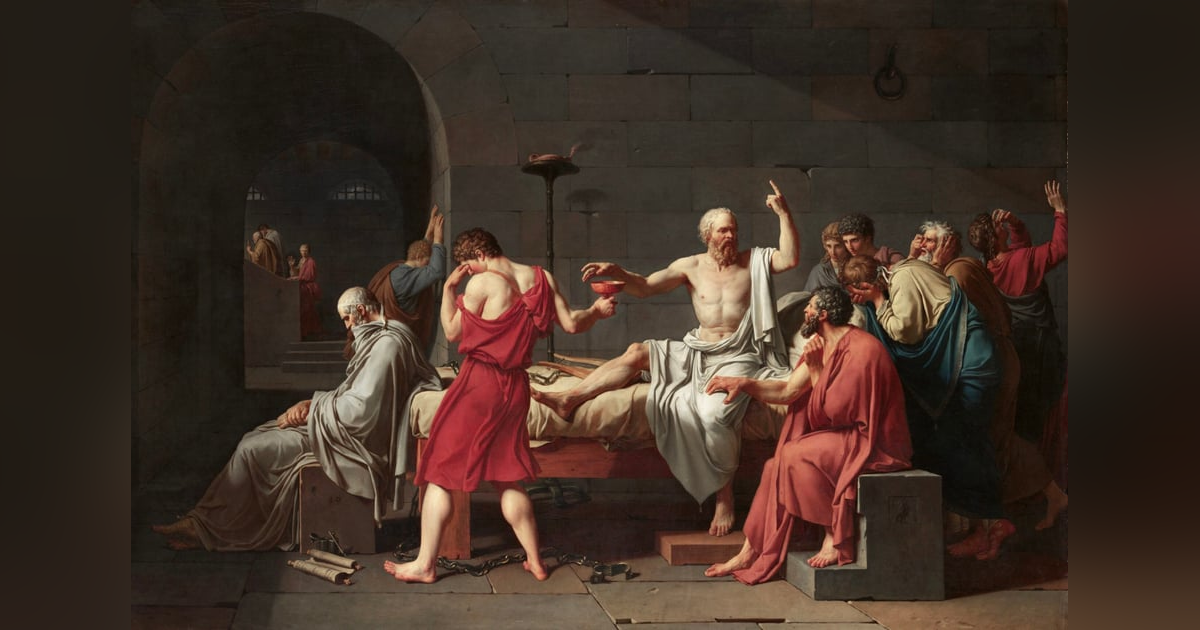
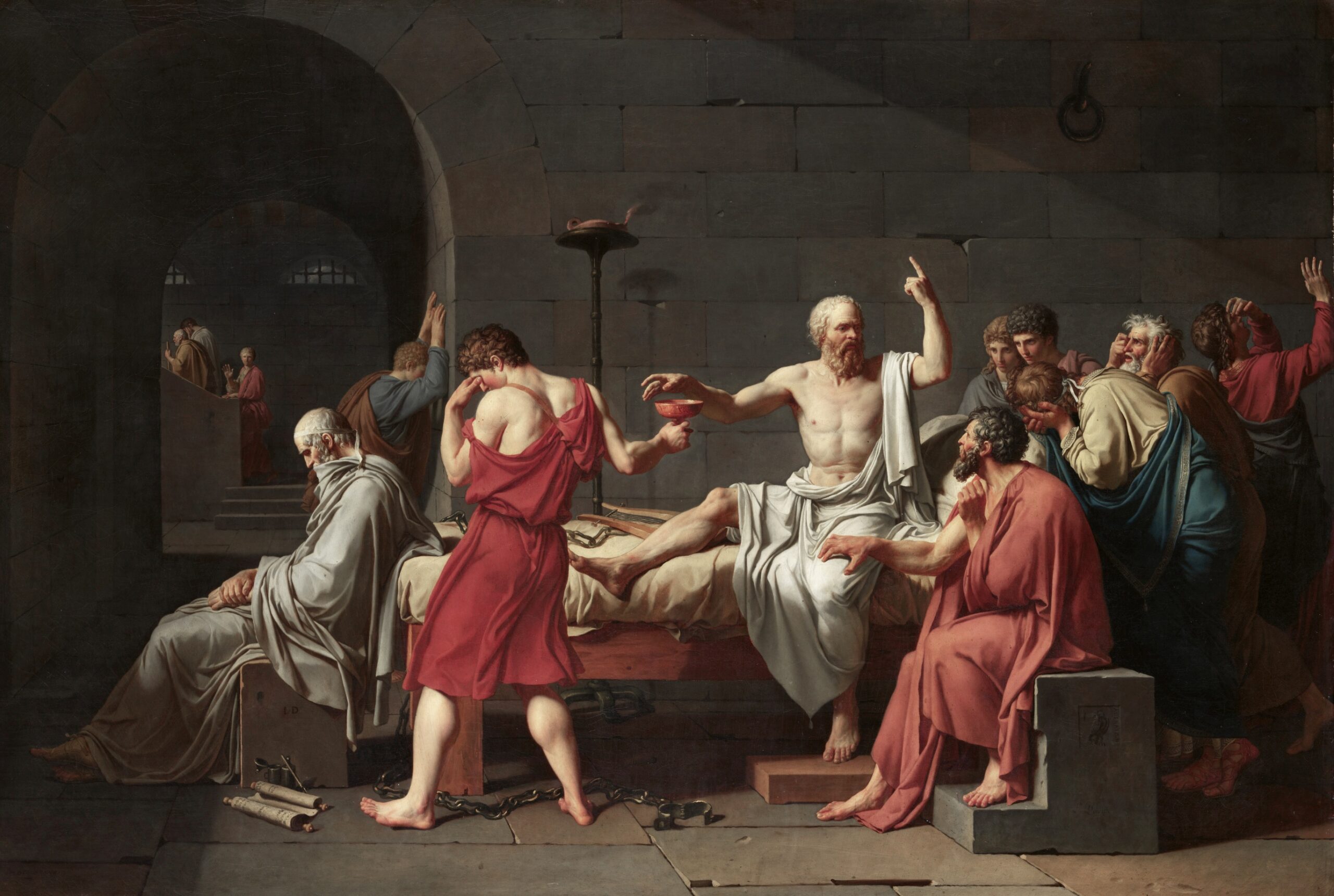


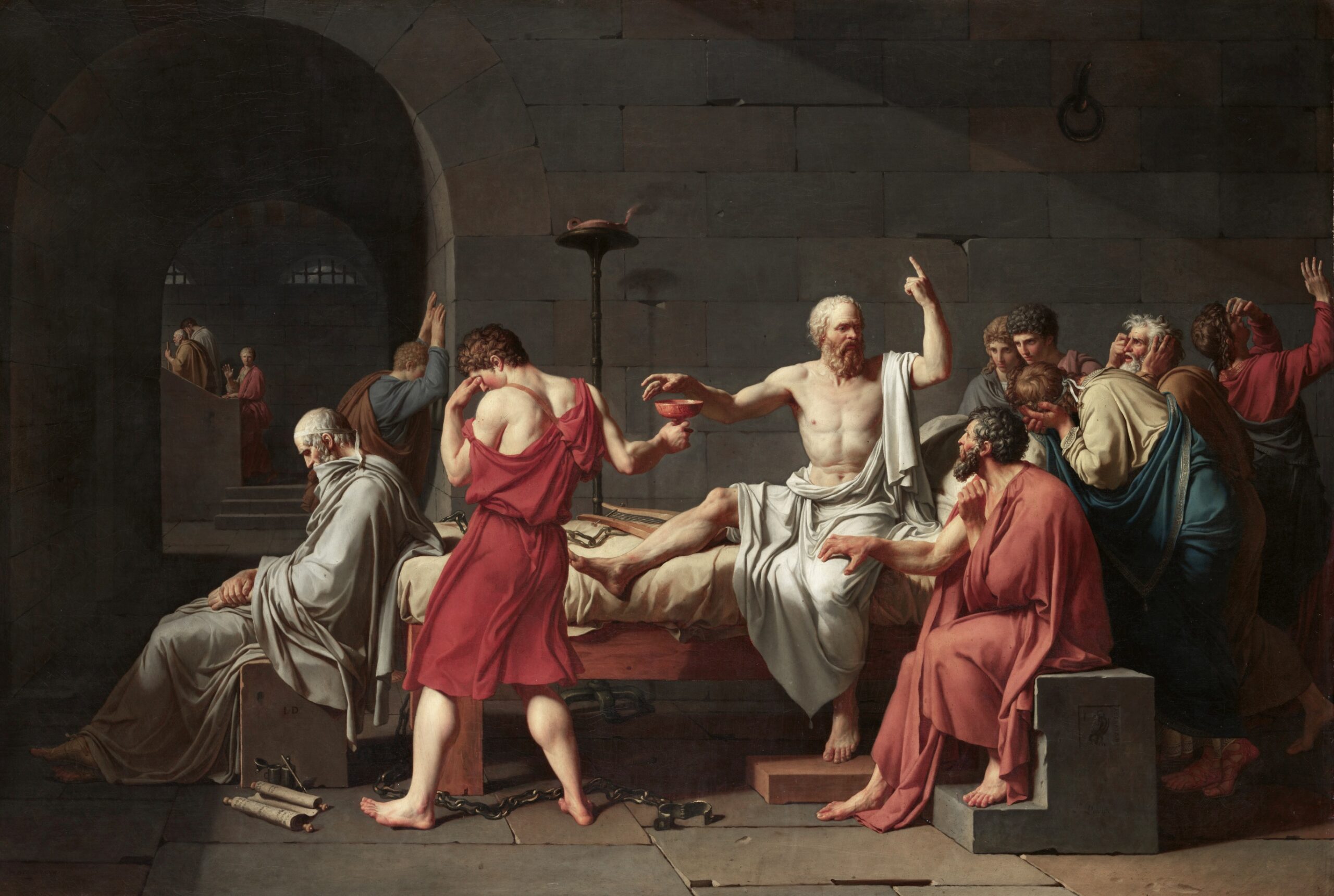
From his jail cell in Athens, Socrates makes his last argument in defense of the immortal soul. Death as separation of body and soul. The essences of Beauty, Justice and more. The perfection and purity of the soul.
RECOMMENDED READS - Click Image for Link:
Episode II.33 - Greek Philosophy IV: The Death of Socrates
(Music)
-There is no release or salvation from evil except the attainment of the highest virtue and wisdom.-
-A quote from Socrates, hours before his execution.
(Music)
Hello and welcome to the Western Traditions Podcast. This is the 33rd episode of the Greek Sun, a podcast series about ancient Greek history. Today we have come, finally, to the death of Socrates as related in Plato’s dialogue, Phaedo.
Before we get started, please remember to check out my website at western-traditions.org, if you’re not already there. Every episode is found there, along with options for listening on a wide variety of platforms and apps, such as Amazon Music, Spotify, Podbean, iHeart Radio and more. While you’re there, please consider supporting the podcast by purchasing some merchandise on the shopping page, or by contributing directly through the PayPal or the patreon options.
(Music)
Phaedo is the name of the narrator in the eponymous dialogue. (Discuss pronunciation) Oddly, this dialogue is not presented in the same form as many others, with names of speakers in the margins. Instead, it is told in recollection, as Phaedo speaks to Echecrates, another follower of Socrates, about the final day of Socrates' life.
The great philosopher has been charged and convicted with impiety, essentially with corrupting the youth of Athens. Along the way, he has had several options to avoid death, such as by pleading guilty in exchange for a lesser penalty, and he has also had the option of exile offered, as well as the possibility of bribing the guards and escaping now that he is actually being held in detention.
And this last, the escape, is not so dangerous as it might sound. One gets the idea here that the politicians would have been glad for Socrates to just leave. They were in the situation that all such authorities fear: allowing Socrates to go on speaking freely would have undermined their authority, but executing him might make him a martyr and hero. Better for everyone for him to just flee the city, and continue preaching his newfangled ideas somewhere else while the authorities continued to manage the affairs of the Athenian state.
But Socrates, for reasons described in the dialogue named after his Crito, has chosen death. He is an old man, about seventy, with a young child and two older sons, and he has no desire to go traipsing about the world, hoping that some other city would permit him to speak. And, it is clear, he loves the city of Athens, the home he has never left except on military duty. He loves it so much that he is willing to accept gracefully, and without complaint, her sentence of death.
Phaedo, speaking to his friend Echecrates in the Peloponnesian town of Phlius, explains why Socrates was not executed right after the trial but instead sent to wait several days in prison, due to a celebration involving the ship of Theseus which had just begun when Socrates was sentenced to death. The ship, every year, made a journey from Athens to Delos and back to commemorate the adventures of Thesues. Such festivals could not be polluted, under ordinary circumstances, with public executions.
Phaedo also describes Socrates and a circle of friends, including friends such as Crito and Ceres and Simmias, and the narrator himself, sitting in the prison. Curiously, the circle does not include Plato, who composed this dialogue, because he was apparently ill at the time.
The setting of this recollection is oddly charming, though it involves a prison. Socrates is initially with friends and with his wife and their small child. It is now known that this is to be the last day of his life, since the sacred ship of the festival has arrived at Athens and the celebration is over. When Socrates’ wife becomes hysterical with grief in one passage, Socrates has her led away and the dialogue with his friends, his last opportunity to teach, now truly begins.
A little later, as the dialogue is just getting underway, Crito, one of Socrates’ friends whom we met in the last dialogue, relates how the jailer had said that a man about to be executed, with the poison hemlock as will be done here, that such a man should avoid talking a great deal before drinking the poison because it interferes with the action of the drug and sometimes causes it to be necessary to drink more poison to finish the job.
This is too much for the normally placid Socrates, who certainly doesn’t like being told to shut up. “Let the jailer mind his business and be prepared to give the poison twice or even thrice if necessary.” He says.
It is easy to imagine oneself sitting there with them all, you can imagine sunlight, the last sunlight Socrates will ever see perhaps, streaming in through a window, hear the child babbling, the friends chatting with one another, laughing at Socrates’ rebuke of the jailer.
Now, initially, you might feel like the dialogue sort of putters around for a bit, as Socrates sits and rubs his leg, which is apparently bothering him, and speaks about how pleasure and pain are oddly related, possessing two bodies or trunks but are joined by a single head. Because one seems to derive from the other, such that when pain fades pleasure appears.
But Socrates’ brief divergence into this matter is really preface, though, to something important that underlies the entire dialogue.
Socrates wishes us to share with his beloved friends his own confidence that death takes a man, especially a good or wise man, to a better place. And one of his arguments in favor of this idea will be, later on, that all things which possess opposites are generated by those opposites. But more on that later.
Now, Socrates makes a brief remark about how death is to be appreciated but also declares that suicide is wrong. As the friends of Socrates usually do when ever he makes one of these pronouncements, they ask for explanation.
Why is suicide wrong? Socrates brings up, not for the only time in this dialogue, “An ancient doctrine.” This particular doctrine says that man is a prisoner and has no right to open the door himself. And he affirms that man is a possession of the gods and that they must not choose their exit.
Nevertheless, he reassures his friends that he is not afraid, that he is happy about finally reaching death, and that all philosophers should share his happiness about concluding their mortality. Socrates’ companions are not so easily persuaded to let go of their grief and share his happiness. And so, a few pages into the dialogue, he asks the question that finally gets the ball really rolling on this discussion.
“Do we believe that there is such a thing as death?”
(Music)
Do you believe that there is such a thing as death?
Socrates is not out to prove or disprove the occurrence of death. Instead, agreement with this idea, that death exists, simply substantiates and leads to his following definition of death:
that death is the separation of the soul and the body.
You might call this a little sleight of hand, the way he avoids discussing the existence of the soul and moves straight into an argument which assumes such existence.
Perhaps, for the ancients, there simply was no doubt about the existence of of the soul. The dialogue will get into different ways in which the soul might exist but there is little space given to the idea of its non-existence.
Today, I think people generally do not believe in the soul, though they may affirm that they believe, I personally think most people are atheists without realizing it, but my personal belief on the matter is a subject for another podcast.
Still, Socrates glides past any objection to the existence of of the soul here and moves straight into trying to prove to his listeners that the soul endures after death and is, in fact, immortal.
A dichotomy is established early in the dialogue. The body is concerned with the world, seeking pleasure and suffering pain. It is, in so many words, described as something lesser, something almost dirty, really, and it returns to the earth, it decomposes.
The soul, however, is pure. It is unconcerned with earthly things, disposed to neither pleasure nor pain.
This is significant for the modern reader for a number of reasons. First, Socrates makes a very clear distinction between body and soul in his dialogues. The body is, in his eyes, a very low thing, a mass of tissue and blood and mucus and various discharges, it defecates and urinates and engages in all sorts of gross bodily functions.
And he even eschews pleasurable things associated with the body, like eating and sex. Both pain and pleasure are sensations of the body and are therefore to be left behind by the soul when it departs.
This idea seems very monastic perhaps, and maybe not what you were expecting from Socrates. But this is actually fundamental to his ideas and to the ideas of his followers:
The body is something to be left behind. As Socrates says, “the body is a source of trouble.” He even states that both pleasures and pains are like nails, nails which fix the soul to the body and from which the soul must release herself.
In this dialogue, Socrates speaks about death, and the separation of the soul from the body and its journey to the underworld, where it will be judged. Those who were good will be purified of any defects and go on to live an ethereal life with the gods. Some who have done great evil but repent will suffer until they are forgiven and then ascend. Others, who are unrepentant, will be cast into the dark chasm for eternity.
He also describes an upper world, somewhere in the sky or space above us, where people lead incorporeal lives blessed without need of bodies. And, this is important, all those described live as souls, not as bodies. Eternity, immortality, and the blessed life is spiritual, not corporeal, not associated with the gross, imperfect body.
And, for many Westerners today, this may sound a lot like Heaven. And they may think that this separation of the soul and its journey to the gods sounds a lot like Christian views of death.
But this is actually directly opposed to Christian ideas on the afterlife. The views expressed by Socrates here in the dialogue are actually much more like Eastern religions, such as Buddhism, in particular. In fact, Socrates’ remarks here about leaving behind both the pleasures and the pains of the body actually sound a lot like the Buddhist idea of our earthly existence as a burning house, from which we must escape.
Such are the similarities that many people have suggested that Buddhist ideas had spread Westward by this time, by the 4th or 5th century BC. In fact, Socrates actually describes a process of reincarnation and describes it as an “ancient doctrine”.
I won’t go off on a too much of a tangent here about this matter, but you will often hear about the likelihood of eastern religious ideas influencing people like Socrates during this time period. There is actually a school of thought, though, which suggests that the flow of religious ideas was actually the other direction, that ideas about the reincarnating, eternal soul and about the need to subdue and leave behind the body, that all these ideas were generated in the Mediterranean or in Mesopotamia and flowed eastward to India. But that’s a topic for someone else’s podcast.
Anyway, you might be wondering why I object to drawing any parallels between Socrates’ ideas here and Christianity. While the reincarnation ideas obviously don’t fit with Christianity, the description of the soul going to be judged and this upper world where the blessed and purified souls live sounds a lot like Christianity, right?
Wrong. While many western christians do imagine the afterlife like this, floating around in a cloudy place as an immortal spirit, that is not actually authentic christianity, Many self-described devout christians today, without knowing it, are actually espousing very eastern ideas, or very socratic ideas, about their future afterlife.
I don’t want to get bogged down in this but the distinction is important for every philosophical and religious interlude that awaits us in the coming podcast series about Ancient Greece, about ancient Rome and about the Middle Ages.
Because the christian creeds, such as the Apostolic creed, the Nicaean creed and even the Athanasian creed, all affirm that the christian awaits a bodily resurrection. This part of the religion is often forgotten, especially in modern entertainment and in megachurch presentations of the faith. That the body will be resurrected and that the future is also physical, not simply spiritual.
The christian believes in the ultimate harmony of body and soul.
Socrates, and many philosophers whom we will come to study in this podcast, disdain the body, and await an afterlife of the pure, immaterial soul that rejects any bodily attachment to the world. Their belief swill come to have a big influence on the Christian gnostics of later centuries, who also disdain the body and are the actual purveyors of the heretical idea that so many modern Christians probably adhere to without knowing it, that we will leave behind the troublesome body and, if we’re good or “saved", become disembodied souls for eternity.
But these ideas and ideals of Socrates about the soul are only acceptable to his listeners if he can convince them that the soul actually exists.
(Music)
That last statement of mine is better said in the following manner: Socrates must convince his listeners, his followers, that the soul endures.
Because his friends, and we can presume most Greeks in general, seem to accept that the soul exists. As Socrates describes in the dialogues it seems to be a given among them all, fundamental to all their ideas about existence, that something, or some who, animates and guides the movements of the body and yet is also separate from the body.
But, when it comes to discussing death, these followers of Socrates who are present with him on his last day, they fear that the soul also dies with the body. That the soul does indeed exist but that it also dies when the body dies.
And, in this, we find essentially the same idea as believed by most atheists today. In other words, we can use this argument, this philosophical discussion about the existence and continuity and endurance of the soul, we can use it to discuss the likelihood of an afterlife even today, when most people do not believe in a soul at all, because, both people who do not believe in souls, and those who think that it dies with the body, they essentially imagine the same thing about death: that there is no immortality, that there is no afterlife, that we simply stop existing when we die. It really doesn’t matter that one of these two groups thinks that there is a soul, because both believe that death is death, that there is no going on, and that all of Socrates’ ideas about judgement, purification and eternal life are just fairy tales.
So how does Socrates try to convince us that we possess not just souls but immortal souls, all of us, the good and the bad?
His major focus for much of the dialogue is on opposites. The way that opposites generate one another. Remember how he made that seemingly passing remark about pain and pleasure having two bodies but one head?
We come back to the idea in the dialogue, the idea that opposites are not just related but that they actually generate one another. Something becomes less hot by becoming cold, and vice versa. As pain fades pleasure appears. Sleep leads to wakefulness and vice versa. And things which are alive die, and things which are dead come to life.
The last may sound presumptuous, that the dead come to life in a sense, but this is essentially scientifically true. Life is generated by dead matter. Even when a body dies, immediately there are processes begun which generate new life, microbes and bacteria and then plant life will feed on the body and grow from it. When you die, even if we have no hope of afterlife, much of or all of the atoms in your body will eventually find their way into some new life form.
So, with these initial ideas of Socrates, one is more or less forced to agree. That opposites do seem to generate one another. And using this as the first step on the path to immortality, Socrates guides his listeners down the road to his firm beliefs in reincarnations and eternal life.
There are some other lines of reasoning that Socrates uses in this dialogue, and we will get to them, but, if we are going to be good philosophers, we should not simply accept ideas without thinking them out ourselves. And, if Socrates ideas about the generation of opposites one from another convinces you to move on and entertain his next idea, so be it.
But if you're like me, you may question this.
Yes, in terms of word play, we can draw this picture of opposites generating or creating one another. Yes, grammatically, death and life are opposites, cold and hot, tall and short, dark and light and so on. But does that necessarily translate into anything real? And are death and life actually opposite or just distinct from one another, just words used to describe different types of matter?
Socrates, to his credit, does get into this difficulty to some extent, trying to point out how some things, especially physical things, can appear to be opposite but deceive us. Naturally, he disdains the physical.
It is important to remember, here, that Socrates believes in a world of perfect, non-material, invisible ideas which represent themselves imperfectly in the material world. Geometry provides a good example of this.
One may draw a square or a circle on paper, build a pyramid, make a cube out of bricks, and so on. But, for each of these real-world shapes and figures, there exists in Socrates’ world of ideas a perfect circle, a perfect square, and so on, which these physical objects and drawings only represent.
It goes beyond geometry, though. Concepts like Justice, courage, temperance, love, beauty, these all are things we see in people’s actions in the world but there exists also, somewhere, on some level of existence, perfect justice, perfect courage, perfect beauty.
These are essences. Nothing comes into existence except through the participation of its own essence, he tells us. So beautiful things are beautiful because this essence of beauty is in them. And a man is courageous because the essence of courage is in him.
And the soul is one of those perfect things, those essences. It is free of all imperfection, free of desire, of hunger, of misery.
So Socrates feels free to depict and rely on his ideas of opposites. This is not just word play for him. These things about which he speaks are the fundamental essences on which the existence of the universe rests, in his view. Justice, the soul, beauty, the triangle, these all are perfect, immaterial, invisible things, whose imperfect representations we see in the world.
As Socrates says during the dialogue, Nothing makes a thing beautiful but the presence and participation of Beauty. Capital B, beauty. That invisible, perfect concept of beauty, which even the most beautiful woman in the world can only imperfectly reflect.
But do you buy it?
Does this argument work for you? That the soul, being perfect, like all those other perfect, invisible conceptual things, these essences, courage, justice, beauty, love and so on, that the soul therefore endures and outlives the imperfect, material body?
I won’t bog down right now into trying to punch holes in the idea of this ancient Greek master, who, if he were still around, in some imperfect, fleshly form, who could run circles around me in a philosophical discussion, but, even if you do accept this reasoning, you may feel what one of Socrates’ listeners, Simmias was his name, what Simmias expressed midway through the discussion.
“I cannot get rid of the feeling of the many… the feeling that when a man dies the soul will be dispersed and this will be the extinction of her.”
A couple of things before moving on. He uses the phrase “the many” here. Hoi polloi. This phrase, as I have mentioned before, is somewhat disparaging term in Socratic circles because it refers to the mass of humanity, who, in the philosopher’s eyes, are generally misinformed and intellectually lazy. While Socrates never says exactly this, he essentially paraphrases the following idea multiple times in many dialogues:
he essentially says that the crowd is always wrong.
This has become a famous maxim among contrarian thinkers of every age.
When we come to the life of Jesus of Nazareth in the Roman series, and discuss the gospels, this phrase will come back to us, particularly when Jesus enters Jerusalem before his crucifixion, and afterward. There is a crowd around him, hoi polloi, remember that the gospels were also originally written in Greek, and they first acclaim him as king and then later it is the same crowd, the same hoi polloi, that cry out demanding his execution.
Getting back to Socrates, secondly, here in this objection Simmias expresses what are most likely your own feelings about the matter, even if you 100% agree with Socrates’ reasoning. That no matter how well someone defends the idea of eternal life, you just can’t shake the idea, the fear, that death is final.
A few moments later in the conversation, another friend expresses these doubts about an afterlife with these words:
“There is a child within us to whom death is a sort of hobgoblin.”
Thus, no matter how a philosopher or a religious leader might assure us and try to convince us of eternal life, we will continue to fear death, not simply due to the pains that might be associated with it, but, more importantly, due to the possibility, the likelihood, that it is really the end.
(Music)
To argue for the pre-existence of the soul, Socrates makes a brief foray into the concept of knowledge as recollection, which I personally find to be the least convincing of his ideas. In another of Plato’s dialogues, called Meno, Socrates makes a full-court press effort to push this idea, and I suspect that is why the Meno is sometimes attached, as a sort of fifth wheel, you might say, to the four dialogues that make up the tetralogy of dialogues about Socrates’ death: Euthyphro, Apology, Crito and Phaedo. Even though the Meno is not apparently from the time period of Socrates’ death, nor does it even mention his trial, people often read it in conjunction with these dialogues.
In the Meno dialogue, and here more briefly in the Phaedo, Socrates makes the case that everything that we think that we learn in this life is merely recollection. That we learned the same things in another, previous life, and are only remembering them know. He applies this even to things like mathematics and geometry, that when we learn certain principles we are really just remembering, and tries to point out how many things do not even have to be learned, we already know them, like how we know when quantities of things are equal just by looking at them, we have an innate understanding of equality, or by knowing that one and one make two, because we learned these things in previous lives, during the long existence of the immortal soul, the ever, multiply-reborn soul.
Socrates, in the Phaedo, further parallels certain eastern ideas that we have heard before, that a person may be reborn as a wolf or a hawk if they were vicious or tyrannical in the immediately previous life and that they may be reborn as something more noble, say, a philosopher, if they were wise and good in a previous life.
As with so many of Plato’s dialogues, Socrates must parry many objections and explain away many details. One idea that comes up is that the soul may be long-lived, yes, but not eternal, if one believes his idea about recollection. Yes, the idea goes, yes, Socrates, we believe you that our souls must have existed before because we are clearly remembering things that we think that we are learning for the first time,
but what if the soul eventually wears out and dies with its last body, and what if my present body is that last body?
Throughout these permutations and objections, Socrates remains gentle, and happy, as he tries to quiet the concerns of his friends, whom he knows are upset about his impending doom. As we learn later, some of them have been weeping anxiously as he speaks.
He tells of his former beliefs, and how he once went to the teachings of Anaxagoras and learned about the moon and the stars but was left unsatisfied about the why of things. Anaxagoras could tell him how the earth and celestial bodies moved and what they were made of and what animals and people were made of, about muscles and bones moving their bodies this way and that but nowhere did he learn why.
Nor who. Who moved these bodies? Such questioning lead him to investigation of the soul, and the great ideas, the essences, beauty, courage, love, justice.
The dialogue itself, as I said, is oddly charming, and both comforting and tragic. Socrates and his friends, as you read, seem to be close by, or perhaps you are close by them. At different points in the conversation, the narrator describes how Socrates stopped speaking for a time, and a general silence fell over the group, with certain members of the group chatting quietly, or just sitting and thinking, and, when I read it anyway, I feel like I am there, among them, I can hear the quiet, so to speak, and sense the preoccupation, the anxiety of a waiting room, like waiting outside the room where where my oldest son was born and that moment between the sound of my wife’s last agonized push and the cry of the newborn baby.
At the last silence, near the very end, after Socrates has made every effort to cheer his friends and convince them that death is not only something not to be feared, but to be accepted gladly, Crito speaks up.
“Do you have any commands for us, Socrates, anything to say about your children, or any other matter in which we can serve you?”
“Nothing particular,” Socrates replies. “Only as I have always told you, take care of yourselves.”
It is hard not to love the man in the moment, no matter how you may have agreed or disagreed with his thoughts on life and death up to now. Plato was an excellent writer, but he truly outdid himself in the most precious of all Socrates’ conversations.
He did so well, in fact, that I am simply going to read aloud the last several paragraphs of the dialogue, as Socrates goes to his death, and end the podcast with Plato’s words.
Forgive me if I struggle against grief as I do so.
(Music)
Read the death of socrates, no epilogue, end with final quote , from “Crito made a sign to the servant….” To end