Episode II.32 - The Anabasis of Xenophon


Xenophon disregards the advice of Socrates and joins the army of Cyrus the Younger. When Cyrus dies in combat against his brother, Artaxerxes, King of Persia, Xenophon and others lead ten thousand Greek soldiers on a long retreat home.
RECOMMENDED READS - Click Image for Link:
Episode II.32 - The Anabasis of Xenophon
(Music)
Thalatta! Thalatta!
- The sea, The sea! The cry of the Ten Thousand when they first caught sight of the Black Sea.
(Music)
Hello and welcome to the Western Traditions podcast. This is the 32nd episode of the Greek Sun, a series of podcasts about ancient Greek culture and history. Today we will look at the adventures of Xenophon, a friend of Socrates who traveled deep into the heart of the Persian Empire with a band of Greek mercenaries and had to fight his way back home when their attempt to overthrow the king failed.
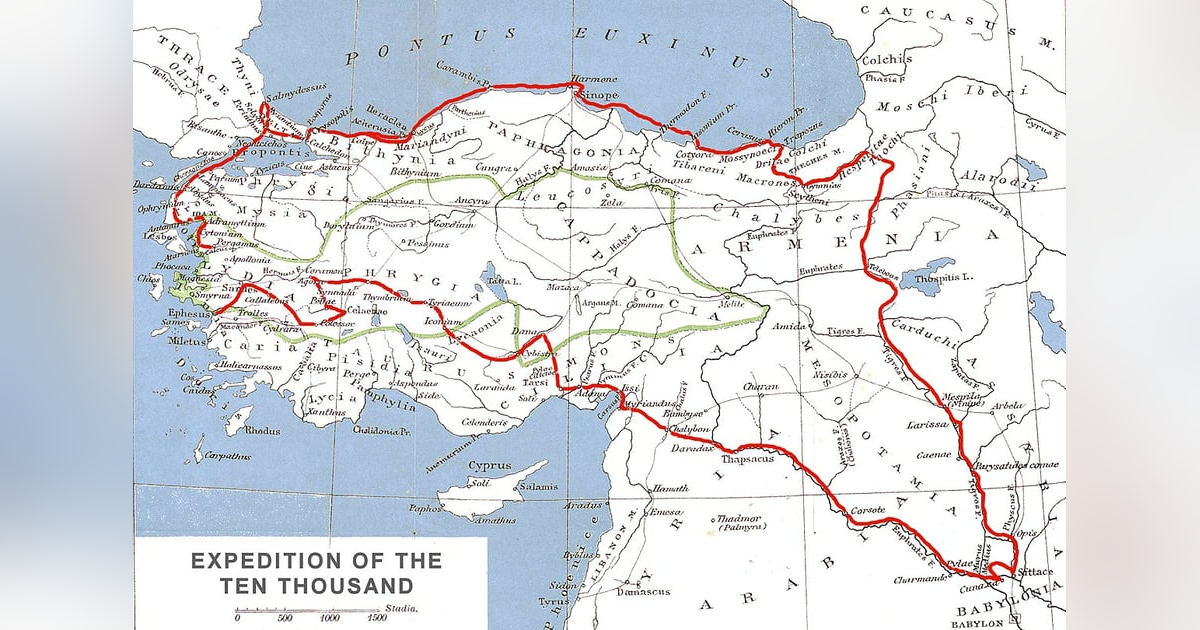
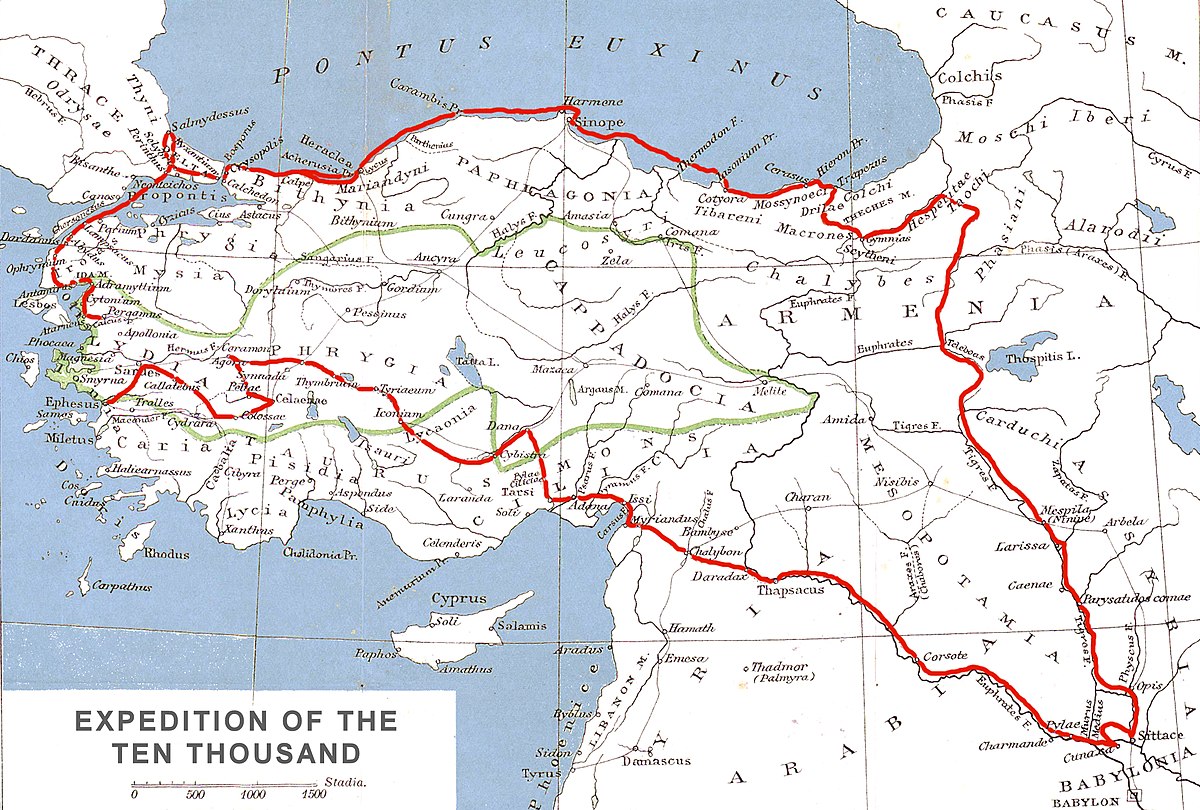
Before we continue, please remember to check out the website, western-traditions.com. All the episodes of every series can be found there, as well as helpful pictures and maps and links to great books to read. You can also buy western Traditions merchandise there, such as T-shirts, coffee mugs, and more. If you wish to support the podcast directly, just use the PayPal or patreon options on the support page.
(Music)
Xenophon was born sometime around 430 BC, just when the Peloponnesian War was getting under way. So his formative years were spent in the chaos and upheaval of the war, when Athens alternated multiple times between the heights of victory and the lowest depredation of famine and despair.
Xenophon wrote several books after his adventures in Mesopotamia. His most famous work, the Anabasis, which is the source material for today’s podcast, concerns events that occurred beginning in 401 BC. We have only the sketchiest ideas about his life before that.
Various writers, and he himself, wrote a great deal about his life, but of Xenophon’s youth we have very little to go on. It is known that he came from a wealthy family with a country estate in Attica. Therefore, he would have been greatly affected by the Peloponnesian war, during which the Spartans regularly terrorized the countryside. After 413 BC, he would have been among those forced to live in the city, much like the comic poet Aristophanes, because the Spartans finally took up residence in Attica and made it impossible for the Athenians to utilize their rural domains.
We also know that Xenophon was a cavalryman, a horsed warrior, and he must have had something to do with the war and the military as a very young man, but beyond that we can only speculate.
Immediately after the war, we also believe that he was closely connected to the thirty tyrants that the Spartans set over to rule the Athenians. These thirty were overthrown within a year and the Athenians resumed their democracy.
Now, since time immemorial, there had been a political divide among the Athenians, with some favoring some sort of oligarchy more like that which ruled over the Spartans, and the majority who wished for a more traditional Athenian democracy.
Socrates and his friends, like Xenophon, were suspected of being Spartan sympathizers, so to speak, and favoring aristocratic or oligarchic rule of some kind.
All these things, his acquaintance with Socrates, his membership among the nobility, his service to the thirty tyrants, and his suspected Spartan leanings, all put Xenophon in a difficult position with the fiercely democratic government in the the years right after the war.
Finding himself in such a bad light, Xenophon learned of an opportunity: to go to Anatolia and serve in an army being raised by Cyrus, the younger brother of the Persian king Artaxerxes. We will talk more about Cyrus in a bit.
In the third book of the Anabasis, Xenophon relates that, presented with this opportunity, he had consulted his mentor, Socrates the Athenian, the great philosopher. He told Socrates about the opportunity with Cyrus. Socrates worried that entering into service with the Persians would hurt Xenophon’s already questionable reputation in Athenian society. So he counseled that Xenophon should go to the oracle at Delphi for advice on the matter.
This little aside in Xenophon’s story, about Socrates, is interesting for a few reasons. First, it is told by a contemporary of the famous philosopher and not in any sort of idolizing fashion. He is simply recounting how he came to this decision to march with the Greeks serving under Cyrus the Persian. So we are getting to hear about an interaction with Socrates that is not meant necessarily to paint the man in one light or the other. If anything, the episode is described to Xenophon’s benefit.
Secondly, it is a little shocking to hear Socrates so worried about public opinion, even for a friend. This sounds different than the Socrates of the dialogues. He does not say, for instance, who cares what the masses, the hoi polloi, think? Do as thou wilt, or anything like that. But he is very concerned about what the present government thinks and may do to his friend, and perhaps that explains his concern.
Thirdly, Socrates does not give advice from his own store of wisdom, but rather thinks it more important for his friend to consult the oracle at Delphi, which confirms for us that Socrates reverenced the oracle enough to trust it with a matter this important.
Xenophon, though, did not quite follow his friend’s advice. He went to Delphi, yes, but he actually asked the oracle to which gods he should sacrifice in order to have a successful expedition with Cyrus? The oracle told him and then he returned to Athens.
Socrates was initially angry that Xenophon had not asked the oracle, instead, whether or not it was even a good idea to go. But, it was too late, now. Xenophon had clearly made one of those decisions we all must make at some point in life, to simply make a clean break with your present situation, and start a new life, a new adventure. And Socrates told him that it was best that he obey the oracle then.
But I shouldn’t overemphasize any irregularity of this move for Xenophon, this decision to skip off and enlist with the Persians. It wasn’t unheard of for Greeks to go and fight for the Persians as mercenaries. Not at all. As strange as it may sound, after hearing about the decades of conflict with the Persians, there had been Greek mercenaries fighting for the Persians for many decades at least. And I’m not talking about just random individuals going to fight for the Persians. We are talking about whole bodies of troops, formations of thousands of them, fighting together as Greeks, in Greek fashion, as in this story here, where over twelve thousand such men will go with Cyrus into the heart of the Persian Empire.
So this was not that unusual. The Persians had money, after all, and the Greeks, due to the near constant state of warfare between their various realms, always had soldiers looking for employment in between and even during those wars.
So, the stage was set. Xenophon lit out for Anatolia, and joined the Greek mercenaries gathering there.
He, like nearly all of his colleagues, thought that Cyrus was assembling an army to battle with local foes within the Persian empire and on its borders.
They would soon find out that they were unwittingly embarking on an ambitious crusade for mastery of the entire Empire.
(Music)
Xenophon’s travels into and out of Mesopotamia resulted not only in a great story of struggle, adversity and survival, but it’s also a geographical and cultural tour of the Persian interior. His account of these adventures became an inspiration, as well as a road map, for future generations of Greek adventurers, in particular Phillip II of Macedon and his son, Alexander the Great. And this all paved the way for the Hellenism that would engulf the Near Eastern World in the coming centuries.
Hellenism’s influence in this region remains today, over two thousand years later. As far East as Afghanistan, Iran and Uzbekistan today you can find towns and villages named Iskander or something similar. These towns just bear the name, pronounced in local dialect, of Alexander the Great, who would rely on much of Xenophon’s report about his travels to guide him on his conquest of the Persian Empire a few generations later and who would found these towns named after himself as his army moved forward, conquering.
But that is several decades in the future. Let’s get back to Xenophon in 401 BC.
Our narrator tells much of the story as an observer, since he was initially just one of many officers among the troops. Xenophon only slowly comes forward in this story, first to a lesser command before eventually leading the entire division himself late in the tale.
Book One of Xenophon’s Anabasis begins with some background on Persian politics at the time of this adventure. There had been multiple Persian Kings while the Peloponnesian war played out, beginning with Artaxerxes I, who died in 424 BC. One of his successors, Darius II, had died just as the war closed in 404 BC. Already, in my episodes on the Peloponnesian war, we have heard of how one of that king’s younger sons, Cyrus, had come to Anatolia to help the Spartans engineer the final defeat of the Athenians.
The eldest son of Darius II, at this same time, in 404 BC, ascended to the throne of the Persian Empire and became Artaxerxes II.
Already, perhaps you can see the source of the coming conflict. The younger son, named after the founder of the Empire, was left out in the hinterlands of Anatolia, fighting the Greeks, while the older son dwelt in the palaces of central Babylonia and Persia.
Convinced that Cyrus was plotting against him, king Artaxerxes almost had his brother killed but the intervention of their mother kept him from doing so, and Cyrus was sent back to his province in Anatolia.
Of course, now Cyrus saw the writing on the wall, and one wit was only a matter of time before the executioner came for him. There was no good reason not to rebel and to usurp the throne now.
Andhe would-be king already had the friendship of many Spartans and other Peloponnesians, because he had helped them win the war against Athens. But he had also gained favor with many Ionians in Anatolia. And, of course, he had a huge loyal following among his own Persians.
Cyrus’ goal was not to take on the entire Persian Imperial army. Instead, he would move with a smaller but fast force against Babylon, from whence the king ruled, fight a quick battle against whatever forces the Empire could bring to bear, kill his brother the king, and seize the throne.
However, since secrecy was of utmost importance anyway, and because most men would not voluntarily go on such a mission against the most powerful nation in the world, very few people on the expedition would know about this purpose of the army until there was no other choice but to fight. So, the Greeks that he gathered about him in Anatolia actually thought that they were going to fight under Cyrus against some of that prince’s local enemies in Anatolia. Only certain commanders, such as Clearchus the Spartan, were privy to Cyrus’ ultimate goal.
Clearchus was a veteran of the Peloponnesian war, during time which he had known both acclaim and infamy for his leadership. He had lost a city to Alcibiades during the conflict, and the Spartans fined him for that strategic loss, but he had also earned the battlefield respect of many other of his peers.
At this time, though, he was, in fact, an outlaw from Sparta, trying to make a living as a mercenary out in the wide world.
This Clearchus had taken money from Cyrus and helped to gather a couple thousand Greeks, from all backgrounds to form part of a mercenary corps employed by Cyrus.
Most of the men recruited were hoplites. Recall that hoplites were the standard heavy infantry of the Greeks, wearing heavy body armor and carrying long spears. These men fought in compact formations sometimes referred to as phalanxes.
Peltasts, usually fewer in number, were light troops carrying bows and slings and whatnot and wearing very little armor but capable of much faster movement, often in irregular formations.
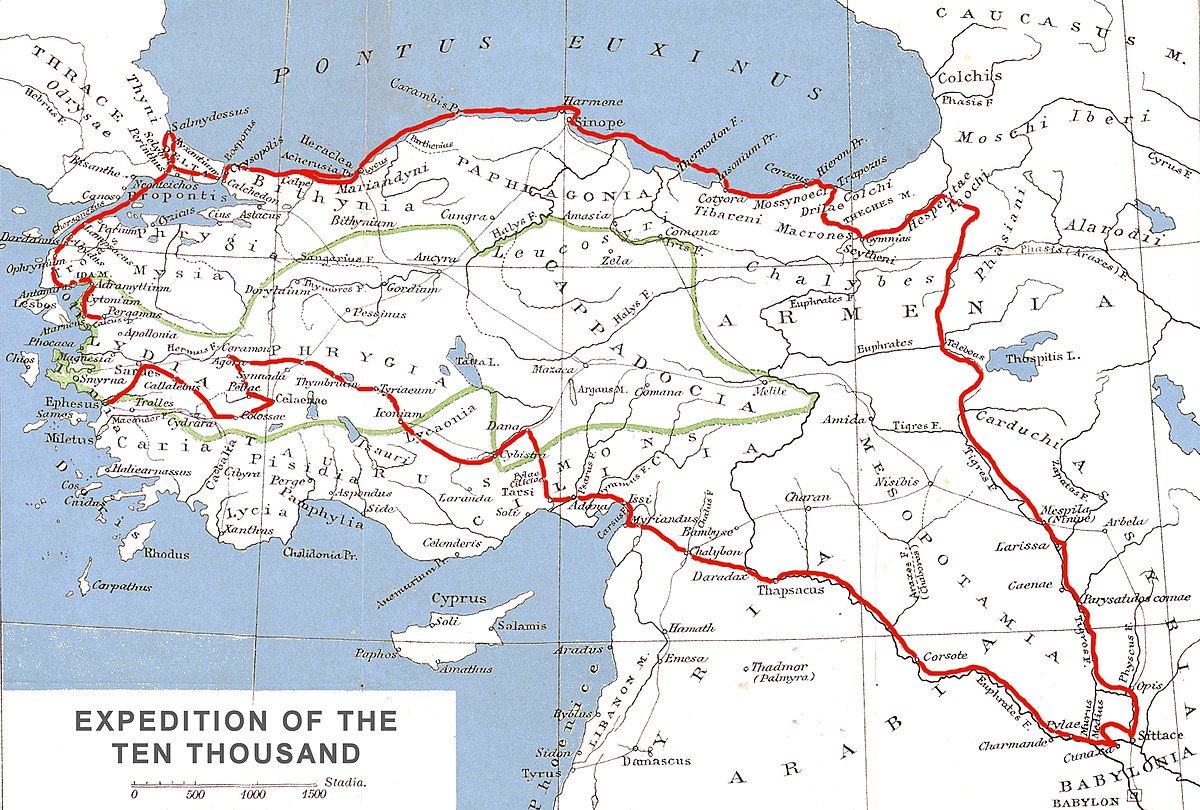
The nucleus of Cyrus’ army started on its journey, beginning from the city of Sardis, in May of 401 BC, traveling slowly through the mountains of central Anatolia.
They tended to travel for a few days at at time and then rest a few days, not really capitalizing on the element of surprise, especially since Cyrus’ personal enemy, Tissaphernes, a Persian general about whom we heard much during the Peloponnesian war, had already fled the territory and gone to warn the king that this army Cyrus intended to gather was too large to just use at home but was probably intending to strike at the king himself.
At these rest stops, the army would often be joined by other groups of recruits and mercenaries. At Kelainai, the army paused to rest for a full thirty days. It was during this time that Clearchus arrived with his two thousands Greek troops.
By July, the army was barely two hundred miles east of their starting point and many of the soldiers were owed as much as three months’ pay. The grumbling about pay became noticeable, but Cyrus, with his charisma and his promises, convinced the men to be patient. The pace of the march picked up up a bit now and by August the army was in Tarsus on the southern coast of Anatolia.
Here, after locals massacred some of the troops, the army sacked the entire city. The Greek troops, fed up with their set backs and their lack of compensation, now refused to move forward. Already they suspected that Cyrus was taking them far beyond their expectations, against the Great King himself, and they had not volunteered for that. Clearchus’ own men, when he tried to move the draft animals carrying his baggage forward, they began to throw stones at him.
Finally, Clearchus stood before his men and spoke to them in a famous and touching, even if somewhat self-serving and deceptive, speech which Xenophon records in Book One of the Anabasis.
Before beginning, Clearchus stood silent before his troops, tears flowing down his face.
He explained how he took money from Cyrus to help him fight wars in Thracian and other places, and how he had come on this expedition in loyalty to the man. He tells how he had not spent the money on himself but on the soldiers’ needs instead.
Clearchus then sort of skips over the whole lying about the purpose of the expedition thing, before saying the following:
“Since you do not want to accompany him any farther…I shall have to either betray you and continue to enjoy the friendship of Cyrus, or break my word to him and stay with you…Nobody shall ever say that…I betrayed the Greeks and chose the friendship of barbarians…since you do not wish to obey me or follow me, I will follow along with you and take the necessary consequences.
“I regard you as being my fatherland, my friends, and my allies…So think of me as someone who will go wherever you may go.”
This speech was so effective that thousands of other Greek soldiers from other contingents moved their belongings into his camp. Cyrus sent for Clearchus, but he refused to go see his Persian master, and this brought him more respect from the Greek mercenaries. However, he also sent private messages to the Persian prince that he should just wait and let the drama play out, and all would turn out well.
Clearchus was a general but also definitely a politician who understood the tides of emotional drama among masses of men.
Now he again spoke to his expanded audience:
“Brave soldiers, it is clear that Cyrus’ stance towards us is the same as ours toward him: we are no longer his soldiers…and he is no longer our paymaster.”
“Cyrus is a man who is a highly worthwhile friend to anyone who is a friend of his, but he is also the most awkward of enemies…”
“And now it is time for any of you to suggest what he reckons to be the best.”
And so now the soldiers began to talk among themselves. And this also sets the stage for much of the coming story, in which the army will often make democratic decisions. For this reason, the Ten Thousand have often been called a marching republic, that is, a body of soldiers on the move who somehow, in truly Greek fashion, manage to alternate between military autocracy and representative democracy.
So, they were far from home, surrounded by unfamiliar terrain and in the presence of enemies. They discussed electing new generals, asking Cyrus for transport ships back home, or a guide, or of seizing nearby strategic points in order to defend themselves.
Clearchus himself refused to take command, but insisted on obeying whomever they chose. Finally, though, they all agreed to send Clearchus and other generals to speak with Cyrus. The prince told them that the enemy that he sought was nearby and that if they could just help him with this effort, they could stop afterward and discuss matters properly. He also agreed pay them more, once they finished punishing this enemy of his.
Given what we know, or think we know, about the Persian royalty and nobility, how the kings saw themselves as unassailable and unapproachable gods among men, this willingness of the prince to negotiate with foreigners is interesting to say the least.
And so the army moved forward, deeper into the Persian Empire. Summer turned to Fall. As they marched, they accumulated more troops, including more Greek mercenaries, some of whom were expressly joining in order to overthrow the king. And so, while the true purpose had yet to be spoken of openly, the understanding that this was a mission to take down the Great King became well-known.
At a place on the Syrian coast known as the Syrian gates, not far from where the road traversed mountain passes and led into the heart of the Persian realms, two Greek generals despaired of the mission, boarded ships and fled. Cyrus let them go without ill will. And here the army turned due east, aiming at the city of Babylon. They had traveled perhaps half the distance required.
There followed great struggle against the elements, against the terrain. Draft animals died of hunger, thirst and overwork in the dry lands of northern Syria. A Persian nobleman was executed for treachery. The motley army of Greeks and barbarians reached the Euphrates river, crossed over, and turned to follow its course southeastward, toward Babylon, and battle.
More than once, the army heard rumors of a coming encounter with the King’s forces. Cyrus’ army began to march in order of battle, to be ready to fight at a moment’s notice. In addition to his nearly 13,000 Greek soldiers, he had somewhere around 100,000 troops from various Asian lands. This was a lot but much smaller than what the Empire would bring to bear against them.
Here Xenophon tells us that the approaching army of the Persian king Artaxerxes numbered more than one million soldiers. Tissaphernes, Persian veteran of the Peloponnesian War, was said to command some 300,000 of these troops himself. In previous episodes, about the Persian War, I discussed the believability of these military numbers. I will let you think what you will about them now and just pass on to the conflict.
Constantly, though, as they approached Babylon, Cyrus’ army found no fight, only traces of a departed enemy force. A force that was surely growing stronger and more numerous the closer they got to the capital.
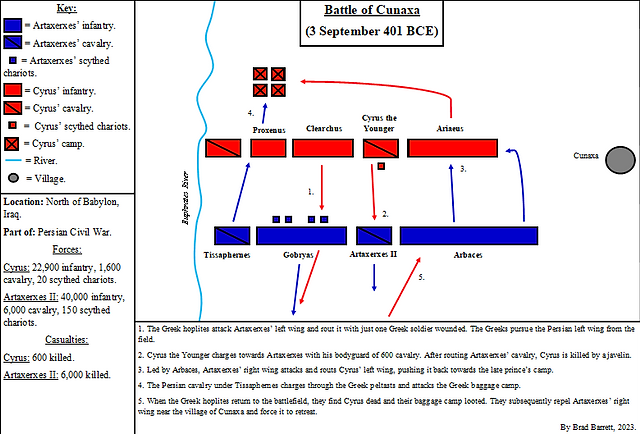
But finally, they did encounter both the king and his vast army, at a place northwest of Babylon, on the river Euphrates, at a place known as Cunaxa.
It was now November of 401 BC. Back home, in Athens, Socrates was getting deeper into trouble with the authorities, and was just a little more than a year from his execution.
When the two armies lined up, Cyrus got down from his chariot, put on his heavy armor, and mounted a horse, spear in hand. Clearchus was placed on the right wing, along the banks of the Euphrates, with the rest of the Greeks. Here the enemy could not go around their flanks, because the river prevented such. However, on the left wing of Cyrus’ army, the story was different. Here was great danger. The superior numbers of the king’s forces meant that he could easily flank this wing.
The only hope, then, was to strike fast and hard at the center of this teeming horde, the army of the the Persian Empire, and to kill the king, Cyrus’ brother, Artaxerxes, in combat. Then those vast numbers of the enemy would have no reason to continue fighting, Cyrus would be the clear victor, and the new king, and the survivors would have their spoils.
And all this came close to happening. And how would history have been changed if Cyrus had won the battle, with his Greek allies at his side? We will never know.
Because Cyrus valiantly drove deep into the ranks of the royal army, followed by his six hundred chosen cavalry, cutting his way through until he reached his brother’s bodyguards. These were all killed or run off and Cyrus struck Artaxerxes, his brother, in the chest, piercing his breastplate and gravely wounding the man. Just then, though, someone struck Cyrus in the eye with a spear, and he too fell to the ground.
Around the two dying men, the battle raged on.
But both men did not die. Artaxerxes was picked up and pulled away from battle, brought to his personal physician, and he recovered as the battle continued. Cyrus, though, had probably died almost immediately. All of his bodyguards, his closest companions, all of them died fighting around his body. Cyrus’ corpse was captured, decapitated, and his right hand was cut off as well.
Meanwhile, the Greek right wing had done well. Early in the fight, Tissaphernes had broken through them with a body of cavalry and passed on toward their war camp, where their stores and food and belongings were kept. But still, the Greeks had routed all the troops in front of them, though they were terribly outnumbered.
This was something that future generations of Greek soldiers would remember: that the Persians were simply not capable of withstanding an onslaught of hoplites in phalanx formation, no matter how much they outnumbered them.
Thus, as Cyrus lay dead in the middle of the battlefield, here, on the right wing, along the river, the Greeks were advancing victoriously, getting farther and farther away from their camp and from the main scene of the battle.
As happened often in ancient battles, one wing of the army was victorious while the other failed. And the Greeks did not know that Cyrus was dead, but assumed that the matter was still in play. So, when the Persian army once again reformed in front of them, in their vast numbers, the Greeks chanted their war hymn and charged again.
And the Persians, as they had always done when faced with the terrible Greek phalanx, the Persian army evaporated, and fled the scene. The Greeks found themselves midday, occupying the denuded hill which had been the battlefield headquarters for the Persians, with the enemy nowhere in sight.
They marveled that Cyrus had not sent news of any sort to them, and wondered what had happened, but they assumed their cause victorious, and that the enemy had fled the battlefield in defeat.
The Greeks marched back to their camp and disappointedly found that all their food, equipment and other stores had either been carried off or spoiled by the marauding Persians. That night, they had no meal.
Hungry and mystified, they awaited word from Cyrus.
(Music)
Daybreak brought only more mystery. Still, Cyrus had not sent word or news of anything. They were preparing to march onward toward the capital, when a messenger finally brought word of what had happened, and that the remnant of Cyrus’ defeated army was nearby, under the command of Ariaeus, a friend of Cyrus. These men were waiting for the Greeks, but only for so long. Soon, the messenger told the Greeks, these survivors intended to flee and escape the certain wrath of the Persian King.
Clearchus, though, since the Greeks had gone undefeated themselves, he offered to march onward, to seize the capital and put this Persian Ariaeus on the throne. So bold did the starving Greeks feel at having run the Persian army off the field.
While they waited for a response, the Greeks butchered some of their draft animals, their donkeys and their oxen, having no other choice, so that they might eat and keep up their strength. They boiled the meat over camp fires that they fueled with fallen arrows, with wicker shields, and with pieces of broken wagons.
Later that morning, finally, messengers came from the King himself. He demanded that the Greeks lay down their arms, and present themselves before the gates of the city to accept whatever fate the King might decree.
And so a discussion ensued among the Greeks. Some preferred to keep their weapons to defend themselves, obviously. Others saw futility in hoping that they might be victorious over the entire Persian Empire, now that these 12,000 or so remaining Greeks were the sole focus of hostilities.
Even as superior as they had proven themselves on the battlefield, they could now be surrounded by millions of enemy troops, fired on with arrows, starved, and picked off until hey were completely destroyed to a man. Perhaps they should give up as asked and hope for the best, hope that the king might recognize their value and put them to work defending and expanding his empire, perhaps in Egypt.
Finally, though, Clearchus, taking a more and more prominent position among the Greek generals, told the herald to tell the King that, if he wanted to use the Greek soldiers thus, they would be rather more valuable to him with their weapons than without.
Later, Clearchus spoke to all the Greeks, and related that he made an animal sacrifice and had the entrails read, and that the sacrifice did not favor attacking the King. In prior episodes, I spoke about how the Greeks used such sacrificial rites to make both great and minor decisions, but also how they could be used to support ones’ own ideas, or to refute those of others.
The long and short of it is that the Greeks joined the nearby remnant of their army. Here they were in a constant state of alarm, with the King and his forces nearby and their fate undetermined, and they were hungry. Eventually, it was arranged for guides from the king to lead the Greeks and others to where they might acquire food in markets established for that purpose while their situation and their safety remained uncertain. And the delay dragged on. They endured 20 days in one spot, waiting for final word of their fate.
But still they were drawn on by promises of safety from Tissaphernes, the Persian nobleman and general. He declared that by the end of it all, they would all be back in Greece and he would be in his homeland in Anatolia. He accompanied the rebels with his own small army as they were led to the Tigris river and then up country, northward.
Constantly, the Greeks thought that they would be betrayed and attacked.
January of 400 BC came, and the rebel army had now been escorted to where the Zapatas river empties into the Tigris.
Far from the capital of Babylon.
Here, Tissaphernes convinced Clearchus and the most of the other generals to leave their separate camps and bring many of their senior officers to an important meeting in the Persian Camp, in which they would discuss the way forward and the relations of the Greeks and the other rebels with the Persian forces.
They never returned from that meeting. The end of Book Two of the Anabasis consists of obituaries for Clearchus and other generals who never came back. Some, like Clearchus, endured for months in prison before they were executed. Others were tortured horribly before being executed.
(Music)
And now the Anabasis truly begins.
The title, Anabasis, is a Greek word meaning ascent, referring to the upward travel from deep in Mesopotamia to the mountains and coast of the Black Sea in northern Anatolia. Normally, the word was used in an almost opposite sense, to describe traveling upward from coastlands into the mountains.
The title has also been often translated, in paraphrase, as the March of the Ten Thousand.
When their generals and senior officers did not return from the meeting with the Persians, the Greeks were at a loss for what to do. They had no designated, recognized leaders to organize them and surely this was all part of the purpose in Tissaphernes executing so many leaders at once, to leave the formidable Greeks without any leadership and to make them as vulnerable as possible.
And now, finally, our narrator appears. Here, in the Anabasis, Xenophon begins to speak of himself in the 3rd person. He does so for the rest of the narrative, always speaking of what Xenophon did, rather than what I did.
The Greeks were now left truly alone. The “barbarians”, as Xenophon refers to their Persian and Asian colleagues in the rebellion, had also abandoned them. That night, after they realized that their generals had been arrested, the entire Greek camp rested fitfully, with heavy hearts.
Xenophon himself slept poorly. He dreamt that he was in a house struck by lightning, by a bolt sent by Zeus himself, and that he could not escape the blaze.
Upon waking, he interpreted the dream more positively than you might expect. It spurred him to action. He realized that, much like in the dream, no one was going to save him but himself.
Xenophon called together the few generals and captains who survived among the troops. There were about hundred such officers. Some spoke of the treachery of the barbarians, that they had violated the oaths all had sworn to the gods. When it was Xenophon’s turn to speak, he declared that they must use their arms to exact justice, and that the gods would aid them to safely depart the land.
Just at that moment, someone sneezed. For the ancient Greeks, this kind of a coincidence was a sign. All those gathered together immediately, quoting Xenophon, “knelt and worshipped the god.”
Xenophon took advantage of this sign and said to all, “Since an omen from Zeus the Savior manifested itself…we should vow to this god to perform a sacrifice for our safe delivery.” All present agreed.
Xenophon then exhorted the men. They had grounds for hope. For one, they were fulfilling their oaths to the gods while their enemies had betrayed their oaths and were therefore the enemies of the gods.
For another, their ancestors had stood their ground and defeated the Persians again and again.
And for more reasons, he outlined their hopeful return home. Xenophon concluded his long speech by reinforcing, in this precarious moment for them all, the importance of absolute obedience now to the new generals that they might elect.
Naturally, they all agreed on placing Chierosophos at their lead. Cheirosophos was a Lacedaemonian officer, and no one seems to have hesitated in accepting him as their natural leader in this situation. In previous episodes, I have mentioned how all Greeks respected the military acumen of the Spartans.
Xenophon himself was chosen as one of a handful of generals to support Cheirosophos. Generally, during their travels, the Spartan would lead from the front, and Xenophon would marshal the rear guard. There was no dishonor in bringing up the rear. It was as deadly a position as any in an army hunted and on the run.
Xenophon encouraged the men to leave behind everything but necessities, so that they might march as fast as possible. Before they set out the next morning, they set their wagons and their tents on fire. There was no going back now.
The army that proceeds from this point, the army that fights its way out of Asia and back to Greece, is remarkable for many reasons.
There were about ten thousand total remaining troops, most of them hoplites, or heavy infantry, with some light armed troops called peltasts.
Of course, that number of ten thousand refers only to the armed men. We should not forget that all ancient armies were accompanied by camp followers. These were the non-combatant servants, frequently slaves but also among them were free individuals - men, women and children - who assisted the soldiers with various duties, such as cooking, cleaning, grooming horses, caring for livestock, carrying messages, conducting religious ceremonies. Among them there would have also been plenty of women and even boys serving as concubines. Historians sometimes assume that there was essentially a shadow army of another ten thousand of these followers accompanying the Greeks, a non-combatant unit which would have been much more fluid in composition and number.
However, remember that this was not really a self-sufficient army but rather just an element of one. A complete Greek army, back home, would have included mostly hoplites but also light troops, cavalry, archers, and other support personnel. The Greeks now stranded in Babylonia were mostly infantry troops and not suited for every kind of combat nor for every mode of travel.
They had no cavalry, in a wide open land over which the Persian cavalry, famous for its combat superiority, could roam at will and make relentless assaults on the Greek infantry.
They also had very few missile troops, A handful of Cretan archers with short range bows. But the Persians would soon come for them with slingers and archers with long bows who could simply fire missiles at them from a distance.
They had no food. They knew that it would take months to walk out of Mesopotamia and reach the Black Sea, which was their initial goal. There they could hopefully find ships and safe passage home. In the meantime, they would have to take food from the land and from towns and villages, which would possibly have to be attacked and seized in order to acquire the food, and this would have to be done again and again, to feed 10,000 men and their followers on the march, over the course of months.
Which meant that every town in their path would likely consider them enemies, so they would have no safe haven anywhere.
The army did not know the terrain. The surrounding land was foreign to all of them. They didn’t know the route home, they could not go back the way that they came because those roads were certainly blocked and guarded by armed forces. They just knew that they had to head north, and would have to rely on local guides whose trustworthiness was obviously suspect.
And, the entire time, the Persian Army would be at their heels, or even in front of them. They were not far away now, in fact. The Ten Thousand would not even have a head start.
And they would have to overcome all these challenges without the discipline of recognized leadership. No, in fact, as I mentioned before, the Ten Thousand have been remembered through history as the marching republic.
Yes, they elected leaders and vowed to follow them and Xenophon stressed the increased importance of of military obedience more than once, but the fact was that the army operated pretty democratically on its trek through the Asian highlands to the coast of the Black Sea. In a pinch, of course, when surprised or in combat, they obeyed their leaders. But nearly every time that there were big decisions ahead, which route to take, which potential ally to trust, what kind of strategy to employ in certain conflicts, every time, the army would sit and discuss the matter, listen to different generals officers and even common men, before making a group decision about how to proceed.
And sometimes, not often, but occasionally, the Ten thousand would disagree and divide into factions.
This is one of the many reasons that the story of the Anabasis has survived down to this day. Not only is it a great story of adventure, but it served for the Greeks of the following generations as both a geographic tour of a far away land and as a document of statesmanship. The narrative is punctuated numerous times with speeches made not just by Xenophon but by others in the army as well as outsiders and they are as insightful and moving as those we read about others making in the Persian and Peloponnesian wars.
This marching republic was also as resourceful as any military unit ever. It overcame the faults and deficits of the army in the following manner.
They knew that they could never defeat the Persians entirely, though they could stand valiantly against superior forces, ultimately they could not defeat and rule over millions of people. The goal, therefore, was to survive.
They did not need to create, out of thin air, a cavalry force or an arsenal of archers superior to the Persians. But they needed something. They needed to be able to make the Persians at least pause and understand that the Greeks had a response for every attack.
Xenophon recognized that the Greeks had no cavalry unit, per se, but there were horses among them, and not just draft animals which would not be very useful as cavalry. Many officers had their own personal horses, for instance.
So all horses were gathered, and willing men chosen, to form a unit of horsemen. At the least, they could show the Persians that they too could fight on horseback and they could chase off cavalry attacks. Some fifty horses and fifty men were organized thus into a cavalry unit. Until the Greeks did this, the Persians were able to attack and retreat the Ten thousand at will with cavalry and inflict continuing losses on the marching republic.
The Persians and their allies also made multiple missile attacks, and a large force of thousands of archers soon threatened to harass the Greeks. So the Greeks recruited men from their own ranks who were capable of using slings and they formed a new unit of 200 slingers, to supplement their few archers.
And when that force of archers came within range again, the trumpet sounded and the Greeks released their cavalrymen and their archers and slingers began firing and their enemies now knew that that they could no longer attack with impunity.
Every arrow that fell during battle, the enemy’s or their own, was recovered to keep Greek archers supplied and every horse lost by the Persians was quickly incorporated into their army. Nothing could be wasted or looked over from now on. Everything had to count.
And they trekked on, generally north, through northern Mesopotamia, toward the Anatolian highlands,
and beyond to the sea.
(Music)
It took them five months to reach the sea at Trapezus. As the bird flies, it was a only few hundred miles but the way was not straight, and who can quantify the suffering of any road taken, or the courage required to walk it?
One day, when the vanguard of the army crested a mountain pass in northern Anatolia, Xenophon heard such an uproar that he mounted his horse, rallied the small cavalry force, and raced forward, thinking that another deadly conflict stood between the Army and salvation. But before he reached the front, Xenophon already understood the word cried out again and again by the exhausted soldiers.
Thalatta! Thalatta! - The sea! The sea!
Indeed, the waters of the Black Sea, still some 20 or 30 miles distant, were visible from the heights.
Of the ten thousand men who had started the march back in January, Xenophon estimates that about five out of six had made it this far.
Since January, they had crossed river after river, often under fire, or chased from behind or even forced to fight their way across. They had fought for control of mountain passes, innovating tactics on the spot. They had suffered hunger and cold, and marched through snow.
They fought their way through the Karduchoii, the ancient ancestors of the Kurds, who still control those mountain passes today, vs Iraqi, Iranian and Turkish assailants. Once the army had the Karduchoi trailing them and the Persians threatening to blockade a mountain pass ahead of them and they only narrowly escaped entrapment and destruction.
Where they could, the Persians had practiced a scorched earth policy, carrying off supplies and burning what they could not carry in all the territories through which the Greeks would have to pass. They were determined, perhaps simply for the sake of honor, to not let the Greeks get away unscathed.
And the Greeks battled their way through Armenia on their way to the sea as well. Along the way, sometimes they were able to trade peacefully with local villages, and always they preferred this, but other times they had to fight for their next meal.
In the mountains of Armenia, they found refuge with villagers who lived underground, and who kept their livestock with them underground as well. Modern archaeology has, indeed, discovered such subterranean settlements in this region, some capable of sustaining tens of thousands of people, throughout the region, some of them much more ancient than Xenophon.
Elsewhere, things were not so amicable. The Tachoi, a tribe living in the mountains of modern-day Georgia, harassed the Ten Thousand and rolled boulders down on them from their mountaintop fortresses.
In order to secure their passage, the Greeks attacked and seized one of the Tachoi’s strongholds. When they broke through the enemy lines, they witnessed a horrible thing: the desperate, frightened Tachoi women throwing their children off cliffs, and then throwing themselves after them, and then the last of the Tachoi men threw themselves to their deaths as well.
The Greeks took their cattle, their sheep, and moved on.
It was a couple weeks later, after more bloody combat with another tribe, that they caught sight of the sea for the first time.
The story does not end here, and this is fittingly Greek, in some way, that we do not get a glorious, albeit brutal, denouement. Never has Greek literature given us this. The Iliad, the Odyssey, they both end in anticlimax, in the telling of mundane events after the conflict is won. In the books of Herodotus’, the history ends not with the Battle of Mycale but with an unexpected meditation on Cyrus the Great, the founder of the Persian Empire, and his views on the value of a difficult life. And often, the heroes in these tales die ugly deaths, in petty squabbles or unfortunate circumstances, after making their name in some glorious battle.
Just so here. In fact, there are seven books in the Anabasis, and they arrive at the sea at the end of book four. So there are three books of what you might call epilogue, an epilogue full of comparatively trivial adventures, compared to the grand odyssey of the Army's march through foreign lands, without food or shelter or trustworthy allies.
The survivors, apparently five out of every sixth man that started the journey, they arrive in Trapezus, a port city on the Black Sea, populated by many Greeks among other nationalities. Here the troops rested, and, in typical Greek fashion, organized and competed in olympic style games, just as the heroes do at the end of the Iliad.
But they were not able to find passage home, not in such a large group which must have still consisted of perhaps some 8 or more men in one body. They were able to secure enough ships to send non-combatants, such as women, children, older men and the ill more securely along the shore, while the main body marched westward, toward Greece itself.
The remaining men, all combatants, ended up marching west along the coast, towards the Greek mainland, in the hopes of eventually finding their way home overland, or of discovering some more allies that would ship them home. Along the way, they fought more battles and engaged in political intrigues and shifting alliances. It is actually here that Xenophon seems to take an even more leading role among the handful of leaders.
While the Ten Thousand struggled against superior numbers on their ascent from Mesopotamia, once they reached the Black Sea, they found themselves unmatched in strength. The cities were small here and ripe for the taking, really. At one point, Xenophon contemplated founding a city or colony with the army there on the coast of the Black Sea, but the idea was not received favorably..
Militarily, Xenophon is remembered for the brilliance of his tactics both in offense and defense, and especially in the tactics of retreat. The army of the ten thousand fought numerous battles on the run, was frequently surrounded or threatened with being surrounded as it escaped enemy territory.
And every time, they found the way to extract themselves from danger. Xenophon was usually a key figure in strategizing in these circumstances. Sometimes he recommended brute force, the heavily armed and armored hoplites pushing their way through a mountain pass held by organized enemies. Sometimes, he improvised tactics, and the troops consistently overcame their inferiority, in numbers or in arms. Sometimes they had to run as if in a race, all the while carrying their armor, their weapons, their provisions and their tired bodies.
When you read the tale yourself, you may find yourself exulting along with the soldiers when they observe the sea for the first time.
The tale comes to an end in March of 399 BC, nearly two years since the army left on the original expedition. Xenophon is now leading a large contingent, perhaps five or six thousand, of the original body of troops. By this time, Cheirosophus, the Spartan general, had already departed with a division of his own troops and died, apparently as a result of a bad medicine that he had taken for a fever. Thus passed the brave, skillful man who had led the Ten Thousand through the most marvelous retreat in history.
Again, it is striking to see how many heroic men in Greek tales die not from battle wounds but from the most mundane events.
The Anabasis peters out, perhaps somewhat disappointingly to the modern reader, in book VII after Xenophon leads the troops to victory over a local warlord in northwest Anatolia, actually not far from where the heroes of the Iliad must have broken and burned the city of Troy.
As a result of this victory, the soldiers agree on rewarding Xenophon with a great deal of the treasure captured, and here our hero acquires the kind of riches that will secure for him a life of wealth hereafter.
By this juncture, the survivors of the expedition had traveled more than four thousand miles on foot, over the occurs of two years, all the while fighting battles, starving, thirsty, freezing in the cold and burning under the desert sun, harassed at every turn, climbing mountains, traversing empty plains, seizing fortresses and cities only to give them up and move on, sacrificing to their native gods in lands that knew different gods,
The army was then turned over to Thibron, a Lacedaemonian general in the area who then put the army to use in Anatolia, fighting against Tissaphernes the Persian, that eternal enemy of Greece.
(Music)
And now, some epilogue.
By the time that Xenophon turned the core of the Ten Thousand over to Thibron in 399 BC, there were probably only about 5,000 men left from the original division of troops that found itself stranded in northern Mesopotamia over a year before. There had been battle losses, of course, illnesses. Some men had fled or disappeared along the way. Other had broken off in small units to stay in some region through which they passed or to leave on another adventure.
These men would join the Spartan expeditionary force that would fight the Persians in Anatolia during the next decade. For a few years, they would be remembered and recognized as a fighting unit in battles there, and then they returned, as a body, to the Peloponnesus to fight under the Spartan flag at the battle of Coronea in 394 BC. After that, they disappear from history.
When Alexander the Great rallied his troops before the great battle of the Issus over 60 years later, he reminded them of the Ten Thousand and how they had faced even worse odds, and had been without any sort of proper cavalry or archers. Mark Antony, centuries later, would lead his army on a disastrous retreat through the same region in Eastern Anatolia. Frequently he would cry aloud, “O the Ten Thousand,” when he thought of their own struggle and compared it to his army’s depredations.
On the Persian side of these matters, Tissaphernes, the Persian general, whose story begins back during the Peloponnesian War, he would battle the Greeks in Anatolia for a few more years, but eventually he would be recalled to Babylon. Cyrus’ mother hated the man for having fought against her favorite son Cyrus and Artaxerxes appears to have placated his mother by having the man executed.
Artaxerxes himself, the Great King, he would go on to become such a famous ruler of Persia that Plutarch actually devoted one of his essays to him. He continued to rule the empire until 359 BC, the longest reign of any monarch from his line. He eventually regained control of most of Western Anatolia, and even pushed the Greeks out of the island of Cyprus, and successfully contested the Greek supremacy at sea for the first time since the end of the Persian War a century before.
As for Xenophon, the general and narrator of our story, he would go on to write many books in his life, and he would come to be remembered as a military leader, a historian and as a philosopher. Greeks would preserve and cherish his writings, especially the Anabasis, as a document of both military strategy and political statesmanship.
In particular, his victories over the Persians would be studied by Phillip II of Macedon, some fifty years later, as he began to formulate plans to not simply defeat the Persians, but to actually take over their Empire. His son, whom we call Alexander the Great, would carry out those plans.
There is no way of knowing if Xenophon, in March of 399 BC, as he led his troops to one last victory in Anatolia, there is no way of knowing if he knew that his friend Socrates had, by then, died, having drunk the poison assigned him by his executioners in February of that year in Athens.
Xenophon himself does not return to Athens at the end of the tale. In fact, he may have never returned. Sometime during the decade that followed, he was permanently exiled from his native city, like so many great Athenians. The Spartans provided him with an estate in the Peloponnesus and he likely lived there to the end of his long life, several decades later.
In our next episode, though, we will return to Athens, and listen one more time to Socrates in Plato’s famous dialogue about the great philosopher’s death, the Phaedo.
Until then, I than you for listening to the Western Traditions podcast.