Episode II.28 - The Peloponnesian War V: The Fall of Athens


Alcibiades finally comes to power. Lysander leads Sparta to victory. The long walls of Athens come tumbling down.
RECOMMENDED READS - Click Image for Link:

Episode II.28 - The Peloponnesian War V - The Fall of Athens
(Music)
“The Lacedaemonians and their allies shall not invade or injure the King’s country, neither shall the king invade or injure territory of the Lacedaemonians or their allies.”
-Words from the treaty establishing an alliance between Sparta and Persia, for the purpose of destroying Athens.
(Music)
Doomsday.
Doomsday had come for the Athenians. After nearly two decades of war, fighting the Spartans, the Corinthians, the Boeotians, the Syracusans and even their own allies, after all that, the entire expeditionary army of Athens had been annihilated. The freshest and finest soldiers and sailors had gone overseas to Sicily, and they would never come back. After the horrible defeat at Syracuse, a handful of stragglers might return someday, maybe some would be ransomed. The vast majority, though, were either killed or captured, and the captured either died of hunger and disease in the desolate quarry in which they were kept, or they were sold, one by one, into into slavery, and disappeared.
The assumption now was that the victorious enemies, Spartans, Corinthians, Syracusans and more, would now turn their entire machinery of war against Athens, whose long walls were presently manned only with skeleton crews, eyeing the horizon fretfully, waiting hopelessly for the return of a non-existent army.
This is the 28th episode of the Greek Sun, my podcast series about ancient Greek history. It’s the final chapter in the sorrowful saga of the Peloponnesian War.
To learn more about this tragic civil war in ancient Greece, please visit my website, western-traditions.org. You can find all the episodes of all my podcasts there, as well as pictures, maps, recommended books, episode transcripts and more. There is a shopping page for Western Traditions merchandise as well as options to directly support the podcast though paypal or patreon.
(Music)
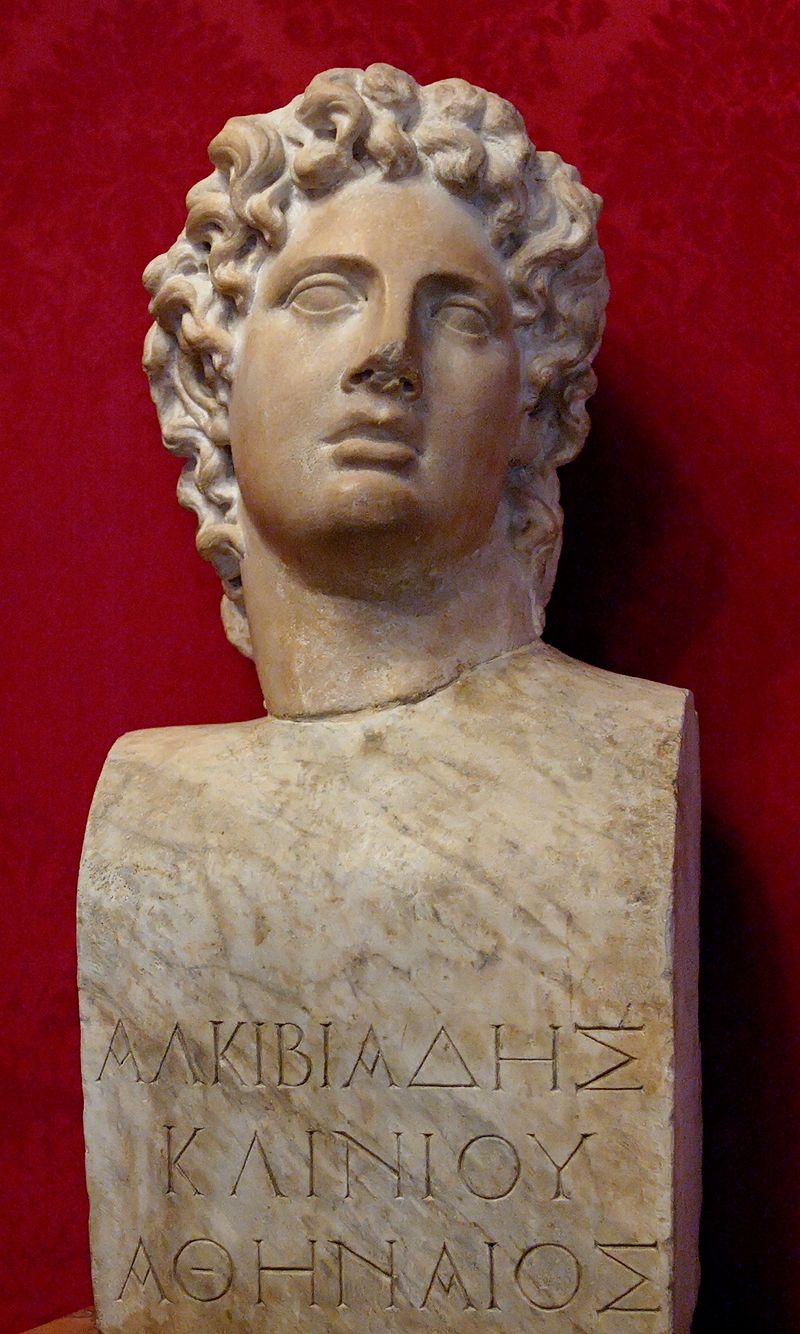
I said, in the last episode of this sequence about the Peloponnesian War, that Alcibiades, the Athenian statesman and general, was irresistible.
And it wasn’t just his fellow Athenians that couldn’t resist his charms. During the Sicilian Expedition, just when it was getting underway actually, Alcibiades was called home to Athens to undergo a trial for blasphemy. Fearing that his personal enemies would use this opportunity to disgrace him or even put him to death, he opted to go on the run. When he didn’t show up for his trial, the Athenian assembly quickly declared a verdict of guilty and sentenced Alcibiades to death.
Shortly thereafter, Alcibiades turned himself in to the the Peloponnesians. When your friends turn against you, you see, sometimes the only safe place is with your enemies.
But the Spartans quickly came to appreciate Alcibiades. They actually liked this man who had not only warred against them for nearly two decades now, but had led troops in many of those battles, who had engineered strategies against them.
In fact, one of the Spartan queens liked Alcibiades so much that had she had his baby.
Maybe all this was because Alcibiades was really a kind of chameleon. Plutarch remarks on this in his biography of the man. The saying was not popular yet in his time, but perhaps Alcibiades already knew the philosophical bent of mind in that old adage,
“When in Rome, do as the Romans do.”
Because, in Sparta, Alcibiades became a Spartan.
In Athens, he had put on the air of an extravagant, lazy fop, careless with money and festivities. In Sparta now, he became quite reserved, almost laconic, if that were possible for the man, and quietly devoted himself to athletics. He cut his hair short, like a Spartan warrior, ate the traditional simple meals of the Spartans and he bathed in cold water. After bathing, Alcibiades donned no perfumes, and went about dressed in modest clothing.
Now, in Sparta, you recall, there were two always kings, one from each of two royal houses. King Agis at this time was the king who devoted himself more to the war effort and was often away in the field. Alcibiades apparently wasted no time in getting to know the lonely wife of this combative king and sired a child upon her while her husband was away.
Privately, Alcibiades would later say that he had done this so that his descendants might rule over the Lacedaemonians. Agis, however, never recognized the son born from this union, and Alcibiades’ dream of mixing his blood anonymously into the royal succession did not pan out.
This social and sexual faux pas would later come to work against the interests of Alcibiades.
Because the war was not over for everyone’s favorite chameleon. Alcibiades now began to guide and advise the Spartans on how to manage the conflict with Athens. It had been his idea, after all, to send more aid to the Syracusans, and to fortify Decelea in Attica.
After the destruction of the Athenian army in Sicily, ambassadors began to arrive in Sparta from all over Ionia, from all those cities under the yoke of the Athenian Empire. Too terrified of Athenian justice to attempt revolt on their now, each of these cities was eager to receive military aid from the Peloponnesians and to overthrow their Athenian masters. All of them, of course, recalled the wicked massacre on the island of Melos, where the Athenians had put all the rebellious men to death and sold their families into slavery, and no one wanted to suffer the same fate.
The initial push for the Peloponnesians and the Syracusans, after their victory in Sicily, to combine forces and destroy Athens, actually came to nothing. The Spartans and their allies took their time, instead of striking fast at a nearly defenseless Athens. By the time that they had brought their forces to bear, the distressed people of Athens had already caught their breath, decided to hold out to the bitter end, and begun to take measures for the safety of their city.
The Athenians cut all costs wherever they could, they abandoned their fort in Laconia, cut down even more timber to build more ships and fortifications, and kept a wary eye on all relations with their subject cities.
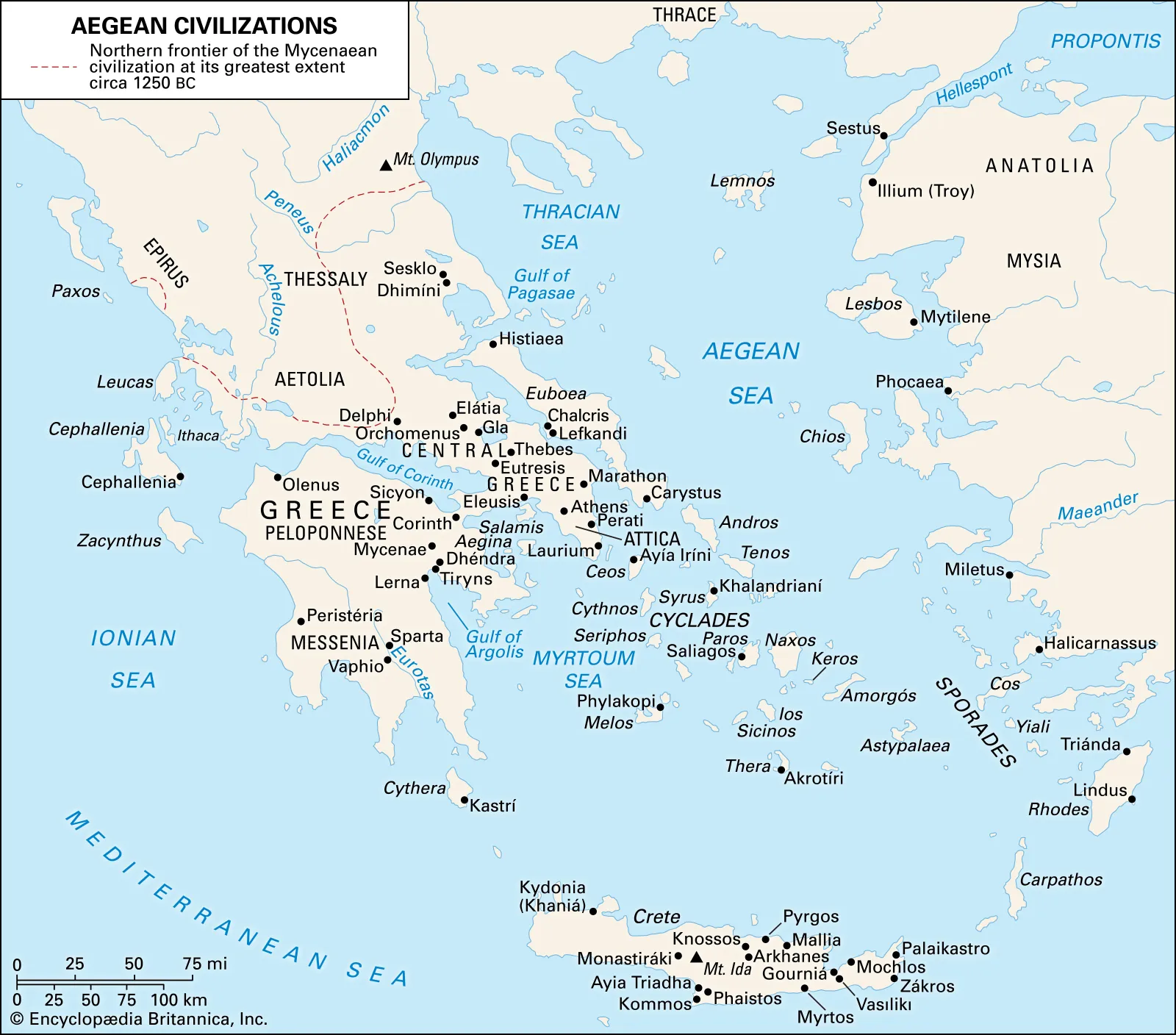
Alcibiades now encouraged the Spartans to give aid to the island of Chios in forming a rebellion. Chios is one of the largest islands off the coast of Anatolia. During the age of classical Greece, it was also very populous and wealthy. This island was a critical element in the league that supported Athens financially. When the Peloponnesian fleet set forth to help Chios throw off the Athenian yoke, Alcibiades went with them.
It was probably a good idea, though, for Alcibiades to get out of town. King Agis despised the man for having dishonored him and his wife with an illegitimate pregnancy.
Now, as an interesting aside on Spartan culture, you might be expecting to hear that this child of Alcibiades and the wife of Agis was euthanized, since we know that the Spartans did not have any qualms about killing infants that they deemed unacceptable additions to their society. But, perhaps due to the combination of the queen’s own standing in the culture, and the fitness or beauty of the child, he was apparently permitted to live, though this son of Alcibiades and the Spartan queen was never allowed to sit on the Spartan throne.
Once on the island of Chios, Alcibiades began to cause great mischief for Athens, and soon all of Ionia was trying to revolt. The Persians, long watching the distress among the Greeks with hope and glee, now got directly involved. And the Lacedaemonians, eager for final victory over the Athens, were not afraid to bargain directly with the devil himself, the King of Persia.
Or with his minions, anyway. Tissaphernes was the Satrap over Lydia, the Persian territory that bordered Ionia, the realm of the Greeks who lived under Athenian protection. The Spartans and their allies entered into negotiations with this Tissaphernes to fund and support revolutions throughout Ionia, especially in Chios.
When the Athenians learned that Chios had revolted, the impact was immense. Chios was a significant contributor to the entire Athenian network. Losing just that island was a big enough blow, but it would also encourage many others to also abandon their servitude to Athens.
But the Athenians, as you might expect by now, were supremely resilient. Since the beginning of the war, they had set aside 1000 talents of silver, to be used for just such a doomsday scenario, and they had faithfully left the money untouched even during the most difficult moments of the war, for nearly 20 years. But now, faced with complete isolation and enemy encirclement, the assembly voted to release the funds. The money was used to pay enough men to crew another 100 ships.
Nevertheless, things went poorly for the Athenians in the field. They sent and maintained an army in Samos, another large island off the Ionian coast, but in most places things turned against their favor.
And now, unbelievably perhaps, unless you have finally become used to the caprice of the ancient greeks, the Spartans negotiated an alliance with Persia.
With Persia.
The ancient enemy of Greek freedom.
Thucydides reproduces the text of the pact between the Lacedaemonians and the Persians. Each side agrees, first of all, not to make war upon the other or the allies of the other. Secondly, the pact also agrees that each party to the agreement will make war upon whomever the other party makes war.
For the most part, this cooperation would involve the Persians funding the Spartans and their allies.
Of course, when you reflect on the transitory nature of all the Greek alliances and pacts and truces and peace treaties, maybe we shouldn’t make too much of this. In the end, it was just another peace of paper and the alliance between the Lacedaemonians and the Persians would continue to be an on-and-off, hot-and-cold romance until the very end of the war.
We have now reached the year 412 BC. There are, somehow, still eight years left in this war. Given the dire straits in which Athens found herself, it seems like most any other city would have asked for terms of peace and tried to end the war as gracefully as possible.
But Athens is a lesson in holding out to the bitter end, the very bitter end.
(Music)
Athens would hold on, but not without going through its own catharsis.
Three hundred Spartans had stood and died fighting the Persian hordes at the Hot Gates in 480 BC. Now, less than seventy years later, they had signed a pact with those same Persians against their Greek brothers, former allies, in Athens.
Athens, the bastion of democracy, would now complete its own reversal, by becoming an oligarchy.
As you might expect, we find Alcibiades at the center of all this ruckus, even though he was in exile from his beloved home city.
Agis, King of Sparta, whom Alcibiades had cuckolded, had not forgotten his dishonor, even though Alcibiades had been instrumental in the recent Spartan advances in the war. While advising the Spartans during combat operations on the island of Rhodes, an order came from Sparta to assassinate Alcibiades, as he was suspected of treachery.
No one could be sure, perhaps not even Alcibiades himself, of just where Alcibiades stood, with Athens, with Sparta, with the Persians? With himself?
Now, Alcibiades received early word of this attempt on his life and he escaped posthaste. He then found refuge in the court of Tissaphernes, that satrap of Lydia and overseer of the Persian cooperation with Sparta. Though the Persians were in alliance now with the Peloponnesians, they were pleased to have a Greek statesman in their grasp and were not in any hurry to surrender him to Spartan justice.
Immediately, Alcibiades began to counsel Tissaphernes on how to manage the Spartans better, and how to reduce their pay and limit the impact of their employ on the Persian King’s treasury. And, as Plutarch tells us, living now among the Persians, Alcibiades the chameleon dropped his Spartan simplicity and he began dress himself extravagantly and to live as if had always been a perfumed member of the Persian court.
Furthermore, and this was crucial for the survival of Athens, Tissaphernes heeded Alcibiades’ advice not to aid the Spartans overmuch. If the Persians had now joined wholeheartedly in the war effort, they probably could have easily consumed all of Ionia while Sparta swept up Athens and her remaining subjects.
But, as Alcibiades reminded the Persians, that would have left them facing a strong, united Greece under Spartan hegemony. Better, Alcibiades counseled, to let the Spartans wear themselves down in the process of achieving supremacy over Athens so that they would be easier to manage after the war ended.
Coincidentally, this decision would allow Athens to continue holding on to independence and it will always be a mystery as to what Alcibiades was up to here. Was he genuinely working in the interests of his new masters, the Persians? The Spartans had been willing to kill him not only because he had cuckolded their king, but he had also become suspicious in their eyes, giving good advice with regard to battling Athens but also never approving of any move that seemed decisive against his homeland.
And now, working for the Persians, he gave counsel that allowed his home city to once again escape complete destruction. As if he was willing to punish the city that had exiled him, but not willing to destroy it. Was Alcibiades always favoring Athens, somehow?
He would have had us believe that, most likely.
But that is not the end of the enigmas around Alcibiades. Thucydides tells us that he now sent word to the Athenians at Samos, where the greatest concentration of Athenian forces outside the city now stood, and Alcibiades’ message suggested to the leaders of those Athenian forces that the Persians might come into the war rather on the side of the Athenians if they would just get rid of that pesky democracy that had exiled him and replace it with an oligarchy.
As happens so many times in studying ancient Greek political history, the series of machinations and reversals and intrigues that follow this is too much for reproduction here. Read Thucydides if you are truly interested in the nitty gritty of it all, but let is suffice to say that the oligarchy in Athens came to be.
Not, however, as you might expect.
At the end of this affair, Alcibiades did not return to power in the city of Athens, but rather at Samos, over the fleet.
Now Athens and the fleet at Samos separately began to overthrow their democratic foundations. In Athens, certain men established a ruling party known as the Four Hundred, after convincing the commoners that this was the only way to save the city, by changing their government and seeking alliance with the Persians against the Spartans. According to Thucydides, the thought of the commoners at this time was that they would put up with this inconvenience for the sake of survival, and revert back to democracy when they could.
This usurpation of power was probably achieved as bloodlessly as it was due to the fact that, at this point in the war, every spare Athenian man, and I mean every spare man, was either manning the walls, crewing a ship or fortifying some other post for the bare defense of the nearly defenseless city. Marshalling forces to stop this coup was probably just not feasible.
Indeed, King Agis, in a rare moment of Spartan alacrity, residing now at his forward base of operations in Decelea in Attica, after he heard about this overthrow of the democracy in Athens, he was not satisfied and he moved against the city with as many troops he could gather. Agis hoped to catch the confused Athenians off guard and capture their capital and bring the war to an end.
But the Athenians united when the Spartans were sighted on the horizon. They sent out a hastily assembled force of cavalry, heavy infantry and archers. These so stoutly battled the Spartans that the latter turned back, convinced that the Athenians were not yet on their last legs.
Simultaneously, there was an attempt to establish an oligarchy over the Athenian army and fleet at Samos. But, in a series of overlapping, contradictory complications in a typically Athenian tapestry of complex events, the fleet and the whole island of Samos rejected the attempt at oligarchy and remained democratic. And so, suddenly, the Athenian fleet at Samos was at odds with the city of Athens itself, and a political enemy of that city’s leaders.
The leaders of the fleet at Samos were not discouraged, even though their home city had betrayed democracy. They still controlled a massively powerful armada, even if its troops were a bit disheartened by news from home. In fact, the fleet was all too capable of returning home immediately and re-establishing the democracy. It was nearly Athenian vs Athenian at this juncture.
And now, you might want to sit down for this next part:
The stubbornly, democratic fleet sent envoys to Tissaphernes, the Persian Satrap, and brought Alcibiades back to Samos and elected him as strategos, as supreme general and admiral, to lead them. Yes, the man who had changed sides multiple times, and who had started the chain of events that led to the overthrow of democracy and the establishment of oligarchy in Athens, was now to lead an army intending to return Athens to democracy.
In my copy of Thucydides, in which I manually jot down notes and underline passages, I have simply written an expletive in the margins at this point in the text. It hits you that hard when you are knee deep in Greek history.
But it was Alcibiades who saved the city, actually, and Thucydides the historian, no fan of this unpredictable rival of his, even admits as much. The wily Athenian statesman and general saw that the Athenian cause would be finally destroyed if its own army made war on the city. So Alcibiades instead counseled the other leaders of the fleet to be patient. Given time, he said, the city will return to democracy. In the meantime, they all had work to do in order to salvage what they could of the faltering Athenian empire.
And so the fleet set about preserving an empire for a city that had betrayed it.
The following year, the Spartans sent a fleet, composed of various allies, East, toward Athens. At first, there was panic in the city, everyone believing that the fleet was meant to land at the Piraeus, the Athenian port, and strike the final blow of the war. The fleet bypassed Athens, though, and instead struck at Euboea, the large island off the coast of Attica, from whence came much of Athen’s remaining tribute and food, since they were not even able to access their own countryside due to constant Spartan raids.
It would have required little effort from the Spartans, at this point, according to Thucydides, to finish off the Athenians. But again, the Spartan tendency to take slow steps lost them this renewed chance at final victory.
Given the pause in hostilities, while the Spartans seized control of Euboea and ran out the majority of the Athenian defenders, the Athenians overthrew their oligarchical government, which had endured less than two years in control. Then they manned 20 ships, a mere twenty, to defend their harbor, while they elected a new government to work on a new constitution.
For a short time, the Athenians were finally ruled by a unity government, of high and low class, all members of which had only one goal, the survival of their city and their culture and their people. They sent envoys to Alcibiades and the army at Samos, informing Alcibiades that he was exonerated of all crimes and guilt, and they recalled him to the city.
In just about 4 years, Alcibiades had been Athenian, then Spartan, then Persian and was now Athenian again, and finally called to the power he had always sought, but over an empire much reduced in scope and entirely lacking any funds, as the treasury was now completely empty, as it never had been before, even during the worst moments of the war.
Nevertheless, over the course of the next year, from 411 to 410 BC, Alcibiades, as strategos, along with other lesser generals, led the Athenian fleet, never possessing more than 100 ships and often much less, and they accomplished two more significant victories over the Peloponnesians at sea. In particular, with these naval victories, the Athenians renewed their control over the around the Bosporus, that stretch of water that separates Europe from Asia, and lands from whence they also received much of their grain.
And the fleet began to grow in size again.
Alcibiades, on the diplomatic side, also managed to keep the Phoenician fleet from coming to the assistance of the Peloponnesians, and so Athens was given renewed hope.
Once again, they were masters of the sea.
And then, these victories behind him, Alcibiades took a portion of the victorious fleet and headed south to Athens. When he landed at the Piraeus, the people came forth and gathered about him in exultation. At a public assembly, he spoke to the multitudes, and strengthened their hopes. They, in turn, publicly forgave him and absolved him from all the curses that had been laid years before when he was sentenced to death.
A hundred ships were fitted out in the Athenian port to escort Alcibiades back to the scenes of the war. But before he left, he noted that the people for the city had not been able to make the traditional procession to Eleusis to celebrate the mysteries there for some years now, because the Spartans roamed the countryside. Ever since, they had made do by traveling to Eleusis by sea, and foregoing many of the traditional rites along the road to the temple.
So Alcibiades, early one morning, sent out his flankers and scouts, and surrounded the marching supplicants of the town with soldiers, and once again the Athenians resumed their pilgrimage to celebrate the mysteries at Eleusis. It is said that the Spartans watched, but dared not attack. The procession returned to Athens safely, and only then was Alcibiades content to depart with his fleet.
He would never see his city again.
(Music)
The story of the Peloponnesian war is like a chain of ever-changing names. At the beginning of the war, it was Pericles and Archidamus. Later, it was Brasidas and Cleon. Then Nicias and Agis and Demosthenes. Now, in the war’s waning days, it will be Alcibiades and Lysander. And Cyrus the Younger, son of Darius, King of Persia, who would now become Satrap in Lydia, and who would try to meddle in the Greek war to Persia’s benefit.
These men, for better or worse, would guide their respective nations and their allies to their final fate.
In 408 BC, the Athenian empire was somehow, inexplicably, still in existence and battling toe-to-toe with the entire Peloponnesian League and their allies from Sicily and with Persia. Though they were drained of funds and their populace had been decimated by disease and combat losses, the Athenians were still a thorn in everyone’s side. Alcibiades had successfully led the fleet to victories at sea, and secured access to the bare minimum resources that the Athenian people needed to stay alive and to continue to fight the war.
That year, in 408 BC, the Spartans elected a man named Lysander as general, with the sole purpose of achieving full Spartan victory and bringing the war to an end.
He would not fail in this endeavor.
We know very little about the life of Lysander before his election to general, except that he was not of the royal family. Still, as we will see in the episode on Xenophon’s Anabasis, it was only necessary for a man to be Spartan for him to be considered suitable for military command.
He possessed an unusual character for a Spartan. According to Plutarch, who wrote his biography of the man several centuries after the man’s death, Lysander was known for his cunning and deceit, rather than for his honesty or his bravery. This may be why he was finally able to put the Athenian threat down once and for all.
It also helped that the Athenians would once again banish Alcibiades, in their final display of the fickleness in their appreciation for men of glory. And it also helped that the Persians advanced Cyrus the Younger, a son of the Great King in Persia, to the satrapy of Lydia.
Lysander began his conquest of Athens in 408 BC, when he came to Ephesus in Ionia, on the coast of Anatolia. After courting the alliance of the great men of that city, and encouraging them to adversity with Athens, he traveled to Sardis, where Cyrus was just taking over from Tissaphernes.
Now, the Persians had been funding the Peloponnesian fleet in its efforts in the Aegean Sea and elsewhere against Athens for some time. The sailors in this fleet were receiving three obols, or pennies, a day, which we are told was a decent but not extravagant amount.
Lysander convinced the new satrap, Cyrus, to provide an extra penny every day for this wage, a 33% raise. This did more than just bolster morale. It also injured Athenian recruiting efforts and even convinced some men to come over to the Peloponnesian side.
Now, Greek mercenaries were already a common thing in the region. The Persian satraps and royalty maintained Greek mercenary forces among their own armies, and they were often the finest soldiers in any division of troops. If Greeks were willing to work for Persians, it was not that much harder to go work for the Spartans, if they were going to pay more.
Plutarch tells us that Alcibiades, amid all his other troubles, now lost many sailors to better offers in Spartan employment, and that this contributed to his loss at the battle of Notium in 406 BC, and his self-exile.
At Notium, a city on the Ionian coast, Alcibiades, functioning both as military leader over all Athenian forces and as chief diplomat for the city of Athens, could not spend all his time directing the fleet. One of his generals needed assistance in a siege farther north, so Alcibiades left about 80 ships under the command of one of his trusted lieutenants, so that he himself could go to aid in this siege. But he left strict instructions not to engage the Spartans in battle while he was away. His lieutenant, though, thinking to impress Alcibiades perhaps, struck out at Lysander’s fleet and was soundly defeated, losing over 20 ships total in the disastrous engagement.
There was uproar in Athens about this loss. Alcibiades, knowing how the Athenians dealt with any reversal in war, chose to self-exile himself this time, and retired to the Chersonese peninsula, what we call Gallipoli today. This was man Athenian possession but far enough away from his Athenian detractors, apparently.
So now, with Alcibiades out of the way, Lysander could now operate more freely, even though the Athenians still had capable sailors and commanders. But Lysander had virtually unlimited Persian funding due to his great friendship with Cyrus the Younger. Lysander now raided and wasted the island of Salamis just off the coast off Athens, and even landed in Attica, meeting up briefly with King Agis who marched out of Decelea and showed the Athenians that Spartan armies could now parade freely in their forsaken land.
Nevertheless, it only took word that an Athenian fleet was nearing and Lysander packed up his boys and headed out again. It was not quite time for the great showdown, and Lysander knew that discretion was the better part of valor. He returned to the Aegean Sea, where the Athenians were holding on to lands around the Bosporus, that Chersonese peninsula among other places, which provided them with life-sustaining grain.
Here, near the straits of Dardanelles, Lysander would achieve the unthinkable dream, he would annihilate the Athenian fleet. At this time, in 405 BC, Cyrus the Younger had been summoned to the Persian capital since his father, King Darius, was on his deathbed. The Persian scion had left generous funding for Lysander, and the latter now set forth with some 170 ships in his allied fleet to engage the Athenians.
Even with that many ships, though, the Athenians still slightly outnumbered Lysander, with 180 ships of their own. Still, the Athenians were struggling to fully staff their fleet, and they were in desperate straits always, their supply lines and sources always under threat. Alcibiades, living nearby, tried to counsel the admirals of the Athenian fleet with regard to strategy, but they paid him no heed and he was forced to essentially watch the disaster unfold from his nearby estate.
At the battle of Aegospotami, Lysander based his fleet at Lampsacus, on the Asian side of the Bosporus, but he refused to go forth to fight the Athenians, who based their fleet at Sestos, on the European side of the strait.
For four days in a row, the Athenians would come forth from their port, eager to demonstrate the superiority of their naval tactics, even in their straitened conditions. And for four days in a row, Lysander would man his ships but, having ordered his men to remain completely quiet and still, the Spartans would refuse to come forth to fight. And so, each day, the Athenians would proudly return to port, having shown that they were still so feared on the open waves.
But on the fifth day, the Spartans waited, quietly manning their ships, until the Athenians had once again vaunted their superiority for all the world to see, and then returned to their base at Sestos. And then, while the Athenians were disembarking and preparing their suppers, Lysander gave the order to attack.
Exact accounts of how it all played out differ, but we know that the Spartan-led fleet caught the Athenians completely off-guard. There was no sea fight whatsoever. It was the ideal way to defeat the Athenian navy. The Spartans overwhelmed the Athenians while they were still trying awkwardly to get back into their ships.
This victory was as complete and devastating as you could imagine. The entire Athenian navy was annihilated. It was as complete a loss as the defeat in Sicily nearly a decade before. One historian records that only nine Athenian ships escaped, another says twelve ships made it out of the straits safely. The Athenian strategos was on board one of those ships, and he sailed to the island of Cyprus, not eager to return to Athens and face judgment for his loss.
The rest of their fleet was completely wiped out.
Lysander also captured thousands of enemy sailors. Three thousand of these prisoners were Athenians. He executed those 3,000 without hesitation, and the last blood of the Athenian fleet was poured out onto the beach at Sestos.
Now, Lysander turned the fleet around and made a slow, methodical approach to Athens. Along the way, he seized control of city after dispirited city, and left Spartan governors in charge of each of them, eating up all Athens’ support. He landed his forces in Attica, and soon met up with the two Spartan kings, at this time Agis and Pausanias. They intended to take the city once and for all but, unbelievably, the half-starved Athenians refused to surrender, and manned their walls since again, ready to fight to the bitter end.
So, in that latter part of 405 BC, the Spartan fleet departed again, and finished the year by reducing every last remaining outpost still loyal to Athens, except for the island of Samos, whose democratic government continued to fight the war even after the loss of the Athenian fleet.
Finally, though, in March of 404 BC, the starving Athenians surrendered. There was, initially, some thought given to conducting mass executions or of selling the entire populace into slavery and plowing the ruins of the city into the ground and turning it into a sheep pasture, as a message to all those who might think about opposing the Spartans in the future. But, after consideration of all the great heroes that Athens had contributed to Greek history, all the mythology tied up with it, the Spartans decided to let the city stand, and simply absorb it into their new empire.
But they demanded the destruction of the long walls, which had protected the city for decades. And the last handful of ships in the harbor were burned in sight of the citizens. The Spartans then put in place a new government of 30 men, remembered in history as the 30 tyrants, or just, “the 30”.
One more thing, though. The Spartans know that they would never now rest easy in their domination if Alcibiades lived, even if he was far away in Thrace. Shortly after the war ended, a group of men surrounded Alcibiades home, where he lived with one of his mistresses. They set fire to the house, and when Alcibiades came out the front door swinging his sword, they shot him down with arrows. As his home burned, Alcibiades widow cradled his dying body in her arms,
and Athens was finished.
(Music)
Throughout this sequence of episodes about the Peloponnesian war, I have often referred to the Spartan side of the war as the Peloponnesians, as the Spartans were leading an alliance of several city-states in the war against Athens. But let there be no doubt, the end of the affair, this 27-year-long conflict, the end of the war was entirely Spartan.
I mentioned how Lysander, while leading the fleet down from the battle of Aegospotami to Athens, how he snatched up city after city. All these cities, he took for Sparta. Not for the Peloponnese. The tribute that these cities had once paid to Athens? They would now pay that tribute to Sparta, not to the Peloponnesian and other allies. In fact, the Allies got nothing.
Nothing.
For the allies, the war was simply over.
For the Spartans, there were spoils to divide.
And amid the political ruin and humiliation of Athens, Socrates, a veteran of that long conflict, will begin to ask questions, questions about life, about good and evil, about justice, about courage, questions that, perhaps, had long been put off while men’s minds were busy with politics and war. Questions that some men, particularly those in power, questions that they rather preferred he not ask, not publicly anyway.
But that is the story of another episode.
Until then, I thank you for listening to the Western Traditions podcast.
(Music)