Episode II.27 - Ancient Greek Religion
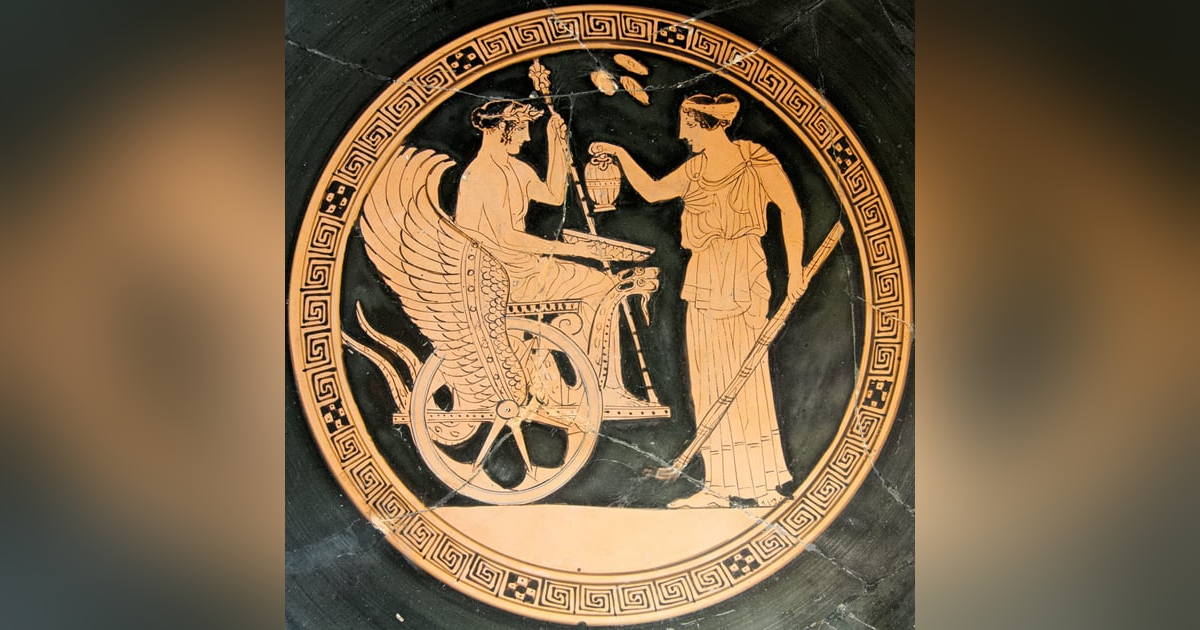
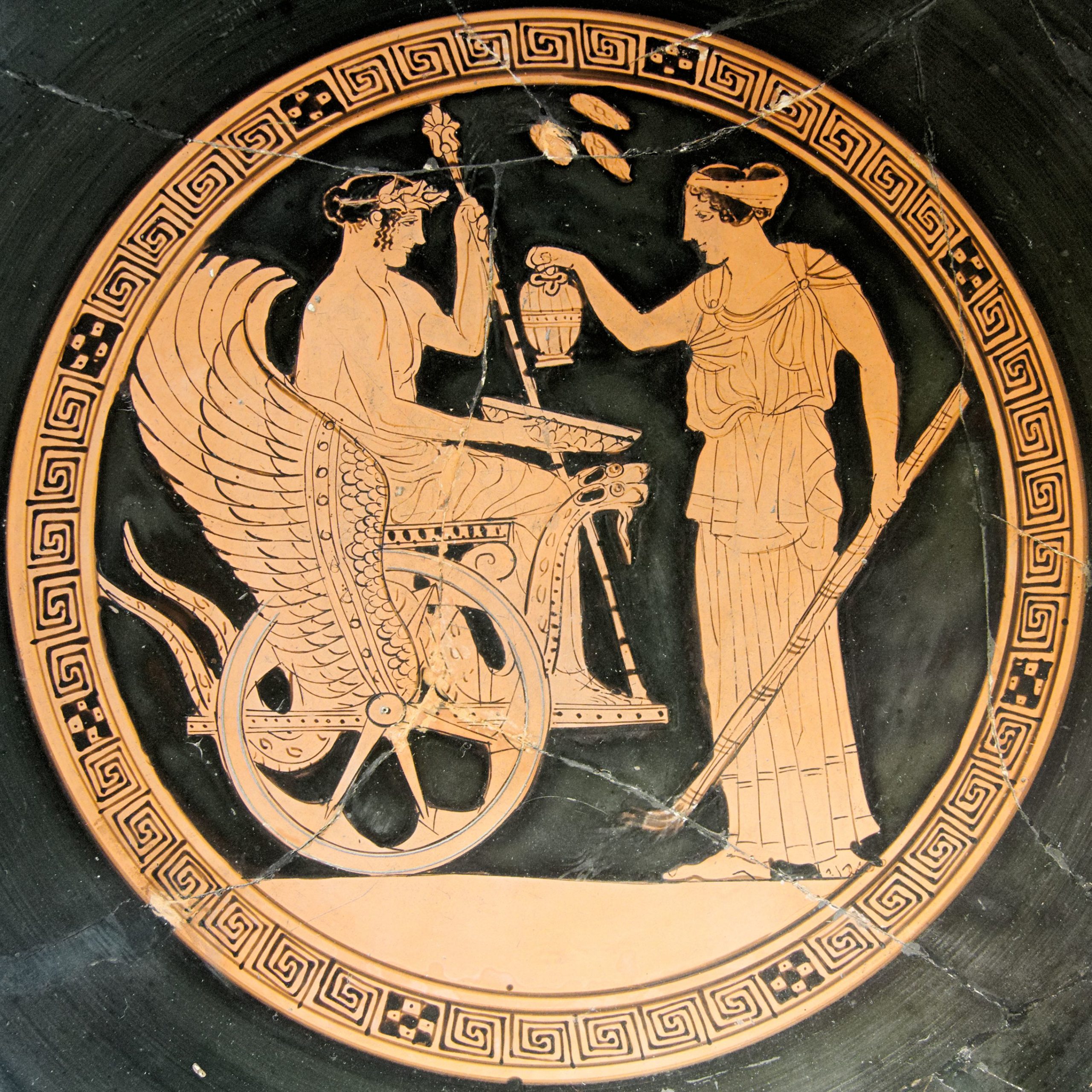


The mystery religions of Ancient Greece: Eleusis, Orphism and Christianity. From the Kykeon of Demeter to the Eucharist of Jesus.
RECOMMENDED READS - Click Image for Link:
Episode II.27 - Ancient Greek Religion
(Music)
-The Athenians, initiating people into the Eleusinian rites, display to those being admitted to the highest mysteries, the marvellous and most perfect secret for those initiated into the highest mystic truth: an ear of grain reaped in silence.-
The words of Hippolytus, a Greek-speaking Christian from the 3rd century AD.
(Music)
Hello and welcome to the Western Traditions podcast. My name is Rob Paxton and this is the 27th episode of the Greek Sun, my second series of podcasts about the history of Western Civilization.
During the Peloponnesian War, when the very survival of Athens was on the line, the Athenian people recalled one of their most popular generals, Alcibiades, from the fighting on the front lines in order to bring him home for a trial. The charge to be laid against him?
Blasphemy.
Alcibiades was suspected, among other things, of connection to religious vandalism in the defacing of numerous statues of the gods. But, by far, the heaviest charge to be presented in court was that he had mimicked and mocked the mystery rites of Eleusis, while drinking with friends in his private residence.
Imagine this. Alcibiades, the man that the Athenian army adored, was brought home from a foreign expedition, at a critical juncture, because he may have, in the privacy of his home, may have mocked the secret rites of the Eleusinian mystery religion that was so widely followed by the Athenian populace.
In this episode, we will try to learn more about the ancient and very secret mystery religions which had such a powerful grip on not just the Athenians but on many Greeks and, indeed, many people throughout the Mediterranean.
Before we begin, though, let me remind you to visit the website, western-traditions.org, to find maps, pictures, source lists, episode transcripts, and recommended books to read. You can also purchase Western Traditions merchandise on the shopping page and/or contribute directly to the support of the podcast through the PayPal and patreon options.
(Music)
Demeter was the Greek goddess of the harvest. This is kind of a loaded title, though. It is not as if she was some boring department manager reporting to Zeus about the quantity and quality of the earth’s production each year.
No, in any pre-modern culture, the goddess of the harvest was often one of the most ancient deities, and shrouded in a number of overlapping identities and powers.
Demeter was no different for the Greeks.
There is the textbook idea of her: that she was the child of the titans Cronus and Rhea, and sister to Zeus. She was responsible, in whatever way gods are responsible for their domains, she was responsible for agricultural matters.
But Demeter is much more than simply a divine bureaucrat overseeing grain production. Her cult, that is, the collection of rites and practices surrounding her worship, this cult goes far back, farther back than we can trace, really.
We do not have to look hard at her name to see some resemblance to the root word for mother. The -meter suffix to her name could, and this is all speculation about Proto-Indo-European, a language which no one had ever seen or heard, but linguists have tried to reconstruct, this —meter suffix could be a form of the proto-indo-european word for mother. You can see how most Indo-European names for mother contain the m, the t or a d, and the r, separated by varying vowels. Mater in latin. Mutter in German, madre in spanish, mother in English, and mitera in Greek. Is -meter simply an ancient root for mother? It is the most likely explanation.
As to what Demeter would be the mother of, this leads to a little more speculation. Is this harvest goddess for the classical greeks really just an updated version of some ancient earth mother? Some researchers have tried to connect the De- prefix in Demeter to some possible ancient word for earth, like De- was a version of something starting with Ge-, and harkening back to Gea, the earth mother.
This earth mother, however she was named, would have been worshipped even before man became agricultural. She would have been the one that the hunter-gatherers praised and thanked for abundant game and the rain that made the fruit grow big and fat on heavy-laden branches.
So, it’s possible that Demeter, relegated in later days to an assistant position in Zeus’ cabinet of gods, was, once upon a time, a much more exalted goddess, maybe not even in a pantheon of gods, maybe she was THE goddess for a time.
Maybe those ancient idols that we have found, some as old as 30 or 40,000 years, those morbidly obese figurines of abundantly fleshed-women, maybe those are idols dedicated to Demeter or her predecessor, someone that Paleolithic men praised when the game ran plentifully through the valleys and surrendered to their arrows, and maybe Demeter was the one whom the women adored when berries and fruits and nuts seemed everywhere to hang plentifully from branches and the roots came up easily from the soil.
And maybe she was the one with whom they all pleaded when things were not so pleasant, when the rain didn’t come, and the plants grew poorly and produced no fruit, when the game was nowhere to be seen, or too fast to be caught.
Certain titles that the Greeks used for Demeter suggest a more recent but still quite ancient connection to goddesses of preceding cultures. She is sometimes referred to as Despoina, or as Potnia. The same titles are applied to her daughter Persephone in different contexts. These are both terms that go back to Mycenaean period and are used to refer to certain goddesses, think of them as the ancient Mycenaean, Cretan or even Proto-Indo-European way of saying “Lady”, just as Catholics refer to Mary as Our Lady of Guadalupe or Our Lady of Fatima or Our Lady of Akita.
So there is a great deal of speculation about Demeter’s relation to goddesses of ancient Crete, of the Minoan culture, and to goddesses even more ancient than that. For more information about Minoan culture, check out the 21st episode of my first series, which you can find on my website at western-traditons.org
What is certain is that the worship of Demeter, especially as practiced at Eleusis and in Greece in general, the worship of Demeter was not simply a matter of checking off a box, of putting in some time at making sure that the goddess of the harvest was going to make the soil fruitful this year. This was not simply a perfunctory ritual performed to placate a potentially angry goddess.
This was, instead, a religious act of profound and personal meaning, a communion with the very essence of life, a contemplation, a rumination, really, about being itself, to borrow a phrase from philosophy that we will hear more about soon.
Demeter, like a woman wearing a heavy, colorful shawl, was wrapped up in a variety of meanings, and those wrappings both defined her and made her true essence even more mysterious. She was not the naked Aphrodite, whose erotic significance was all too apparent. Demeter is an obscured goddess, in some sense. She is shaded from the glaring eye, she rests in shadows, where she does her will.
In the myths about Demeter, she has more than one lover. Sometimes it is Poseidon who forces himself on her, in another myth she lays consensually with a mortal named Jason. She has offspring through these unions, but her most famous union is with her brother deity Zeus, with whom she conceived her daughter, Persephone.
Now, the tale of Persephone’s abduction and her mother’s desperate search is told in an ancient Greek text known as the Homeric Hymn to Demeter.
As the story goes, one day Persephone was out in the fields under the shining sun when another child of the titans, Hades, emerged from the subterranean world and captured her. He took her down to the underworld and lay with her there in a tale known in Greek mythology as the Rape of Persephone.
In response, Demeter essentially holds the world hostage, and the grain does not grow and the trees produce no fruit, until Zeus intervenes and negotiates a settlement: Persephone will enjoy part of the year above ground with her mother, and part of the year in the underworld with her husband Hades, the god of the dead.
Right away, here, we should see that this is more than simply a way to explain the seasons, but also a tale symbolic of death and resurrection, much like the Egyptian story of Osiris dying and being brought back to life by his grieving spouse Isis.
And just as that story did for the Egyptians, this tale of the death, as you might call it, and the resurrection of Persephone and the grieving of her mother, became meaningful in a personal way for the Greeks. This was not simply a national, public form of worship in which the gods were placated, praised or thanked. It was not simply a group petition for a good harvest. The worship of Demeter and her daughter became an introspective, contemplative, inward journey in the heart of each worshipper, of each participant in the rite.
But what was that rite? This, the nuts and bolts of the rituals surrounding the worship of Demeter and her rescued daughter, this is the most mysterious element of the story, actually. Only after many centuries of putting together random fragments of remarks made by ancient Greeks and Romans, along with the odd piece of archaeological remains, only after centuries of working with even less than the bare bones, really, only in recent years have we really been able to get some grasp of what was going on at Eleusis, and why the Athenians considered it all so sacred that even the idea that Alcibiades had mocked the rituals of that temple merited his dismissal from the army and, eventually, a sentence of death passed on him when he refused to appear for trial.
If you want to know something about a particular ritual, let’s say the Catholic mass, then your best option would probably be to go and attend a well-celebrated mass at some nearby cathedral. Lacking that option, you would be best-off looking at the roman missal, a bible-sized book that contains descriptions of all the rituals as well as all the scriptural readings and the responses of the faithful and so on.
But we cannot attend the Eleusinian mysteries. There are no practitioners of the rite left among us, no temples, no brotherhood of priests. And they printed no missal, left behind no written, lasting guide as to the order of their rites.
In contrast, we know, for example, that the catholic worshipper makes the sign of the cross when he enters the church, he genuflects before the altar, he kneels in prayer, he stands to say the Lord’s Prayer, he recites the Nicene creed after hearing the gospel, he chants lamb of God three times before receiving the eucharist.
But we don’t really know much about what the Greeks did at Eleusis. We know a little about what they believed, and a little about some of the instruments or the rituals performed there. Most of what we think we know is really just speculation, though.
There were lesser and greater mysteries, or ceremonies, to be performed at different times of the year. Participants would walk in procession to Eleusis, making a sort of pilgrimage with ritualized stopping points.
There does seem likely to have been three parts of the greater mystery rite, one of which would have been re-enactment of the story of the rape of Persephone and her retrieval from the underworld. There would have also been a display of certain items such as grain, the bowls or baskets used to carry that grain, perhaps the blade used to cut the ear of grain, and maybe other things as well.
Finally, the priests apparently made some sort of spoken commentary about the events.
We know, or believe we know, based on a single sentence written by a christian author several centuries later, which I quoted at the beginning this episode, that the high point of the entire ritual was the display of an ear of grain before the gathered congregation, and the cutting of that ear of grain in silence.
Some ceremonies involved a ritual bath, which has an obvious parallel in Christian baptism.
Other scholars speculate that some sort of holy fire was also involved at some point during the rite, as a symbol of purification, perhaps of leaving the old self behind.
Because that was likely the real purpose, not just of the Eleusinian mysteries but of all the mystery rites that we see around the ancient world, especially the Mediterranean basin, at this point in history. The purification of the self through a kind of death, the redemption of your erring ways, and a rebirth as a better individual, not better at athletics or at public speaking or at being a mother or father or a warrior or a sailor. A wiser, better person in purely spiritual terms, a person more at peace with divinity, with mortality, with existence.
At some point, and the timing of this is not really known at all, at some point the mystery rituals, not just the Eleusinian mysteries but all the mystery rites of the ancient world, all these rites became more than just ways to guarantee a pleasant existence in the underworld, where you would hopefully no longer expect to be punished for your shortcomings, the ritual instead became about resurrection, at the very least a spiritual resurrection and immortality, living in glory with the gods.
In at least one mystery rite, and this one we know very well, we know absolutely everything about its theology and the details of its worship rituals and so on, in that mystery religion the rites became a way to secure a physical resurrection and physical immortality as well, not just life as a shade in the underworld but a physical being, living for eternity in a glorified world.
And this mystery religion, which promised physical immortality for the believer, this mystery religion about which we know so much, is still practiced today by more than two billion people.
It’s called Christianity.
(Music)
Often, when people think of the religious transition in the ancient Greek world from “paganism” to Christianity, they imagine a disruption, a significant break, going from standing around smoking altars, sacrificing animals to Zeus and then suddenly turning to the clean, bloodless worship of Christ in cathedrals.
But this viewpoint oversimplifies ancient Greek religious practices, and it also oversimplifies the early Christian church. The more you study Greek religion from the classical era on to the birth of Christ, and the more that you learn about the actual practices of Christians in the early centuries of the church, the more you realize that Christianity, under another name, was essentially being practiced many centuries before the birth of Christ.
And practice is a key word here. You see, today, in the West, perhaps due more than anything to the Protestant reformation, we tend to conflate religion with belief. In other words, what you believe in your head, what you perhaps confess in your creed, these things are what determine your religion today.
But for the ancients, and for many people around the world still today, even many Christians, religion is more determined by what you do. By your practice, or praxis as the greeks would say. You are a Hindu because of what you do, not because off what you believe about Siva or Vishnu, but rather due to where you pray and how you pray and when you pray, and where you light candles or when you make offerings or what you eat or don’t eat.
You can see, studying history, that it was this way for Christians for a long time, too. You were a Catholic not simply because you believed that Jesus died on the Cross and rose again, but because you ate fish on Fridays, you prayed the rosary, you went to mass on Sunday, you confessed your sins, you walked in processions on high holy days, you put ashes on your forehead on Ash Wednesday, you fasted for lent, and so on.
This should go some way to explain why I think that the Greeks never really stopped practicing their religion, that Christianity, at least as practiced by the early christians and, really, maybe as still practiced by the eastern orthodox christians, is simply an extension of those same mystery religions that they were practicing two thousand years ago when Christ appeared.
After all, what drew early believers to the the new cult that came out of Jerusalem in the first century AD, which initially only called itself The Way? (and this is attested in the Christian scriptures, several times in the book of Acts, beginning with chapter 9, that the name of this new rite, this new religious practice that we now call Christianity, was simply known as The Way. Was this a reference to a way of living, to the daily practices of its adherents?)
Anyway, what drew people to the Way, this new mystery religion? Now, the Jewish believers in Christ obviously had political and religious motivations of their own. They believed that Jesus of Nazareth fulfilled prophecies for their nation. The Gentile believers, though, who were entirely Greeks, at least culturally Greek if not genetically, at this juncture, probably couldn’t have cared less about Jewish prophecies. They probably saw this as simply an appealing mystery religion that just happened to be Jewish.
After all, the Way promised the same things that the Greek mystery religions offered, and did it in the same way. Let’s take a moment and revisit what we know about the mystery rites at Eleusis and compare with Christianity:
At Eleusis, there was an important story behind the rites, about the child of a god suffering cruelty, descending into the underworld, and then returning to life, to a new life, to a transformed identity.
So check off this box for Christianity, too, right? Even today, at all traditional services of ancient Christianity, the Catholic Mass, the Orthodox Divine Liturgy, and in some Protestant traditions such as the Lutheran or Anglican, the story is retold in every single worship service, as part of a scripted rite: Jesus was born the son of God, he taught his doctrines during his earthly life, and after a cruel death on the Cross, he descended into hell, returned from death with a glorified body that could walk through walls, appear and disappear, and levitate, and then he ascended into Heaven. And then the gathered believers consume the body and blood of their lord.
The religious rite at Eleusis offered the individual believer, the one who attended the rite, the opportunity to achieve a similar transformation, to undergo what happened to this child of god, to die to oneself, and to reform and transform into someone else, a better version of oneself, anyway.
And the same went for Christianity. By following the commandments of the Way and partaking of this new mystery rite, about which St. Paul speaks in various epistles in the New Testament, Christians could achieve this self-transformation and then achieve immortality after their deaths. St. Paul, by the way, uses the word greek word mysterion, mystery, frequently throughout his epistles.
The mystery rites at Eleusis also displayed relics important to the story told by the priests. The culmination of this display was the display and cutting of an ear of grain as the congregation watched in silence.
And the Christians, in their rites, have the eucharist. In the Catholic mass, after all the readings have been done and the creeds and prayers recited, the priest holds up a piece of unleavened bread, made, of course, from grain. He elevates it before the congregation, which remains silent at that juncture, and, acting in persona Christi, as the latin saying goes, he declares openly:
This is my body.
Another example: In the story of the rape of Persephone, the grief of Demeter, her suffering, becomes part of her character, she becomes the personification of the long-suffering mother.
And in Christianity, we have the same image, Mary is the suffering mother, who watches her son be crucified. Catholics perform the stations of the cross, a yearly ritual carried out before Easter in which they remember the journey of Christ from his condemnation to his suffering and death on the cross and his placement in the tomb. At one of those stations he meets his grieving, sorrowful mother. And in their religious practices and prayers catholics also remember the seven sorrows of Mary.
The rituals at Eleusis, and in mystery rites practiced elsewhere, were also accompanied by what scholars call “commentary.”. This is just another word for sermon or homily. So the priests of the Eleusinian rites preached sermons.
And speaking of priests, the mystery religion of eleusis had a hierarchy, both among the priesthood and the laity. There was the high priest, or hierophant, and the high priestess, and then the lesser priests that served them. Among the lay people, there were the initiates, who were new to the rites, and then there were at least two levels of other believers, there were full members and there were those known as the elevated, who were initiated into the highest secrets of the faith. There was, furthermore, a group of “secluded women” associated with the temple. And there were varieties of jobs to do during the services, such as carrying the bowls or torches and other items used in the ceremonies.
And there is the exact same thing in the more traditional Christian sects, such as Catholicism and Orthodoxy. A hierarchy of clerics, and a hierarchy among lay people, too, including monks and nuns, who are actually lay people under vows and who could easily just be interpreted as the christian version of the “elevated” members of the Eleusinian religion and the nuns are obviously just the modern version of the secluded women. And among the regular lay people, there are jobs at the liturgies, serving at the altar, carrying various items in the procession of clerics in and out of each mass, someone has to carry the cross, someone else the holy books, there are readers, ushers, doorkeepers, and so on.
Even the names of the modern Christian rituals reflect this ancient Greek separation in the hierarchy of believers. The Catholic mass is actually divided into two main parts, two separate masses actually, though few lay people are aware of this today. The first half of the mass, in which the readings are recited, the homily or sermon is spoken and the creed recited, this is officially called the mass of the catechumens. In the early church, the “initiated”, those who had not been baptized, who were still learning and had not been introduced to the high mysteries of the of the religion, these people would be dismissed. The elect who remained would then participate in the mass of the faithful, the second half of the modern mass, during which time the body and blood of their god would be consumed.
And consider the implements of the rites. At Eleusis, the grain was carried about in a special, sacred basket or bowl known as a ciste (spell). In the catholic mass, the hosts, the wafers made from wheat, are carried in a sacred vessel called a ciborium (spell).
As mentioned before, the Eleusinians also apparently burned a holy fire as part of their ceremonies and, to this day, catholic priests burn a holy fire on the easter vigil, the dark of the Saturday night before Easter morning.
The worshippers at Eleusis drank a special brew, a concoction made from barley beer. Christians, traditional christians, anyway, drink wine at their ceremonies, wine which they believe is the blood of their god.
But, actually, there were other mystery religions at play in Greece during this same time period, the late 5th century BC, when Alcibiades was recalled from his role as general in the Peloponnesian War and ordered to come home for a trial of blasphemy.
At least one of these other mystery rites required the drinking of wine rather than beer. And while these worship services did not exclude Demeter and her daughter, the focus was rather on a different deity:
the god of wine, Dionysus.
(Music)
When we consider the other mystery rites prevalent in Greece, we begin to see even more similarities to Christianity. I want to consider now the Orphic rites, which originally stemmed from the story of Orpheus, who also descended into the underworld, after suffering a personal tragedy. You may remember that the love of his life was killed by snakes, and then Orpheus returned to the world above.
Born out of this particular myth was another mystery religion.
But first, I have thrown this term around already quite a bit, mystery religion. Why do we call them mystery religions?
In modern English, we use the term mystery to mean something unknown and simultaneously strange, perhaps incomprehensible. The meaning of the word has more nuance in greek. The mystery religions centered around knowledge that was hidden, yes, so in that way the unknown sense of the definition is there, but the mystery in these religions was something that was meant to be revealed to the initiated.
Those who were already in the religion, then, possessed a secret knowledge, a collection of mysteries, which they revealed to those whom they chose to initiate into these mysteries. That is why it is called mystical knowledge, because you must spiritually ascend or transform in order to comprehend it.
So mystery religions required initiation. Just so, many Christian traditions, especially the older branches of Christianity, Catholicism and Orthodoxy, these sects utilize long initiation processes. In Catholicism, it is known as the catechumenate, the year-long or more process in which a candidate is slowly brought into the church, learning its doctrines, and usually completing the journey in a special ceremony at Easter.
One could also only learn the mysteries of Eleusis by being initiated, through a long process, into the group of believers, the elevated ones. And this goes some way to explain why those who belonged to such a cult would be angry with someone who revealed the information publicly, such as Aeschylus was accused of doing, and this helps explain why Alcibiades was publicly charged, because not only had he allegedly discussed the rites openly but also mocked them.
And this explains the suspicion toward early christians in Rome, who performed a secret ceremony about which they could explain nothing to the public. This was at a time when many mystery religions were breaking out in roman society and replacing more formal, ancient worship of the Roman gods of the state religion.
Now the threats made against Aeschhylus and Alcibiades, during the 5th century BC, involved the mystery rites of Eleusis, but there were other mystery religions around Greece during this time period.
As I mentioned, one of the more popular sects in classical era Greece was the Orphic mysteries.
But, contrary to the name of the rites, the Orphic mysteries appear to have focused most of their rituals around the story of the god of wine, Dionysus.
(Mandela effect)
For a long time, scholars of ancient Greek history viewed Dionysus as a later addition to the Greek pantheon. For instance, as a child in school, I was taught that Dionysus had joined the 12 Olympians later, and that you had to remove one of the other gods to make room for him, Hades or Hestia perhaps. The standard, scholarly explanation of this addition was that Dionysus was a deity from Thrace or some area adjacent to mainland Greece and was only reluctantly incorporated into the pantheon in a later age of greek history.
In more recent times, researchers have come to see that Dionysus was probably always a part of the Greek religious spectrum, having some sort of divine status even among the early Mycenaeans and therefore being quite ancient and actually integral to the Greek pantheon of gods.
But the story of Dionysus is difficult to tell because it has so many versions. The textbook version told to schoolchildren is simply that he was the god of wine and a son of Zeus. But there are a variety of stories about Dionysus which reveal that he was, for the Greeks, much more than simply a god of wine and merriment.
In one widely told tale, Dionysus was a son of Zeus who was killed by titans. In the tale, these titans actually tear Dionysius into pieces and eat him. Recall, for a moment, the Egyptian story of Osiris also being cut into pieces before being put back together and resurrected. In response to the death of his son, Dionysus, Zeus throws one of his famous thunderbolts and turns the titans to ashes.
Later, Dionysus is brought back to life, and an important symbology is born here. Dionysus’ material body, here, is perceived theologically, by ancient greeks, to have come from the titans, the earlier gods, who are depicted as evil. And therefore the physical body of all people is deemed somehow tainted by evil. But the spiritual, resurrected form of Dionysus, then, comes from Zeus, and so the human soul is perceived in a more positive light, a contrast to the earthly body. This will be a more significant philosophical and theological point in our discussion of Christian gnosticism during the third series on the Roman Empire.
But other myths associated with the mystery religions instead describe Dionysus as a close family member with Demeter and Persephone, either as a husband or son to one of these female deities. Sometimes, in the telling, he is known by the name Iacchus, (spell), which, perhaps, goes some way to explaining why the Romans called him by the similarly spelled name, Bacchus. Either way, Dionysus is wrapped into a sort of trinity with these two goddesses, Demeter and Persephone.
And in these tales, Dionysus, or Iacchus, is a suffering soul, one who dies and is brought back to life, by one means or another. And his earthly followers, the participants in the Orphic rites, commemorated his suffering and death in religious rituals, and in these rites, the initiated drank special wine, which is described as his blood, Dionysus’s blood, in order to achieve communion with their god.
Sound familiar?
(Music)
Now, I know that this episode is supposed to be about Ancient Greek religion, and the rites of Eleusis. You might find the interlacing of early Christianity to be incongruous with this proposition, but I hope that what I have described so far and what I continue to describe helps you to see that there never really was any kind of break in Greek religion, that many westerners today are essentially still practicing an ancient Greek religion. The name of the god is different, and he has a Jewish heritage, but the promises and the practices of the religions are essentially the same.
And, I would also hope you understand now that ancient Greek religion was not simply a series of animal sacrifices, the heroes of the Iliad standing on a beach beside smoking hecatombs dedicated to Zeus or Poseidon and so on.
Let there be no doubt, of course, that such practices, animal sacrifices, and even the occasional human sacrifice, were a significant part of the religious expression of the ancient Greeks, even in the classical era, as public worship of the Olympians. But many Greeks also adhered to other forms of spiritual expression, and mystery religion appears to have been more fundamental, more meaningful to them, than we have been able to completely understand even though thousands of years have passed since they were practiced.
And as for the Jewishness of the final winner in the competition of mystery religions that was occurring in the Mediterranean two thousand years ago, even the Jewishness of Jesus is not as alien to Greek culture as you might initially think. In later episodes of this podcast series, you will hear how the Greeks, under Alexander the Great, actually conquered Palestine, and came into direct contact with Judaism in the 4th century BC, and how those Jews, when they rebelled against their Greek masters two centuries later, how those Jews reached out to the Spartans, of all people, for aid and assistance in their revolutionary struggle. The Jews who wrote the letter appealing for aid, a copy of which is found in the book of Maccabees in the Bible, these Jews claimed ancient brotherhood with the Spartans.
And, really, we already know of numerous other connections between the mythologies of all the religions of the Mediterranean basin, Greek, Egyptian, Phoenician, Hebrew. The story of the flood, for instance, was everywhere, for example, among all cultures. Or consider the offering of bread and wine in a religious ceremony, as described in Genesis chapter 14, which is probably one of the oldest sections of the Bible, that is, a portion of the text originating father back in the past than most of the rest of the Bible. Clearly, these ideas, these practices, these ceremonies, were widespread throughout the Mediterranean.
And consider this similarity in story from both the Greek and Hebrew mythos:
Recall that Demeter brought Persephone, her daughter, back from imprisonment in the underworld. But Persephone was not allowed to entirely forsake that underworld. She could only spend part of each year in the world of daylight, according to the story, because, while she was Hades’ captive, she ate some of a pomegranate, a fruit from that underworld. Eating any food of the underworld had been forbidden to her, but she had not been able to resist and consumed some of that fruit before departing Hades with her mother. So, ultimately, she was cursed by this act and not allowed to entirely escape but had to return for a portion of each year to reside with Hades.
It is not that difficult to compare this story, of eating forbidden fruit and being punished for it, to the Eden story in the 3rd chapter of the book of Genesis. In that story, not only are Adam and Eve removed from paradise for eating the forbidden fruit but they are cursed to work the earth and to suffer those very climatic changes which occur in the wake of Persephone’s sojourn in Hell.
You will come to see, I hope, that people have often, unfortunately, in studying the past, they have divided our ancestors into neat, clean classes, into groups of completely distinct people with no communication with one another and no cultural sharing, placed them in separate boxes, essentially, to make them easier to understand perhaps, The Greeks here in this box, the Romans here, the Jews over there, and over there the Egyptians, and so on. But, in reality, the past is all part of this same tapestry in which we live now, and the threads are all intertwined.
And this ancient Greek religion that I’ve been telling you about, it is still all around us. Inside every church that you pass anywhere in the west, the mystery rites, in some form, are still being practiced.
(Music)
The rites at Eleusis and elsewhere involved the ingestion of substances. Food and drink. We have seen already how grain and barley beer were key elements of worship at Eleusis. The Orphic rites concentrated more on the drinking of wine.
But the term used to describe the beverage generally remains the same throughout references to these celebrations. The drink is usually called Kykeon. Some people pronounce it Kukeon but I will use Kykeon for the purposes of this podcast.
Anyway, the kykeon was often mixed with other substances. It may very well, in fact, have been what Alcibiades and his friends were drinking when they allegedly mocked the rites of Eleusis.
The term kykeon is actually used in the lines of the Iliad and the Odyssey. Recall passages from the Iliad in which the greek heroes prepare drinks and sprinkle barley and cheese into them. These are kykeons.
In the Odyssey, kykeon is the word used to describe the potion that the witch Circe prepares in order to turn Odysseus’ sailors into swine. Into the mixture of barley, wine, water, herbs and such, she also mixes “evil drugs”, according to Homer.
Pharmaka is the greek word used here for these drugs that Circe mixes into the kykeon. From this word we derive pharmacy in English.
But the basic ingredients of the kykeon, anyway, seem to have been barley and water, to which you could add cheese, herbs, wine, herbs, and other substances, such as those pharmaka that Circe added to her potion.
On this matter of pharmaka, we have learned a lot more about in recent years, with regard to how ancient people used drugs.
Now, I know that drug-use may sound like a modern phenomenon, but this couldn’t be farther from the truth.
In the west, we have long tended to separate alcohol from “drugs”, probably to ease our minds when we crack open a beer with friends, but really almost everyone is using drugs of some kind, especially the prescription kind. But even if you just drink coffee or tea, you are ingesting a substance to alter your physiology somehow, to affect your mind or to give you energy, wakefulness or to dull your senses or heighten some experience.
When Europeans discovered coffee and tea and tobacco in the last four or five centuries, use of these substances swept the West no differently than cocaine did after it was discovered and developed. But coffee and tea and tobacco were bought, transported, marketed and sold by major corporations, such as the East India Company, so they were not declared illegal.
That digression aside, consider how long we have been using some of these drugs. Beer itself was invented some 10,000 years ago, possibly before that. And wherever scientists find remains of early agriculture, they always find evidence of beer brewing as well. In fact, there is a very plausible theory that we invented agriculture in order to brew beer, not to make bread, that bread was more bug than feature in this critical cultural development of the stone age.
Anyway, it is also known now that the ancients were very aware of other mind-altering substances, as well. Studies of still-existing hunter-gatherer groups show us that even pre-agricultural humans will look for and/or manufacture mind-altering substances to either alleviate their boredom or to heighten their natural experiences. And in the middle ages such substances were certainly known already, and there is no sign that they were newly discovered then. No, they had clearly been around for some time in the ancient world.
One such mind-altering substance, getting back to the subject now, is the fungal parasite ergot, which can grow on grains and cereals, such as barley, wheat or rye. If you are an American, you may be aware of the theory that the Salem witch trials of 1692 may have been inadvertently caused by this very fungus growing on their cereal crops and which, when consumed by humans, can lead to visions and experiences not unlike those caused by LSD, a modern, synthetic hallucinogenic.
It has been speculated, as well then, that the growth of ergot, or possibly some other substance, may have been purposefully provoked and infused into the barley beer that was used at Eleusis, into the kykeon, in order to provoke visions or some other type of ecstatic experience. Perhaps this was the pharmaka that Circe put into her potion, causing the sailors of Odysseus’ crew to believe that they were pigs.
Among the other possible substances used in these potions, in these kykeons, we must also consider mushrooms, which appear significantly associated with religious and or magic rituals in ancient greek art, and also appear in both early and medieval Christian paintings, actually. I will include examples of this art on my website, western-traditions, org. (Repeat) Some mushrooms contain the substances psilocybin, which induces hallucinations in humans.
This possibility should not surprise us all that much. After all, we already know now that at Delphi, where it was believed that the gods spoke directly to petitioners through the mouth of the priestess, even if it was in the form of riddles and enigmas, we know that the visions of the priestesses at Delphi were likely inspired by one or more of a variety of substance-related causes, such as the inhalation, purposeful or not, of hydrocarbon fumes emitted from a chasm below the site.
Other scholars speculate that the bible actually contains multiple references to such events, that the burning bush, for example, actually provoked Moses’ visions in the book of Exodus. A number of plants in the Middle East contain substances similar to DMT, a recognized hallucinogen, and when they burn you could easily inhale enough of the substance to alter your perceptions, to see God, so to speak.
In the New Testament, in St. Paul’s epistles, he often instructs and admonishes his followers about their eucharistic ceremonies in which they remember the death of Jesus and consume his body and blood. In his epistle to the Galatians, chapter 5 verse 20, he warns his flock to avoid pharmaka, drugs. If this sounds surprising to you, it is because the greek word here in the text is usually translated into English as witchcraft.
And this is not necessarily bad translation. Pharmaka and witchcraft were closely associated in the ancient world. Witches used substances to alter the perceptions of their clientele.
But it is also possible that the instructions of St. Paul here have a lot to do with toning down certain aspects of this new mystery religion, aspects which may have been more common in other rites. Speculation abounds as to exactly what sorts of things that Paul was objecting to. It may have been, though, that he was telling Christians to stop using pharmaka, in their eucharist.
The takeaway, from all these digressions about mysticism and drug use, should be that ancient Greek religion was not a cut-and-dry matter, just one hecatomb of animal sacrifice after another. The Greek countryside was alive with temples and shrines and sacred groves. Every river was a canyon of spirits. There were wandering prophets channeling Teiresias and there were witches, brewing kykeons with their pharmaka and no doubt each of them styling themselves as another Calypso. The Olympians were worshipped formally and publicly, bulls were sacrificed, but there were also a wide variety of spiritual practices among the ancient Greeks. And among them were the mystery religions, and their secret ceremonies and their holy meals.
Now, to continue the theme that I have already established, it seems like this drink, this kykeon, in whatever formulation, probably continued to be used in the rites of the mystery religion known as the Way, the original name for Christianity, which began to gain popularity in Greece in the 1st century AD.
We have already made the strong connection between the forms of the pagan mystery rites and the christian celebrations of their eucharist. And how they both involved the display and sharing of grain or bread along with storytelling and preaching and the drinking of a beverage.
By the time that Christ appeared, the Greeks were primarily drinking wine in these rites, and the focus of their worship had moved more toward Dionysus.
So the story being told at these rites was more frequently that of Dionysus, of his death and his resurrection, which was reflected every year in the way that the vegetation died in the winter and was reborn every spring and tied Dionysus strongly then to the changing of the seasons and the fertility of the soil, somewhat supplanting Demeter and Persephone in these roles.
In particular, grape vines, when fall and winter come round, the vines that we use to grow wine grapes, these vines die back considerably, at the end of every year, all the way to their roots, and then they are gloriously reborn in the spring, bursting dramatically into vibrant life.
Dionysus was god of wine, and therefore the god of these vines. And his followers drank a kykeon, made from wine and other substances, which was said to be his blood.
Now there was another deity in the Mediterranean who made similar claims, who said, in the gospel according to John, written in excellent greek, by the way, who said that he was the true vine, and who bade his followers to drink wine which he said was his blood. Jesus of Nazareth, in fact, said that his followers must eat his flesh and drink his blood in order to achieve immortality with him.
Its not hard to see how the Greeks could have easily embraced Christianity as just one more option among the various mystery rites available to them. And thus, when looked at this way, Greek religion continues to be practiced today. Modern-day Christians, receiving communion and professing to eat the flesh and drink the blood of their savior, are in many ways continuing a tradition much more ancient than they think, not simply two thousand years old but much, much older.
Because the Greeks did not begin any of this. They inherited these ideas from prior indigenous cultures, and probably from the Egyptians.
When I think now of the communion hosts being distributed at Christian rites, I invariably think not only of Jesus at the passover with his disciples or of his sacrifice at the cross. I also think of the pieces of Dionysus’ body which the titans consumed, and I think of Egyptian mythology, and the pieces of Osiris’ body falling into the river, one morsel of which the crocodile Sobek consumed and then became a god himself.
(Music)
In this episode, I have made frequent references to the Catholic mass and drawn comparisons to ancient Greek mystery religions. I have done this because I am most familiar with the Catholic liturgy out of all the Christian rites. And it is also the Christian religion that is most representative of western history, followed by more westerners than any other sect.
I think, based on what little I know about it, I think, though, if one were able to attend a Greek Orthodox divine liturgy, as they call their religious service, or any Eastern Orthodox liturgy, you might see even more evidence of a smooth transition from ancient pagan religious practices to christian. The orthodox liturgies are the oldest christian rites in existence, and their medley of incense, bells, the offering of the bread and wine which are presented as the body and blood of the Lord Jesus, their singing, their routine commemoration of the life, suffering, death, and resurrection of their god, all done in the language of the Iliad and the Odyssey, all this might just convince you, if I have not done so already.
Hopefully, though, I have made clear that there really never was a violent break between religious traditions, from paganism to Christianity, at least not in the Greek world, where Christianity got its start. Rather, the Christians were one of several groups that practiced mystery rites in the Greek religious sphere, and their religion happened to be the one that endured, survived, overcame and eventually dominated Western thought and spirituality for thousands of years.
Even in Rome, for at least the first couple centuries after the birth of christ, the religious language of the local Roman christians was Greek, not latin, because this Christianity was a greek religion, a greek mystery religion.
I firmly believe that what eventually happened, that is, Christianity eclipsing the other mystery religions and becoming the sole mystery religion, all this was going to happen, no matter what, in one way or another. One of these religions would have overtaken the rest and come to eliminate the others.
If the West were not Christian today, then it would be Dionysian, or Orphic or Eleusinian or Persephonian, or what have you.
And, therefore, this episode underlines a point that I have made since the very beginning of this Western traditions project. That our history is not as foreign to us as many would have you believe.
We know, for example, from genetic science, that our ancient ancestors are actually still physically alive. They exist in the strands of DNA that they have passed down to us. Somewhere among us today, most likely, Socrates and Pericles and Leonidas live on in the form of haplogroups, chunks of genes that keep successfully reproducing. If not those individuals, then, others still live on. There’s a genetic study somewhere that declares that some really large portion of western men today are descendants of Charlemagne. So that great king is still with us now, in a sense, we are in the same river in which his blood still flows.
And I would hope that this history of our Western Traditions teaches you that even the practices, the habits, the beliefs and the very words that our ancestors spoke are still among us today, still flowing through our words and our thoughts and our actions. We are still thinking about the Roman Empire every day, according to the latest social media meme. We are all today still in the same tapestry with those ancient ancestors, just a little farther down the strand, at the edge, where the fibers are still tangling themselves together into a new design.
So, until the next episode, until the next intertwining of the threads of history, until then, I thank you for listening to the Western Traditions podcast.
(Music)