Episode II.20 - The Peloponnesian War I - To the Death of Pericles.
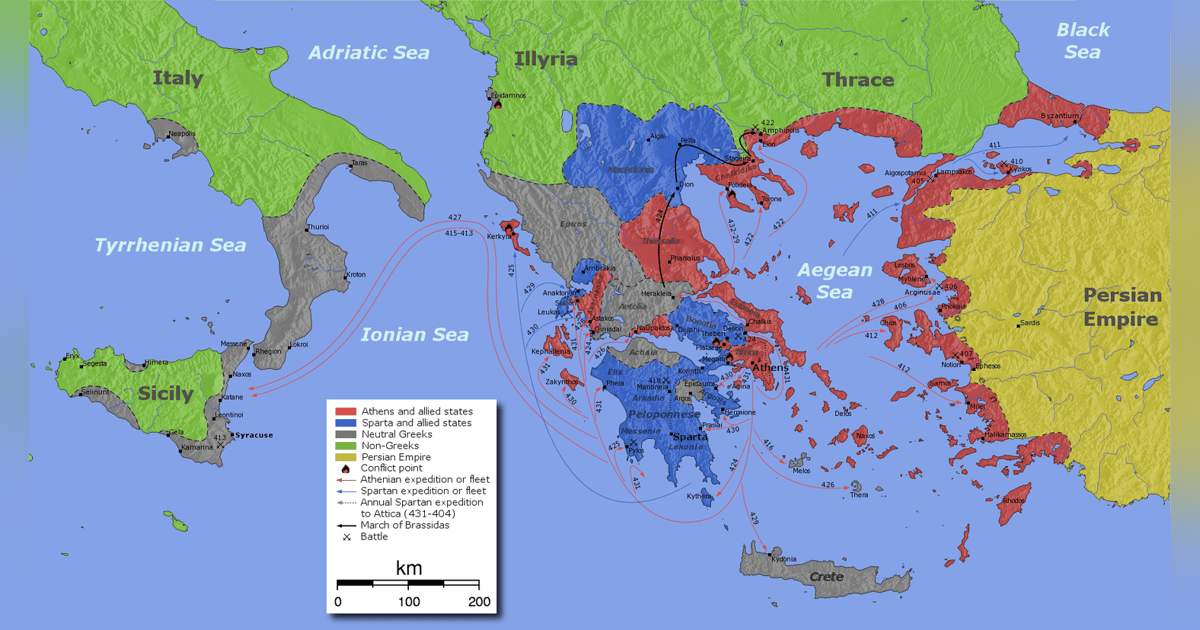
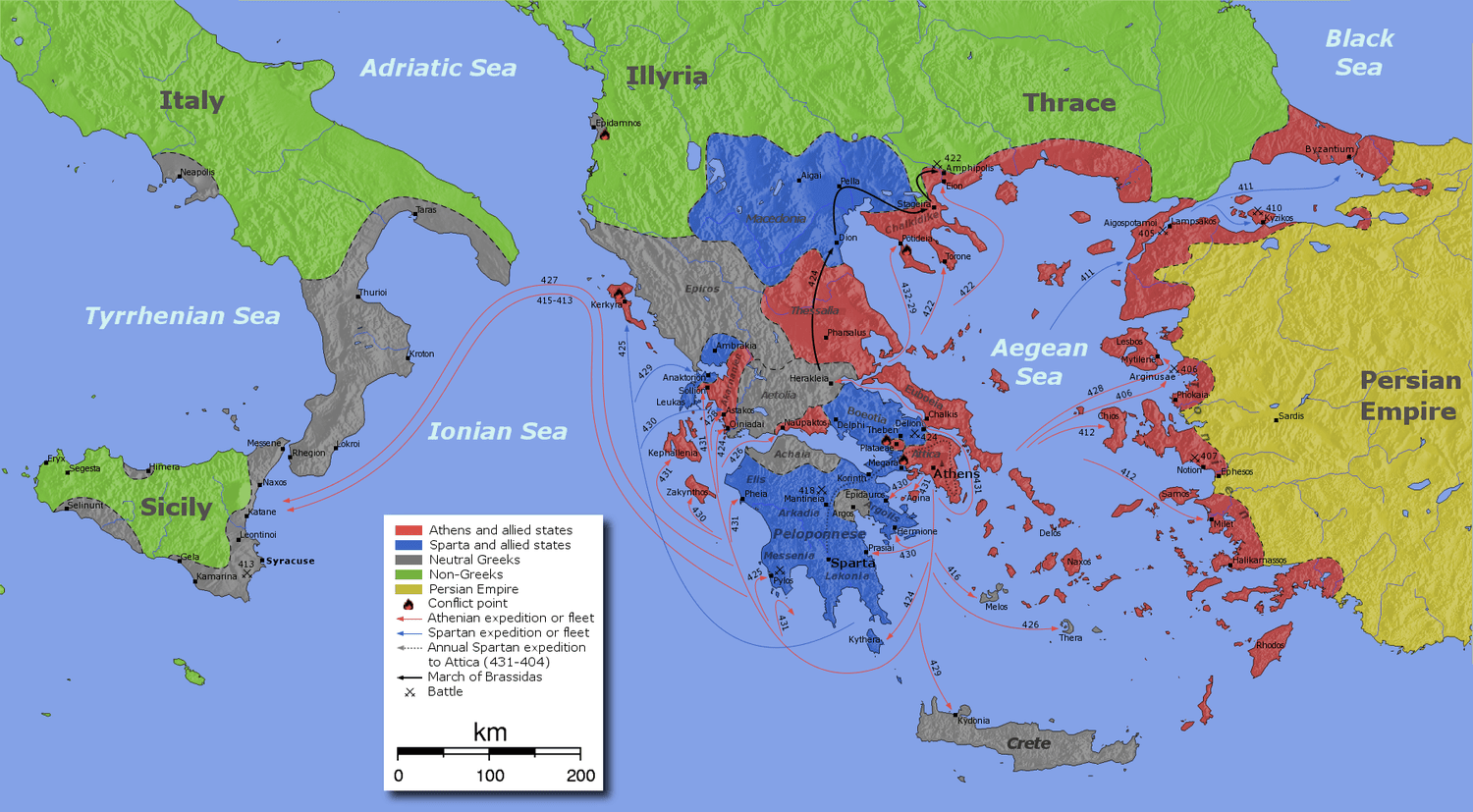


It begins at Epidamnus but only after conflicts at Potidaea and Plataea are all the cities of Greece brought into general warfare. The Plague of Athens. Pericles’ Funeral Oration. The death of Pericles.
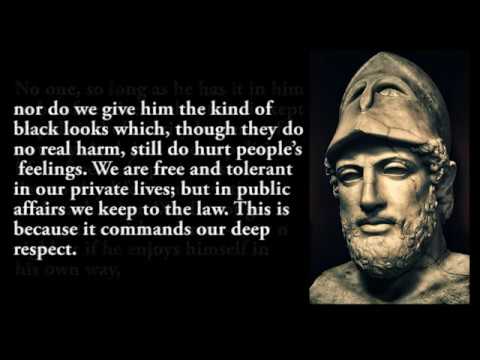
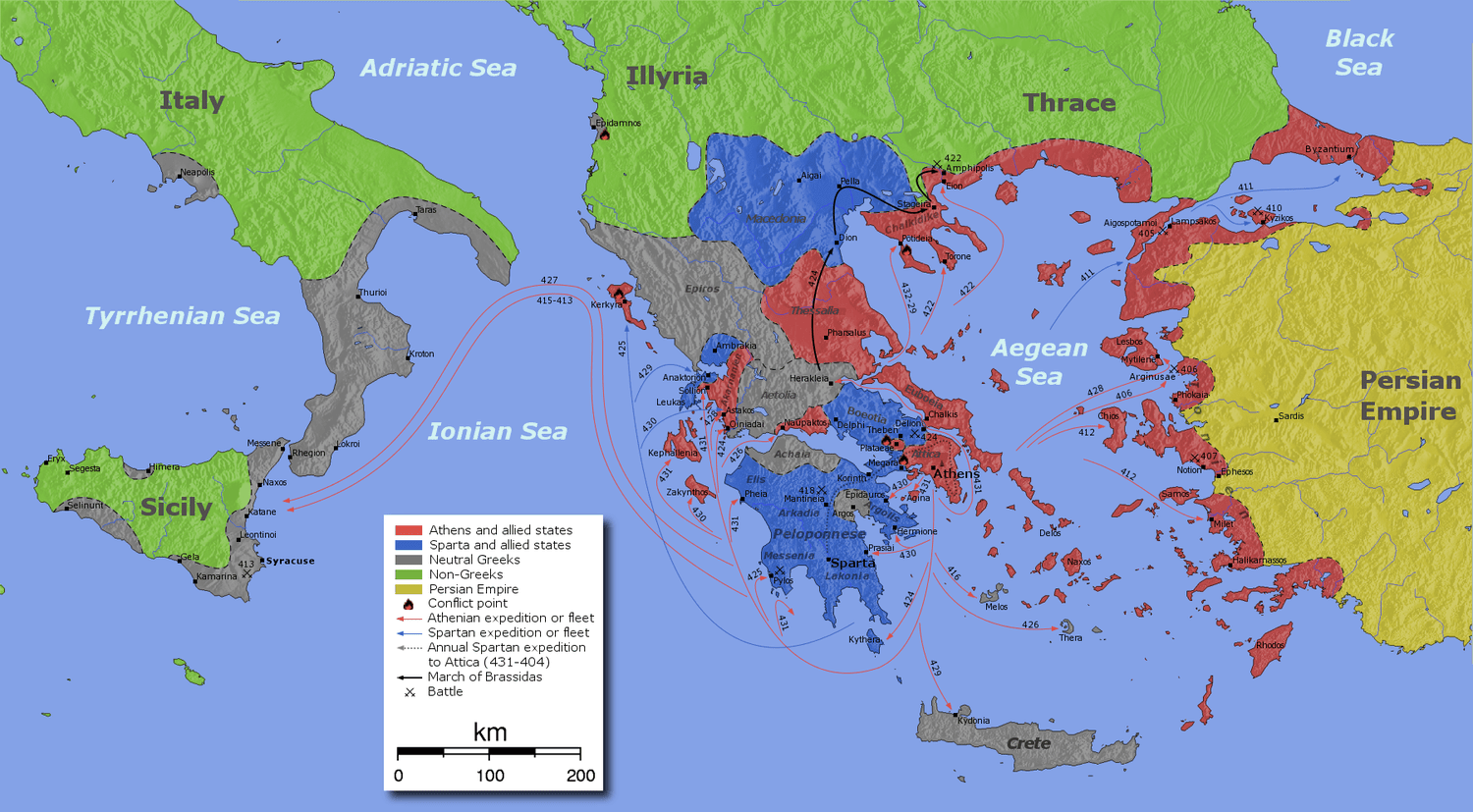
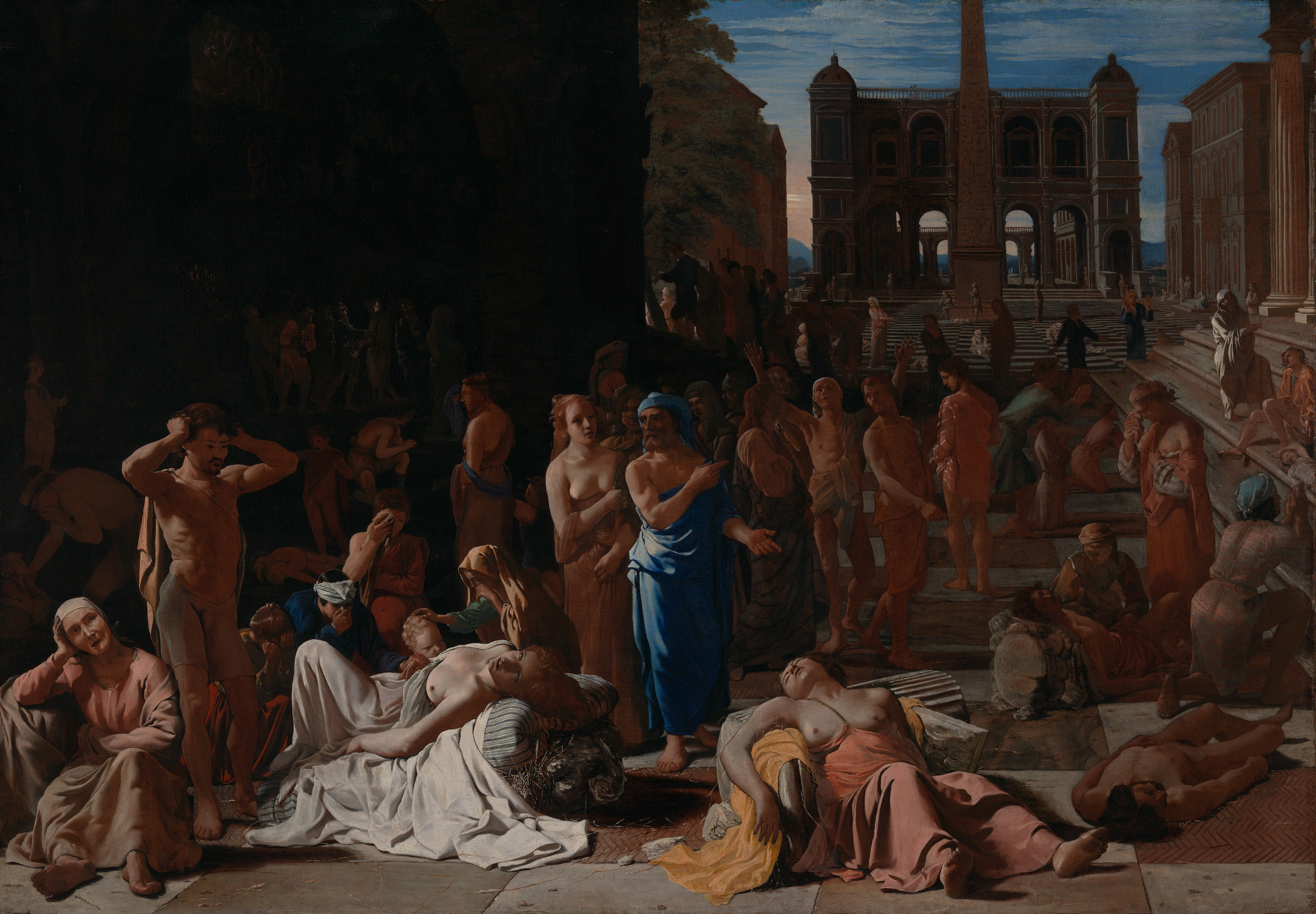
RECOMMENDED READS - Click Image for Link:
Episode II.20 - The Peloponnesian War I - To the Death of Pericles
“Thucydides, an Athenian, wrote the history of the war between the Peloponnesians and the
Athenians, beginning at the moment that it broke out, believing that it would be a great war and
more worthy of relation that any that had preceded it.”
-The opening sentence of the History of the Peloponnesian War, written by Thucydides in the
5th century BC.
Hello and welcome to the Western Traditions Podcast. My name is Rob Paxton and this is the
20th episode of the Greek Sun, the second of nine series of podcasts about Western
Civilization.
Today we will begin looking into the Peloponnesian War, which broke out between the formerly
allied states of Athens and Sparta in 431 BC. I will rely most heavily on Thucydides for my
content. I prefer to speak from primary sources in my work, and Thucydides was an actual
participant in the war as well as its historian until he died a few years before its conclusion. He
was an Athenian general and statesmen, and knew figures such as Pericles personally.
Before I begin, let me remind you to head over to the website at western-traditions.org, if
you’re not already listening to my podcasts there. Check out the maps and pictures, buy a
recommended book or some Western Traditions merchandise, or support the podcast directly
through the PayPal and Patreon options.
And now, let’s return to Classical Greece, as it unravels into a civil war that threatens not just to
undermine the stability of the newborn West, but also endangers its very survival.
This is not the first time that I have referred to Thucydides.
Though he is known for his book on the Peloponnesian War, Thucydides wrote many other
books and I have also cited his work in previous episodes.
The author of this history of the war does not limit himself to the bare facts of the conflict. The
first book of his eight-book, magnum opus about the war begins with some chapters about the
prelude to the war, which encompasses more than just the immediate preparations of the war .
Thucydides actually begins his history with a brief summary of the Trojan War, from some
seven or eight centuries before, and the period from then until his own present day in the 5th
century.
Also, in this first book, Thucydides describes the evolution of the relationship between Athens
and the rest of the Greek city-states after the end of the Persian War at the battle of Mycale.
How Sparta and the Peloponnesians returned home to live in peace, or as peacefully as the
warlike Greeks ever lived, anyway, while the Athenians formed a confederacy of States that still
lived in the shadow of the Persian Empire, which was by no means diminished by their recent
losses.
No, the Persian empire remained the greatest power in the world, financially, militarily,
culturally, etc. The Athenians were proud of their victory but they did not let this victory go to
their heads. They not only saw the need to maintain a vigilant stance against the Great King in
the East, but they also desired to revenge themselves upon the Persians, and to drive them
back at every chance.
Even as early as this, some Greeks were ambitious enough to think about the conquest of
Persia, or at least portions of it. But that is a matter for a later podcast.In the fourth chapter of his first book, Thucydides describes how the confederacy of the Delian
League initially assented to the leadership of Athens, and how this initial assent soon turned
into acceptance of the supremacy of Athens at the head of its own Empire. This process I also
covered in an earlier episode.
Now, the war that Thucydides, and most historians, calls the Peloponnesian War is called that
by consensus, but really there had already been conflict between the states allied with Athens
and those allied with Sparta in the decades prior to this conflict. In fact, some call the war that I
am describing in this episode the Second Peloponnesian War.
The point, as Thucydides himself says, is that the war brewed for a long time, until it broke out
into a conflict that would last 27 years, a war that Thucydides himself would not outlast as he
would die before its end.
Also in this first book, Thucydides actually describes the particular events that finally led to the
war breaking out. I won’t rehash those events in detail here. As you should have already
learned by now, the Greek fascination with conflicts that we might consider ugly and petty
squabbles, this fascination knows no end. The average greek reader appears to have been
hungry for the tawdry details of every minor quarrel between cities, like some small-town group
of friends sitting on a porch and sharing squalid gossip about a fellow villager, delving
heedlessly into every particular of the latest event.
I’ll sum it all up by saying that basically a dust-up between the city of Corinth and one of her
colonies ended up with the Athenians getting called in for assistance on the side of Corinth’s
opponents. And Corinth was in league with the Spartans, so this basically meant that the two
leagues were coming into military confrontation directly. If you’re curious about the nitty-gritty
details of this conflict, read the first of Thucydides eight books or just look up the Affair of
Epidamnus online.
Now, one thing that is interesting about the war’s beginning is the fact that Epidamnus, where
the war was initially provoked, is a region in the far northwest of Greece proper, on the Adriatic
seacoast, and it was a city that hitherto had not been a part of any alliance. It had remained
neutral.
Now, the agreements between the two leagues, the Peloponnesian League, led by Sparta, and
the Delian League, led by Athens, these agreements had always allowed for previously neutral
cities to join whichever alliance they preferred.
But when Epidamnus asked the Athenians for permission to join their alliance at a time when
the far-flung colony was at war with Corinth, a member of the Peloponnesian League, this
momentous request was the first step on a road that eventually brought nearly all the cities of
Greece into conflict with one another.
Apparently, it was about this time that Thucydides began to write down his accounting of the
war.
We know very little about this writer, except that he was of a wealthy Athenian family that
probably owned significant property in Thrace. We suspect this because we know that he was
exiled after a military failure in the war and retired to an estate in Thrace to devote himself to
history.
It is curious that we know so little about the man because his book, though it can easily be
overlooked among the many annals of history, his book is truly a first in historical writing. Yes,he was preceded by Herodotus, in a sense, who wrote about the Persian War, but Thucydides
does not write about a past event, like Herodotus did, but rather about an ongoing event,
which he himself not only witnessed but in which he played a not insignificant role. Thucydides
would actually briefly command some of Athens forces.
Reading the History of the Peloponnesian War, then, is something like reading a book about
world war two written by a general who fought in the war.
Thucydides also writes as a realist. There are no spirits or ghosts or dreams or visions of Gods
moving the men in his history, as there are in Herodotus, though there ares some references to
prophecy. Often, he will speak of how some people recited oracles or visions that some seer
had told them about. Even with this, though, Thucydides comes off as very modern,
suggesting that people just interpreted the prophecies in ways that suited their purposes. He
does not appear to believe in any supernatural forces guiding or shaping world events.
He therefore focuses on real motives, about causes and forces that we can understand today,
such as the way that political ambition or personal financial gain moved people to make the
decisions that they ultimately made.
Like Herodotus, though, Thucydides does reproduce very long speeches. I will bring up a
couple of those more famous speeches in the next segment.
But for now, though, let’s raise the curtain on Greece in 431 BC, at the start of the
Peloponnesian War.
As the war began, Pericles was still at the head of the city and of the Delian League, the so-
called Athenian Empire.
He was the last of the old-timers now. He had, as a young man, been contemporary with some
of the great names of classical Greek history. Born in 495 BC, Pericles was old enough to
actually remember the Persian War, though he had been too young to play a role in it.
His father, Xanthippus, had been commander of the Athenian forces at the final battle at
Mycale. And Pericles would have at least remembered stories about heroes like Miltiades in his
youth. And he would have been among the Athenians who heard the news of the Spartan
stand at Thermopylae, of Leonidas’ death. He would have experienced the ruin of Athens as a
teenager, and known the pangs of exile and loss, as well as the triumph of return and victory.
Reading or hearing the history of Herodotus would have been a trip down memory lane, for
Pericles.
And he had come into politics less than a decade after the war, in the tradition of Themistocles.
Indeed, he would have personally known Themistocles. And he had been both a colleague and
a rival of men like Aristides and Cimon.
All those men, though, were now long dead. Only Pericles remained. He, along with those men
and others, had marshaled the meager resources of a broken city and turned it into the capital
of the West. The bastion against which the forces of the East had foundered and broke.
He had tried hard to hold the peace among the Greeks. In 445 BC, after years of minor
conflicts between the formerly allied Greek city-states, the Athenians and the Spartans had
brought all parties into agreement in a pact known as the 30-years peace. It was named thus
because it was intended to last 30 years before being reevaluated by both parties.This peace treaty had not been an easy one for Athens, either. They had had to give up port
cities on the isthmus of Corinth and in the Peloponnesus to seal the deal.
But the treaty had seemed foolproof for good reasons. One, because it allowed for either the
Spartans or the Athenians to demand arbitration in any rising conflict, and thus neutralize the
possibility of escalation to an armed struggle. The pact also recognized the formal existence of
the two leagues, the Delian League, which had essentially become an Athenian empire, and the
Peloponnesian league composed of Sparta and other allies, such as Corinth.
The peace treaty also, as I mentioned earlier, allowed for the remaining neutral greek-city states
to apply for entrance to either league in the future.
Now, prior to the actual outbreak of war, the thirty-years’ peace had withstood multiple tests of
its integrity. When the island of Samos rebelled from the Delian league and the entire Athenian
apparatus seemed to be in jeopardy, exposed to the possibility of the entire empire breaking
apart, the Spartans and their allies refused to attack and destabilize the situation, though they
could have.
Even the conflict over the Corinthian colony of Epidamnus, which actually began in 435 BC, did
not immediately disrupt the peace. As you can read in Thucydides, numerous conferences and
meetings were called after this event. There was no immediate attack by one league against
the other as each league tried to use diplomacy to de-escalate the situation.
It was not until 432 BC when things really began to get heated. Thucydides describes how
things began to melt down at Potidaea, a city in the far north, a greek colony on one of those
three long small peninsulas that juts down from the coast of Thrace into the Aegean.
This small city was a member of the Delian league, and paid tribute to Athens, like many cities
in the region. It held a strategic point on the neck of the Pallene peninsula, from which it could
control all traffic and trade from the mainland to the rest of the peninsula.
However, the place was also a former Corinthian colony, and filled with people therefore
sympathetic to Corinth even though they had joined the Delian league. And Corinth was a
leading member of the Peloponnesian league, second, of course, to the Spartans.
Athens, at this time, ordered the Potidaeans to destroy the walls which faced southward
toward the peninsula. The Athenians did this because they feared that the Potidaeans might
revolt, and bring the rest of Thrace into rebellion and even involve a prince of the Macedonians
as well. They allowed the Potidaeans to leave the northern walls up, to defend themselves from
the mainland, but wanted the southern walls reduced so that they might be vulnerable to an
Athenian landing force, if necessary.
The Potidaeans hesitated to obey, and the Athenians immediately sent 30 ships with a
thousand heavy infantry to enforce this request. Already in communication with various
enemies of the Athenian cause, the Potidaeans now openly rebelled, and so did the
surrounding countryside. After several political machinations, diplomatic intrigue, instances of
Macedonians switching sides and some small-scale battles, this all ended with the Athenians
setting in to besiege the city of Potidaea.
Even so, with blood spilt, the two leagues of allies were not quite at war yet. It took one more
provocation, in the spring of the following year, while Potidaea was still besieged, to tip the
scales into full-blown war.Down in Boeotia, far from Potidaea, the Thebans at this moment in history saw a chance to
finally defeat Plataea, a nearby small town which had long defied them. You may remember
that the Plataeans were allies with the Athenians, and, for their size, had made great great
contributions during the Persian war.
One night, three hundred Theban soldiers snuck into Plataea, aided by their own sympathizers
inside the town, and declared themselves in control, instead of attacking. The idea was to give
the Plataeans an opportunity to join them in peace and avoid bloodshed.
The Plataeans were initially under the impression that a very large number of Thebans were
inside their gates, and they were ready to negotiate a surrender. However, during talks with the
Theban leaders, they began to realize that there were only a few hundred of the enemy inside
the walls. And then the Plataeans made an immediate attack.
The Thebans fell back to a more defensible position in the town center. But as the Plataean
soldiers attacked them in then streets, women and slaves pelted the Thebans from rooftops
with stones and tiles that they tore up from their own roofs.
The end result: many thebans were massacred, a few escaped, and 180 of them, along with
the men who had helped them enter the town, were captured.
Theban reinforcements arrived in the morning. They found the city already prepared for them,
though, and 180 of their own soldiers held captive inside the walls.
Now, the Thebans would later claim that they retreated after the Plataeans promised to release
the prisoners unharmed. The Thebans did leave the area, but the Plataeans had no intention of
releasing 180 enemy soldiers. They immediately executed them all and sent to Athens for
assistance.
Athens, not knowing that the Plataeans had executed the prisoners, responded by sending
troops to quell the situation. They arrived, occupied the town and sent the Plataean civilian
population south to safety, before they realized all that had occurred there in Plataea.
Now, it is important to see this massacre of the prisoners through 5th century BC Greek eyes.
As moderns, we see this mass execution as an atrocity, and are liable to attribute the beginning
of the war to it as such. In other words, you might think that the Plataeans committed this
ghastly war crime and brought the war on themselves and on Athens.
But, let’s be clear, executing prisoners was NOT an atrocity in this time and place. Executing
prisoners was pretty common. We can judge or pardon the ancients as we wish for this
tendency, and I won’t bog down getting into why it may or may not have been necessary in
ancient warfare, but executing prisoners would have been pretty typical after a battle.
Of course, sometimes war captives were also ransomed or traded for other captives held by
the opposing forces. That was as often as much an option as execution.
No, what made the execution of the prisoners at Plataea so unforgivable was that it simply was
not what the opposing party believed would happen. The Thebans left the scene of the battle,
according to their own testimony anyway, believing that they had an accord with the Plataeans,
that there would be a negotiation to come.
So the Plataeans were perceived to have broken their word. And the Athenians had appeared
to publicly support them in this malfeasance.And it was really just this, this misunderstanding, that tipped the scales and brought on general
warfare in Greece.
The first ten years of the war are sometimes referred to as the Archidamian War, because
Archidamus was one of the kings of Sparta during this period and at the head of the
Peloponnesian War effort. At the end of these first ten years, Athens and Sparta would
negotiate a peace and temporarily suspend the war.
Indeed, it is really only convention that contains the Peloponnesian War within the years from
431 to 404 BC. One could easily consider the first ten years a separate war, with another war
starting in 413 BC and lasting until 404 BC. Or consider everything from about the middle of
that century to its end as one 50-year-long war.
And, truthfully, its not like the Greeks stopped their infighting after 404 BC. War continues in
Greece after that date, but it is no longer really war between the two old leagues. By then, the
nature of all alliances had changed, new generations had been born, and the wars that
followed no longer had much to do with the alliances of the 5th century.
But, anyway, the first ten years of the Peloponnesian War were also characterized by a certain
type of warfare. If the Peloponnesian war is known for nothing else, it is known for particular
developments of combat tactics and strategy during the 27-year engagement between Athens
and Sparta.
During these first ten years of the war, warfare between Athens and Sparta conformed to a
certain model.
Sparta, for the most part, stuck to land warfare. Not every year was exactly the same, but
generally, every year, Sparta would lead an allied force to invade Attica sometime in the spring
or summer. They would ravage the land, destroy crops and orchards, and then leave after a few
weeks. They never stayed longer than 40 days at a time.
Now, this may seem kind of ineffectual, but you have to remember a couple things. First, for
most people living 2,500 years ago, destroying their crops would have a devastating impact. It
would mean starvation and lead to an eventual surrender or at least a request for terms. It was
only the Athenian access to the sea, ensured by the long walls that led from Athens to the port
at Piraeus, it was only this access to the sea which enabled them to endure this loss of their
crops.
Throughout the war, they would shelter behind these walls and rely on their fleets both to carry
the war to the Spartans and to provide them with sustenance brought from the tribute of their
allies and from trade.
But the Spartans had to hurry back home every year for good reason. If you’ve listened to
earlier episodes in this podcast, you may already know what I’m talking about. The Spartans
could not afford to be away from home for long because of their large and generally hostile
slave population known as the Helots.
So the Spartans would invade Attica, burn and destroy what they could, and then return home
to keep the slaves down. Then the Athenian rural populace would return to their fields.
There are departures from this pattern but the first year of the war was very much like that.
Now, in the text of Thucydides, should you read it yourself, you should know that he typically,
but not always, refers to the Spartans as Lacedaemonians. For sake of simplicity and thebetter familiarity most modern people have with the term “Spartan”, I will almost always use
Sparta and Spartans where he says Lacedaemonian, except where I think the distinction is
important.
Anyway, as the Spartans and their allies gathered in the Peloponnesus and prepared to invade
Attica for the first time, in the summer of 431 BC, king Archidamus cautioned his forces in a
long speech, preserved in Thucydides’ text. He tells them not to be overconfident, just
because of the size of their force.
The Spartan king clearly respects the capabilities of the Athenians. He expresses some
admiration of their ambition and their tenacity, even if those same traits make them terrible
enemies of the Spartans.
As the Spartan League gathered its forces, Pericles in Athens called for all the people of rural
Attica, or those most under threat anyway, to come to the city and take shelter behind the
walls.
He explained his strategy to everyone. To let the Spartans waste their strength burning crops
and farms, while the people of Athens survived by overseas commerce. Meanwhile, the
Athenian navy could unleash hell on the Peloponnesian coastlines and bring the Spartans to
negotiation.
This was a defensive strategy, meant to let the Spartans wear themselves down without risking
Athenian lives. There was no idea of conquering Sparta.
Now, as the Spartans entered Athenian territory, Pericles, ever the clear politician, knew that
the Spartan king Archidamus, who was actually a friend of his, he knew that Archidamus might
not destroy the Athenian leader’s rural estate, either out of respect, or to weaken him politically.
Because if everyone else’s home was destroyed but the enemy left Pericles’ home untouched,
it would turn people against him.
So Pericles offered his estate to become a public possession in that case that happened. He
was going all-in on Athens, risking everything on the survival of his city.
So the Athenians came in from the countryside, bringing as many belongings and goods as
they could. Some, the wealthy, had homes of their own to go to inside the city walls. Others
had friends they could stay with. Most, however, were forced to camp out on open spaces
within the city, which now became crowded with tens of thousands of new occupants.
Archidamus, for his part, was criticized by Spartans for his slow approach. He wasted days
besieging a small and unimportant fortress on the border instead of rushing into Attica and
perhaps catching the Athenians in their retreat. Thucydides speculates that he did this because
he hoped that the Athenians would see the size of his army and ask for terms right away.
Archidamus, like all politicians of the peace treaty years, Archidamus wanted to preserve the
peace and keep the two leagues from descending into general warfare.
After several days were lost in this endeavor, Archidamus finally lead the Spartans farther into
Attica and began ravaging the crops in the fields under the summer sun.
He loitered with this vast army for many days in the territory of Acharnae, just seven miles from
the city walls of Athens. Archidamus hoped that the Athenians would see his depredations,
become enraged, and come out to battle. This the Spartans desired more than anything, for
the Athenians to meet them on the field of battle and to suffer defeat there, and then to begin
negotiations for terms of peace.But Pericles kept the young hotheads in check inside Athens, though they clamored to form an
army and venture forth against the Spartans and their allies. Instead, Pericles sent a hundred
ships out from the port to go and raid the coast of the Peloponnesus and nearby regions. This
fleet would ravage several areas in enemy territory that year, and capture more than one city
before turning it over to enemies of the Spartans.
Pericles also sent cavalry out to harass the enemy where he could.
And after the Peloponnesians had returned to their home cities in response to these Athenian
raids, in the autumn of that year, Pericles put together one of the greatest armies Athens had
ever fielded, including 10,000 heavy infantry, and invaded the territory of Megara, which was on
the isthmus of Corinth and part of the Peloponnesian league, and the Athenians inflicted great
damage to homes and fields. They then returned to Athens, though, and did not invade the
Peloponnesus.
As much as they avoided a grand battle, there were deaths among the Athenians that year, in
the skirmishes and in the many accidents of war.
Such heroes, according to old Athenian tradition, were given publicly-funded funerals. These
funerals took place over several days, during which their were processions and rituals and
viewing of the bones, before the corpses were buried in tribal graves or placed in tombs.
So, that winter, the Athenians buried their dead, and Pericles was chosen to speak, to give a
eulogy for all the dead. I will include a number of excerpts here, straight from the speech, in
Pericles’ words.
After his opening remarks, Pericles praises the Athenian forefathers:
He also praises the government of the city and its citizenry:
He then praises the Athenian way of life, contrasting it with that of the Spartans:
Finally getting to the matter of the dead men whom he came to eulogize, Pericles goes on:
In one of his most moving remarks, Pericles notes that many men have beautiful shrines to
mark their graves, but that men who die for their country have a better sepulcher:
“For heroes have the whole earth as their tomb.” He says, noting that they will be spoken of
everywhere, for all time, and thus be remembered far longer than the man buried beneath the
most beautiful grave marker.
Pericles then addresses the families of the men and offers, as he says, comfort, not
condolences. These men, he says, avoided all the pains of life and died a glorious death.
Listeners should draw a connection here between these remarks and those of Solon on
happiness. It is only at the time of death that we can judge whether a man was fortunate in life
or not. These men they bury, he essentially says, have completed their journey and died in
glory.
He goes on:
Here at the end of his speech, he also makes a remark about grieving widows that I alluded to
in an earlier episode:And he finishes:
The following year then, 430 BC, followed that first winter of war. And, just as in the first year of
the war, Archidamus returned with his Spartans and his Peloponnesian allies, and ravaged
Attica, burning crops and destroying buildings. The Athenians fell back behind their walls,
relying on their strategy of waiting out the enemy and surviving on tribute from their reluctantly
supportive allies and on their trade, while they worked on other ways to defeat the
Peloponnesians, through diplomacy, naval harassment, and expecting that the Spartans would
eventually just give up, realizing that they could not defeat an Athens which was so well
connected to the outside world through its control of the sea lanes.
And Pericles himself, though he would have now been in his 60s, led the naval expedition of
this year, harassing the coastlines of Sparta and of her allies.
Before boarding the ships, though, the people of the city witnessed a terrible omen; the sun
was eclipsed. Pericles assured the crews of his fleet’s ships that there was nothing to be afraid
of, that eclipses were astronomical events, predictable by science, and no cause for alarm.
This may be the first recorded time that someone used science to explain away one of the
many natural occurrences that had previously functioned as omens for the common people.
But this would be a dark time for Athens. The city that year was struck by plague.
Today, this scenario does not surprise us. At leasts tens of thousands, and possibly a hundred
thousand or more people, sitting behind the long walls of Athens and the Piraeus, sharing a
crowded space and the same air, in a city not designed for that quantity of sewage, with their
livestock probably gathered in with them: it is easily recognized today that this scenario is ripe
for an outbreak of at least one pathogen.
It is not necessarily the case that the ancients were unfamiliar with this likelihood, either.
Thucydides does not write of the plague as of something completely unheard of. People had
been living in cities for thousands of years and had experienced such plagues before.
Often these things, plagues and such, happened to armies in the field, living in unhygienic
conditions and often exposed to the elements and poorly fed, frequently dehydrated. The Old
Testament records such things happening to an army that besieged Jerusalem centuries
before.
And Thucydides seems familiar with the idea of a plague. He even tracks its progress from
Ethiopia through Egypt and from there to Athens, though he does not necessarily seem to
grasp the idea of a vector, like fleas or airborne particles or something else.
But, regardless of how new the occurrence of a plague was for the populace of that time
period, Thucydides’ book remains as the earliest, secular writing about the advent and the
proliferation of a disease among an enclosed populace.
Reading Thucydides’ account, those of us living in the post-covid era may see some
similarities in experience, in hearing about fatalities, in experiencing some of the symptoms, of
the way that other diseases seemed to recede in the presence of the plague. People only
seemed to get sick from plague and more well-known maladies seemed to disappear for a
time. In the same way, during the height of Covid, no one seemed to get sick from the flu or
any other respiratory illnesses. You either had covid or you weren’t sick.The symptoms of the plague as he describes it are many: he describes, among other things,
extreme fevers and diarrhea, but also skin breakouts that he calls ulcers, and even memory
loss. It was always possible that there more than one illness at play here, but it is hard to be
sure.
Unfortunately, many of the people brought in from the countryside had no where to stay and
they were crowded into cabins, and this during the hot weather, and there the disease raged
unchecked. Thucydides relates that some people spoke of a curse that had been placed on the
ground before the citadel, which had heretofore been left unoccupied, and that they blamed
this sacrilege of using the cursed ground as the cause for the plague.
But Thucydides seems to dismiss the prophecy just as quickly as he brings it up. Again, this
may be the earliest recorded instance of such religious skepticism.
Regardless of the explanation for its genesis, the plague raged on. Bodies lay atop one another
and half-dead people reeled through the streets like madmen. Funeral rites were at first hurried,
then they were poorly attended, then, they were finally abandoned. Corpses were carelessly
tossed into piles and burned, by those that even cared to do so.
Bodies also piled upin the sacred spaces where people futilely sought the aid of the gods.
On the flip side of the coin, some people abandoned religion entirely instead of seeking the
gods’ help. Faced with this apocalypse, many men and women foreswore all forms of morality.
As the author says,
“Men now coolly ventured on what they had formerly done in a corner…they resolved to spend
quickly and enjoy themselves…Perseverance in what men called honor was popular with
none…Fear of gods or law or man there was none to restrain them…no one expected to live
long enough to be brought to trial for his offenses…and before this, they felt it was only
reasonable to enjoy themselves a little.”
Thucydides tells us that those who tried to minister to others with the disease quickly became
ill themselves. Entire families were wiped out and houses were emptied of living occupants
after the plague destroyed entire bloodlines.
Further, he reports that even though the dead lay everywhere at the height of the plague that
year, birds and dogs either avoided the corpses or died after feeding on them.
Thucydides records that those few who did become ill with some more familiar malady during
the time of the plague always quickly moved on to become ill with the plague itself, and this fits
with the idea that it took advantage of weakened immune systems.
He also writes that those who survived the plague felt something like an invincibility, having
survived something that killed so many others, as if, he says, that they would never succumb
to any disease as a result.
The symptoms described have led epidemiologists reading these passages to ponder exactly
what kind of illness struck the Athenians. We are dependent entirely on descriptions of
symptoms, and the symptoms of many varied diseases and illnesses tend to overlap.
But most experts tend to think that the Athenians were either struck by an early variant of
smallpox or some kind of typhus.Pericles held on to power throughout this initial outbreak of the plague. He continued to
organize naval expeditions to harass the Peloponnesian coast even as the men intended to
crew those ships died in the streets. As always occurs in politics, though, opposition arose as
soon as circumstances became difficult.
The populace tired of Pericles’ conservative approach to the war, and they believed little could
be worse than waiting behind the walls of the city and dying undignified deaths from disease.
In the meantime, the allies of Athens were beginning to cause trouble.
As Athens itself weakened due to plague and war losses, the allies each saw opportunities for
breaking away from the city which had functioned more as a slavemaster than an ally for
decades now.
So now the Athenains had to expend ships, and money and even their own blood in keeping
their allies in check, sending out fleets to discourage dissent and sometimes actually squash
rebellions, at the same time that they continued to harass the Peloponnesians and suffer the
periodic destruction of their countryside.
Thucydides here records another long speech that Pericles made in his own defense, before
the Assembly of Athens. He defends not so much himself but his war policy, which he assumes
is really on trial.
He chides the Athenians for weakness in not wanting to follow through on the original plan to
which they had committed and he makes an interesting point, which continues to carry
meaning even unto today’s politics and geopolitical strategies.
He says that the Athenians, though they are reputedly a democracy, have reluctantly come to
realize that they possess a tyranny, the tyranny over their many allies. But he chides them for
backing away from the challenges of the day, in essence, he says that they have the tiger by
the tail and they dare not let go.
However much they may recognize the tyranny as unjust and difficult to maintain, they must
have the resources of their many allies in the Delian League at their disposal, or they will suffer
not just a reduction in wealth and power, but rather they will be completely destroyed.
They could choose to be tyrants, or to be slaves. There was no place in between for them.
All for nothing. In spite of this masterful, if defensive, speech, Pericles was removed from
power anyway.
One of the men who had led the charge against him, by the name of Cleon, rose now to lead as
the strategos, or high general of the war. Cleon had already served in the present war as one of
the ten generals beneath the strategos, and he had now become the leader of the long-
suppressed aristocratic faction in the city. Remember that Pericles had led the whole city for
decades but his roots were really with the democratic faction.
That year also, unrelated to events in Athens, the city of Potidaea finally fell to its Athenian
besiegers. A rare victory amid the early troubles of the war, but it did little to alleviate the
suffering of the Athenian people, trapped behind their walls, always near starvation and
succumbing to plague left and right.
So Pericles lost power that year. Later that same year, two of his sons died from the plague as
well. But the aristocrats were unable to provide any sort of viable alternative to Pericles, and he
was recalled to power. But, not long after, in the third year of the war, in 429 BC, Pericles, amidhis administration of the many endeavors of the city, Pericles himself sickened and died from
plague symptoms.
The war carried on, initially with few changes. But what changes there were, were significant, if
not immediately then later in the war.
Already, in the second year of the war, the Spartans loaded men onto ships and sent a fleet to
harass the allies of Athens. This was not the first time that the Spartans had ever taken to the
sea, but it would mark the first step in an evolution of Spartan military strategy in this war.
Remember that the Spartans had always focused on land victories with a highly disciplined
and heavily armored infantry force. As the war progressed, the Spartans would take to the
waters with increasing confidence and with strategic decisiveness.
For Athens, with the death of Pericles, the city would begin its long, miserable decline into
political strife and dissension. The city would return to its former ways, dividing up into political
factions.
However, the regression into political division would be more violent than it ever had been.
Power would change hands multiple times during the war, between different poles of political
thought, between those who prized democracy, and the rights of the commoners and those
who longed for the stability and certainty of aristocratic rule. And, of course, tyranny would
always threaten.
We will get into the details of this political unraveling in future episodes.
So, then, with the passing of Pericles, the last link to the glorious past of greek unity and their
victory over the Persians was gone. Now the diplomatic stage was peopled by entirely new
actors, men whose primary experience of war had always been of the internecine kind, the war
between greek brothers. This, truly, was a traditional Greek way of life after all. You may
remember from prior episodes that this was the usual greek internal strife, multiple and
constant wars between petty city-states, not large blocks of united allies fighting for a common
cause.
Greece was, in a sense, reverting to the mean.
For many years after this, no more thought would be given to freeing people in the East from
Persian tyranny. From now on, the real struggles were internal to Greece and to each of her
cities. Spartan vs Athenian. Democrat versus Aristocrat.
In the next episode, we will take another brief break from the chronology of greek history, and
look again at the evolution of Greek drama during this troubled period, before returning again,
in the following episode, to the decades-long Peloponnesian war.
Until then, I thank you for listening to the Western Traditions podcast.
Bibliography
Thucydides
Durant
The plague of Athens: epidemiology and paleopathology, by Robert J. Littman
Episode II.20 - The Peloponnesian War I - To the Death of Pericles
“Thucydides, an Athenian, wrote the history of the war between the Peloponnesians and the
Athenians, beginning at the moment that it broke out, believing that it would be a great war and
more worthy of relation that any that had preceded it.”-The opening sentence of the History of the Peloponnesian War, written by Thucydides in the
5th century BC.
Hello and welcome to the Western Traditions Podcast. My name is Rob Paxton and this is the
20th episode of the Greek Sun, the second of nine series of podcasts about Western
Civilization.
Today we will begin looking into the Peloponnesian War, which broke out between the formerly
allied states of Athens and Sparta in 431 BC. I will rely most heavily on Thucydides for my
content. I prefer to speak from primary sources in my work, and Thucydides was an actual
participant in the war as well as its historian until he died a few years before its conclusion. He
was an Athenian general and statesmen, and knew figures such as Pericles personally.
Before I begin, let me remind you to head over to the website at western-traditions.org, if
you’re not already listening to my podcasts there. Check out the maps and pictures, buy a
recommended book or some Western Traditions merchandise, or support the podcast directly
through the PayPal and Patreon options.
And now, let’s return to Classical Greece, as it unravels into a civil war that threatens not just to
undermine the stability of the newborn West, but also endangers its very survival.
This is not the first time that I have referred to Thucydides.
Though he is known for his book on the Peloponnesian War, Thucydides wrote many other
books and I have also cited his work in previous episodes.
The author of this history of the war does not limit himself to the bare facts of the conflict. The
first book of his eight-book, magnum opus about the war begins with some chapters about the
prelude to the war, which encompasses more than just the immediate preparations of the war .
Thucydides actually begins his history with a brief summary of the Trojan War, from some
seven or eight centuries before, and the period from then until his own present day in the 5th
century.
Also, in this first book, Thucydides describes the evolution of the relationship between Athens
and the rest of the Greek city-states after the end of the Persian War at the battle of Mycale.
How Sparta and the Peloponnesians returned home to live in peace, or as peacefully as the
warlike Greeks ever lived, anyway, while the Athenians formed a confederacy of States that still
lived in the shadow of the Persian Empire, which was by no means diminished by their recent
losses.
No, the Persian empire remained the greatest power in the world, financially, militarily,
culturally, etc. The Athenians were proud of their victory but they did not let this victory go to
their heads. They not only saw the need to maintain a vigilant stance against the Great King in
the East, but they also desired to revenge themselves upon the Persians, and to drive them
back at every chance.
Even as early as this, some Greeks were ambitious enough to think about the conquest of
Persia, or at least portions of it. But that is a matter for a later podcast.
In the fourth chapter of his first book, Thucydides describes how the confederacy of the Delian
League initially assented to the leadership of Athens, and how this initial assent soon turned
into acceptance of the supremacy of Athens at the head of its own Empire. This process I also
covered in an earlier episode.Now, the war that Thucydides, and most historians, calls the Peloponnesian War is called that
by consensus, but really there had already been conflict between the states allied with Athens
and those allied with Sparta in the decades prior to this conflict. In fact, some call the war that I
am describing in this episode the Second Peloponnesian War.
The point, as Thucydides himself says, is that the war brewed for a long time, until it broke out
into a conflict that would last 27 years, a war that Thucydides himself would not outlast as he
would die before its end.
Also in this first book, Thucydides actually describes the particular events that finally led to the
war breaking out. I won’t rehash those events in detail here. As you should have already
learned by now, the Greek fascination with conflicts that we might consider ugly and petty
squabbles, this fascination knows no end. The average greek reader appears to have been
hungry for the tawdry details of every minor quarrel between cities, like some small-town group
of friends sitting on a porch and sharing squalid gossip about a fellow villager, delving
heedlessly into every particular of the latest event.
I’ll sum it all up by saying that basically a dust-up between the city of Corinth and one of her
colonies ended up with the Athenians getting called in for assistance on the side of Corinth’s
opponents. And Corinth was in league with the Spartans, so this basically meant that the two
leagues were coming into military confrontation directly. If you’re curious about the nitty-gritty
details of this conflict, read the first of Thucydides eight books or just look up the Affair of
Epidamnus online.
Now, one thing that is interesting about the war’s beginning is the fact that Epidamnus, where
the war was initially provoked, is a region in the far northwest of Greece proper, on the Adriatic
seacoast, and it was a city that hitherto had not been a part of any alliance. It had remained
neutral.
Now, the agreements between the two leagues, the Peloponnesian League, led by Sparta, and
the Delian League, led by Athens, these agreements had always allowed for previously neutral
cities to join whichever alliance they preferred.
But when Epidamnus asked the Athenians for permission to join their alliance at a time when
the far-flung colony was at war with Corinth, a member of the Peloponnesian League, this
momentous request was the first step on a road that eventually brought nearly all the cities of
Greece into conflict with one another.
Apparently, it was about this time that Thucydides began to write down his accounting of the
war.
We know very little about this writer, except that he was of a wealthy Athenian family that
probably owned significant property in Thrace. We suspect this because we know that he was
exiled after a military failure in the war and retired to an estate in Thrace to devote himself to
history.
It is curious that we know so little about the man because his book, though it can easily be
overlooked among the many annals of history, his book is truly a first in historical writing. Yes,
he was preceded by Herodotus, in a sense, who wrote about the Persian War, but Thucydides
does not write about a past event, like Herodotus did, but rather about an ongoing event,
which he himself not only witnessed but in which he played a not insignificant role. Thucydides
would actually briefly command some of Athens forces.Reading the History of the Peloponnesian War, then, is something like reading a book about
world war two written by a general who fought in the war.
Thucydides also writes as a realist. There are no spirits or ghosts or dreams or visions of Gods
moving the men in his history, as there are in Herodotus, though there ares some references to
prophecy. Often, he will speak of how some people recited oracles or visions that some seer
had told them about. Even with this, though, Thucydides comes off as very modern,
suggesting that people just interpreted the prophecies in ways that suited their purposes. He
does not appear to believe in any supernatural forces guiding or shaping world events.
He therefore focuses on real motives, about causes and forces that we can understand today,
such as the way that political ambition or personal financial gain moved people to make the
decisions that they ultimately made.
Like Herodotus, though, Thucydides does reproduce very long speeches. I will bring up a
couple of those more famous speeches in the next segment.
But for now, though, let’s raise the curtain on Greece in 431 BC, at the start of the
Peloponnesian War.
As the war began, Pericles was still at the head of the city and of the Delian League, the so-
called Athenian Empire.
He was the last of the old-timers now. He had, as a young man, been contemporary with some
of the great names of classical Greek history. Born in 495 BC, Pericles was old enough to
actually remember the Persian War, though he had been too young to play a role in it.
His father, Xanthippus, had been commander of the Athenian forces at the final battle at
Mycale. And Pericles would have at least remembered stories about heroes like Miltiades in his
youth. And he would have been among the Athenians who heard the news of the Spartan
stand at Thermopylae, of Leonidas’ death. He would have experienced the ruin of Athens as a
teenager, and known the pangs of exile and loss, as well as the triumph of return and victory.
Reading or hearing the history of Herodotus would have been a trip down memory lane, for
Pericles.
And he had come into politics less than a decade after the war, in the tradition of Themistocles.
Indeed, he would have personally known Themistocles. And he had been both a colleague and
a rival of men like Aristides and Cimon.
All those men, though, were now long dead. Only Pericles remained. He, along with those men
and others, had marshaled the meager resources of a broken city and turned it into the capital
of the West. The bastion against which the forces of the East had foundered and broke.
He had tried hard to hold the peace among the Greeks. In 445 BC, after years of minor
conflicts between the formerly allied Greek city-states, the Athenians and the Spartans had
brought all parties into agreement in a pact known as the 30-years peace. It was named thus
because it was intended to last 30 years before being reevaluated by both parties.
This peace treaty had not been an easy one for Athens, either. They had had to give up port
cities on the isthmus of Corinth and in the Peloponnesus to seal the deal.
But the treaty had seemed foolproof for good reasons. One, because it allowed for either the
Spartans or the Athenians to demand arbitration in any rising conflict, and thus neutralize thepossibility of escalation to an armed struggle. The pact also recognized the formal existence of
the two leagues, the Delian League, which had essentially become an Athenian empire, and the
Peloponnesian league composed of Sparta and other allies, such as Corinth.
The peace treaty also, as I mentioned earlier, allowed for the remaining neutral greek-city states
to apply for entrance to either league in the future.
Now, prior to the actual outbreak of war, the thirty-years’ peace had withstood multiple tests of
its integrity. When the island of Samos rebelled from the Delian league and the entire Athenian
apparatus seemed to be in jeopardy, exposed to the possibility of the entire empire breaking
apart, the Spartans and their allies refused to attack and destabilize the situation, though they
could have.
Even the conflict over the Corinthian colony of Epidamnus, which actually began in 435 BC, did
not immediately disrupt the peace. As you can read in Thucydides, numerous conferences and
meetings were called after this event. There was no immediate attack by one league against
the other as each league tried to use diplomacy to de-escalate the situation.
It was not until 432 BC when things really began to get heated. Thucydides describes how
things began to melt down at Potidaea, a city in the far north, a greek colony on one of those
three long small peninsulas that juts down from the coast of Thrace into the Aegean.
This small city was a member of the Delian league, and paid tribute to Athens, like many cities
in the region. It held a strategic point on the neck of the Pallene peninsula, from which it could
control all traffic and trade from the mainland to the rest of the peninsula.
However, the place was also a former Corinthian colony, and filled with people therefore
sympathetic to Corinth even though they had joined the Delian league. And Corinth was a
leading member of the Peloponnesian league, second, of course, to the Spartans.
Athens, at this time, ordered the Potidaeans to destroy the walls which faced southward
toward the peninsula. The Athenians did this because they feared that the Potidaeans might
revolt, and bring the rest of Thrace into rebellion and even involve a prince of the Macedonians
as well. They allowed the Potidaeans to leave the northern walls up, to defend themselves from
the mainland, but wanted the southern walls reduced so that they might be vulnerable to an
Athenian landing force, if necessary.
The Potidaeans hesitated to obey, and the Athenians immediately sent 30 ships with a
thousand heavy infantry to enforce this request. Already in communication with various
enemies of the Athenian cause, the Potidaeans now openly rebelled, and so did the
surrounding countryside. After several political machinations, diplomatic intrigue, instances of
Macedonians switching sides and some small-scale battles, this all ended with the Athenians
setting in to besiege the city of Potidaea.
Even so, with blood spilt, the two leagues of allies were not quite at war yet. It took one more
provocation, in the spring of the following year, while Potidaea was still besieged, to tip the
scales into full-blown war.
Down in Boeotia, far from Potidaea, the Thebans at this moment in history saw a chance to
finally defeat Plataea, a nearby small town which had long defied them. You may remember
that the Plataeans were allies with the Athenians, and, for their size, had made great great
contributions during the Persian war.One night, three hundred Theban soldiers snuck into Plataea, aided by their own sympathizers
inside the town, and declared themselves in control, instead of attacking. The idea was to give
the Plataeans an opportunity to join them in peace and avoid bloodshed.
The Plataeans were initially under the impression that a very large number of Thebans were
inside their gates, and they were ready to negotiate a surrender. However, during talks with the
Theban leaders, they began to realize that there were only a few hundred of the enemy inside
the walls. And then the Plataeans made an immediate attack.
The Thebans fell back to a more defensible position in the town center. But as the Plataean
soldiers attacked them in then streets, women and slaves pelted the Thebans from rooftops
with stones and tiles that they tore up from their own roofs.
The end result: many thebans were massacred, a few escaped, and 180 of them, along with
the men who had helped them enter the town, were captured.
Theban reinforcements arrived in the morning. They found the city already prepared for them,
though, and 180 of their own soldiers held captive inside the walls.
Now, the Thebans would later claim that they retreated after the Plataeans promised to release
the prisoners unharmed. The Thebans did leave the area, but the Plataeans had no intention of
releasing 180 enemy soldiers. They immediately executed them all and sent to Athens for
assistance.
Athens, not knowing that the Plataeans had executed the prisoners, responded by sending
troops to quell the situation. They arrived, occupied the town and sent the Plataean civilian
population south to safety, before they realized all that had occurred there in Plataea.
Now, it is important to see this massacre of the prisoners through 5th century BC Greek eyes.
As moderns, we see this mass execution as an atrocity, and are liable to attribute the beginning
of the war to it as such. In other words, you might think that the Plataeans committed this
ghastly war crime and brought the war on themselves and on Athens.
But, let’s be clear, executing prisoners was NOT an atrocity in this time and place. Executing
prisoners was pretty common. We can judge or pardon the ancients as we wish for this
tendency, and I won’t bog down getting into why it may or may not have been necessary in
ancient warfare, but executing prisoners would have been pretty typical after a battle.
Of course, sometimes war captives were also ransomed or traded for other captives held by
the opposing forces. That was as often as much an option as execution.
No, what made the execution of the prisoners at Plataea so unforgivable was that it simply was
not what the opposing party believed would happen. The Thebans left the scene of the battle,
according to their own testimony anyway, believing that they had an accord with the Plataeans,
that there would be a negotiation to come.
So the Plataeans were perceived to have broken their word. And the Athenians had appeared
to publicly support them in this malfeasance.
And it was really just this, this misunderstanding, that tipped the scales and brought on general
warfare in Greece.
The first ten years of the war are sometimes referred to as the Archidamian War, because
Archidamus was one of the kings of Sparta during this period and at the head of thePeloponnesian War effort. At the end of these first ten years, Athens and Sparta would
negotiate a peace and temporarily suspend the war.
Indeed, it is really only convention that contains the Peloponnesian War within the years from
431 to 404 BC. One could easily consider the first ten years a separate war, with another war
starting in 413 BC and lasting until 404 BC. Or consider everything from about the middle of
that century to its end as one 50-year-long war.
And, truthfully, its not like the Greeks stopped their infighting after 404 BC. War continues in
Greece after that date, but it is no longer really war between the two old leagues. By then, the
nature of all alliances had changed, new generations had been born, and the wars that
followed no longer had much to do with the alliances of the 5th century.
But, anyway, the first ten years of the Peloponnesian War were also characterized by a certain
type of warfare. If the Peloponnesian war is known for nothing else, it is known for particular
developments of combat tactics and strategy during the 27-year engagement between Athens
and Sparta.
During these first ten years of the war, warfare between Athens and Sparta conformed to a
certain model.
Sparta, for the most part, stuck to land warfare. Not every year was exactly the same, but
generally, every year, Sparta would lead an allied force to invade Attica sometime in the spring
or summer. They would ravage the land, destroy crops and orchards, and then leave after a few
weeks. They never stayed longer than 40 days at a time.
Now, this may seem kind of ineffectual, but you have to remember a couple things. First, for
most people living 2,500 years ago, destroying their crops would have a devastating impact. It
would mean starvation and lead to an eventual surrender or at least a request for terms. It was
only the Athenian access to the sea, ensured by the long walls that led from Athens to the port
at Piraeus, it was only this access to the sea which enabled them to endure this loss of their
crops.
Throughout the war, they would shelter behind these walls and rely on their fleets both to carry
the war to the Spartans and to provide them with sustenance brought from the tribute of their
allies and from trade.
But the Spartans had to hurry back home every year for good reason. If you’ve listened to
earlier episodes in this podcast, you may already know what I’m talking about. The Spartans
could not afford to be away from home for long because of their large and generally hostile
slave population known as the Helots.
So the Spartans would invade Attica, burn and destroy what they could, and then return home
to keep the slaves down. Then the Athenian rural populace would return to their fields.
There are departures from this pattern but the first year of the war was very much like that.
Now, in the text of Thucydides, should you read it yourself, you should know that he typically,
but not always, refers to the Spartans as Lacedaemonians. For sake of simplicity and the
better familiarity most modern people have with the term “Spartan”, I will almost always use
Sparta and Spartans where he says Lacedaemonian, except where I think the distinction is
important.Anyway, as the Spartans and their allies gathered in the Peloponnesus and prepared to invade
Attica for the first time, in the summer of 431 BC, king Archidamus cautioned his forces in a
long speech, preserved in Thucydides’ text. He tells them not to be overconfident, just
because of the size of their force.
The Spartan king clearly respects the capabilities of the Athenians. He expresses some
admiration of their ambition and their tenacity, even if those same traits make them terrible
enemies of the Spartans.
As the Spartan League gathered its forces, Pericles in Athens called for all the people of rural
Attica, or those most under threat anyway, to come to the city and take shelter behind the
walls.
He explained his strategy to everyone. To let the Spartans waste their strength burning crops
and farms, while the people of Athens survived by overseas commerce. Meanwhile, the
Athenian navy could unleash hell on the Peloponnesian coastlines and bring the Spartans to
negotiation.
This was a defensive strategy, meant to let the Spartans wear themselves down without risking
Athenian lives. There was no idea of conquering Sparta.
Now, as the Spartans entered Athenian territory, Pericles, ever the clear politician, knew that
the Spartan king Archidamus, who was actually a friend of his, he knew that Archidamus might
not destroy the Athenian leader’s rural estate, either out of respect, or to weaken him politically.
Because if everyone else’s home was destroyed but the enemy left Pericles’ home untouched,
it would turn people against him.
So Pericles offered his estate to become a public possession in that case that happened. He
was going all-in on Athens, risking everything on the survival of his city.
So the Athenians came in from the countryside, bringing as many belongings and goods as
they could. Some, the wealthy, had homes of their own to go to inside the city walls. Others
had friends they could stay with. Most, however, were forced to camp out on open spaces
within the city, which now became crowded with tens of thousands of new occupants.
Archidamus, for his part, was criticized by Spartans for his slow approach. He wasted days
besieging a small and unimportant fortress on the border instead of rushing into Attica and
perhaps catching the Athenians in their retreat. Thucydides speculates that he did this because
he hoped that the Athenians would see the size of his army and ask for terms right away.
Archidamus, like all politicians of the peace treaty years, Archidamus wanted to preserve the
peace and keep the two leagues from descending into general warfare.
After several days were lost in this endeavor, Archidamus finally lead the Spartans farther into
Attica and began ravaging the crops in the fields under the summer sun.
He loitered with this vast army for many days in the territory of Acharnae, just seven miles from
the city walls of Athens. Archidamus hoped that the Athenians would see his depredations,
become enraged, and come out to battle. This the Spartans desired more than anything, for
the Athenians to meet them on the field of battle and to suffer defeat there, and then to begin
negotiations for terms of peace.
But Pericles kept the young hotheads in check inside Athens, though they clamored to form an
army and venture forth against the Spartans and their allies. Instead, Pericles sent a hundred
ships out from the port to go and raid the coast of the Peloponnesus and nearby regions. Thisfleet would ravage several areas in enemy territory that year, and capture more than one city
before turning it over to enemies of the Spartans.
Pericles also sent cavalry out to harass the enemy where he could.
And after the Peloponnesians had returned to their home cities in response to these Athenian
raids, in the autumn of that year, Pericles put together one of the greatest armies Athens had
ever fielded, including 10,000 heavy infantry, and invaded the territory of Megara, which was on
the isthmus of Corinth and part of the Peloponnesian league, and the Athenians inflicted great
damage to homes and fields. They then returned to Athens, though, and did not invade the
Peloponnesus.
(Music)
As much as they avoided a grand battle, there were deaths among the Athenians that year, in
the skirmishes and in the many accidents of war.
Such heroes, according to old Athenian tradition, were given publicly-funded funerals. These
funerals took place over several days, during which their were processions and rituals and
viewing of the bones, before the corpses were buried in tribal graves or placed in tombs.
So, that winter, the Athenians buried their dead, and Pericles was chosen to speak, to give a
eulogy for all the dead. I will include a number of excerpts here, straight from the speech, in
Pericles’ words.
After his opening remarks, Pericles praises the Athenian forefathers:
He also praises the government of the city and its citizenry:
He then praises the Athenian way of life, contrasting it with that of the Spartans:
Finally getting to the matter of the dead men whom he came to eulogize, Pericles goes on:
In one of his most moving remarks, Pericles notes that many men have beautiful shrines to
mark their graves, but that men who die for their country have a better sepulcher:
“For heroes have the whole earth as their tomb.” He says, noting that they will be spoken of
everywhere, for all time, and thus be remembered far longer than the man buried beneath the
most beautiful grave marker.
Pericles then addresses the families of the men and offers, as he says, comfort, not
condolences. These men, he says, avoided all the pains of life and died a glorious death.
Listeners should draw a connection here between these remarks and those of Solon on
happiness. It is only at the time of death that we can judge whether a man was fortunate in life
or not. These men they bury, he essentially says, have completed their journey and died in
glory.
He goes on:
Here at the end of his speech, he also makes a remark about grieving widows that I alluded to
in an earlier episode:
And he finishes:The following year then, 430 BC, followed that first winter of war. And, just as in the first year of
the war, Archidamus returned with his Spartans and his Peloponnesian allies, and ravaged
Attica, burning crops and destroying buildings. The Athenians fell back behind their walls,
relying on their strategy of waiting out the enemy and surviving on tribute from their reluctantly
supportive allies and on their trade, while they worked on other ways to defeat the
Peloponnesians, through diplomacy, naval harassment, and expecting that the Spartans would
eventually just give up, realizing that they could not defeat an Athens which was so well
connected to the outside world through its control of the sea lanes.
And Pericles himself, though he would have now been in his 60s, led the naval expedition of
this year, harassing the coastlines of Sparta and of her allies.
Before boarding the ships, though, the people of the city witnessed a terrible omen; the sun
was eclipsed. Pericles assured the crews of his fleet’s ships that there was nothing to be afraid
of, that eclipses were astronomical events, predictable by science, and no cause for alarm.
This may be the first recorded time that someone used science to explain away one of the
many natural occurrences that had previously functioned as omens for the common people.
But this would be a dark time for Athens. The city that year was struck by plague.
Today, this scenario does not surprise us. At leasts tens of thousands, and possibly a hundred
thousand or more people, sitting behind the long walls of Athens and the Piraeus, sharing a
crowded space and the same air, in a city not designed for that quantity of sewage, with their
livestock probably gathered in with them: it is easily recognized today that this scenario is ripe
for an outbreak of at least one pathogen.
It is not necessarily the case that the ancients were unfamiliar with this likelihood, either.
Thucydides does not write of the plague as of something completely unheard of. People had
been living in cities for thousands of years and had experienced such plagues before.
Often these things, plagues and such, happened to armies in the field, living in unhygienic
conditions and often exposed to the elements and poorly fed, frequently dehydrated. The Old
Testament records such things happening to an army that besieged Jerusalem centuries
before.
And Thucydides seems familiar with the idea of a plague. He even tracks its progress from
Ethiopia through Egypt and from there to Athens, though he does not necessarily seem to
grasp the idea of a vector, like fleas or airborne particles or something else.
But, regardless of how new the occurrence of a plague was for the populace of that time
period, Thucydides’ book remains as the earliest, secular writing about the advent and the
proliferation of a disease among an enclosed populace.
Reading Thucydides’ account, those of us living in the post-covid era may see some
similarities in experience, in hearing about fatalities, in experiencing some of the symptoms, of
the way that other diseases seemed to recede in the presence of the plague. People only
seemed to get sick from plague and more well-known maladies seemed to disappear for a
time. In the same way, during the height of Covid, no one seemed to get sick from the flu or
any other respiratory illnesses. You either had covid or you weren’t sick.
The symptoms of the plague as he describes it are many: he describes, among other things,
extreme fevers and diarrhea, but also skin breakouts that he calls ulcers, and even memoryloss. It was always possible that there more than one illness at play here, but it is hard to be
sure.
Unfortunately, many of the people brought in from the countryside had no where to stay and
they were crowded into cabins, and this during the hot weather, and there the disease raged
unchecked. Thucydides relates that some people spoke of a curse that had been placed on the
ground before the citadel, which had heretofore been left unoccupied, and that they blamed
this sacrilege of using the cursed ground as the cause for the plague.
But Thucydides seems to dismiss the prophecy just as quickly as he brings it up. Again, this
may be the earliest recorded instance of such religious skepticism.
Regardless of the explanation for its genesis, the plague raged on. Bodies lay atop one another
and half-dead people reeled through the streets like madmen. Funeral rites were at first hurried,
then they were poorly attended, then, they were finally abandoned. Corpses were carelessly
tossed into piles and burned, by those that even cared to do so.
Bodies also piled upin the sacred spaces where people futilely sought the aid of the gods.
On the flip side of the coin, some people abandoned religion entirely instead of seeking the
gods’ help. Faced with this apocalypse, many men and women foreswore all forms of morality.
As the author says,
“Men now coolly ventured on what they had formerly done in a corner…they resolved to spend
quickly and enjoy themselves…Perseverance in what men called honor was popular with
none…Fear of gods or law or man there was none to restrain them…no one expected to live
long enough to be brought to trial for his offenses…and before this, they felt it was only
reasonable to enjoy themselves a little.”
Thucydides tells us that those who tried to minister to others with the disease quickly became
ill themselves. Entire families were wiped out and houses were emptied of living occupants
after the plague destroyed entire bloodlines.
Further, he reports that even though the dead lay everywhere at the height of the plague that
year, birds and dogs either avoided the corpses or died after feeding on them.
Thucydides records that those few who did become ill with some more familiar malady during
the time of the plague always quickly moved on to become ill with the plague itself, and this fits
with the idea that it took advantage of weakened immune systems.
He also writes that those who survived the plague felt something like an invincibility, having
survived something that killed so many others, as if, he says, that they would never succumb
to any disease as a result.
The symptoms described have led epidemiologists reading these passages to ponder exactly
what kind of illness struck the Athenians. We are dependent entirely on descriptions of
symptoms, and the symptoms of many varied diseases and illnesses tend to overlap.
But most experts tend to think that the Athenians were either struck by an early variant of
smallpox or some kind of typhus.
Pericles held on to power throughout this initial outbreak of the plague. He continued to
organize naval expeditions to harass the Peloponnesian coast even as the men intended tocrew those ships died in the streets. As always occurs in politics, though, opposition arose as
soon as circumstances became difficult.
The populace tired of Pericles’ conservative approach to the war, and they believed little could
be worse than waiting behind the walls of the city and dying undignified deaths from disease.
In the meantime, the allies of Athens were beginning to cause trouble.
As Athens itself weakened due to plague and war losses, the allies each saw opportunities for
breaking away from the city which had functioned more as a slavemaster than an ally for
decades now.
So now the Athenains had to expend ships, and money and even their own blood in keeping
their allies in check, sending out fleets to discourage dissent and sometimes actually squash
rebellions, at the same time that they continued to harass the Peloponnesians and suffer the
periodic destruction of their countryside.
Thucydides here records another long speech that Pericles made in his own defense, before
the Assembly of Athens. He defends not so much himself but his war policy, which he assumes
is really on trial.
He chides the Athenians for weakness in not wanting to follow through on the original plan to
which they had committed and he makes an interesting point, which continues to carry
meaning even unto today’s politics and geopolitical strategies.
He says that the Athenians, though they are reputedly a democracy, have reluctantly come to
realize that they possess a tyranny, the tyranny over their many allies. But he chides them for
backing away from the challenges of the day, in essence, he says that they have the tiger by
the tail and they dare not let go.
However much they may recognize the tyranny as unjust and difficult to maintain, they must
have the resources of their many allies in the Delian League at their disposal, or they will suffer
not just a reduction in wealth and power, but rather they will be completely destroyed.
They could choose to be tyrants, or to be slaves. There was no place in between for them.
All for nothing. In spite of this masterful, if defensive, speech, Pericles was removed from
power anyway.
One of the men who had led the charge against him, by the name of Cleon, rose now to lead as
the strategos, or high general of the war. Cleon had already served in the present war as one of
the ten generals beneath the strategos, and he had now become the leader of the long-
suppressed aristocratic faction in the city. Remember that Pericles had led the whole city for
decades but his roots were really with the democratic faction.
That year also, unrelated to events in Athens, the city of Potidaea finally fell to its Athenian
besiegers. A rare victory amid the early troubles of the war, but it did little to alleviate the
suffering of the Athenian people, trapped behind their walls, always near starvation and
succumbing to plague left and right.
So Pericles lost power that year. Later that same year, two of his sons died from the plague as
well. But the aristocrats were unable to provide any sort of viable alternative to Pericles, and he
was recalled to power. But, not long after, in the third year of the war, in 429 BC, Pericles, amid
his administration of the many endeavors of the city, Pericles himself sickened and died from
plague symptoms.The war carried on, initially with few changes. But what changes there were, were significant, if
not immediately then later in the war.
Already, in the second year of the war, the Spartans loaded men onto ships and sent a fleet to
harass the allies of Athens. This was not the first time that the Spartans had ever taken to the
sea, but it would mark the first step in an evolution of Spartan military strategy in this war.
Remember that the Spartans had always focused on land victories with a highly disciplined
and heavily armored infantry force. As the war progressed, the Spartans would take to the
waters with increasing confidence and with strategic decisiveness.
For Athens, with the death of Pericles, the city would begin its long, miserable decline into
political strife and dissension. The city would return to its former ways, dividing up into political
factions.
However, the regression into political division would be more violent than it ever had been.
Power would change hands multiple times during the war, between different poles of political
thought, between those who prized democracy, and the rights of the commoners and those
who longed for the stability and certainty of aristocratic rule. And, of course, tyranny would
always threaten.
We will get into the details of this political unraveling in future episodes.
So, then, with the passing of Pericles, the last link to the glorious past of greek unity and their
victory over the Persians was gone. Now the diplomatic stage was peopled by entirely new
actors, men whose primary experience of war had always been of the internecine kind, the war
between greek brothers. This, truly, was a traditional Greek way of life after all. You may
remember from prior episodes that this was the usual greek internal strife, multiple and
constant wars between petty city-states, not large blocks of united allies fighting for a common
cause.
Greece was, in a sense, reverting to the mean.
For many years after this, no more thought would be given to freeing people in the East from
Persian tyranny. From now on, the real struggles were internal to Greece and to each of her
cities. Spartan vs Athenian. Democrat versus Aristocrat.
In the next episode, we will take another brief break from the chronology of greek history, and
look again at the evolution of Greek drama during this troubled period, before returning again,
in the following episode, to the decades-long Peloponnesian war.
Until then, I thank you for listening to the Western Traditions podcast.
Bibliography
Thucydides
Durant
The plague of Athens: epidemiology and paleopathology, by Robert J. Littman